Construction Project Scheduling and Control 2nd Edition: A Practical Guide for Modern Engineering Projects
Introduction
Construction projects are complex systems where hundreds or thousands of activities must work together. Materials need to arrive at the right time, workers must be available when required, equipment must be operational, and subcontractors must complete their work according to an agreed sequence. Even a small delay in one activity can affect many others.
This is why construction project scheduling and control is one of the most important disciplines in modern construction management. A well-developed schedule provides a roadmap for the project, while effective control ensures that actual progress remains aligned with the plan. 🏗️📅

Scheduling is not simply creating a list of tasks. It involves determining what must be done, when it should happen, how long it may take, what resources are required, and how activities depend on one another.
Control adds another dimension. Project teams continuously compare planned performance with actual performance and take corrective action when deviations appear.
For students, engineers, project managers, contractors, and construction professionals in the USA, UK, Canada, Australia, and Europe, understanding scheduling and control provides a practical foundation for managing projects successfully.
Background Theory
Construction scheduling developed from the need to coordinate increasingly complicated projects. Traditional construction relied heavily on experience, calendars, drawings, and manually prepared work programs.
As projects became larger, engineers needed more systematic planning techniques. Methods such as the Critical Path Method (CPM) and Program Evaluation and Review Technique (PERT) introduced structured approaches for analyzing activity relationships and project duration.
Later, computer-based scheduling transformed the discipline. Modern project teams can build detailed schedules, connect activities, assign resources, establish baselines, record actual progress, and generate reports using specialized software.
Planning, Scheduling, and Control
These three concepts are closely connected but have different purposes.
Planning determines the overall strategy for delivering the project.
Scheduling converts that strategy into a time-based sequence of activities.
Control monitors actual performance and compares it with the approved plan.
A simplified project management cycle looks like this:
Plan → Schedule → Execute → Monitor → Compare → Correct → Update → Repeat 🔄
Why Scheduling Matters
A construction schedule helps answer important questions:
- When does construction begin?
- Which activity comes first?
- Which activities can occur simultaneously?
- When should materials be delivered?
- When are specialized workers required?
- Which activities control completion?
- Where are delays developing?
- When should inspections occur?
- When can the facility be handed over?
Without a reliable schedule, construction teams may work hard but still lose control of time and resources.
Definition
Construction project scheduling and control is the systematic process of planning construction activities, establishing their sequence and timing, assigning resources, monitoring actual performance, identifying deviations, and implementing corrective actions to achieve project objectives.
The main objectives normally include:
- Completing the project within the planned duration ⏱️
- Coordinating labor and subcontractors
- Managing equipment utilization
- Planning material deliveries
- Identifying critical activities
- Reducing construction delays
- Supporting cost management
- Improving communication
- Managing project risks
- Providing reliable progress information
Major Components
A professional construction schedule normally contains:
- Work Breakdown Structure (WBS)
- Activity list
- Activity durations
- Logical relationships
- Milestones
- Resource information
- Calendars
- Constraints
- Baseline schedule
- Progress updates
- Forecast completion dates
- Recovery actions
Step-by-Step Construction Scheduling Process
Creating a useful construction schedule should follow a logical process rather than starting with software immediately.


Step 1: Understand the Project Scope
Begin by studying the contract documents, drawings, specifications, site conditions, procurement requirements, and project objectives.
The scheduler needs to understand what the project must deliver before deciding how it will be constructed.
Step 2: Develop the Work Breakdown Structure
Divide the project into manageable sections.
For example, a building project may be divided into:
- Site preparation
- Excavation
- Foundations
- Structural frame
- External walls
- Roofing
- Mechanical systems
- Electrical systems
- Interior finishes
- Testing
- Commissioning
- Handover
The WBS creates a logical structure for the entire project.
Step 3: Identify Activities
Each WBS section is divided into specific activities.
For example, foundation work might include:
- Setting out
- Excavation
- Ground preparation
- Formwork
- Reinforcement
- Concrete placement
- Curing
- Waterproofing
- Backfilling
The activities should be detailed enough to monitor but not so detailed that the schedule becomes unnecessarily complicated.
Step 4: Establish Activity Relationships
Construction activities rarely operate independently.
For example:
Excavation → Foundation Preparation → Reinforcement → Formwork → Concrete → Curing
These relationships help determine the construction sequence.
Common relationship types include:
- Finish-to-Start
- Start-to-Start
- Finish-to-Finish
- Start-to-Finish
The most commonly encountered relationship is Finish-to-Start, where one activity must finish before another begins.
Step 5: Estimate Durations
Activity durations are estimated using information such as:
- Historical project data
- Productivity rates
- Crew size
- Equipment capacity
- Material availability
- Site conditions
- Working calendars
- Weather considerations
Experienced construction professionals should avoid relying exclusively on optimistic estimates.
Step 6: Assign Resources
Resources can include:
👷 Labor
🚜 Equipment
🧱 Materials
🏢 Subcontractors
💰 Financial resources
Resource planning reveals situations where too many activities require the same workforce or equipment simultaneously.
Step 7: Identify Milestones
Milestones represent important project events.
Examples include:
- Site possession
- Foundation completion
- Structural completion
- Building enclosure
- Mechanical completion
- Testing
- Practical completion
- Final handover
Milestones provide management with clear checkpoints.
Step 8: Develop the Baseline
Once the schedule is reviewed and approved, the project team establishes a baseline schedule.
The baseline becomes the reference against which actual progress is measured.
Changing the baseline simply because the project is falling behind can hide the real problem. Baseline changes should therefore follow appropriate project procedures.
Step 9: Monitor Progress
During construction, the team collects actual information.
This may include:
- Actual start dates
- Actual finish dates
- Percentage complete
- Remaining duration
- Quantity installed
- Labor hours
- Equipment usage
- Material status
Step 10: Update and Control the Schedule
The scheduler compares actual performance with planned performance.
If an activity is delayed, the team investigates the reason and determines whether the delay affects subsequent work or the overall completion date.
Possible responses include:
- Adding resources
- Changing activity sequence
- Increasing working hours where appropriate
- Using alternative construction methods
- Resequencing subcontractors
- Accelerating procurement
- Removing unnecessary constraints
Comparison of Scheduling Techniques
Different scheduling methods serve different purposes.
| Technique | Main Purpose | Strength | Typical Use |
|---|---|---|---|
| Gantt Chart | Visual time planning | Easy to understand | General construction planning |
| CPM | Identify critical activities | Strong logical analysis | Large construction projects |
| PERT | Manage uncertain durations | Handles uncertainty | Research and complex projects |
| Line of Balance | Repetitive work | Excellent for production flow | Roads, housing, high-rise floors |
| Look-Ahead Schedule | Short-term coordination | Highly practical | Weekly field planning |
| Last Planner System | Collaborative production planning | Improves team reliability | Lean construction |
Gantt Charts vs. CPM
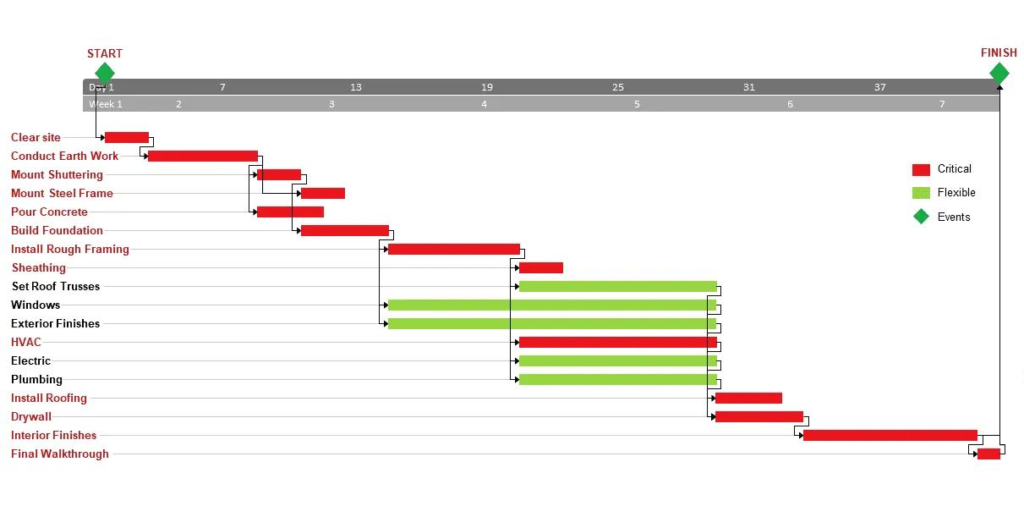
A Gantt chart is excellent for communication because activities are displayed visually against time.
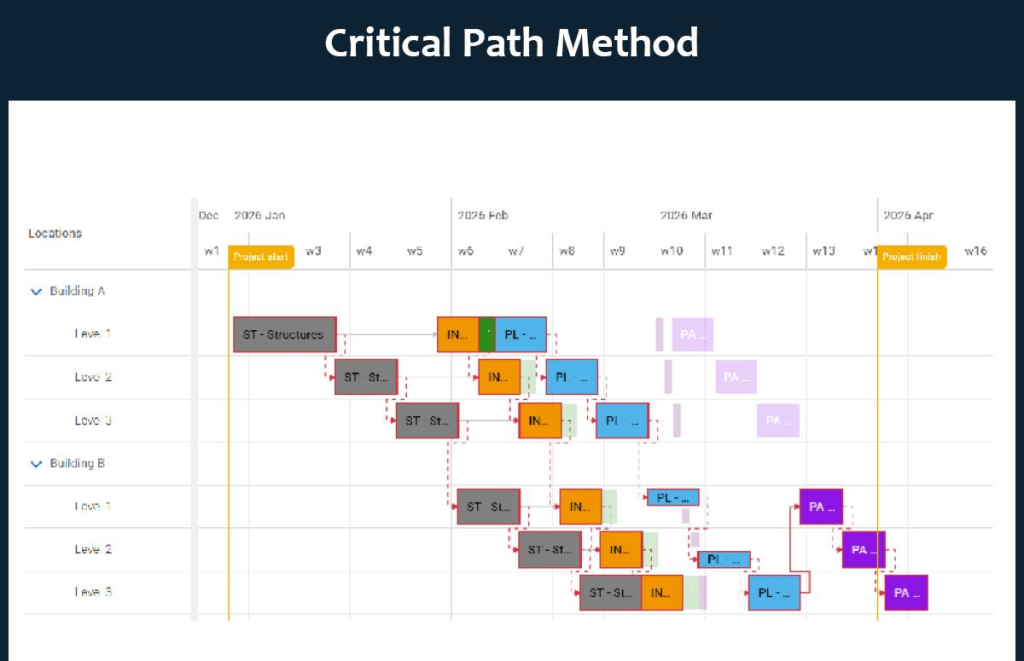
CPM provides deeper logical analysis by identifying the sequence of activities that controls project completion.
In practice, professional teams often use both.
Diagrams, Tables, and Scheduling Visualization
A simple conceptual schedule can be represented as:
PROJECT
   │
   ├── Design
   │
   ├── Procurement
   │
   ├── Site Preparation
   │
   ├── Foundations
   │       │
   │       └── Structure
   │               │
   │               └── Building Envelope
   │                       │
   │                       ├── MEP Installation
   │                       │
   │                       └── Finishes
   │
   └── Testing & Handover


Typical Schedule Control Indicators
| Indicator | What It Tells the Team |
|---|---|
| Planned Progress | What should have been completed |
| Actual Progress | What has actually been completed |
| Schedule Variance | Difference between planned and actual performance |
| Critical Activities | Activities requiring close attention |
| Milestone Status | Whether key dates are being achieved |
| Forecast Completion | Expected project finish |
| Resource Utilization | How efficiently resources are being used |
Good schedule control is based on trends, not just individual daily observations.
Practical Examples
Example 1: Delayed Concrete Delivery
Suppose a concrete pour is planned for Monday, but the concrete supplier cannot deliver until Wednesday.
The scheduler should not simply move the concrete activity forward. The team should investigate what activities depend on that pour.
If reinforcement inspection, formwork removal, waterproofing, and backfilling depend on the concrete operation, the delay could create a chain reaction.
A control response might involve arranging another supplier or reorganizing nearby work while waiting.
Example 2: High-Rise Construction
A high-rise building may repeat similar work across multiple floors.
Instead of treating every floor as an unrelated operation, planners can create a repetitive production sequence.
For example:
Floor 1 → Floor 2 → Floor 3 → Floor 4 → …
This allows crews to move systematically through the building.
Example 3: Road Construction
A highway project may involve:
Surveying → Earthworks → Drainage → Sub-base → Base Course → Pavement → Road Markings
Weather, traffic restrictions, material deliveries, and equipment availability can significantly influence the sequence.
A good schedule therefore needs flexibility rather than assuming perfect conditions.
Real-World Applications
Construction scheduling and control are used across almost every major construction sector.
Building Construction
Residential, commercial, educational, and healthcare buildings require coordination among structural, architectural, mechanical, electrical, plumbing, and finishing teams.
Infrastructure
Roads, bridges, tunnels, railways, airports, and utilities often contain thousands of interconnected activities.
Scheduling helps coordinate different work zones and construction stages.
Industrial Construction
Factories, energy facilities, processing plants, and large industrial projects require careful coordination of engineering, procurement, construction, testing, and commissioning.
Renovation Projects
Renovation schedules are particularly challenging because hidden site conditions may be discovered after work begins.
A flexible schedule helps accommodate unexpected conditions.
Common Mistakes
Creating an Unrealistic Schedule
One of the biggest mistakes is creating a schedule that looks impressive but cannot realistically be executed.
A schedule should reflect actual productivity, site limitations, procurement times, and construction methods.
Ignoring Procurement
Long-lead materials can become major schedule drivers.
Equipment such as transformers, elevators, specialist mechanical systems, or custom architectural components may require significant procurement time.
Overusing Constraints
Excessive date constraints can make a schedule appear stable while hiding the actual logical relationships between activities.
Updating Without Investigating
Changing dates every week does not constitute schedule control.
The team needs to understand why performance changed.
Poor Activity Definitions
Activities that are too broad are difficult to monitor.
For example, “Construct Building” provides almost no useful control information.
Ignoring Subcontractors
A schedule developed without subcontractor input may fail when field execution begins.
Challenges and Solutions
| Challenge | Practical Solution |
|---|---|
| Material delays | Early procurement tracking |
| Labor shortages | Resource forecasting |
| Weather | Weather allowances and contingency planning |
| Design changes | Formal change management |
| Poor communication | Regular coordination meetings |
| Productivity problems | Field productivity monitoring |
| Conflicting activities | Detailed logic review |
| Equipment breakdown | Maintenance and backup planning |
| Unexpected site conditions | Risk and contingency planning |
Schedule Risk Management
Not every delay can be prevented.
The objective is to identify potential problems early enough to respond effectively.
Useful risk categories include:
- Design risk
- Procurement risk
- Labor risk
- Equipment risk
- Weather risk
- Site risk
- Regulatory risk
- Financial risk
- Interface risk
🚨 Early warning is usually more valuable than late recovery.
Case Study: Controlling a Delayed Commercial Building Project
Consider a hypothetical commercial building project that begins according to the approved schedule.
During the structural phase, steel deliveries are delayed because a supplier experiences production problems.
The initial reaction is to move the affected activities forward. However, the project controls team discovers that the delayed steel affects several subsequent operations.
Instead of waiting passively, the team develops a recovery strategy.
Recovery Strategy
The project team:
- Reviews the remaining schedule.
- Identifies activities that can proceed independently.
- Reorganizes site work.
- Coordinates with the steel supplier.
- Reviews alternative procurement options.
- Adjusts labor deployment.
- Updates the short-term look-ahead schedule.
- Monitors the critical sequence more frequently.
The result is not simply a new schedule. It is a controlled recovery process.
This illustrates an important principle:
A schedule is valuable only when it supports better decisions.
Essential Tips for Better Schedule Control
Build the Schedule With the Construction Team
Schedulers should communicate with site managers, engineers, subcontractors, procurement teams, and supervisors.
The people executing the work often understand practical constraints better than anyone else.
Use Multiple Planning Levels
A strong construction control system can contain:
Master Schedule → Phase Schedule → Look-Ahead Schedule → Weekly Plan → Daily Activities
Each level serves a different purpose.
Protect the Critical Work
Critical activities deserve additional monitoring because delays can directly affect project completion.
Track Procurement Separately
A construction schedule should not exist independently from procurement planning.
Long-lead items should be tracked from:
Design → Approval → Purchase → Manufacturing → Shipping → Delivery → Installation
Use Actual Field Data
Do not rely exclusively on assumptions.
Record real productivity, actual delivery dates, crew performance, and installation progress.
Keep the Schedule Clean
Remove obsolete activities, duplicate relationships, unnecessary constraints, and incorrect progress information.
A technically sophisticated schedule can still be useless if its data quality is poor.
Communicate Clearly
📊 A schedule is a communication tool as much as it is a planning tool.
Field teams should understand what is expected, what has changed, and which activities require immediate attention.
FAQs
What is construction project scheduling?
Construction project scheduling is the process of organizing construction activities according to sequence, duration, resources, and planned dates so that the project can be delivered efficiently.
What is the difference between scheduling and schedule control?
Scheduling creates the planned execution roadmap. Schedule control monitors actual performance against that roadmap and introduces corrective actions when deviations occur.
What is CPM in construction?
The Critical Path Method is a scheduling technique used to analyze activity relationships and identify the sequence of activities that controls the project’s completion date.
Why is a baseline schedule important?
A baseline provides an approved reference point for measuring actual project performance. Without a reliable baseline, it becomes difficult to determine whether the project is genuinely ahead or behind plan.
Which software is commonly used for construction scheduling?
Professional construction organizations commonly use tools such as Microsoft Project, Primavera P6, and other project-management platforms. The best choice depends on project size, organizational requirements, and reporting needs.
How often should a construction schedule be updated?
The main schedule is commonly updated periodically according to the project’s control procedures, while short-term look-ahead plans may be reviewed weekly or even more frequently on complex projects.
Can scheduling prevent every construction delay?
No. Construction contains uncertainty from weather, procurement, design changes, labor, equipment, site conditions, and external events. Effective scheduling aims to reduce uncertainty and detect problems early.
Why are look-ahead schedules useful?
Look-ahead schedules translate the long-term project plan into practical short-term actions. They help field teams identify upcoming constraints before work is scheduled to begin.
Conclusion
Construction project scheduling and control provides the backbone for organized project execution. 🏗️📅 From a small residential building to a major airport, bridge, industrial facility, or infrastructure program, successful construction depends on coordinating thousands of decisions over time.
An effective approach begins with understanding the project scope, developing a logical WBS, defining activities, establishing relationships, estimating realistic durations, assigning resources, and creating an approved baseline.
However, planning alone is not enough.
The real value comes from continuously comparing planned performance with actual field performance, identifying deviations, understanding their causes, and taking corrective action before small problems become major delays.
Modern construction professionals should therefore view scheduling as a dynamic management system, not simply a Gantt chart.
When scheduling, procurement, resources, risk management, communication, and field control work together, project teams gain greater visibility and decision-making power. 🚧📊
Ultimately, the goal is straightforward: put the right work, people, materials, equipment, and information together at the right time—and keep the project moving toward successful completion.