Construction Project Scheduling and Control 3rd Edition: A Practical Guide for Planning, Monitoring, and Successful Project Delivery
Introduction
Construction projects are complex systems involving people, materials, equipment, subcontractors, budgets, designs, permits, inspections, and constantly changing site conditions. Without a reliable schedule and effective control process, even a well-designed project can experience delays, cost overruns, resource conflicts, and quality problems. 🏗️📅
Construction project scheduling and control provides a structured way to determine what must be done, when it should be done, who is responsible, and how progress will be monitored.
A schedule is more than a list of activities. It is a management tool that connects engineering decisions with field operations. Project managers use schedules to coordinate construction crews, procurement, equipment, inspections, subcontractors, and handover activities.


Modern construction scheduling can range from a simple bar chart for a small building to sophisticated Critical Path Method (CPM) schedules, 4D BIM models, resource-loaded schedules, and digital project-control platforms.
For students, understanding scheduling establishes an important foundation for construction management. For professionals, effective scheduling and control can improve productivity, communication, risk management, and project delivery. 🌍🔧


Background Theory
Construction scheduling developed from the need to coordinate increasingly complicated engineering projects. Early construction planning often relied on simple calendars and manually prepared charts. As projects became larger, managers needed more systematic techniques for representing relationships between activities.
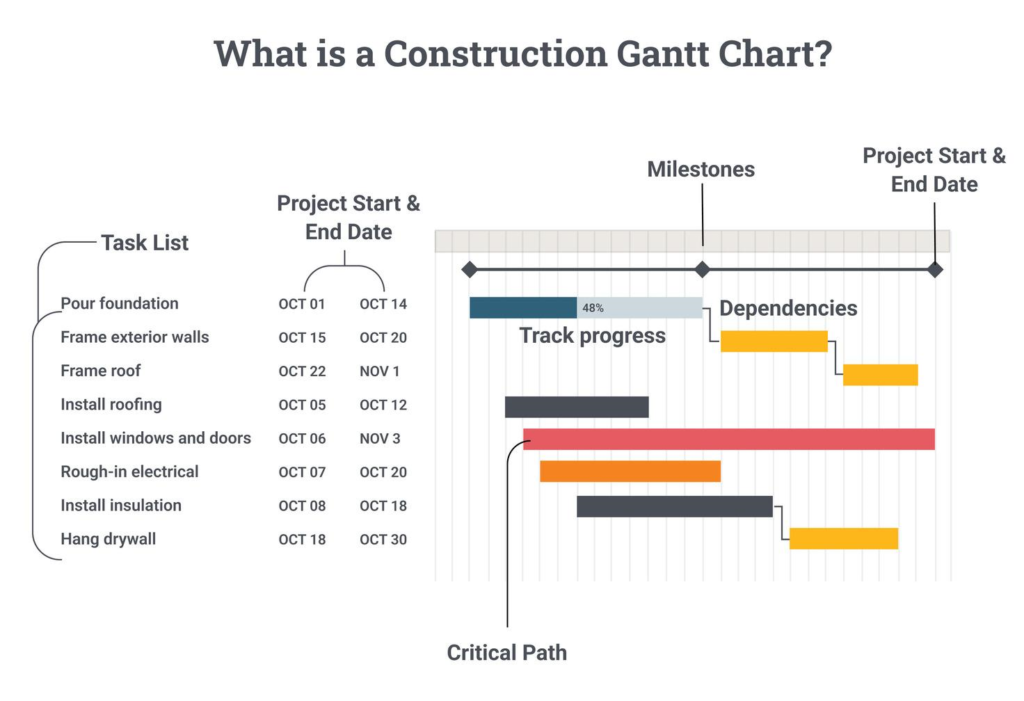
The Gantt chart, traditionally represented as horizontal bars against a time scale, became one of the most recognizable scheduling methods. It provides an intuitive view of when activities are planned to start and finish.
However, large projects require more than visual timelines. Activities may depend on one another. For example, structural work may need to be completed before certain architectural finishes can begin. Procurement may need to occur before equipment installation. Testing may depend on the completion of several systems.
This requirement for logical relationships led to network-based scheduling techniques, particularly the Critical Path Method.
Project scheduling is also closely connected to project control. Scheduling establishes the baseline plan, while control compares actual performance with the plan and determines whether corrective action is required.
A simplified management cycle is:
Plan → Schedule → Execute → Measure → Compare → Correct → Update 🔄
This cycle continues throughout the construction project.
The Role of Time in Construction
Time affects almost every aspect of construction.
A delayed structural package can postpone finishing trades. A late delivery can leave workers waiting. Poor coordination can create congestion between subcontractors. Weather can interrupt site activities. Design changes can require previously completed work to be modified.
Therefore, schedule management is not simply about meeting a final completion date. It is about managing the sequence and interaction of thousands of smaller decisions.
Relationship Between Schedule, Cost, and Resources
Construction time, cost, and resources are strongly interconnected.
A project may theoretically be accelerated by increasing labor or equipment, but acceleration can increase costs and introduce safety or quality risks.
Similarly, reducing resources may lower short-term expenditure but extend the project duration.
Effective scheduling attempts to create a realistic balance among:
- ⏱️ Time
- 💰 Cost
- 👷 Labor
- 🚜 Equipment
- 🧱 Materials
- 📐 Engineering requirements
- 🦺 Safety
- ✅ Quality
Definition
Construction project scheduling and control is the systematic process of planning construction activities, establishing their sequence and expected duration, assigning resources, monitoring actual performance, comparing progress with the approved plan, and implementing corrective actions when deviations occur.
Scheduling answers:
“What should happen and when?”
Control answers:
“What is actually happening, and what should we do about the difference?”
Construction Schedule
A construction schedule identifies project activities and places them within a logical time framework.
Typical activities might include:
- Site preparation
- Excavation
- Foundation construction
- Structural framing
- Roofing
- Mechanical installation
- Electrical installation
- Plumbing
- Internal finishes
- External works
- Testing and commissioning
- Inspection
- Handover
Baseline Schedule
The baseline is the approved version of the project schedule against which actual performance is compared.
Once approved, it becomes an important reference for project control.
Progress Update
A progress update records the current status of activities. It may include:
- Actual start dates
- Actual completion dates
- Percentage progress
- Remaining duration
- Delays
- Constraints
- Resource information
- Forecast completion dates
Critical Path
The critical path is the sequence of activities that determines the earliest possible completion of the project under the schedule’s current logic and assumptions.
A delay affecting a critical activity can potentially delay project completion unless corrective action or available schedule flexibility exists.
Step-by-Step Explanation
Developing a useful construction schedule requires more than entering activities into software. The quality of the schedule depends heavily on the quality of planning behind it.
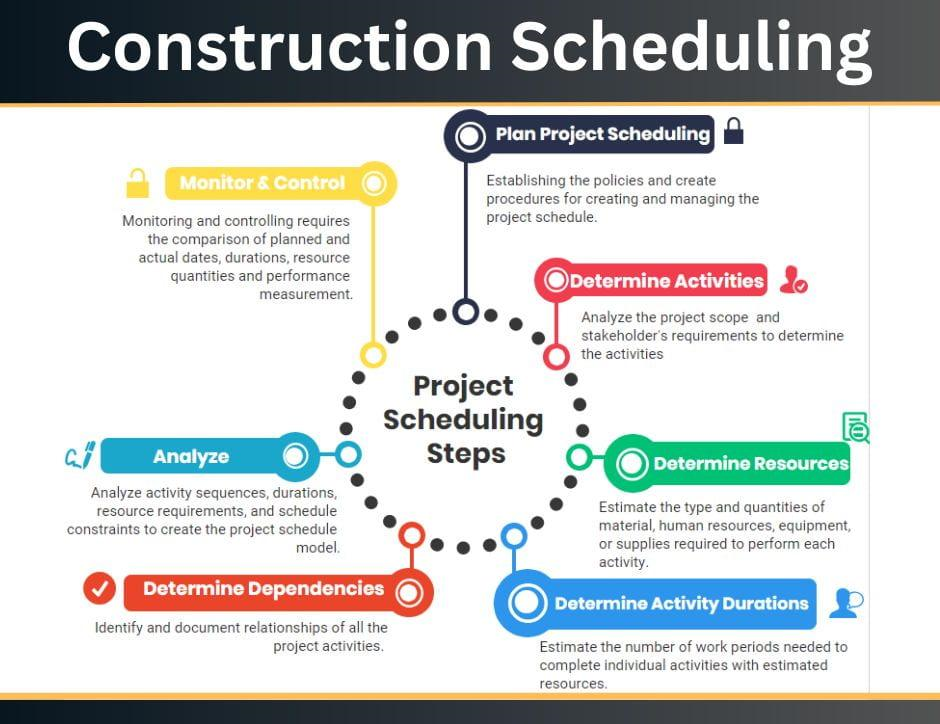
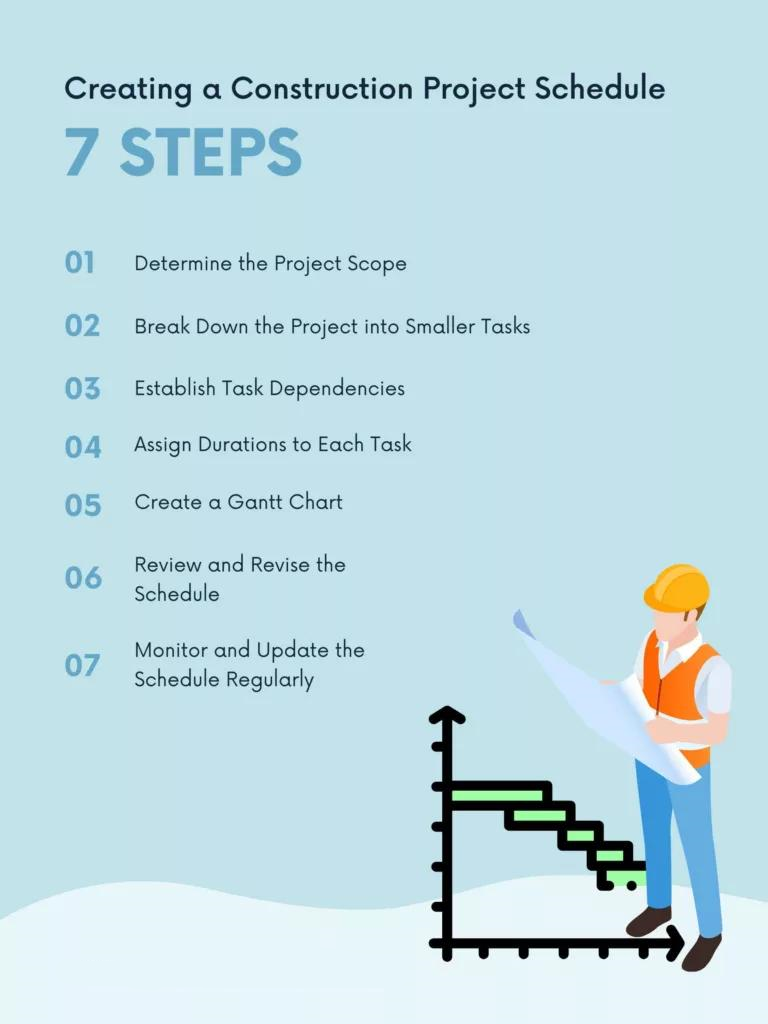


Step 1: Understand the Project Scope
Start by studying:
- Contract documents
- Architectural drawings
- Structural drawings
- MEP drawings
- Specifications
- Bills of quantities
- Site information
- Contract conditions
- Completion requirements
The scheduler must understand what the project is supposed to deliver before determining how it will be constructed.
Step 2: Develop a Work Breakdown Structure
The project should be divided into manageable components.
For example:
Building Project
→ Site Works
→ Substructure
→ Superstructure
→ Envelope
→ MEP Systems
→ Interior Finishes
→ External Works
→ Testing and Handover
This structure helps transform a large project into manageable work packages.
Step 3: Identify Activities
Each work package is divided into activities that can be planned, assigned, monitored, and updated.
An activity should be sufficiently detailed to provide meaningful control without creating unnecessary administrative complexity.
Step 4: Determine Activity Relationships
Activities must be logically connected.
Common relationships include:
- Finish-to-Start
- Start-to-Start
- Finish-to-Finish
- Start-to-Finish
The most familiar relationship is Finish-to-Start, where one activity must finish before another begins.
Step 5: Estimate Durations
Activity durations should be based on realistic production assumptions.
Consider:
- Crew size
- Productivity
- Quantity of work
- Equipment availability
- Working hours
- Site conditions
- Weather
- Material availability
- Access restrictions
- Inspection requirements
Avoid creating durations simply because they “look reasonable.”
Step 6: Add Resources
Assign appropriate resources to activities.
Resources may include:
- Engineers
- Supervisors
- Skilled workers
- General labor
- Cranes
- Excavators
- Concrete pumps
- Trucks
- Materials
- Specialist subcontractors
Step 7: Build the Network and Identify the Critical Path
Once activities and relationships are established, scheduling software can calculate the project network and identify activities that require particularly close monitoring.
Step 8: Establish the Baseline
After reviewing the schedule with the project team, the approved schedule becomes the baseline.
This is the reference point for future progress analysis.
Step 9: Monitor Actual Progress
Field teams should provide regular information about actual work.
Useful sources include:
- Daily reports
- Site inspections
- Photographs
- Quantity measurements
- Timesheets
- Delivery records
- Inspection reports
- Subcontractor updates
Step 10: Compare Plan With Actual Performance
The project team should identify:
Planned → Actual → Variance → Cause → Action
For example:
A concrete activity was planned for a particular week but was delayed because reinforcement inspection was not completed. The control team should investigate why the inspection was delayed and determine whether the issue affects following activities.
Step 11: Forecast the Outcome
A schedule should not only explain what happened yesterday.
It should help answer:
“Where are we likely to finish if current conditions continue?”
Forecasting allows management to act before a delay becomes irreversible.
Step 12: Implement Corrective Action
Possible responses include:
- Increasing labor
- Changing work sequences
- Adding equipment
- Improving material procurement
- Working additional shifts
- Releasing design information earlier
- Coordinating subcontractors more effectively
- Removing site constraints


Comparison
Different scheduling techniques serve different purposes.
| Method | Main Purpose | Strength | Limitation |
|---|---|---|---|
| Gantt Chart | Visual timeline | Easy to understand | Can become complex |
| CPM | Logical scheduling | Identifies critical activities | Requires reliable logic |
| Milestone Schedule | Major events | Excellent for management reporting | Limited activity detail |
| Lookahead Schedule | Short-term planning | Useful for site teams | Not a complete project schedule |
| Line of Balance | Repetitive construction | Excellent for repetitive work | Less suitable for unique activities |
| 4D BIM | Time + 3D visualization | Strong visual coordination | Requires BIM capability |
| Resource-Loaded Schedule | Time + resources | Supports resource planning | More data-intensive |
Gantt Chart vs CPM
A Gantt chart provides a highly visual representation of activities across time.
CPM goes deeper by representing the logical relationships among activities and identifying the sequence that controls project completion.
In practice, the two methods can complement each other rather than compete.
Baseline vs Updated Schedule
The baseline represents the approved plan.
The updated schedule represents current project conditions.
The difference between them helps project managers understand whether the project is progressing according to expectations.
Diagrams and Tables
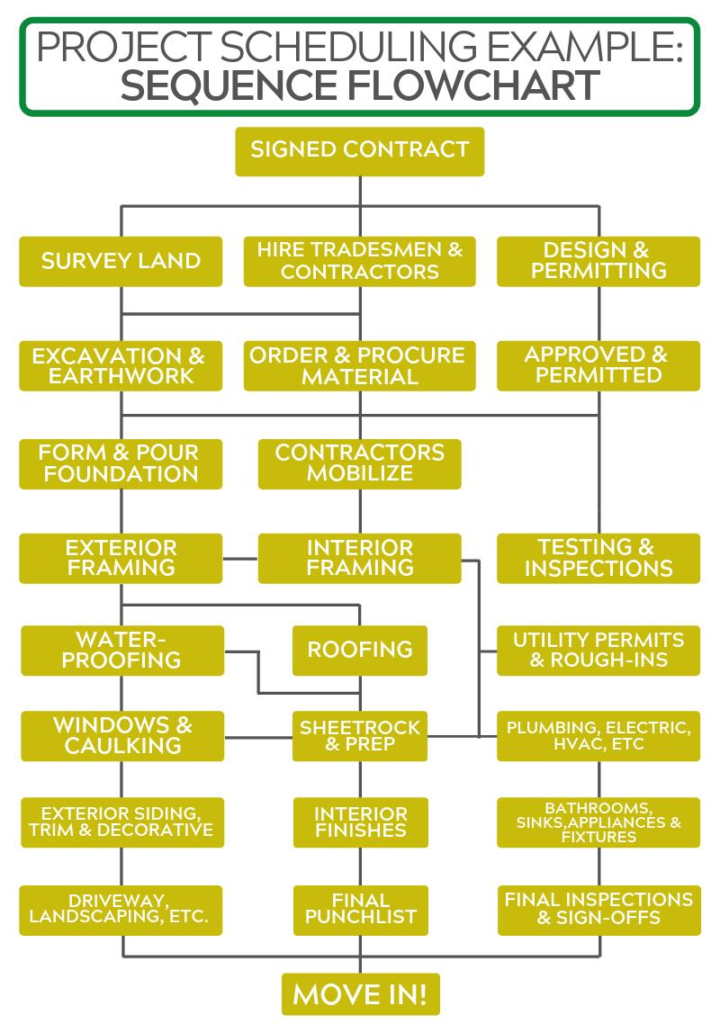
A simplified construction scheduling structure can be visualized as:
PROJECT
   │
   ├── Site Preparation
   │       ↓
   ├── Excavation
   │       ↓
   ├── Foundations
   │       ↓
   ├── Structure
   │       ↓
   ├── Building Envelope
   │       ↓
   ├── MEP Installation
   │       ↓
   ├── Finishes
   │       ↓
   ├── Testing & Commissioning
   │       ↓
   └── Handover
The actual construction sequence may differ depending on project type, procurement strategy, design, site conditions, and construction methodology.


Typical Schedule Control Information
| Control Item | Question |
|---|---|
| Planned Start | When should the activity begin? |
| Actual Start | When did it actually begin? |
| Planned Finish | When should it finish? |
| Actual Finish | When did it finish? |
| Progress | How much work is complete? |
| Constraint | What is preventing progress? |
| Forecast | When is completion now expected? |
| Corrective Action | What should management do? |
Examples
Example 1: Residential Building
A residential building schedule may begin with site preparation and excavation, followed by foundations and structural construction.
Once the structure progresses, different trades can enter the project.
Electrical and plumbing installation may occur alongside architectural activities, depending on the construction method.
The schedule allows the contractor to coordinate these activities rather than allowing every subcontractor to work independently.
Example 2: Highway Project
A highway project may involve:
- Surveying
- Clearing
- Earthworks
- Drainage
- Subgrade preparation
- Pavement construction
- Road furniture
- Markings
- Testing
- Opening
A delay in drainage construction could affect pavement operations. The schedule helps identify these dependencies.
Example 3: Hospital Construction
Hospital projects are particularly challenging because they contain sophisticated MEP, medical, fire protection, communication, and specialist systems.
The schedule must therefore incorporate extensive testing and commissioning activities.
A building that appears physically complete may still be far from operational completion.
Real-World Application
Construction project scheduling and control is used across virtually every major construction sector.
Commercial Buildings
Office buildings, shopping centers, hotels, and mixed-use developments require detailed coordination among structural, architectural, electrical, mechanical, and specialist trades.
Infrastructure
Railways, highways, bridges, airports, tunnels, and utilities frequently use advanced scheduling techniques because of their scale and complex interfaces.
Industrial Projects
Factories and processing facilities often require coordination between civil works, structural steel, mechanical equipment, electrical systems, instrumentation, commissioning, and specialist vendors.
Residential Construction
Residential projects may use simpler schedules, but effective planning remains essential for coordinating trades and controlling completion dates.
Digital Construction
Modern projects increasingly integrate scheduling with:
- BIM
- Cloud collaboration
- Mobile field reporting
- Digital drawings
- Automated progress tracking
- Drone surveys
- Project dashboards
- Data analytics


Common Mistakes
Creating an Unrealistic Schedule
One of the most damaging mistakes is preparing a schedule that looks impressive but cannot realistically be executed.
A schedule should reflect actual site constraints.
Ignoring Procurement
Materials and equipment must arrive when needed.
Ignoring procurement lead times can create serious downstream delays.
Using Excessive Detail
An extremely detailed schedule may become difficult to maintain.
The objective is useful control, not maximum activity count.
Poor Activity Relationships
Incorrect logic can produce misleading critical paths and unrealistic forecasts.
Updating Without Field Verification
A schedule should not be updated simply because someone reports progress by email.
Field information should be verified whenever possible.
Ignoring Subcontractor Input
Specialist subcontractors often understand their work sequences better than the general project team.
Their knowledge should be incorporated into planning.
Failing to Analyze Delay Causes
Recording a delay without identifying its cause does not provide effective control.
Challenges and Solutions
| Challenge | Practical Solution |
|---|---|
| Material delays | Improve procurement tracking |
| Design changes | Establish controlled document workflows |
| Labor shortages | Improve manpower planning |
| Poor productivity | Monitor production and investigate causes |
| Weather | Include realistic allowances and contingency planning |
| Site congestion | Coordinate work zones and sequences |
| Subcontractor delays | Use regular coordination and lookahead planning |
| Inaccurate progress | Verify quantities and field conditions |
| Frequent changes | Maintain controlled schedule updates |
| Communication gaps | Use centralized project information |
Managing Change
Construction projects rarely proceed exactly as originally planned.
Design revisions, client instructions, unforeseen site conditions, regulatory requirements, and supply-chain disruptions can change the schedule.
The objective is not to pretend that change will never happen.
Instead, project teams should establish a controlled process for evaluating its impact.
Case Study
Consider a hypothetical mid-rise office development in Europe.
The contractor establishes a baseline schedule covering design coordination, procurement, foundations, structural works, façade installation, MEP systems, interior finishes, testing, and handover.
During construction, the façade subcontractor reports that several critical materials will arrive later than expected.
The project team initially views this as a procurement issue. However, schedule analysis reveals that façade completion affects internal finishing activities in several zones.
Instead of waiting for the delay to occur, the team develops a recovery strategy.
The project is divided into work zones. Available façade materials are installed in the first zones while procurement continues for later zones. Interior teams are reorganized so that they can work in completed areas.
At the same time, procurement tracking is intensified and coordination meetings are increased.
The important lesson is that schedule control is not simply measuring delay—it is using information early enough to influence the outcome.
A good control system transforms schedule information into management decisions. 📊🏗️
Essential Tips
Build the Schedule With the Construction Team
Schedulers should communicate with:
- Site managers
- Engineers
- Supervisors
- Procurement teams
- Quantity surveyors
- Subcontractors
A schedule created without field knowledge may contain unrealistic assumptions.
Use Lookahead Planning
Long-term schedules establish the overall direction.
Short-term lookahead schedules help the site team prepare the immediate work.
A useful lookahead review asks:
What must happen next?
What could prevent it?
What must be prepared today?
Track Constraints
A delayed activity may not be the real problem.
The underlying constraint could be:
- Missing drawing
- Missing material
- Unavailable equipment
- Incomplete preceding work
- Inspection requirement
- Access restriction
- Labor shortage
Finding the constraint is often more valuable than simply recording the delay.
Keep the Schedule Current
A schedule loses value when updates are irregular or inaccurate.
Regular updates provide better forecasting and decision-making.
Connect Schedule and Cost
Schedule performance and financial performance should not be managed as completely separate systems.
Delays can increase:
- Labor costs
- Equipment costs
- Site overhead
- Financing costs
- Subcontractor claims
- Material costs
Use Technology Wisely
Software is powerful, but software cannot compensate for poor planning.
The principle is:
Better planning + better information + better communication = better control. 🚀
FAQs
What is construction project scheduling?
Construction project scheduling is the process of identifying construction activities, determining their sequence and duration, assigning resources, and organizing them within a project timeline.
What is construction project control?
Construction project control involves monitoring actual project performance, comparing it with the approved plan, identifying deviations, forecasting outcomes, and implementing corrective actions.
What is the Critical Path Method?
The Critical Path Method is a scheduling technique that uses activity relationships and durations to identify the sequence of activities that controls the project’s planned completion.
Why is a baseline schedule important?
A baseline provides an approved reference against which actual progress can be compared. Without a reliable baseline, it becomes difficult to determine whether project performance is ahead of or behind the original plan.
What is a lookahead schedule?
A lookahead schedule is a short-term planning tool that focuses on upcoming construction activities and identifies constraints that could prevent them from being completed.
Is scheduling software necessary for every construction project?
No. Small projects may be effectively managed with simple scheduling tools. Larger and more complex projects generally benefit from dedicated scheduling and project-control software.
How often should a construction schedule be updated?
The appropriate frequency depends on project size and contract requirements. Many projects use regular weekly or monthly updates, while active site teams may use shorter lookahead cycles for detailed operational planning.
What causes construction schedule delays?
Common causes include design changes, late materials, labor shortages, poor productivity, equipment problems, weather, site constraints, approval delays, coordination failures, and unforeseen conditions.
Conclusion
Construction project scheduling and control is one of the most important disciplines in modern construction management. 🏗️📅
A successful schedule does much more than show dates. It creates a structured representation of how the project is expected to progress and provides a framework for coordinating people, materials, equipment, information, and decisions.
For beginners, the fundamental concepts are straightforward:
Define → Break Down → Sequence → Schedule → Execute → Monitor → Compare → Correct.
For advanced professionals, the discipline extends into CPM analysis, resource management, delay analysis, forecasting, BIM integration, digital progress monitoring, risk management, and sophisticated project controls.
The most effective construction teams understand that a schedule is a living management system, not a document that is created once and forgotten.
When planning is realistic, progress information is reliable, constraints are identified early, and corrective actions are implemented quickly, construction organizations have a much stronger opportunity to deliver projects safely, efficiently, and predictably.
A strong schedule tells the team where it needs to go. Effective project control helps the team get there. 🚀🏗️