Fundamentals of Project Management 2nd Edition: Planning and Control Techniques Based on PMBOK 6th Edition and APM BoK 6th Edition
Edition note: PMBOK® Guide Sixth Edition was published in 2017, while the APM Body of Knowledge Sixth Edition dates from 2012. They are therefore not the current editions in 2026, but they remain useful frameworks for studying traditional project planning and control. PMI’s Sixth Edition also explicitly incorporated agile, iterative, and adaptive approaches.
Introduction to Project Management Planning and Control
Project management is the discipline of turning an idea into a controlled, measurable result. Whether the project involves constructing a bridge, developing software, installing an industrial plant, launching a product, or upgrading an energy system, successful delivery depends on more than technical knowledge.
A project needs scope, time, cost, resources, quality, risk management, communication, procurement, and stakeholder coordination.
The fundamental relationship can be viewed simply:
Plan → Execute → Monitor → Control → Improve → Deliver 🎯
The PMBOK® Guide Sixth Edition organizes project management around ten knowledge areas, while the APM Body of Knowledge Sixth Edition presents a broader professional framework covering projects, programmes, portfolios, and related disciplines. APM’s Sixth Edition contains 69 topics organized into four major sections.


For engineering students and professionals, planning and control are especially important because engineering projects frequently involve expensive equipment, specialist labor, complex dependencies, regulatory requirements, contractors, suppliers, and strict deadlines.
A strong project plan therefore acts as a technical and managerial roadmap.
Background Theory
Why project planning matters
Project planning transforms a general objective into organized work.
For example, “build a modern water-treatment facility” is not an actionable plan. The project team must determine:
- What must be delivered?
- Who will perform each task?
- Which activities depend on others?
- What resources are required?
- When must each activity start?
- What could go wrong?
- How much will the project cost?
- How will progress be measured?
- Who approves changes?
Project planning answers these questions before and during execution.
PMI literature describes planning, execution, and controlling as a connected feedback loop: the plan establishes the intended path, execution produces results, and measured variances trigger corrective action or plan changes.
Planning and control are connected
Planning should never be considered a one-time activity.
A realistic project behaves more like this:
Plan → Work → Measure → Compare → Correct → Replan
This is particularly important for long engineering projects because new information appears continuously.
A project may encounter:
- material delays,
- design changes,
- unexpected ground conditions,
- labor shortages,
- equipment failures,
- inflation,
- regulatory changes,
- client requests,
- safety incidents.
Consequently, effective project management requires both a baseline plan and a controlled mechanism for updating that plan.
Definition of Project Planning and Control
What is project planning?
Project planning is the structured process of defining the work required to achieve project objectives and organizing that work into an executable strategy.
Planning normally addresses:
Scope + Schedule + Cost + Resources + Quality + Risk + Communication + Procurement + Stakeholders
APM describes integrated planning as bringing together elements such as benefits, success criteria, scope, quality, time, resources, cost, risk, and communications into project management planning.
What is project control?
Project control is the systematic process of measuring actual project performance, comparing it with approved expectations, forecasting future performance, and taking corrective action.
APM describes project controls as an analytical part of project management involving scope, time, cost, risk, and change, with measurement and forecasting continuing after work begins.
Planning versus control
| Planning | Control |
|---|---|
| Defines what should happen | Measures what actually happens |
| Creates the baseline | Compares performance with baseline |
| Estimates resources | Tracks resource consumption |
| Develops schedules | Monitors schedule performance |
| Establishes budgets | Tracks actual and forecast costs |
| Identifies risks | Monitors and responds to risks |
| Defines responsibilities | Checks accountability |
| Anticipates problems | Corrects emerging problems |
A professional project manager needs both sides of the equation. 📊
Step-by-Step Project Planning Process
Step 1: Define the project objective
Start with a clear statement of what the project is intended to accomplish.
A good objective should identify the expected result, major constraints, and success criteria.
For an engineering project, the objective might involve:
- constructing a facility,
- developing a machine,
- delivering a software system,
- upgrading an electrical network,
- producing an engineering prototype.
Avoid vague objectives such as “improve the system.”
Instead, define the desired outcome in terms that can eventually be verified.
Step 2: Establish project scope
Scope defines what is included and what is excluded.
This distinction is critical.
For example, an industrial automation project may include:
- control-panel design,
- PLC programming,
- sensor installation,
- commissioning,
- operator training.
It might exclude:
- building renovation,
- production-line replacement,
- long-term maintenance.
Clear boundaries reduce uncontrolled scope expansion.
Step 3: Develop the Work Breakdown Structure
The Work Breakdown Structure (WBS) divides the project into manageable components.
A simplified engineering WBS might look like:
Industrial Facility
→ Engineering
→ Procurement
→ Civil Works
→ Mechanical Installation
→ Electrical Installation
→ Automation
→ Testing
→ Commissioning
The WBS creates the foundation for scheduling, estimating, assigning responsibility, and monitoring progress.
Step 4: Define activities
Each WBS component is divided into activities that can be planned and monitored.
For example:
Electrical Installation
→ Cable-tray installation
→ Cable pulling
→ Termination
→ Testing
→ Inspection
Activities should be sufficiently detailed to measure progress without creating unnecessary administrative work.
Step 5: Sequence activities
Some activities cannot begin until other activities are completed.
For example:
Foundation → Structural frame → Roof → Equipment installation
The project team creates logical relationships between activities.
Common dependency relationships include:
- Finish-to-Start
- Start-to-Start
- Finish-to-Finish
- Start-to-Finish
Understanding dependencies is essential for identifying schedule constraints.
Step 6: Estimate resources
Determine what each activity requires.
Resources may include:
- engineers,
- technicians,
- operators,
- construction workers,
- machinery,
- vehicles,
- software,
- materials,
- specialist contractors.
Resource planning is particularly important when several activities compete for the same specialist team.
Step 7: Develop the schedule
The schedule combines activities, dependencies, durations, milestones, and resources.
Typical scheduling tools include:
Gantt charts 📅
Network diagrams 🔗
Critical Path Method
Milestone schedules
Rolling-wave planning
PMI research on project planning emphasizes that schedule development integrates scope, workflow, resources, external commitments, and constraints, while recognizing that planning continues throughout project execution.


Step 8: Establish the cost baseline
Estimate project costs and establish an approved budget.
Typical cost categories include:
- labor,
- materials,
- equipment,
- subcontractors,
- transportation,
- software,
- permits,
- testing,
- contingency.
Cost planning should connect directly to the schedule because spending occurs as project work progresses.
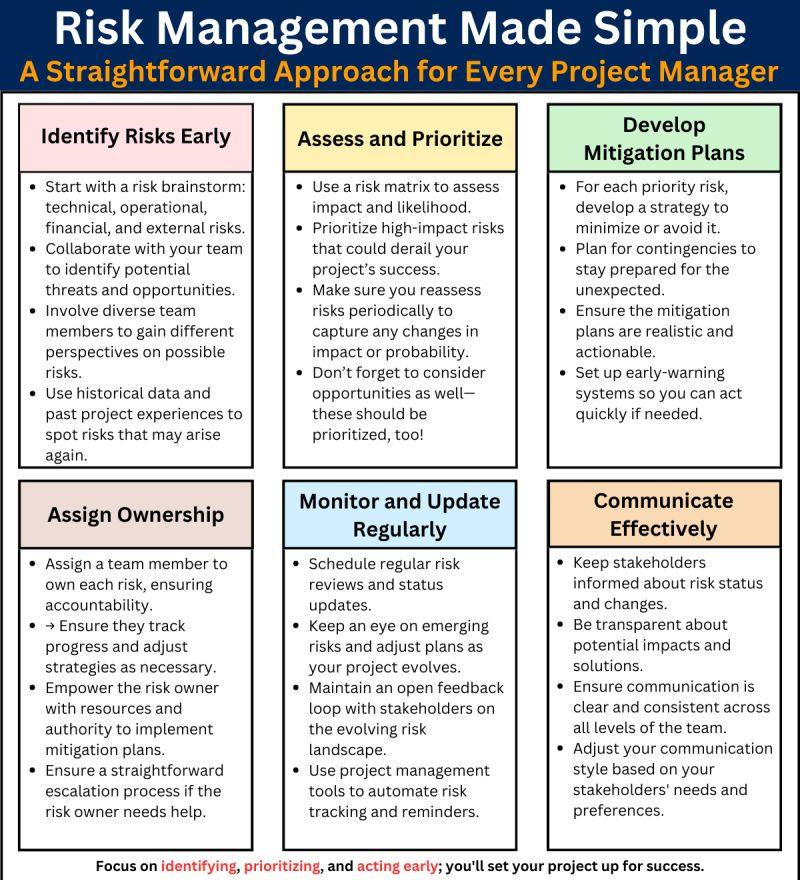
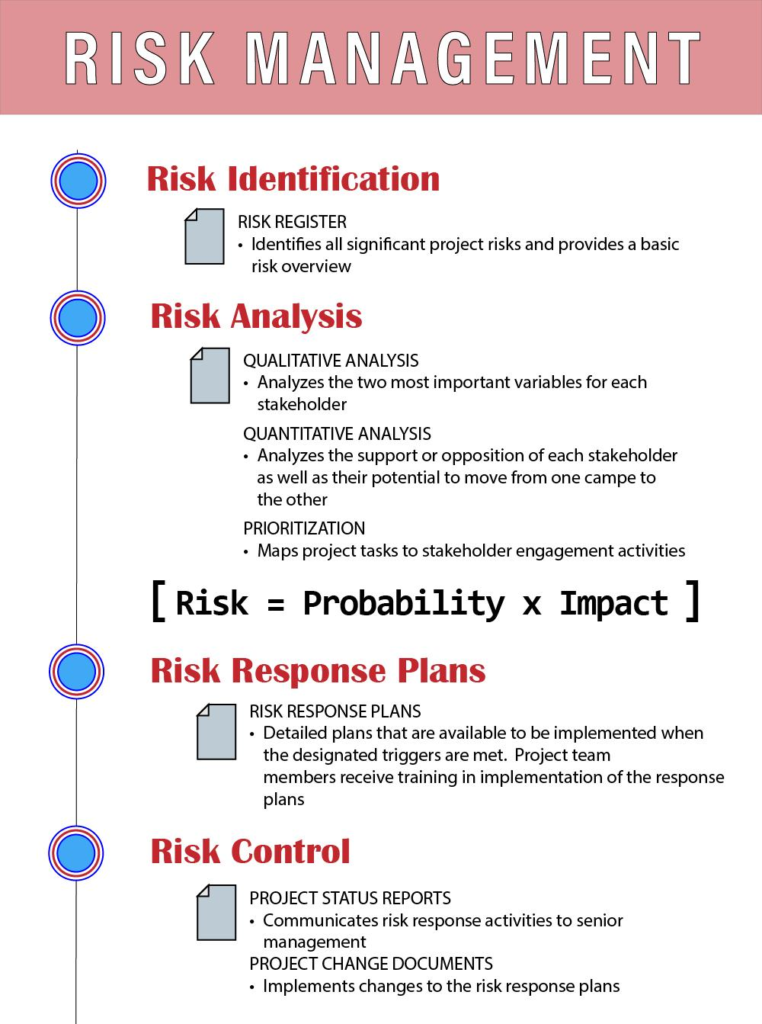
Step 9: Identify risks
Risk management asks:
“What might prevent us from achieving the project objectives?”
A risk register can contain:
| Risk | Probability | Impact | Response |
|---|---|---|---|
| Material delay | Medium | High | Alternative supplier |
| Design error | Low | High | Independent review |
| Labor shortage | Medium | Medium | Backup resources |
| Equipment failure | Low | High | Preventive maintenance |
| Scope change | High | Medium | Formal change control |
Step 10: Establish the control system
Once the plan is approved, determine how performance will be measured.
Useful control information includes:
- planned progress,
- actual progress,
- forecast completion,
- actual cost,
- committed cost,
- remaining work,
- risk status,
- change requests,
- quality performance.
The objective is not simply to collect data.
The objective is to detect deviations early enough to do something useful about them.
Comparison: PMBOK 6th Edition vs APM BoK 6th Edition
Different perspectives
The PMBOK Sixth Edition and APM BoK Sixth Edition overlap considerably but approach project management from somewhat different perspectives.
| Area | PMBOK 6th Edition | APM BoK 6th Edition |
|---|---|---|
| Main orientation | Project management processes and knowledge areas | Broader professional body of knowledge |
| Scope | Strong project-delivery framework | Projects, programmes, portfolios and professional disciplines |
| Planning | Detailed process-oriented approach | Integrated professional perspective |
| Risk | Dedicated risk-management knowledge area | Risk and uncertainty as professional topics |
| Stakeholders | Dedicated stakeholder management | Stakeholder and relationship-oriented topics |
| Agile | Explicit agile/iterative/adaptive discussion | Broader recognition of different delivery contexts |
| Engineering use | Strong | Strong |
| Scheduling | Highly structured | Strong planning and control emphasis |
| Professional development | PMI-oriented | APM-oriented |
PMI states that its Sixth Edition added discussion of agile, iterative, and adaptive environments across knowledge areas and increased emphasis on strategic and business knowledge.
The APM Sixth Edition, meanwhile, was designed as a comprehensive professional sourcebook and foundation for project, programme, and portfolio management.
Which framework should engineers use?
There is no requirement to treat them as competing systems.
An engineer can use the structured planning and knowledge-area thinking of PMBOK while applying the broader professional perspective of APM.
The best approach is to select techniques according to the project’s:
- size,
- complexity,
- industry,
- contractual environment,
- delivery model,
- organizational maturity,
- uncertainty.
Diagrams and Project Control Tables
Project management control loop
        PROJECT OBJECTIVES
                ↓
          PROJECT PLAN
                ↓
            EXECUTION
                ↓
        ACTUAL PERFORMANCE
                ↓
       PERFORMANCE REVIEW
                ↓
      ┌─────────┴─────────┐
      ↓                   ↓
 Within Baseline      Variance Found
      ↓                   ↓
 Continue Work      Analyze Cause
                          ↓
                   Correct / Change
                          ↓
                    Updated Plan
                          ↓
                       Execute
This feedback-loop concept is fundamental to effective project control. PMI research describes recurring status-update and plan-update cycles as mechanisms for keeping project activity aligned with the plan.


Practical control dashboard
| Control Area | Question | Typical Indicator |
|---|---|---|
| Scope | Are we delivering the agreed work? | Approved scope/change log |
| Schedule | Are activities progressing as planned? | Milestone status |
| Cost | Is spending under control? | Budget vs actual |
| Quality | Does the output meet requirements? | Defect/inspection data |
| Risk | Are threats changing? | Risk register |
| Resources | Are people and equipment sufficient? | Resource utilization |
| Procurement | Are suppliers performing? | Delivery status |
| Safety | Are incidents being controlled? | Safety indicators |
| Stakeholders | Are expectations aligned? | Communication/status reports |
Examples
Example 1: Bridge construction
A bridge project begins with design approval, followed by site preparation, foundations, structural works, utilities, road connections, testing, and handover.
If foundation work is delayed, the project manager should not simply record the delay.
The team should investigate:
- Why did the delay occur?
- Does it affect the critical path?
- Can another activity start earlier?
- Can additional resources reduce the delay?
- Does the forecast completion date change?
- Is a formal change required?
That is project control in action.
Example 2: Software development
A software project may use an iterative delivery approach.
The team develops a product increment, obtains stakeholder feedback, identifies new requirements, and updates future work.
The original plan provides direction, but the team maintains flexibility.
This illustrates why PMBOK Sixth Edition’s inclusion of adaptive and iterative approaches is important.
Example 3: Manufacturing equipment installation
An engineering company installs a new production machine.
The schedule includes:
- equipment delivery,
- foundation preparation,
- mechanical installation,
- electrical connection,
- control integration,
- testing,
- operator training.
If the machine arrives late, project control determines which downstream activities are affected and whether resources can be reorganized.
Real-World Applications
Construction engineering
Project planning controls:
- site activities,
- subcontractors,
- materials,
- equipment,
- safety,
- inspections,
- milestones.
Mechanical engineering
Planning helps coordinate equipment design, procurement, fabrication, installation, testing, and commissioning.
Electrical engineering
Electrical projects benefit from detailed resource, procurement, testing, and commissioning schedules.
Software engineering
Planning and control help coordinate requirements, development, testing, deployment, cybersecurity, and user acceptance.
Renewable energy projects
Solar and wind projects require coordination between engineering design, land preparation, equipment procurement, civil works, grid connection, commissioning, and regulatory approvals.
Infrastructure programmes
Large infrastructure programmes require strong integration among projects, contractors, government bodies, suppliers, communities, and financial stakeholders.
Common Mistakes in Project Management
Starting execution before planning
A common mistake is to begin physical work immediately because the project appears urgent.
Poor planning often creates greater delays later.
Creating an unrealistic schedule
A schedule should represent achievable work rather than management wishes.
Adding arbitrary deadlines does not make a project faster.
Ignoring dependencies
A project may contain dozens of activities that appear independent but are actually connected.
Missing one important dependency can create cascading delays.
Treating the baseline as permanent
A baseline is a control reference, not a substitute for professional judgment.
When approved changes occur, the project plan may need controlled revision.
Poor change management
Small changes can accumulate into major scope expansion.
Every significant change should be evaluated for its effect on:
- scope,
- cost,
- schedule,
- quality,
- risk,
- resources.
Monitoring too late
Waiting until the end of a reporting period to discover major problems can dramatically reduce available corrective options.
Challenges and Solutions
Challenge: Uncertain requirements
Solution: Use progressive elaboration, stakeholder workshops, prototypes, and controlled change management.
Challenge: Resource conflicts
Solution: Build a realistic resource plan and identify shared specialist resources early.
Challenge: Supplier delays
Solution: Track procurement milestones, identify critical materials, and develop alternative sourcing strategies.
Challenge: Schedule slippage
Solution: Identify the root cause, review dependencies, reassess the critical path, and develop recovery options.
Challenge: Cost growth
Solution: Monitor actual and forecast expenditure continuously rather than waiting for project completion.
Challenge: Stakeholder conflict
Solution: Establish communication responsibilities, decision authority, escalation routes, and clear success criteria.
Challenge: Long project duration
Solution: Use rolling-wave planning where appropriate. PMI research specifically discusses rolling-wave planning as a useful response to changing conditions in longer projects.
Case Study: Engineering Facility Upgrade
Project background
Imagine an engineering company upgrading an existing manufacturing facility.
The project includes:
- new production equipment,
- electrical upgrades,
- automation,
- mechanical installation,
- software integration,
- testing,
- operator training.
The project has a fixed operational shutdown period, making schedule control extremely important.
Initial planning
The project team develops the WBS and divides the work into engineering, procurement, construction, installation, testing, and commissioning.
Major milestones are established.
The team also identifies long-lead equipment and assigns responsibility for procurement.
Risk identification
Several major risks are identified:
Risk 1: Equipment delivery delay
Risk 2: Existing electrical infrastructure is inadequate
Risk 3: Integration problems between new and existing control systems
Risk 4: Production shutdown window is reduced
Each risk receives an owner and response strategy.
Control during execution
During implementation, the main equipment supplier reports a delivery problem.
The project manager evaluates the schedule and discovers that the equipment sits on an important sequence of activities.
Instead of waiting for the delay to occur, the team:
- reviews alternative delivery options,
- rearranges preparatory work,
- advances electrical installation,
- increases coordination with the supplier,
- updates the forecast,
- communicates the potential impact to stakeholders.
This is the difference between reactive management and professional project control.
Outcome
The project team does not eliminate uncertainty.
Instead, it detects uncertainty early and converts it into manageable decisions.
That is one of the central principles of effective project management.
Essential Tips for Engineering Students and Professionals
Build the plan around deliverables
Do not create a schedule simply because scheduling software requires one.
Start with the required deliverables and work backward.
Keep the WBS logical
Every major deliverable should be broken into manageable work packages.
Make ownership visible
Every significant work package should have someone responsible for coordinating it.
Connect schedule and cost
A schedule without resource and cost information provides an incomplete picture.
Maintain a live risk register
Risk management should continue throughout the project.
Use milestones
Milestones provide simple checkpoints for management and stakeholders.
Control changes formally
Never allow important scope changes to enter the project unnoticed.
Communicate frequently
A technically excellent plan can still fail if stakeholders do not understand it.
Use dashboards carefully
A dashboard should highlight decisions and exceptions rather than overwhelm managers with unnecessary data.
Learn from actual performance
At project closeout, capture lessons that can improve future projects.
The central philosophy is simple:
Good planning creates visibility.
Good control creates predictability.
Good leadership creates delivery. 🚀
FAQs
What is the difference between project planning and project control?
Project planning establishes how the project should be delivered, while project control measures actual performance and determines whether corrective action is necessary.
Why is the WBS important?
The WBS breaks a complex project into manageable deliverables and work packages. It supports scheduling, estimating, resource allocation, responsibility assignment, and progress measurement.
What is a project baseline?
A baseline is an approved reference used to evaluate project performance. Common baselines include scope, schedule, and cost information.
Is PMBOK Sixth Edition still the latest PMBOK edition?
No. PMBOK Sixth Edition was published in 2017. It is specifically useful when a course, organization, examination, or project is based on that edition. PMI has subsequently published newer editions.
Is APM BoK Sixth Edition still the latest APM Body of Knowledge?
No. APM currently identifies its Eighth Edition as its definitive Body of Knowledge. The Sixth Edition was published in 2012.
Which is better for engineering projects: PMBOK or APM?
Neither is universally “better.” PMBOK provides a highly structured project-management framework, while APM provides a broader professional perspective. Engineering organizations can use concepts from both.
What is the most important project control technique?
There is no single universal technique. Effective control normally combines schedule monitoring, cost control, risk management, quality monitoring, change control, resource management, and stakeholder communication.
Can these approaches work with Agile?
Yes. PMBOK Sixth Edition explicitly included discussion of agile, iterative, and adaptive approaches, while modern project environments commonly combine predictive and adaptive techniques according to project needs.
Conclusion
Project management is fundamentally about turning objectives into controlled action.
The traditional planning-and-control approach associated with PMBOK Sixth Edition and APM Body of Knowledge Sixth Edition remains highly valuable for understanding engineering project fundamentals. The frameworks emphasize the importance of defining scope, organizing work, developing schedules, managing resources, controlling cost, identifying risks, engaging stakeholders, and monitoring performance.
The most important lesson is that planning and control are not separate activities.
A project plan provides the expected path. Execution creates actual results. Monitoring reveals differences between expectation and reality. Control then provides the mechanisms for corrective action.
Plan intelligently → Execute systematically → Measure objectively → Control proactively → Learn continuously. ⚙️📊🚀
For engineering students, this way of thinking develops an essential professional skill: the ability to understand not only how something should be engineered, but also how the engineering work can be delivered successfully within real-world constraints.
PMI research likewise describes project control as an effort to reduce the gap between planning and implementation, while APM treats project controls as an analytical discipline spanning scope, time, cost, risk, and change.
Important reference note: This article is an original educational explanation and does not reproduce copyrighted text from PMBOK® or APM publications. The PMBOK® Guide and APM Body of Knowledge are referenced only as professional frameworks.