🔧✨ 10 LED Projects for Geeks: Build Light-Up Costumes, Sci-Fi Gadgets, and Other Clever Inventions
🚀 Introduction
Light-Emitting Diodes (LEDs) have revolutionized modern electronics and engineering design. These tiny semiconductor devices produce light efficiently, consume minimal power, and have extremely long lifespans compared with traditional lighting technologies. Because of these characteristics, LEDs are widely used in everything from household lighting to advanced aerospace systems.
For engineering students, hobbyists, and professionals, LED technology also offers an exciting gateway into creative electronics projects. LEDs can be combined with microcontrollers, sensors, wearable fabrics, and programmable systems to build visually impressive and technically challenging inventions.
From wearable LED costumes used in concerts and festivals to science-fiction inspired gadgets, LEDs allow engineers to merge creativity with technical skill. Many modern prototypes for smart devices, wearable computing, robotics, and Internet-of-Things (IoT) systems incorporate LED indicators or displays.
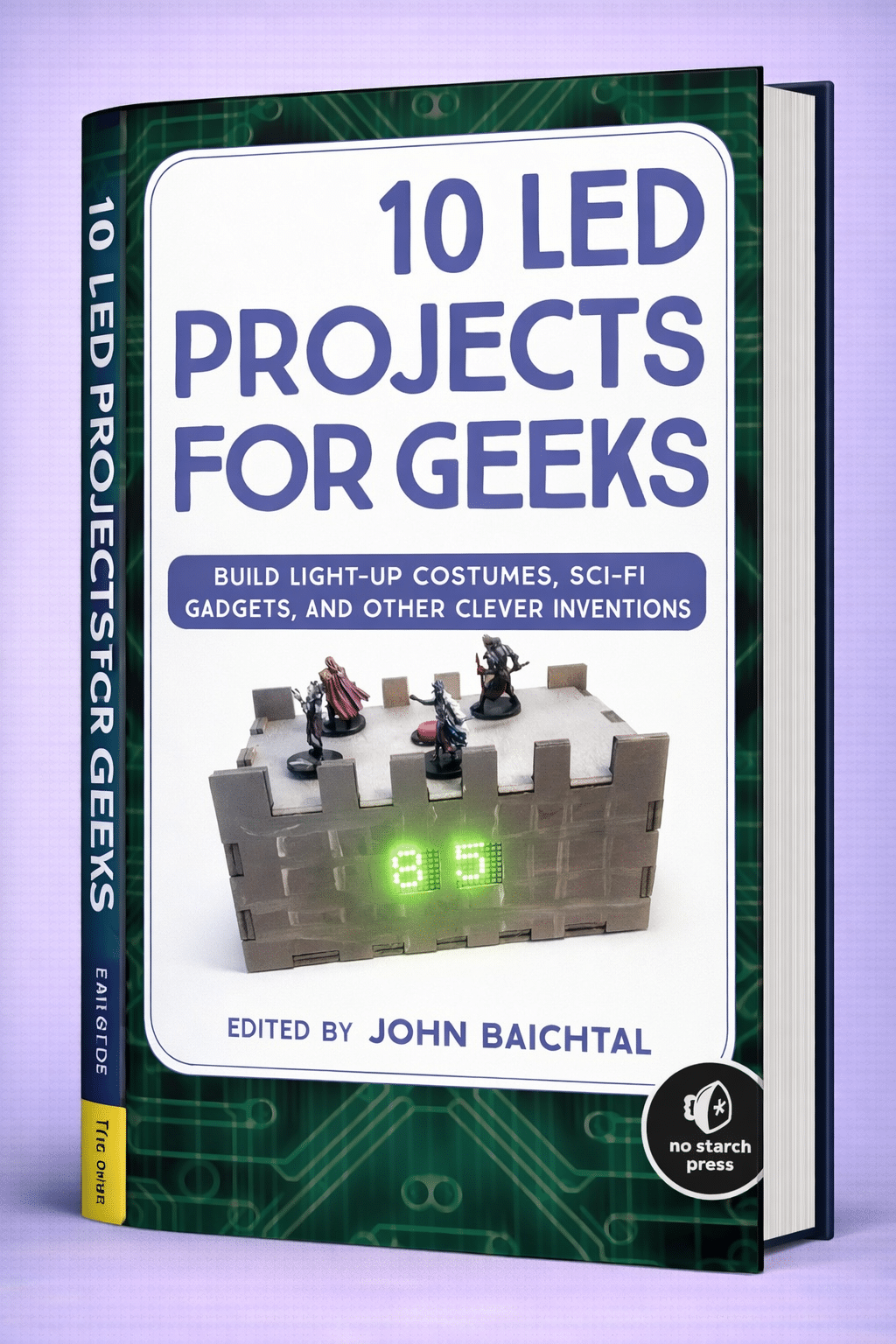
This article explores 10 LED engineering projects designed specifically for geeks, makers, and engineering learners. Each project introduces practical circuit design concepts, power management strategies, and programming logic.
The goal is not only to inspire creativity but also to demonstrate how LEDs can serve as a foundation for understanding electronics, embedded systems, and product design.
These projects are suitable for:
- Electrical engineering students
- Electronics hobbyists
- Embedded systems developers
- Makers and DIY inventors
- Technology educators
- Robotics enthusiasts
By the end of this guide, readers will understand how to design, build, and expand LED-based inventions that combine electronics, coding, and creativity.
💡 Background Theory
Before building LED projects, it is important to understand the underlying engineering principles behind LED technology.
⚡ Semiconductor Physics of LEDs
An LED is a semiconductor diode that emits light when electric current flows through it. The phenomenon responsible for light generation is known as electroluminescence.
When a forward voltage is applied:
- Electrons move from the n-type region
- Holes move from the p-type region
- The electrons recombine with holes
- Energy is released in the form of photons (light)
The wavelength (color) of the light depends on the semiconductor material.
Common materials include:
| Semiconductor Material | LED Color |
|---|---|
| Gallium Arsenide | Infrared |
| Gallium Phosphide | Green |
| Gallium Nitride | Blue |
| Aluminum Gallium Indium Phosphide | Red / Yellow |
🔋 Electrical Characteristics
LEDs require careful electrical control.
Important parameters include:
| Parameter | Description |
|---|---|
| Forward Voltage (Vf) | Voltage required to activate LED |
| Forward Current (If) | Safe current level |
| Power Dissipation | Heat generated |
| Luminous Intensity | Brightness output |
Typical values:
| LED Color | Forward Voltage |
|---|---|
| Red | 1.8 – 2.2 V |
| Green | 2.0 – 3.0 V |
| Blue | 3.0 – 3.5 V |
| White | 3.0 – 3.6 V |
Because LEDs are current-sensitive devices, engineers use current-limiting resistors or constant-current drivers.
🧠 Digital Control with Microcontrollers
Most modern LED projects involve microcontrollers such as:
- Arduino
- Raspberry Pi Pico
- ESP32
- STM32
These devices allow engineers to:
- Control brightness using PWM (Pulse Width Modulation)
- Animate LED patterns
- Synchronize with music
- React to sensors
🎨 LED Types Used in Projects
LED projects may use several categories:
| LED Type | Description |
|---|---|
| Standard LEDs | Simple indicator lights |
| RGB LEDs | Red, Green, Blue color mixing |
| Addressable LEDs | Individually programmable |
| LED Strips | Flexible lighting strips |
| LED Matrices | Grid display panels |
Addressable LEDs like WS2812 allow each LED to be controlled independently using a single data line.
This capability is essential for advanced visual projects.
⚙️ Technical Definition
An LED engineering project is a system or device that uses Light-Emitting Diodes as the primary output mechanism for illumination, signaling, or visual display, combined with electronic control circuits and often programmable logic.
Such systems typically consist of:
- Power supply
- LED elements
- Control circuitry
- Microcontroller or driver IC
- Structural or wearable framework
A simplified LED control circuit:
│
▼
Current Limiting Resistor
│
▼
LED
│
▼
Ground
In programmable systems:
│
▼
LED Driver IC
│
▼
LED Array / Strip
The combination of electronics, programming, and mechanical design forms the foundation of LED engineering projects.
🛠 Step-by-Step Explanation: General LED Project Workflow
Although each LED invention is different, most projects follow a similar development process.
Step 1 – Define the Objective
Examples include:
- Wearable costume lighting
- Decorative smart lighting
- Sci-fi prop gadgets
- Interactive LED displays
Step 2 – Select LED Type
Consider:
- Brightness
- Color capability
- Power consumption
- Control method
Step 3 – Design the Circuit
Basic LED circuit:
More advanced circuits include:
- MOSFET switching
- LED drivers
- Multiplexing systems
Step 4 – Choose a Controller
Microcontroller options:
| Controller | Advantage |
|---|---|
| Arduino Nano | Easy prototyping |
| ESP32 | Wi-Fi + Bluetooth |
| Raspberry Pi Pico | Fast processing |
Step 5 – Write Control Code
Programming tasks may include:
- LED animations
- Sensor triggers
- Pattern sequences
- Bluetooth control
Step 6 – Build Physical Structure
For wearable devices this might involve:
- Sewing LEDs into fabric
- 3D printing enclosures
- Mounting circuits on PCBs
Step 7 – Power System Design
Common power sources:
- Li-ion battery packs
- USB power banks
- Rechargeable cells
Engineers must calculate total current draw.
Step 8 – Testing and Optimization
Testing focuses on:
- Heat management
- Electrical stability
- Battery life
- Visual brightness
🧪 Comparison of LED Project Complexity
| Project Type | Difficulty | Required Skills |
|---|---|---|
| LED Throwies | Beginner | Basic wiring |
| LED Bike Lights | Beginner | Simple circuits |
| LED Matrix Display | Intermediate | Programming |
| Wearable LED Suit | Intermediate | Electronics + Fabric |
| Music Reactive LEDs | Advanced | Signal processing |
| LED Hologram Fan | Advanced | Motor control |
📊 Diagrams & Tables
Example LED Strip Control Diagram
│
▼
Voltage Regulator
│
▼
Microcontroller
│
▼
Data Line
│
▼
LED Strip (WS2812)
Power Consumption Example
| LEDs | Current per LED | Total Current |
|---|---|---|
| 10 | 60 mA | 600 mA |
| 50 | 60 mA | 3 A |
| 100 | 60 mA | 6 A |
Power design becomes critical in large LED systems.
💡 10 LED Projects for Geeks
🧥 1. Light-Up LED Costume
Wearable LED costumes are popular in:
- concerts
- festivals
- cosplay
- stage performances
Components
- Addressable LED strips
- Arduino Nano
- Li-Po battery
- Conductive thread
Features
- color animations
- sound synchronization
- motion effects
🚲 2. Smart LED Bicycle Lights
This project improves cyclist safety.
Features include:
- automatic braking lights
- turn signals
- night visibility
Sensors may include:
- accelerometers
- gyroscopes
🛰 3. Sci-Fi Energy Core Reactor
Inspired by science-fiction reactors.
Design includes:
- circular LED array
- rotating light patterns
- acrylic diffuser
Perfect for:
- gaming rooms
- props
- decorations
🤖 4. LED Robot Eyes
Robotics projects often require expressive visual elements.
LED matrices can simulate:
- blinking
- emotions
- scanning lights
🎵 5. Music Reactive LED System
This system converts audio signals into lighting patterns.
Key modules:
- microphone sensor
- audio amplifier
- FFT algorithm
LEDs pulse to music beats.
🧊 6. LED Infinity Mirror
An optical illusion using mirrors and LED strips.
Structure:
LED Ring
Two-way mirror
Creates a tunnel-like light effect.
🎮 7. Gaming Desk LED Controller
Adds ambient lighting to gaming setups.
Features:
- PC synchronized lighting
- keyboard color matching
- programmable effects
🛸 8. UFO LED Drone Lighting
Drones often use LEDs for orientation.
This project creates:
- glowing flying saucer effect
- navigation lights
- programmable colors
🔬 9. LED Matrix Information Display
Displays data such as:
- weather
- stock prices
- notifications
Often connected to Wi-Fi.
🧠 10. Brainwave LED Visualizer
A futuristic concept using EEG sensors.
Brain signals control LED brightness.
Used for:
- neuro-feedback experiments
- art installations
🌍 Real-World Applications
LED project skills translate into real engineering fields:
| Industry | Application |
|---|---|
| Automotive | dashboard lighting |
| Aerospace | cockpit indicators |
| Medical devices | diagnostic indicators |
| Architecture | smart lighting |
| Robotics | visual signaling |
❌ Common Mistakes
Overdriving LEDs
Excess current damages LEDs quickly.
Always use resistors.
Poor Heat Management
High-power LEDs generate heat.
Solutions:
- heat sinks
- aluminum PCBs
Incorrect Power Supply
Underpowered supplies cause flickering.
Ignoring Current Calculations
Large LED arrays require careful current analysis.
⚠️ Challenges & Solutions
| Challenge | Solution |
|---|---|
| Battery life | use efficient LEDs |
| Wiring complexity | use PCB design |
| heat buildup | add cooling |
| programming difficulty | use libraries |
📚 Case Study: LED Wearable Suit for Stage Performance
A team of engineers designed a programmable LED suit for a music festival performance.
Design Goals
- 500 RGB LEDs
- wireless control
- synchronized music effects
Engineering Approach
Hardware:
- ESP32 microcontroller
- addressable LED strips
- lithium battery pack
Software:
- custom animation firmware
- wireless control app
Results
The suit delivered:
- 3 hours battery life
- over 100 color animations
- synchronized stage lighting
This demonstrates how creative LED projects can evolve into professional entertainment technology.
🧠 Tips for Engineers
✔ Always prototype circuits on breadboards first.
✔ Use LED driver chips for large arrays.
📊 Design power systems early.
✔ Test brightness levels in real lighting conditions.
✔ Document wiring and software logic.
❓ FAQs
1. What microcontroller is best for LED projects?
Arduino and ESP32 are the most popular because they provide simple programming and strong community support.
2. How many LEDs can a microcontroller control?
With addressable LEDs, a single data pin can control hundreds or even thousands of LEDs.
3. Are LED projects expensive?
Beginner projects can cost less than $20, while advanced installations may reach several hundred dollars.
4. How do engineers control LED brightness?
Brightness is controlled using Pulse Width Modulation (PWM).
5. Can LEDs run on batteries?
Yes. Many wearable projects use rechargeable Li-Po batteries.
6. Are LEDs energy efficient?
LEDs consume up to 80% less energy than incandescent bulbs.
7. What software is used to program LED systems?
Common environments include:
- Arduino IDE
- PlatformIO
- Python (for Raspberry Pi)
🔚 Conclusion
LED technology provides one of the most accessible and creative platforms for engineering innovation. From wearable lighting systems and artistic installations to robotics displays and smart gadgets, LEDs allow engineers to combine electronics, programming, and design into compelling inventions.
The 10 LED projects presented in this guide demonstrate how simple electronic components can be transformed into complex and visually striking systems. These projects help engineers develop critical skills including circuit design, embedded programming, power management, and creative prototyping.
For students, LED projects offer a practical entry point into electronics and embedded systems. For professionals, they provide opportunities to explore rapid prototyping and interactive product design.
As LED efficiency, microcontroller capabilities, and smart control systems continue to evolve, the possibilities for innovative LED creations will expand dramatically. Future engineers will likely integrate LED technologies into wearable computing, smart environments, robotics, and immersive entertainment systems.
By experimenting with these projects and expanding upon them, engineers can transform simple lighting components into powerful tools for innovation, creativity, and technological advancement.