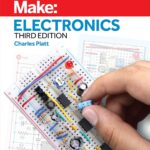
Electronic Devices 10th Global Edition: Principles, Types, Applications, and Modern Engineering Technologies
Introduction
Electronic devices are the building blocks of modern technology. From smartphones and laptops to industrial controllers, electric vehicles, medical instruments, satellites, and smart-home systems, electronic components allow engineers to sense, process, control, store, and communicate information. ⚡🔌
An electronic device can be as simple as a diode used for protection or as sophisticated as a microprocessor containing billions of transistors. Although these devices differ enormously in complexity, they are connected by fundamental concepts such as voltage, current, semiconductor behavior, switching, amplification, and signal processing.

For engineering students, understanding electronic devices provides a foundation for electrical engineering, computer engineering, robotics, automation, telecommunications, embedded systems, renewable-energy technology, and control engineering.
For professionals, this knowledge helps with component selection, troubleshooting, circuit design, system optimization, reliability engineering, and maintenance.
The fascinating part is that sophisticated electronic systems are often created by combining relatively simple components. A sensor, transistor, resistor, capacitor, integrated circuit, and power-management component can work together to create an intelligent system capable of making decisions in real time. 🤖⚙️


Background Theory
From Electrical Circuits to Electronic Systems
Electrical engineering traditionally deals with the generation, distribution, and utilization of electrical energy. Electronics focuses more specifically on controlling electrical signals and energy using electronic components.
The development of semiconductor technology transformed electronics. Early systems depended heavily on mechanical switches, relays, vacuum tubes, and other comparatively large components. Semiconductor devices introduced smaller, faster, and more reliable methods of controlling electrical behavior.
The transistor was particularly important. It enabled engineers to construct compact amplifiers, electronic switches, memory systems, and eventually integrated circuits.
Semiconductor Fundamentals
Many modern electronic devices are based on semiconductor materials. Silicon is the most widely used material because its electrical properties can be controlled through manufacturing processes.
Semiconductors can behave differently depending on their structure, impurities, temperature, and applied electrical conditions. This controllability makes them suitable for devices such as:
- Diodes
- Transistors
- Light-emitting diodes
- Photodiodes
- Solar cells
- Integrated circuits
- Microcontrollers
- Power semiconductor devices
Active and Passive Devices
Electronic components are commonly divided into passive and active categories.
Passive devices generally do not provide electrical amplification. Resistors, capacitors, and inductors are common examples.
Active devices can control electrical signals and may provide switching, amplification, or other forms of signal control. Transistors, operational amplifiers, and integrated circuits are examples.
This distinction is fundamental when designing electronic systems because different components perform very different engineering functions.
Definition
What Are Electronic Devices?
An electronic device is a component or system that uses controlled electrical behavior to perform a useful function such as switching, amplification, sensing, signal processing, energy conversion, computation, communication, or control.
Electronic devices can range from individual semiconductor components to highly integrated systems.
Major Categories
Some important categories include:
| Category | Examples | Typical Function |
|---|---|---|
| Passive | Resistor, capacitor, inductor | Control energy and signals |
| Semiconductor | Diode, transistor | Switching and signal control |
| Optoelectronic | LED, photodiode | Convert electrical and optical energy |
| Sensor | Temperature, pressure, motion sensor | Detect physical conditions |
| Integrated circuit | Timer, amplifier, processor | Complex electronic functions |
| Power electronics | MOSFET, IGBT, power diode | Control electrical power |
| Digital devices | Logic gates, microcontrollers | Process binary information |
| Display devices | OLED, LCD, LED display | Present information |
Step-by-Step Explanation of How Electronic Devices Work
Step 1: Electrical Power Is Supplied
Every electronic system requires an appropriate energy source.
The source might be:
- Battery
- AC-to-DC power supply
- Solar panel
- USB power
- Industrial DC supply
- Energy-harvesting circuit
The power system must provide suitable voltage, current, stability, and protection.
Step 2: Passive Components Condition the Circuit
Resistors can limit current and establish operating conditions. Capacitors can store electrical energy and filter unwanted variations. Inductors can interact with changing electrical currents and are widely used in filters and power converters.
These apparently simple components are critical to reliable electronic design.
Step 3: Semiconductor Devices Control Electrical Behavior
A transistor can operate as an electronic switch or as an amplifier.
A diode can allow current to flow preferentially in one direction and can therefore be used for rectification, protection, signal processing, and many other purposes.
Step 4: Sensors Detect the Environment
Modern electronics frequently interact with the physical world through sensors.
A sensor might detect:
🌡️ Temperature
💨 Pressure
💡 Light
📳 Acceleration
🔊 Sound
🧭 Position
💧 Humidity
⚙️ Mechanical movement
The sensor converts a physical condition into an electrical signal that another device can process.
Step 5: Integrated Circuits Process Information
Integrated circuits combine many electronic functions into a compact semiconductor package.
A microcontroller, for example, can receive sensor information, execute programmed instructions, control actuators, communicate with other systems, and monitor faults.
Step 6: The System Produces an Output
Finally, the processed information can control an output device.
Examples include:
- Motor
- Relay
- Display
- Speaker
- Valve
- LED
- Robotic actuator
- Communication transmitter


Comparison of Common Electronic Devices
Passive Versus Active Devices
| Feature | Passive Devices | Active Devices |
|---|---|---|
| Main purpose | Store, limit, or condition energy | Control or amplify signals |
| Examples | Resistor, capacitor, inductor | Transistor, IC, amplifier |
| Amplification | Generally no | Often possible |
| Complexity | Usually low | Can range from simple to extremely high |
| Applications | Filtering, protection, biasing | Computing, switching, amplification |
Analog Versus Digital Devices
Analog electronics deals with continuously varying signals, while digital electronics primarily represents information using discrete states.
| Feature | Analog | Digital |
|---|---|---|
| Signal | Continuous | Discrete |
| Typical applications | Audio, sensors, instrumentation | Computing, processors, communication |
| Noise tolerance | Often more sensitive | Usually higher |
| Processing | Analog circuits | Logic and programmable systems |
| Examples | Audio amplifier | Microcontroller |
Discrete Components Versus Integrated Circuits
Discrete devices perform individual functions, while integrated circuits combine many functions into one semiconductor package.
A discrete transistor might control one switching function. A modern processor can contain an enormous number of transistors working together.
Diagrams and Component Relationships
Basic Electronic System Architecture
A typical electronic system can be viewed as a chain:
Power Source → Signal/Input → Processing → Control → Output
For example:
Battery → Temperature Sensor → Microcontroller → Control Circuit → Cooling Fan
This architecture appears in many engineering systems.
Typical Electronic Component Roles
| Component | Main Role | Example Application |
|---|---|---|
| Resistor | Current limiting/control | LED circuit |
| Capacitor | Energy storage/filtering | Power supply |
| Inductor | Magnetic energy storage/filtering | Converter |
| Diode | One-way conduction/protection | Rectifier |
| Transistor | Switching/amplification | Motor controller |
| LED | Light generation | Indicator/display |
| Sensor | Physical measurement | Industrial monitoring |
| IC | Integrated processing/control | Embedded system |
| Microcontroller | Programmable control | Robot |
| MOSFET | Fast power switching | Power converter |


Examples
Example 1: Smartphone
A smartphone contains numerous electronic devices working together.
Sensors detect movement, light, orientation, and other environmental conditions. Processors handle computation. Memory stores information. Power-management circuits regulate energy. Radio-frequency components support wireless communication.
The user experiences this as one device, but internally it is a highly integrated electronic system.
Example 2: Automatic Street Lighting
A street-lighting controller can use a light sensor to determine whether the environment is sufficiently dark.
The sensor provides information to a control circuit. The controller processes the signal and switches the lighting system on or off.
This simple example demonstrates sensing, processing, switching, and output control.
Example 3: Electric Vehicle
Electric vehicles depend heavily on power electronics.
Electronic controllers monitor battery conditions, control motor operation, manage charging, communicate with sensors, and provide protection.
Power semiconductor devices are particularly important because they must handle substantial electrical power while switching efficiently.
Example 4: Industrial Robot
An industrial robot uses sensors to monitor position and movement. Controllers process this information and command motors or actuators.
Electronic devices therefore form the connection between software instructions and physical mechanical movement.
Real-World Applications
Consumer Electronics
Televisions, computers, cameras, smartphones, gaming systems, wireless headphones, and smart appliances depend on electronic devices.
Miniaturization has allowed increasingly powerful functions to fit into smaller products.
Automotive Engineering
Modern vehicles contain sophisticated electronic systems for:
- Engine management
- Battery management
- Driver assistance
- Infotainment
- Lighting
- Safety systems
- Communication
- Climate control
Automotive electronics are becoming increasingly important as vehicles become more connected and automated. 🚗⚡
Renewable Energy
Solar-energy systems use electronic converters, controllers, monitoring devices, sensors, and power semiconductor components.
Electronics help convert, regulate, monitor, and distribute energy efficiently.
Medical Engineering
Medical equipment relies on electronic devices for sensing, measurement, imaging, monitoring, and control.
Examples include patient monitors, diagnostic equipment, imaging systems, wearable devices, and laboratory instruments.
Aerospace and Defense Engineering
Aircraft and spacecraft require electronics for communication, navigation, sensing, control, instrumentation, and power management.
Reliability is especially important because component failure can have serious consequences.
Industrial Automation
Factories use electronic devices to monitor machines and control manufacturing processes.
Programmable controllers, sensors, variable-speed drives, industrial communication systems, and safety controllers form an interconnected electronic ecosystem.
Common Mistakes
Selecting Components Only by Price
The cheapest component is not necessarily the most appropriate.
Engineers should consider:
- Operating conditions
- Reliability
- Temperature
- Electrical ratings
- Mechanical requirements
- Availability
- Lifecycle
- Manufacturer quality
Ignoring Thermal Management
Electronic components generate heat during operation.
If heat cannot escape effectively, temperature can rise and reduce reliability or cause failure.
Heat sinks, airflow, thermal interfaces, PCB design, and appropriate component selection can help manage thermal conditions.
Incorrect Polarity
Some components are polarity-sensitive.
Connecting polarized capacitors, diodes, LEDs, batteries, or other components incorrectly can damage the circuit.
Poor PCB Layout
A circuit may be electrically correct in theory but perform poorly because of an inappropriate printed circuit board layout.
Engineers must consider signal integrity, grounding, electromagnetic interference, thermal paths, component placement, and power distribution.
Insufficient Protection
Electronic systems can encounter:
⚠️ Voltage surges
⚠️ Electrostatic discharge
⚠️ Overcurrent
⚠️ Overheating
⚠️ Reverse polarity
⚠️ Electrical noise
Protection should therefore be considered during the design stage rather than added only after a failure occurs.
Challenges and Solutions
Miniaturization
Smaller electronics create challenges involving heat, manufacturing, inspection, and component placement.
Solution: Engineers increasingly use advanced PCB technologies, thermal analysis, automated inspection, and high-density packaging techniques.
Electromagnetic Interference
Electronic systems can generate or receive unwanted electromagnetic signals.
Solution: Proper grounding, shielding, filtering, PCB layout, cable management, and electromagnetic compatibility testing can reduce interference.
Thermal Stress
High temperatures can reduce component lifetime.
Solution: Use thermal simulation, appropriate cooling strategies, temperature monitoring, and components with suitable operating ratings.
Component Obsolescence
Electronic components can become unavailable as manufacturers introduce newer technologies.
Solution: Engineers should consider lifecycle management, approved alternatives, second sources, and long-term procurement strategies.
Cybersecurity
Connected electronic systems can become targets for unauthorized access.
Solution: Secure communication, authentication, firmware protection, software updates, access controls, and secure system architecture are increasingly important.
Case Study: Smart Industrial Temperature-Control System
Consider a factory system designed to maintain the temperature of an industrial machine.
System Design
The system includes:
- Temperature sensor
- Signal-conditioning circuit
- Microcontroller
- Display
- Power supply
- Switching device
- Cooling fan
- Alarm indicator
Operation
The temperature sensor continuously monitors the machine.
The microcontroller receives the sensor information and evaluates the machine’s condition.
If the temperature becomes too high, the controller activates the cooling system.
If the condition becomes dangerous, an alarm can notify the operator.
Engineering Benefits
Such a system can provide:
- Automatic control
- Reduced operator workload
- Continuous monitoring
- Early fault detection
- Improved equipment protection
- Better energy management
This example demonstrates how simple electronic devices can be combined into an intelligent engineering system.
Essential Tips for Engineering Students and Professionals
Start With Fundamental Components
Before studying advanced processors, learn how resistors, capacitors, diodes, transistors, inductors, sensors, and integrated circuits behave.
A strong foundation makes advanced electronics significantly easier to understand.
Read Datasheets Carefully
A component datasheet contains critical information about:
- Electrical ratings
- Temperature limits
- Packaging
- Pin configuration
- Performance characteristics
- Recommended operating conditions
📘 Never design a production circuit from a component’s name alone.
Learn to Use Test Equipment
Practical electronics requires measurement skills.
Important tools include:
- Digital multimeter
- Oscilloscope
- Function generator
- Power supply
- Logic analyzer
- LCR meter
Learning how to measure signals safely is just as important as learning circuit theory.
Design for Reliability
A successful electronic design should work not only under ideal laboratory conditions but also under realistic environmental and electrical stresses.
Consider temperature, vibration, humidity, power fluctuations, component tolerances, manufacturing variation, and long-term aging.
Combine Hardware and Software Knowledge
Modern electronics increasingly combines physical circuits with embedded software.
Learning microcontrollers, communication protocols, programming, and debugging can dramatically expand an engineer’s capabilities. 💻⚡
FAQs
What is the difference between an electrical and an electronic device?
Electrical devices generally focus on producing, distributing, converting, or using electrical energy, while electronic devices typically control electrical signals or energy using semiconductor and other electronic components. The distinction is useful but not absolute because modern systems often combine both.
What are the most important electronic components to learn first?
Beginners should start with resistors, capacitors, inductors, diodes, LEDs, transistors, switches, sensors, and integrated circuits. Understanding these components provides a strong foundation for studying more advanced electronics.
Why are transistors important?
Transistors are fundamental because they can perform switching and amplification functions. Large numbers of transistors can also be integrated into processors, memory devices, controllers, and other sophisticated semiconductor systems.
What is an integrated circuit?
An integrated circuit is a semiconductor device that combines multiple electronic functions within a single package. Modern ICs can contain relatively simple circuits or extremely complex computational systems.
Are electronic devices used in mechanical engineering?
Yes. Modern mechanical engineering increasingly incorporates electronics into machines, robots, vehicles, manufacturing equipment, sensors, actuators, and automated control systems.
Why do electronic components fail?
Failures can result from overheating, electrical overstress, manufacturing defects, aging, mechanical stress, moisture, contamination, poor design, incorrect installation, or unsuitable operating conditions.
What skills are useful for learning electronics?
Useful skills include circuit analysis, semiconductor fundamentals, PCB design, soldering, programming, instrumentation, troubleshooting, datasheet interpretation, embedded systems, and basic electromagnetic concepts.
What is the future of electronic devices?
The field is moving toward greater integration, lower power consumption, intelligent sensing, advanced semiconductor technologies, edge computing, flexible electronics, electrification, automation, and increasingly connected systems.
Conclusion
Electronic devices are at the heart of modern engineering. ⚡🔬 From a simple diode to an advanced microprocessor, each device provides a specific capability that can become much more powerful when combined with other components.
Understanding electronics begins with fundamental concepts: passive components manage electrical behavior, semiconductor devices provide switching and control, sensors connect electronics to the physical world, and integrated circuits enable increasingly sophisticated computation and communication.
For students, electronics offers a pathway into electrical engineering, computer engineering, robotics, automation, embedded systems, and many other technical disciplines. For professionals, understanding electronic-device behavior is essential for designing reliable products, diagnosing failures, optimizing systems, and developing next-generation technologies.
The most important lesson is simple: modern electronic systems are not defined by one component—they are engineered ecosystems in which power, sensing, processing, communication, and control work together. 🚀
As technology continues to advance, electronic devices will become smaller, smarter, more energy-efficient, and more deeply integrated into transportation, healthcare, manufacturing, energy, communications, and everyday life. Learning their principles today provides engineers with the foundation needed to design the intelligent technologies of tomorrow.