Power Electronics 2nd Edition: Devices and Circuits – Complete Guide to Modern Power Conversion
Introduction ⚡🔌
Power electronics is one of the most important engineering fields behind modern electrical and electronic systems. It combines electrical engineering, electronics, control systems, semiconductor technology, and energy conversion to control electrical power efficiently.
From smartphone chargers and laptop adapters to electric vehicles, solar-energy systems, industrial motor drives, data centers, and renewable-energy installations, power electronic circuits are everywhere. Whenever electrical energy must be converted, controlled, switched, regulated, or efficiently delivered, power electronics is likely involved.
Unlike conventional electronics, which often focuses on processing information using relatively small electrical signals, power electronics focuses on handling significant amounts of electrical power while maintaining efficiency, reliability, safety, and thermal stability.


A modern power converter may contain semiconductor switches, diodes, capacitors, inductors, transformers, sensors, gate drivers, controllers, heat sinks, and protection circuits. These components work together to transform electrical energy into a form suitable for a particular load.
For students, power electronics provides a foundation for understanding how electrical energy is manipulated. For professionals, it is essential for designing efficient power supplies, motor drives, renewable-energy converters, battery systems, and high-power industrial equipment.

Background Theory ⚙️
The fundamental idea behind power electronics is controlled energy conversion.
Electrical energy can exist in different forms. A system may receive alternating current (AC) from the electrical grid but require direct current (DC) internally. Another system may store energy in a battery and need AC to operate a motor. A solar panel produces DC power, while most household electrical networks operate with AC.
Power electronic circuits provide the bridge between these requirements.
The Four Main Types of Power Conversion
Power conversion is commonly divided into four major categories:
| Converter Type | Input | Output | Typical Application |
|---|---|---|---|
| AC–DC | AC | DC | Battery chargers |
| DC–DC | DC | DC | Voltage regulators |
| DC–AC | DC | AC | Solar inverters |
| AC–AC | AC | AC | Motor controllers |
Each category uses semiconductor devices as controlled switches.
Switching Rather Than Continuous Operation
A major principle of power electronics is switching.
Instead of continuously controlling a semiconductor device like a traditional variable resistor, modern converters frequently operate devices between highly conductive and highly non-conductive states.
This approach reduces power losses.
⚡ ON state → current flows efficiently
⛔ OFF state → current is strongly restricted
Rapid switching between these states allows a converter to regulate voltage, current, frequency, or power.
Why Efficiency Matters
Power losses become extremely important when a converter handles hundreds of watts, kilowatts, or megawatts.
Even a small percentage of energy loss can produce substantial heat.
Therefore, power-electronic engineering considers:
- Semiconductor conduction losses
- Switching losses
- Magnetic losses
- Capacitor losses
- Heat dissipation
- Electromagnetic interference
- Control losses
- Standby consumption
Efficient design improves operating cost, battery life, reliability, and environmental performance. 🌱
Definition 📘
Power electronics is the branch of electrical and electronic engineering concerned with the conversion, control, switching, and conditioning of electrical energy using semiconductor devices and associated circuits.
A typical power-electronic system contains several functional blocks:
Electrical Source → Converter → Control System → Load
However, the practical system is more complex:
Source → Protection → Power Converter → Filter → Load
with a Controller + Sensors + Gate Drivers supervising the converter.
The semiconductor devices perform the high-speed switching, while passive components such as inductors and capacitors smooth and store energy.
Major Power Semiconductor Devices 🔧
Power semiconductor devices are the building blocks of power converters.
Power Diode
A power diode allows current to flow primarily in one direction.
It is widely used in:
- Rectifiers
- Freewheeling paths
- Protection circuits
- DC power supplies
- Inverter circuits
The diode is simple because it does not normally require an external gate-control signal.
Thyristor
A thyristor is a controlled semiconductor device that can be triggered into conduction.
Thyristors are particularly useful in high-power applications because they can handle substantial voltage and current.
Typical applications include:
- Controlled rectifiers
- Industrial heating
- High-power motor control
- HVDC systems
- Soft starters
MOSFET
The Metal-Oxide-Semiconductor Field-Effect Transistor (MOSFET) is one of the most widely used switching devices in modern power electronics.
MOSFETs are especially attractive for high-frequency applications.
They are commonly found in:
- Laptop chargers
- DC–DC converters
- Battery-management systems
- Automotive electronics
- Computer power supplies
IGBT
The Insulated-Gate Bipolar Transistor (IGBT) combines useful characteristics of MOS-controlled devices with bipolar conduction behavior.
IGBTs are frequently used in medium- and high-power applications such as:
- Motor drives
- Industrial inverters
- Electric vehicles
- Renewable-energy converters
- Uninterruptible power supplies
Wide-Bandgap Devices
Modern power electronics increasingly uses semiconductor materials such as silicon carbide (SiC) and gallium nitride (GaN).
These technologies can enable:
- Higher switching frequencies
- Lower losses
- Higher operating temperatures
- Smaller passive components
- Higher power density
🚀 This is one reason modern chargers and power converters can become dramatically smaller than older designs.
Step-by-Step Explanation of a Power Converter 🔍
Consider a simplified AC-to-DC power supply.

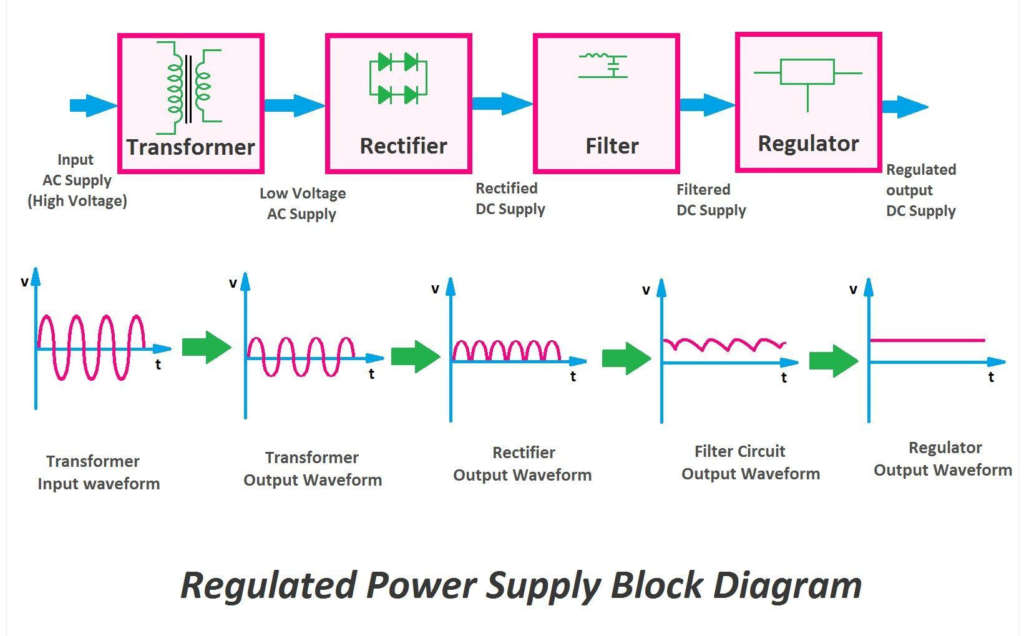


Step 1: Electrical Input
The system receives electrical power from an AC source.
Protection components may be placed at the input to protect the converter against abnormal electrical conditions.
Step 2: Rectification
A rectifier converts the incoming AC waveform into a unidirectional electrical waveform.
A bridge rectifier is a common topology for basic AC-to-DC conversion.
Step 3: Energy Filtering
Capacitors and inductors can reduce unwanted waveform variations.
The resulting DC voltage becomes more suitable for downstream conversion.
Step 4: High-Frequency Switching
A semiconductor switch rapidly turns electrical current on and off.
The switching pattern is controlled by a dedicated controller.
Step 5: Voltage Transformation
Depending on the topology, a transformer or inductive energy-storage network can modify the voltage level.
High-frequency transformers can provide electrical isolation while operating at much higher frequencies than traditional line-frequency transformers.
Step 6: Output Filtering
Inductors and capacitors smooth the switched waveform.
This produces a cleaner electrical output.
Step 7: Feedback Control
Sensors monitor output conditions.
If the output voltage changes because the load changes, the controller can adjust the switching behavior.
Step 8: Protection
A practical converter also monitors abnormal conditions such as:
⚠️ Overcurrent
⚠️ Overvoltage
⚠️ Overtemperature
⚠️ Short circuit
⚠️ Input abnormalities
The controller can reduce power or shut the converter down when necessary.
Comparison of Major Power Devices
Different semiconductor devices are appropriate for different applications.
| Device | Control | Typical Strength | Common Applications |
|---|---|---|---|
| Diode | Uncontrolled | Simple and reliable | Rectifiers |
| Thyristor | Trigger controlled | High-power operation | Industrial systems |
| MOSFET | Voltage controlled | High-frequency switching | DC–DC converters |
| IGBT | Voltage controlled | Medium/high-power switching | Motor drives |
| SiC MOSFET | Voltage controlled | High efficiency and temperature capability | EVs, solar |
| GaN transistor | Voltage controlled | Very high-frequency operation | Compact chargers |
There is no universally perfect semiconductor.
The correct choice depends on:
- Voltage
- Current
- Switching frequency
- Efficiency requirements
- Cost
- Thermal conditions
- Switching speed
- Reliability
- Package limitations
Diagrams and Circuit Structures 📊
A simple power-electronic system can be visualized as:
        ELECTRICAL SOURCE
                │
                ▼
        ┌───────────────┐
        │   Protection  │
        └───────┬───────┘
                │
                ▼
        ┌───────────────┐
        │ Power Switches│
        └───────┬───────┘
                │
                ▼
        ┌───────────────┐
        │ L/C Filtering │
        └───────┬───────┘
                │
                ▼
              LOAD
                ▲
                │
        ┌───────┴───────┐
        │    Control    │
        │ + Sensors     │
        └───────────────┘


Common Converter Topologies
Several circuit structures appear repeatedly in engineering practice.
Buck converter: reduces DC voltage.
Boost converter: increases DC voltage.
Buck-boost converter: can provide a different output-voltage level while offering flexible polarity/topology options.
Half-bridge converter: uses two controlled switches.
Full-bridge converter: uses four switches and is widely used for higher-power conversion.
Inverter: converts DC electrical energy into AC.
Rectifier: converts AC electrical energy into DC.
Practical Examples 💡
Smartphone Charger
A modern charger takes electrical power from the AC grid and converts it into a controlled low-voltage output.
The charger uses semiconductor switching, magnetic components, filtering, feedback, and protection.
High-frequency operation allows the transformer and other components to be smaller than those used in older linear supplies.
Electric Vehicle
An electric vehicle contains multiple power-electronic systems.
The traction inverter converts battery DC power into controlled AC power for the motor.
Additional converters manage auxiliary electrical systems and battery charging.


Solar Inverter
Solar panels generate DC electricity.
A solar inverter converts this energy into AC electricity suitable for a building or electrical grid.
The inverter must continuously manage voltage, current, synchronization, protection, and energy efficiency.
Industrial Motor Drive
Factories use variable-speed drives to control motors.
Instead of operating a motor continuously at one fixed condition, the drive can adjust operating speed according to production requirements.
This can improve process control and reduce unnecessary energy consumption.
Real-World Applications 🌍
Power electronics has become fundamental to modern infrastructure.
Renewable Energy
Solar and wind systems depend heavily on power converters.
Converters allow variable electrical generation to interact with electrical grids and energy-storage systems.
Transportation
Electric cars, trains, aircraft systems, ships, and industrial vehicles use power electronics for propulsion and energy management.
Data Centers
Modern data centers consume large amounts of electrical power.
Efficient power supplies and UPS systems help reduce losses and improve operational reliability.
Aerospace
Aircraft electrical systems require compact, lightweight, highly reliable power converters.
Industrial Automation
Robotics, pumps, compressors, conveyors, welding equipment, and machine tools frequently use controlled power conversion.
Consumer Electronics
Televisions, computers, game consoles, chargers, appliances, and networking equipment all depend on power conversion.
Common Mistakes ❌
Choosing a Device Only by Voltage Rating
A semiconductor’s voltage rating is important, but it is not enough.
Engineers must also evaluate current, switching frequency, thermal conditions, transient behavior, and safe operating limits.
Ignoring Heat
A converter can function correctly in simulation but fail in hardware because excessive heat was ignored.
Thermal design should begin early.
Using Poor Gate Driving
Fast semiconductor switches require appropriate gate-drive circuits.
Poor gate control can cause:
- Excessive switching losses
- Unwanted oscillations
- EMI
- Device overheating
- Reliability problems
Ignoring Layout
At high switching speeds, PCB traces are not electrically invisible.
Parasitic inductance and capacitance can produce voltage spikes and ringing.
Neglecting Protection
A prototype should not depend on software alone for every protection function.
Hardware-level protection can be essential for high-energy systems.
Challenges and Solutions 🛠️
| Challenge | Effect | Possible Solution |
|---|---|---|
| Excessive heat | Reduced reliability | Improve cooling |
| Switching losses | Lower efficiency | Optimize switching strategy |
| EMI | Interference | Improve layout and filtering |
| Voltage spikes | Device stress | Snubbers and appropriate layout |
| Control instability | Poor regulation | Improve feedback design |
| Component variation | Performance changes | Design with tolerances |
| Short circuits | Device failure | Fast protection |
| Poor PCB layout | Ringing/noise | Minimize high-current loops |
Thermal Management
Thermal solutions can include:
- Heat sinks
- Forced-air cooling
- Thermal interface materials
- Copper planes
- Liquid cooling
- Better semiconductor selection
Electromagnetic Compatibility
EMI must be considered from the beginning.
Good PCB layout, filtering, shielding, grounding, controlled switching edges, and minimized current loops can significantly improve electromagnetic performance.
Case Study: Solar Energy Conversion ☀️⚡
Imagine a commercial building equipped with rooftop solar panels.
During daylight hours, photovoltaic modules generate DC electrical energy. The building, however, uses an AC electrical distribution system.
A solar inverter becomes the critical interface.
System Operation
The panels supply DC power to the converter.
The converter controls the electrical operating point of the photovoltaic system to extract useful energy.
A DC-link stage provides an intermediate energy interface.
The inverter then generates an AC waveform synchronized with the electrical network.
Sensors continuously monitor electrical conditions.
The controller adjusts switching commands based on operating requirements.
Protection functions detect abnormal voltage, current, temperature, or grid conditions.
The result is a coordinated power-electronic system capable of transferring renewable energy into the building or grid.
Engineering Lessons
This example demonstrates that power electronics is not simply about selecting a transistor.
A successful design requires coordination among:
Semiconductors + Magnetics + Control + Thermal Design + Protection + PCB Layout + Software + System Requirements
That multidisciplinary nature is what makes power electronics both challenging and exciting. 🚀
Essential Tips for Students and Engineers 🎓
Start With the Fundamentals
Before designing sophisticated converters, understand:
- Voltage and current
- AC and DC behavior
- Semiconductor operation
- Inductors
- Capacitors
- Transformers
- Switching concepts
- Feedback control
Learn to Read Waveforms
A power-electronics engineer should become comfortable interpreting:
- Voltage waveforms
- Current waveforms
- Switching signals
- Gate signals
- Ripple
- Transients
- Temperature behavior
Waveforms often reveal problems faster than equations or specifications.
Simulate Before Building
Simulation tools can help engineers identify problems before hardware is manufactured.
Simulation is not a replacement for laboratory testing, but it is a valuable design step.
Think About Safety
High-energy circuits can be dangerous.
Professional development should include appropriate isolation, current limiting, protective equipment, safe measurement techniques, and controlled laboratory procedures.
Design for Manufacturing
A circuit that works once on a laboratory bench is not necessarily a production-ready product.
Engineers should consider:
- Component availability
- PCB manufacturing
- Thermal assembly
- Tolerances
- Reliability
- Testing
- Serviceability
- Cost
FAQs ❓
What is power electronics?
Power electronics is the engineering discipline concerned with converting and controlling electrical energy using semiconductor switching devices and associated circuits.
What are the main power-electronic converters?
The major categories are AC–DC rectifiers, DC–DC converters, DC–AC inverters, and AC–AC converters.
What is the difference between a MOSFET and an IGBT?
Both can be voltage-controlled semiconductor switches, but they are optimized for different operating regions. MOSFETs are particularly useful for fast switching, while IGBTs are widely used in many medium- and higher-power applications.
Why are MOSFETs important in modern electronics?
MOSFETs can switch rapidly and efficiently, making them valuable in power supplies, battery systems, automotive electronics, and high-frequency converters.
Why does a power converter need a heat sink?
Power semiconductors and other components produce heat due to electrical losses. A heat sink helps transfer this heat away from the device and maintain an acceptable operating temperature.
What is an inverter?
An inverter is a power-electronic converter that changes DC electrical energy into AC electrical energy.
Where is power electronics used?
It is used in electric vehicles, solar systems, wind turbines, industrial drives, chargers, computers, data centers, appliances, aircraft, telecommunications equipment, and energy-storage systems.
Is power electronics difficult to learn?
The subject can initially appear challenging because it combines circuits, semiconductor physics, control systems, magnetics, thermal engineering, and practical hardware design. Learning these topics progressively makes it much easier.
Conclusion ⚡🚀
Power electronics is the technology that enables electrical energy to be converted, controlled, regulated, and delivered efficiently.
Its importance continues to grow as society moves toward electrification, renewable energy, electric transportation, intelligent manufacturing, energy storage, and highly efficient computing infrastructure.
Understanding devices such as diodes, thyristors, MOSFETs, IGBTs, SiC devices, and GaN devices provides the foundation for understanding modern converters. From there, engineers can explore rectifiers, DC–DC converters, inverters, motor drives, renewable-energy systems, and advanced power-management architectures.
The most important lesson is that a power-electronic circuit should never be viewed as a collection of isolated components. A reliable converter is a complete engineering system in which semiconductor selection, switching behavior, magnetic components, thermal management, control algorithms, PCB layout, EMI, protection, and safety must work together.
For students, mastering these fundamentals creates a strong pathway into electrical engineering, embedded systems, renewable energy, automotive engineering, and industrial automation. For professionals, continuous advances in wide-bandgap semiconductors, high-frequency switching, digital control, and intelligent energy management are creating new opportunities to build smaller, faster, more efficient, and more reliable power systems. 🌍⚡
Power electronics is ultimately about one thing: making electrical energy work smarter. 🔋💡