Bridge Engineering Handbook 2nd Edition: Construction and Maintenance: Construction and Maintenance
Introduction 🌉
Bridge engineering combines structural design, construction technology, materials science, geotechnical engineering, transportation planning, and long-term asset management. A bridge must do more than carry vehicles, pedestrians, trains, or utilities from one side of an obstacle to another. It must remain safe and serviceable while facing traffic loads, temperature changes, moisture, corrosion, wind, earthquakes, flooding, fatigue, and aging.
Bridge construction therefore begins long before concrete is poured or steel girders are lifted. Engineers investigate the site, understand the ground and environmental conditions, select an appropriate structural system, coordinate construction activities, and establish inspection and maintenance requirements for the entire service life.


For students, bridge engineering provides an excellent example of how theoretical engineering becomes a real infrastructure system. For professionals, it demonstrates why constructability, durability, inspection, and lifecycle planning are just as important as structural capacity.


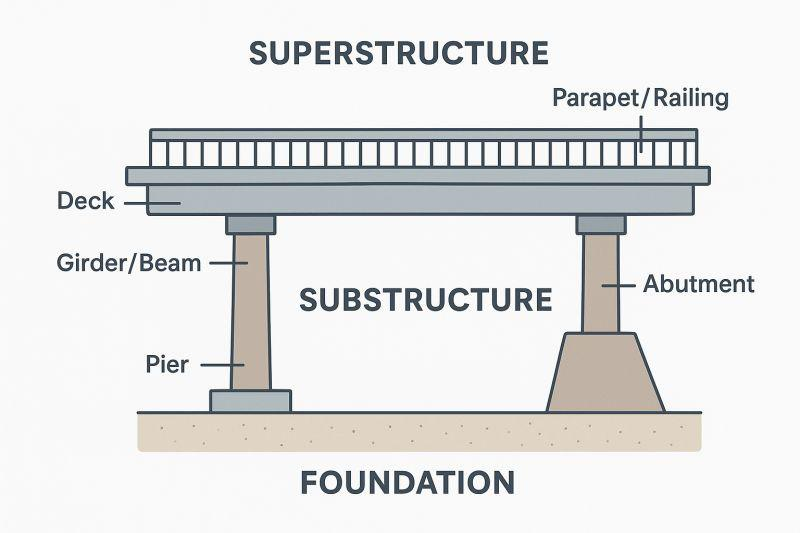
This article presents a practical introduction to bridge construction and maintenance, covering the major components, construction sequence, materials, inspection techniques, common problems, and modern solutions. 🏗️
Background Theory 🧠
How a bridge carries load
A bridge works as a continuous load-transfer system. Loads applied to the deck are transferred through the superstructure toward bearings and then into piers, abutments, foundations, and finally the supporting ground.
Typical load paths can be visualized as:
Traffic → Deck → Girders → Bearings → Piers/Abutments → Foundations → Ground
This simple sequence is fundamental to understanding bridge behavior.
A bridge is also subjected to loads that are not always visible. These can include:
- Dead loads from structural components
- Vehicle and pedestrian loads
- Wind actions
- Temperature effects
- Seismic actions
- Water and hydraulic forces
- Braking and acceleration forces
- Construction loads
- Fatigue from repeated traffic
- Soil and foundation movements
Superstructure and substructure
The bridge is commonly divided into two major systems.
The superstructure includes the deck, girders, beams, trusses, arches, cables, and related components above the supports.
The substructure includes piers, abutments, foundations, pile caps, columns, and other elements transferring forces to the ground.
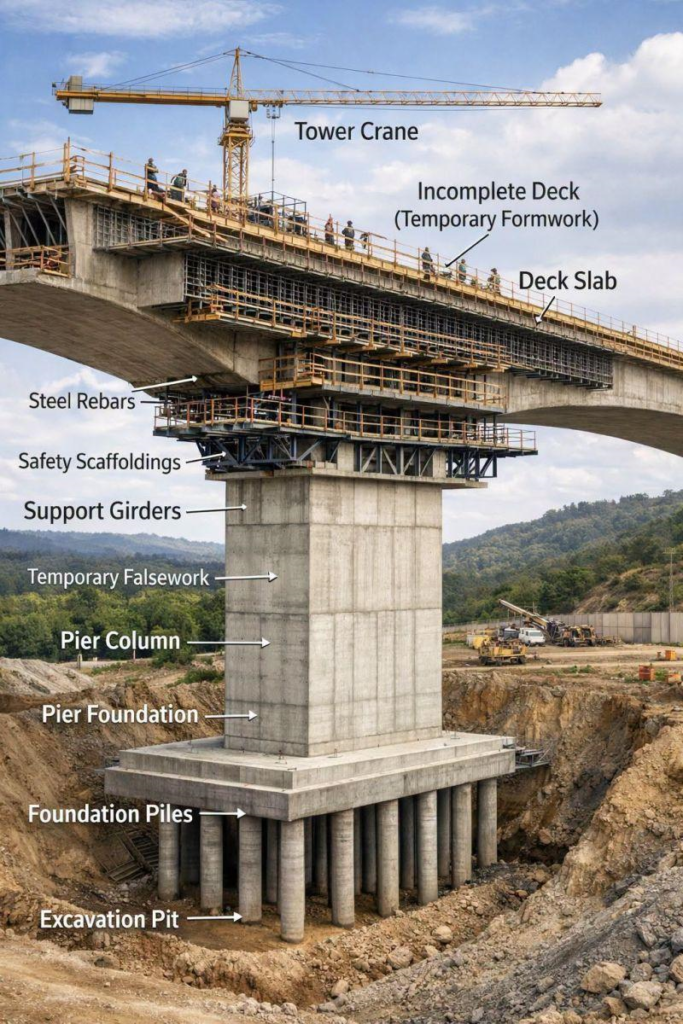
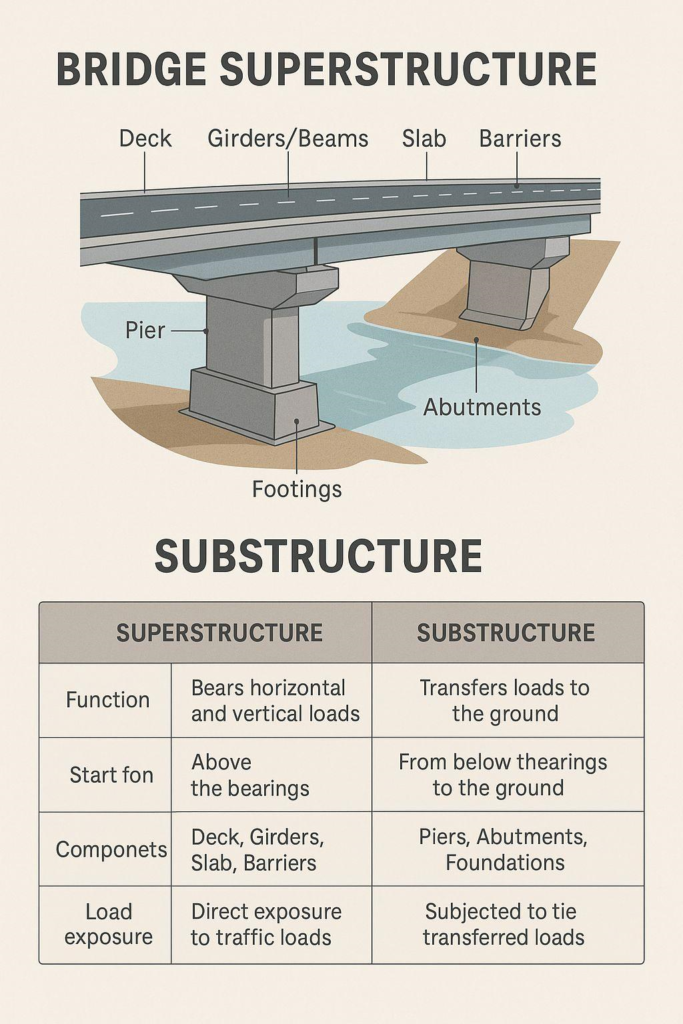


Understanding this division makes inspection and maintenance easier because engineers can identify whether a defect originates in the load-carrying superstructure, support system, or foundation.
Definition 📘
What is bridge engineering?
Bridge engineering is the branch of civil and structural engineering concerned with the planning, analysis, design, construction, inspection, maintenance, rehabilitation, and management of bridges.
Bridge engineering is not limited to structural calculations. A successful bridge project must also consider:
- Geotechnical conditions
- Hydrology and drainage
- Traffic management
- Construction equipment
- Environmental constraints
- Material durability
- Worker safety
- Inspection access
- Maintenance requirements
- Construction cost
- Lifecycle performance
What is bridge construction?
Bridge construction is the controlled process of converting an approved bridge design into a physical structure. It can involve excavation, foundation construction, reinforcement installation, concrete placement, steel fabrication, girder erection, deck construction, waterproofing, expansion joints, barriers, drainage, and finishing works.
What is bridge maintenance?
Bridge maintenance includes planned inspections, cleaning, preventive treatments, repairs, component replacement, corrosion protection, drainage management, and rehabilitation activities intended to preserve safety and serviceability.
The key principle is simple:
A bridge is not finished when construction ends; it enters its maintenance phase. 🔧
Step-by-Step Bridge Construction 🏗️
1. Site investigation
The first major stage is understanding the physical environment.
Engineers investigate:
- Soil and rock conditions
- Groundwater
- Existing utilities
- River or waterway behavior
- Flood levels
- Traffic conditions
- Environmental restrictions
- Access for construction equipment
Geotechnical investigation is especially important because foundation selection depends heavily on ground conditions.
2. Foundation construction
Foundations transfer bridge loads into the ground.
Depending on the site, engineers may use shallow foundations, piles, drilled shafts, or other deep foundation systems.
Construction quality is critical because foundation defects can be extremely difficult and expensive to correct after the bridge is completed.
3. Piers and abutments
After foundations are prepared, vertical supports and end supports are constructed.
Piers support intermediate portions of the bridge.
Abutments support the ends of the bridge and often retain the approach embankments.
Reinforcement placement, form-work, concrete quality, curing, and dimensional control must be carefully monitored.
4. Bearing installation
Bearings provide controlled interaction between the superstructure and supports.
They can accommodate movements caused by:
- Temperature
- Shrinkage
- Creep
- Traffic effects
- Structural rotation
Incorrect bearing installation can create unintended forces and accelerate structural damage.
5. Girder fabrication and erection
Girders may be fabricated from steel, reinforced concrete, or prestressed concrete.
Depending on the project, girders can be:
- Cast on site
- Precast
- Prestressed
- Fabricated in steel plants
- Assembled from segments
Large cranes, launching systems, transporters, or specialized erection equipment may be required.

6. Deck construction
The deck creates the primary roadway or walking surface.
Construction may involve:
- Installing deck form-work
- Placing reinforcement
- Installing embedded components
- Positioning shear connectors where required
- Placing concrete
- Finishing the surface
- Curing the concrete
- Applying waterproofing or protective systems
- Installing pavement or surfacing
Accelerated construction methods can use precast deck elements to reduce site time. Research into precast deck systems has focused heavily on improving construction speed for steel–concrete composite bridges.
7. Expansion joints, barriers, and drainage
The final structural and roadway systems include expansion joints, parapets, barriers, drainage components, lighting where required, and road connections.
Poor drainage is one of the most common pathways to long-term bridge deterioration because water can transport aggressive substances toward concrete and steel components.
8. Inspection and commissioning
Before opening the bridge, engineers verify construction quality and compliance with design requirements.
Typical activities can include:
- Dimensional checks
- Material testing
- Weld inspections
- Concrete testing
- Bearing inspection
- Drainage checks
- Load testing where specified
- Safety-system verification
- Documentation and as-built records
Comparison of Bridge Construction Systems ⚖️
Different bridge systems are suitable for different site conditions.
| Construction system | Main advantage | Typical consideration |
|---|---|---|
| Precast concrete girders | Fast erection | Requires transportation and lifting |
| Cast-in-place concrete | Flexible geometry | Longer site construction period |
| Steel girders | High strength and relatively fast erection | Corrosion and fabrication quality |
| Prestressed concrete | Efficient for many medium spans | Requires specialized stressing operations |
| Segmental construction | Useful where access is difficult | More complex construction control |
| Incremental launching | Reduces work below the bridge | Requires suitable geometry and launching area |
| Balanced cantilever | Useful over obstacles | Demands careful construction-stage control |
| Cable-stayed | Efficient for longer spans | Complex cable and structural coordination |
| Suspension | Suitable for very long spans | High design and construction complexity |
The correct choice depends on span, terrain, traffic, waterway restrictions, available equipment, environmental requirements, schedule, cost, and lifecycle considerations.
Diagrams and Engineering Tables 📊
Typical bridge load-transfer concept


A simplified conceptual diagram is:
Vehicle Load
↓
Deck System
↓
Main Girders / Structural Members
↓
Bearings
↓
Piers and Abutments
↓
Foundation
↓
Ground
Common bridge components
| Component | Primary function | Typical concern |
|---|---|---|
| Deck | Carries traffic | Cracking, wear, water penetration |
| Girder | Main load-carrying member | Fatigue, corrosion, cracking |
| Bearing | Transfers load and allows movement | Seizure, deterioration, displacement |
| Expansion joint | Accommodates movement | Leakage and wear |
| Pier | Intermediate support | Impact, scour, cracking |
| Abutment | End support and earth retention | Settlement and drainage |
| Foundation | Transfers loads to ground | Settlement, scour, capacity |
| Drainage system | Removes water | Blockage and leakage |
| Barrier/parapet | Provides safety | Impact damage |
| Protective coating | Protects materials | Peeling, corrosion, degradation |
Examples 🔍
Example 1: Highway overpass
Imagine a bridge carrying three lanes of highway traffic over a railway.
The construction team cannot simply close the railway for weeks. Therefore, the project may require prefabricated structural components and carefully planned night-time lifting operations.
The major engineering challenge is not only structural capacity. It is also constructability and safety around an active railway.
Example 2: Bridge across a river
A bridge crossing a river must account for water flow, flooding, debris, erosion, and foundation scour.
Even if the superstructure remains in excellent condition, erosion around foundations can threaten the bridge.
This demonstrates an important lesson:
Bridge maintenance must consider the surrounding environment, not just visible structural cracks.
Example 3: Urban bridge replacement
An urban bridge may cross several roads while carrying heavy daily traffic.
Accelerated bridge construction can reduce disruption by moving fabrication away from the site and completing major assembly quickly.
Modern bridge construction increasingly considers user delay and traffic disruption, not merely contractor construction time.
Real-World Applications 🌍
Bridge engineering supports transportation networks throughout the United States, United Kingdom, Canada, Australia, and Europe.
Highway infrastructure
Bridges allow highways to cross:
- Rivers
- Railways
- Valleys
- Existing roads
- Urban developments
- Other highways
Railway bridges
Railway bridges require strict control of structural movement, alignment, vibration, fatigue, and operational safety.
Pedestrian and cycling bridges
These structures may be lighter but still require careful consideration of vibration, accessibility, durability, and user safety.
Urban flyovers
Dense cities increasingly depend on elevated structures to separate traffic flows and reduce congestion.
Coastal and marine bridges
Marine environments can be particularly aggressive because salt and moisture can accelerate corrosion of steel and deterioration of reinforced concrete.
Bridge projects in Egypt, for example, demonstrate the combination of steel, reinforced concrete, pile foundations, and composite structural systems in major transportation infrastructure.
Common Bridge Maintenance Problems ⚠️
Concrete cracking
Cracks may result from shrinkage, thermal movement, overloading, corrosion of reinforcement, poor construction, or structural movement.
Not every crack represents immediate structural failure, but every significant crack should be evaluated according to its location, width, pattern, progression, and cause.
Reinforcement corrosion
Water and aggressive chemicals can reach reinforcing steel. Corrosion products occupy more volume than the original steel, potentially causing cracking and concrete spalling.
Steel corrosion
Steel bridges require effective corrosion protection and regular inspection.
Paint systems, protective coatings, drainage, detailing, and environmental exposure all influence durability.
Bearing deterioration
Bearings can experience:
- Corrosion
- Wear
- Loss of movement
- Excessive deformation
- Contamination
- Misalignment
Expansion joint failure
Expansion joints receive repeated traffic loading and environmental exposure. Failure can allow water to penetrate structural areas that should remain protected.
Foundation scour
Scour can remove soil around bridge foundations during floods or strong water flow.
It may remain hidden until significant damage has already occurred.
Challenges and Solutions 🛠️
| Challenge | Engineering solution |
|---|---|
| Heavy traffic | Staged construction and traffic management |
| Limited site access | Precast and modular construction |
| Deep water | Specialized foundation and erection methods |
| Corrosion | Protective systems and improved detailing |
| Extreme weather | Durable materials and resilient design |
| Aging infrastructure | Condition assessment and rehabilitation |
| Construction delays | Detailed planning and digital scheduling |
| Difficult inspections | Drones, sensors, and remote inspection |
| Foundation scour | Hydraulic assessment and scour protection |
| Limited maintenance budgets | Risk-based asset management |
Modern bridge engineering increasingly emphasizes durability at the design stage instead of treating maintenance as an afterthought.
Case Study: Steel–Concrete Composite Bridge 🌉
Consider a hypothetical highway bridge using steel girders with a reinforced-concrete deck.
The steel girders are fabricated under controlled factory conditions and transported to the construction site. Concrete piers and abutments are constructed first, followed by bearing installation.
The girders are then erected using cranes during controlled traffic closures.
After the girders are aligned, the deck reinforcement and concrete are installed. Shear connectors provide the required interaction between steel and concrete so the components can work together as a composite system.
A modern composite bridge may therefore combine the advantages of both materials: steel provides efficient structural members while concrete provides the deck system.
Real composite bridge projects commonly use shear connectors to develop interaction between steel girders and concrete decks.
After opening, the bridge enters a structured inspection program.
Engineers monitor:
- Deck condition
- Steel corrosion
- Concrete cracking
- Bearings
- Expansion joints
- Drainage
- Barriers
- Foundations
- Approach settlement
If a small drainage defect causes persistent water leakage, early repair may prevent much larger deterioration.
This illustrates the central principle of bridge asset management:
Early intervention is usually better than waiting for visible structural deterioration to become severe. 🔧
Essential Tips for Students and Professionals 🎓
For students
Focus first on understanding how forces travel through the structure.
Do not memorize bridge components individually without understanding their relationships.
Study:
- Structural mechanics
- Reinforced concrete
- Steel structures
- Soil mechanics
- Hydraulics
- Construction management
- Materials
- Structural inspection
For practicing engineers
Always connect design decisions with construction and maintenance.
A technically elegant design can become inefficient if it is difficult to construct or inspect.
For construction teams
Quality control should begin before material placement.
Check:
- Drawings
- Material certificates
- Reinforcement
- form-work
- Alignment
- Concrete placement
- Curing
- Welding
- Bolted connections
- Bearing installation
- Waterproofing
For maintenance engineers
Document changes over time.
A single inspection provides a snapshot. A series of inspections creates a condition history, allowing engineers to identify deterioration trends.
Think lifecycle, not just construction
A bridge should be evaluated across:
Planning → Design → Construction → Inspection → Maintenance → Rehabilitation → Replacement
This lifecycle approach can improve safety, reliability, and long-term value.
FAQs ❓
What is the most important part of bridge construction?
There is no single universally most important component. Foundation quality, structural integrity, construction control, drainage, and inspection all contribute to bridge safety.
What materials are commonly used in bridges?
Steel, reinforced concrete, prestressed concrete, asphalt or other surfacing materials, protective coatings, and specialized bearing and joint materials are commonly used.
Why are bridge bearings important?
Bearings transfer forces between the superstructure and supports while allowing controlled movement and rotation. Their correct installation and maintenance are essential.
How often should bridges be inspected?
Inspection frequency depends on the bridge type, jurisdiction, condition, exposure, traffic, and applicable regulations. Inspection programs should follow the requirements of the responsible transportation authority.
What causes bridge deterioration?
Common causes include water penetration, corrosion, freeze-thaw exposure, deicing chemicals, fatigue, traffic impact, poor drainage, construction defects, environmental exposure, foundation movement, and inadequate maintenance.
Why is drainage so important?
Water is one of the major drivers of bridge deterioration. Effective drainage reduces water accumulation and helps protect concrete, reinforcement, steel, bearings, joints, and foundations.
Can old bridges be strengthened instead of replaced?
Yes. Depending on their condition and structural requirements, bridges may be strengthened through techniques such as member replacement, concrete repair, strengthening systems, additional structural components, bearing replacement, or other rehabilitation methods.
What is the future of bridge maintenance?
Future maintenance is expected to increasingly combine sensors, drones, digital inspection records, structural health monitoring, predictive analytics, robotics, and data-driven asset management.
Conclusion 🌉✨
Bridge engineering is a complete lifecycle discipline rather than simply the process of designing and constructing a crossing.
A successful bridge must be structurally safe, constructible, durable, inspectable, maintainable, economical, and appropriate for its environment.
The construction process begins with site investigation and foundation work, progresses through substructure and superstructure construction, and finishes with the deck, joints, drainage, safety systems, inspection, and commissioning.
But the engineering responsibility does not end there.
Long-term bridge performance depends on regular inspection, effective drainage, corrosion control, timely repairs, foundation monitoring, and appropriate rehabilitation. Modern engineering also adds accelerated construction, prefabrication, digital monitoring, advanced materials, and data-driven maintenance strategies.
For students, bridge engineering provides a powerful way to connect structural theory with real infrastructure. For professionals, it reinforces an even more important lesson:
The best bridge is not merely the one that can be built—it is the one that can remain safe, functional, and economical throughout its intended service life. 🏗️🌉🔧
A well-engineered bridge is therefore a partnership between design, construction, materials, inspection, maintenance, technology, and people.