Principles of Data Science: A Complete Engineering Guide for Students and Professionals
Introduction
Data science has become one of the most important technical disciplines in modern engineering. It combines statistics, mathematics, programming, computing, domain knowledge, and analytical thinking to transform raw data into useful information and reliable decisions. 📊⚙️
Engineers increasingly work with data generated by sensors, machines, industrial systems, software applications, experiments, simulations, and connected devices. Understanding the principles of data science therefore helps professionals move beyond simply collecting data toward extracting meaningful engineering knowledge from it.

At its core, data science asks several important questions:
- What data do we have? 🔍
- Where did the data come from?
- Can we trust it?
- What patterns exist?
- What relationships are meaningful?
- Can future behavior be predicted?
- How should the results influence engineering decisions?
A successful data science project is not simply about creating a sophisticated machine-learning model. It is a complete process that begins with a well-defined problem and ends with an interpretable, useful, and maintainable solution.


For students and professionals in the USA, UK, Canada, Australia, and Europe, these principles are particularly valuable because data-driven engineering is increasingly connected with automation, digital twins, predictive maintenance, artificial intelligence, energy optimization, smart infrastructure, and industrial analytics.
Background Theory
Data science developed from the convergence of several established fields rather than appearing as an entirely independent discipline.
Statistics and Probability
Statistics provides methods for understanding variation, uncertainty, distributions, relationships, and experimental results.
Probability helps engineers reason about uncertain events. For example, a structural engineer may need to understand the probability of a particular load condition, while a manufacturing engineer may analyze the probability of defects occurring.
Computer Science and Programming
Modern data science depends heavily on computational technologies.
Programming languages such as Python and R allow engineers to:
- Process large datasets
- Automate repetitive analysis
- Build predictive models
- Create visualizations
- Connect analytical systems to databases
- Develop machine-learning applications
Machine Learning
Machine learning provides algorithms that can identify patterns from historical data and use those patterns for classification, prediction, recommendation, or anomaly detection.
However, machine learning is only one component of data science. A technically impressive model cannot compensate for poor-quality data or an incorrectly defined engineering problem.
Domain Engineering Knowledge
Engineering knowledge is essential because data does not automatically explain physical reality.
An engineer understands whether a relationship is physically reasonable, whether a sensor is positioned correctly, whether a measurement is realistic, and whether a model’s prediction makes sense in an operational environment.
Definition
Data science is the systematic discipline of collecting, preparing, analyzing, modeling, interpreting, and communicating data to generate useful knowledge and support evidence-based decisions.
The major principles can be summarized as:
Problem → Data → Quality → Exploration → Modeling → Validation → Communication → Deployment → Monitoring
Each stage affects the stages that follow.
Data Is Not Automatically Knowledge
A database may contain millions of measurements, but quantity alone does not guarantee useful information.
For example, a factory may collect temperature measurements every second. If sensors are incorrectly calibrated, timestamps are inconsistent, or important operating conditions are missing, a huge dataset may still produce misleading conclusions.
Quality Comes Before Complexity
One of the most important principles is:
Better data often produces better results than a more complicated algorithm.
An understandable model trained on reliable data can be more valuable than an advanced model trained on poorly prepared data.
Step-by-Step Explanation
A practical data science workflow can be organized into several stages.
Step 1: Define the Engineering Problem
Begin with the decision or engineering problem rather than the algorithm.
Instead of saying:
“We need artificial intelligence.”
define a measurable objective such as:
“We want to identify equipment behavior that indicates an increased risk of failure.”
A clear problem makes it easier to determine what data is needed and how success will be evaluated.
Step 2: Collect Relevant Data
Data may come from:
- Sensors
- Databases
- Laboratory experiments
- Surveys
- Industrial machines
- Websites and APIs
- Simulation software
- Business systems
- IoT devices
- Engineering monitoring systems
The source, measurement process, sampling frequency, and collection conditions should be documented.
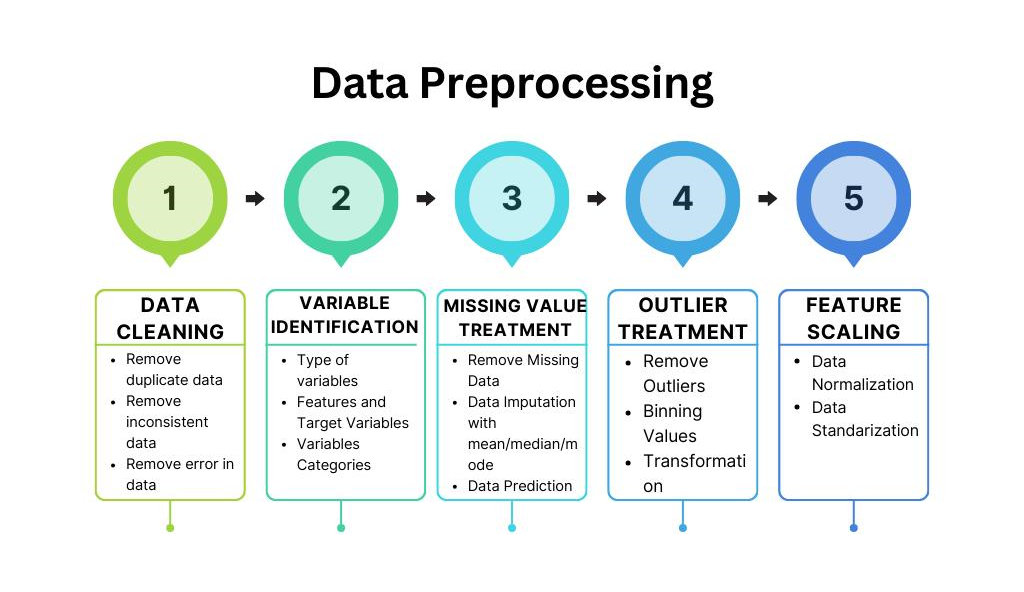
Step 3: Clean the Data
Raw datasets frequently contain missing values, duplicate records, incorrect measurements, inconsistent units, and unusual observations.
Cleaning may involve:
- Removing duplicate records
- Correcting inconsistent formats
- Handling missing values
- Detecting extreme observations
- Standardizing units
- Checking timestamps
- Identifying sensor failures



Step 4: Explore the Dataset
Exploratory data analysis helps engineers understand what the dataset actually contains.
Useful techniques include:
- Histograms
- Scatter plots
- Box plots
- Correlation analysis
- Time-series visualization
- Group comparisons
- Distribution analysis
Visualization can reveal patterns that are difficult to detect from raw tables.
Step 5: Prepare Features
A feature is a measurable characteristic used by an analytical model.
For example, equipment analysis might use:
- Operating temperature
- Vibration level
- Pressure
- Rotation speed
- Operating hours
- Maintenance history
Feature engineering can transform raw measurements into more informative representations.
Step 6: Select an Appropriate Model
The model should match the problem.
Common categories include:
Regression: predicting a continuous quantity.
Classification: assigning observations to categories.
Clustering: discovering naturally occurring groups.
Anomaly detection: identifying unusual behavior.
Time-series analysis: understanding measurements that change over time.
Step 7: Validate the Results
A model should be tested using data that was not simply memorized during training.
Validation helps determine whether the model generalizes to new observations.
Engineers should consider:
- Accuracy
- Precision
- Recall
- Error
- Robustness
- Generalization
- Interpretability
Step 8: Communicate the Findings
A technically correct analysis is not useful if decision-makers cannot understand it.
Good communication should explain:
- What was analyzed?
- What was discovered?
- How reliable are the results?
- What limitations exist?
- What action should be considered?
Step 9: Deploy and Monitor
A data science solution does not end when a model is deployed.
Real-world conditions change. Sensors can degrade, user behavior can change, equipment can be replaced, and the statistical properties of incoming data can shift.
Continuous monitoring is therefore essential. 🔄
Comparison
Different approaches serve different engineering objectives.
| Approach | Main Purpose | Typical Output | Example |
|---|---|---|---|
| Descriptive analytics | Understand what happened | Reports and summaries | Production dashboard |
| Diagnostic analytics | Understand why it happened | Relationships and causes | Finding reasons for downtime |
| Predictive analytics | Estimate what may happen | Forecasts | Predicting equipment failure |
| Prescriptive analytics | Recommend actions | Decisions or recommendations | Optimizing maintenance schedules |
| Machine learning | Learn patterns from data | Predictions or classifications | Defect detection |
| Traditional statistical analysis | Quantify relationships and uncertainty | Statistical evidence | Experimental analysis |
No single approach is universally superior. The correct method depends on the engineering question.
Diagrams & Tables
A useful conceptual data science pipeline is:
┌──────────────────┐
│ Engineering      │
│ Problem          │
└────────┬─────────┘
         ↓
┌──────────────────┐
│ Data Collection  │
└────────┬─────────┘
         ↓
┌──────────────────┐
│ Data Cleaning    │
└────────┬─────────┘
         ↓
┌──────────────────┐
│ Exploration      │
└────────┬─────────┘
         ↓
┌──────────────────┐
│ Feature Creation │
└────────┬─────────┘
         ↓
┌──────────────────┐
│ Modeling         │
└────────┬─────────┘
         ↓
┌──────────────────┐
│ Validation       │
└────────┬─────────┘
         ↓
┌──────────────────┐
│ Deployment       │
└────────┬─────────┘
         ↓
┌──────────────────┐
│ Monitoring       │
└──────────────────┘


Another important distinction is between training performance and real-world performance.
| Situation | Interpretation |
|---|---|
| Excellent training results | The model learned the training dataset well |
| Poor validation results | The model may not generalize |
| Excellent validation results | Stronger evidence of generalization |
| Unexpected real-world results | Data or operating conditions may have changed |
Examples
Example 1: Predictive Maintenance
Imagine an industrial pump equipped with vibration and temperature sensors.
The system continuously records operational information. Data scientists can analyze historical measurements associated with normal and abnormal operation.
A model may learn that a combination of increasing vibration, unusual temperature behavior, and operating conditions frequently appears before a maintenance event.
The engineering team can then investigate the equipment before a major failure occurs. 🔧
Example 2: Structural Engineering
A bridge-monitoring system can collect information from sensors measuring vibration, displacement, strain, and environmental conditions.
Data science can help identify unusual patterns and support engineers in prioritizing inspections.
The model does not replace structural engineering judgment. Instead, it acts as an additional analytical layer.
Example 3: Energy Systems
A building may contain years of electricity consumption data together with weather and occupancy information.
Data science can identify consumption patterns and help estimate periods of unusually high demand.
Engineers can use those insights to investigate inefficient equipment, optimize schedules, and improve energy management.
Example 4: Manufacturing Quality
A production line may record machine settings, material properties, environmental conditions, and inspection results.
Data analysis can reveal combinations of operating conditions associated with defective products.
Engineers can then investigate the production process and improve quality control.
Real World Application
Data science is now used across many engineering sectors.
Mechanical Engineering
Applications include:
- Predictive maintenance
- Fault detection
- Machine-condition monitoring
- Manufacturing optimization
- Robotics
Civil Engineering
Applications include:
- Structural health monitoring
- Traffic analysis
- Construction productivity
- Infrastructure management
- Smart-city systems
Electrical Engineering
Data science supports:
- Load forecasting
- Power-quality monitoring
- Renewable-energy prediction
- Grid optimization
- Fault classification
Chemical Engineering
Engineers can use data science for:
- Process optimization
- Quality prediction
- Equipment monitoring
- Process control
- Anomaly detection
Software and Systems Engineering
Applications include:
- System monitoring
- User behavior analysis
- Reliability engineering
- Performance optimization
- Intelligent automation
The growing combination of IoT + cloud computing + artificial intelligence + data science is creating increasingly sophisticated engineering systems. ☁️🤖
Common Mistakes
Starting With the Algorithm
Choosing a sophisticated model before understanding the problem can lead to unnecessary complexity.
Better approach: define the engineering objective first.
Ignoring Data Quality
Incorrect measurements can create misleading patterns.
Better approach: establish data-quality checks before modeling.
Using Too Many Features
Adding every available variable does not necessarily improve a model.
Better approach: select meaningful and defensible features.
Confusing Correlation With Causation
Two variables may change together without one directly causing the other.
Better approach: combine statistical evidence with engineering knowledge and experimental reasoning.
Ignoring Data Leakage
Information that would not actually be available when making a prediction can accidentally enter the training dataset.
This can produce impressive testing results but disappointing real-world performance.
Forgetting Model Maintenance
A model can become less effective as operating conditions change.
Better approach: monitor model performance continuously.
Challenges & Solutions
| Challenge | Effect | Practical Solution |
|---|---|---|
| Missing data | Incomplete analysis | Investigate why data is missing |
| Noisy sensors | Unstable results | Improve measurement and filtering |
| Imbalanced classes | Poor detection of rare events | Use appropriate evaluation strategies |
| Changing environments | Model degradation | Monitor data drift |
| Limited labeled data | Difficult supervised learning | Consider domain knowledge and alternative methods |
| Poor documentation | Difficult reproducibility | Maintain clear data and model records |
| Complex models | Difficult interpretation | Use interpretable methods where appropriate |
| Security risks | Data compromise | Apply access control and secure data pipelines |
Case Study
Smart Manufacturing Failure Detection
Consider a manufacturing facility producing precision components.
The engineering team notices that unexpected machine downtime is reducing production efficiency.
The facility already collects:
- Motor vibration
- Temperature
- Production speed
- Machine status
- Operating hours
- Maintenance records
- Quality inspection results
Rather than immediately purchasing new equipment, the team begins with data exploration.
First, engineers verify sensor quality and remove duplicate records. They then align timestamps so measurements from different systems can be compared.
Exploratory analysis reveals that abnormal vibration patterns frequently appear before certain machine failures.
The team develops a classification system that categorizes equipment states as normal or potentially abnormal.
The model is tested against historical observations that were not used during training. After satisfactory validation, the system is integrated into the plant’s monitoring dashboard.
Instead of automatically shutting down machines, the system generates an engineering alert.
Maintenance engineers investigate the alert and determine whether an inspection is required.
This approach demonstrates an important principle: data science supports engineering decisions rather than eliminating engineering expertise.
Over time, the team continues monitoring model performance. New failure modes are incorporated into future training datasets, allowing the analytical system to evolve with the manufacturing environment.
Essential Tips
For Beginners
Start with the fundamentals:
- Learn Python.
- Understand basic statistics.
- Practice data visualization.
- Work with real datasets.
- Learn SQL and databases.
- Study data cleaning.
- Build small projects.
- Explain your results in plain language.
📌 Do not rush directly into deep learning. Strong fundamentals are more valuable.
For Engineering Students
Try projects connected to your discipline.
A mechanical engineering student could analyze machine vibration.
A civil engineering student could analyze structural-monitoring data.
An electrical engineering student could investigate energy consumption.
Connecting data science with an existing engineering skillset makes learning more practical.
For Professionals
Focus on the complete lifecycle rather than only model development.
Ask:
Can the data be trusted?
Can the result be explained?
Can the solution operate reliably?
Can another engineer reproduce the analysis?
What happens when the data changes?
These questions distinguish a production-quality data science system from a simple demonstration project.
FAQs
What are the main principles of data science?
The major principles include problem definition, data quality, appropriate data collection, exploratory analysis, feature engineering, suitable modeling, validation, communication, deployment, and continuous monitoring.
Is data science only about machine learning?
No. Machine learning is an important component, but data science also includes statistics, data engineering, visualization, experimentation, domain knowledge, communication, and decision-making.
Why is data cleaning so important?
Poor-quality data can produce unreliable conclusions. Cleaning helps identify missing information, duplicates, inconsistent measurements, incorrect formats, and other problems before they affect analysis.
Which programming language is best for data science?
Python is widely used because it provides extensive tools for data processing, visualization, scientific computing, and machine learning. R is also highly valuable, particularly for statistics and analytical research.
Can data science replace engineers?
No. Data science can automate certain analytical tasks, but engineering judgment remains essential for understanding physical systems, safety requirements, constraints, and practical implementation.
What is the difference between data science and data analysis?
Data analysis generally focuses on examining and interpreting data to answer questions. Data science covers a broader lifecycle that can include data engineering, statistical analysis, machine learning, deployment, and automated decision systems.
What makes a data science model reliable?
Reliability depends on several factors, including data quality, representative training data, appropriate validation, suitable evaluation metrics, robustness, interpretability, and continuous monitoring after deployment.
How can students learn data science effectively?
A strong path is to combine programming, statistics, SQL, visualization, machine learning fundamentals, and practical projects. Engineering students should preferably work with datasets related to their own technical discipline.
Conclusion
The principles of data science provide a structured way to transform raw measurements into meaningful engineering knowledge. 📊⚙️
The most important lesson is that successful data science is not simply about using the newest artificial-intelligence algorithm. It begins with a clearly defined problem, depends on trustworthy data, requires appropriate analysis, and must produce results that can be validated and understood.
For engineers, the discipline becomes especially powerful when combined with domain expertise. Data can reveal hidden patterns in machines, structures, energy systems, manufacturing processes, and complex technological environments.
The complete philosophy can be summarized as:
Good Question → Good Data → Good Analysis → Reliable Validation → Useful Decision → Continuous Improvement
As engineering systems become increasingly connected through sensors, cloud platforms, IoT technologies, and intelligent automation, the ability to understand and apply these principles will become an increasingly valuable professional skill. 🚀
The best data scientist is therefore not simply someone who can build a model—it is someone who can connect data, engineering knowledge, uncertainty, technology, and real-world decisions into one reliable process.