Essential Math for Data Science: Master Linear Algebra, Probability, and Statistics to Take Control of Your Data
Introduction 📊🧠
Data science may appear to be dominated by Python, machine learning libraries, dashboards, and artificial intelligence. However, beneath almost every successful data science workflow is a mathematical foundation.
You do not need to become a mathematician before becoming a data scientist. What you need is a practical understanding of the mathematical ideas that explain how data behaves, how models learn, and how predictions can be evaluated.
Three areas are especially important:
- Linear algebra helps represent and manipulate structured data.
- Probability helps us reason about uncertainty and randomness.
- Statistics helps us understand data, identify patterns, and make evidence-based decisions.
Together, these disciplines provide a mathematical toolkit for turning raw observations into useful information. 🚀


For beginners, these subjects can initially feel abstract. For professionals, they become increasingly valuable when working with machine learning, experimentation, forecasting, anomaly detection, optimization, and artificial intelligence.
The goal of this article is therefore not to overwhelm you with equations. Instead, it focuses on intuition, practical interpretation, examples, and real-world applications.
Background Theory 📚
Modern data science combines computer science, statistics, mathematics, and domain knowledge.
A dataset can contain thousands or millions of observations. Each observation may have many characteristics called features. Mathematical methods provide a structured way to represent those observations and extract information from them.
Why Mathematics Matters in Data Science
Consider a dataset containing information about houses.
Each house might have:
- Floor area
- Number of bedrooms
- Location
- Age
- Number of bathrooms
- Energy efficiency
- Sale price
A computer can store these values easily, but simply storing them does not explain how the variables interact.
Mathematics provides concepts for answering questions such as:
Which features are related?
How strongly are they related?
How uncertain is a prediction?
Is an observed difference meaningful or random?
How can hundreds of variables be processed simultaneously?
These questions lead directly to linear algebra, probability, and statistics.
The Three Mathematical Pillars
A useful mental model is:
Linear Algebra → Representation
Probability → Uncertainty
Statistics → Evidence
This relationship makes the three subjects easier to understand as complementary rather than isolated topics.
Definition 🔎
Essential mathematics for data science refers to the mathematical concepts needed to represent, analyze, interpret, and model data effectively.
Linear Algebra
Linear algebra studies vectors, matrices, transformations, and relationships between multidimensional quantities.
In data science, a spreadsheet can often be interpreted mathematically as a matrix.
A dataset containing 10,000 customers and 20 characteristics can therefore be viewed as a large mathematical structure rather than merely a spreadsheet.
Probability
Probability provides a framework for describing uncertain events.
For example, a data scientist may want to estimate:
- The probability that a customer will cancel a subscription.
- The probability that a transaction is fraudulent.
- The probability that a machine will fail.
- The likelihood that a particular outcome occurs.
Statistics
Statistics focuses on collecting, summarizing, analyzing, and interpreting data.
It helps data scientists distinguish between actual patterns and random variation.
Statistics is particularly important when making conclusions from samples rather than entire populations.
Step-by-Step Explanation: Building Mathematical Understanding 🧩
Learning these concepts in the right sequence makes data science mathematics considerably easier.


Step 1: Understand Data as Structured Information
Start by viewing data as organized information.
A row can represent an observation, while a column can represent a feature.
For example, in a customer dataset:
| Customer | Age | Purchases | Visits | Subscription |
|---|---|---|---|---|
| A | 24 | 5 | 12 | Yes |
| B | 41 | 2 | 4 | No |
| C | 33 | 8 | 15 | Yes |
The dataset already contains mathematical structure.
Step 2: Learn Vectors
A vector can represent multiple characteristics belonging to one observation.
Instead of thinking about a customer as a row in a spreadsheet, you can think of the customer as a point in a multidimensional feature space.
This concept becomes extremely important in machine learning.
Step 3: Learn Matrices
A collection of vectors can be represented as a matrix.
Matrices allow computers to process many observations and features efficiently.
This is one reason linear algebra is fundamental to modern machine learning.
Step 4: Understand Relationships Between Variables
Statistics introduces concepts such as:
- Mean
- Median
- Variance
- Standard deviation
- Correlation
- Distribution
- Sampling
These concepts help describe the behavior of data.
Step 5: Introduce Probability
Once you understand distributions and variation, probability becomes much more intuitive.
Probability lets you reason about uncertain outcomes rather than treating every observation as completely predictable.
Step 6: Connect Mathematics to Machine Learning
Finally, connect these ideas to machine learning.
For example:
Vectors → Features
Matrices → Datasets
Probability → Prediction uncertainty
Statistics → Model evaluation
Linear algebra → Model computation
This is where mathematical knowledge becomes especially powerful.
Linear Algebra vs. Probability vs. Statistics ⚖️
Although these subjects overlap, each serves a different purpose.
| Area | Main Purpose | Data Science Use |
|---|---|---|
| Linear Algebra | Represent and transform data | Machine learning, PCA, neural networks |
| Probability | Model uncertainty | Classification, forecasting, risk |
| Statistics | Analyze evidence | Experiments, inference, reporting |
| Calculus | Understand change and optimization | Model training |
| Optimization | Find better solutions | Machine learning training |
When Linear Algebra Is Most Important
Linear algebra becomes particularly valuable when working with:
- Machine learning
- Computer vision
- Natural language processing
- Recommendation systems
- Neural networks
- Dimensionality reduction
When Probability Is Most Important
Probability becomes especially useful for:
- Risk modeling
- Forecasting
- Classification
- Bayesian methods
- Fraud detection
- Decision-making under uncertainty
When Statistics Is Most Important
Statistics is essential for:
- A/B testing
- Business analytics
- Scientific research
- Experimental design
- Data interpretation
- Model evaluation
Diagrams, Structures, and Visual Thinking 📐


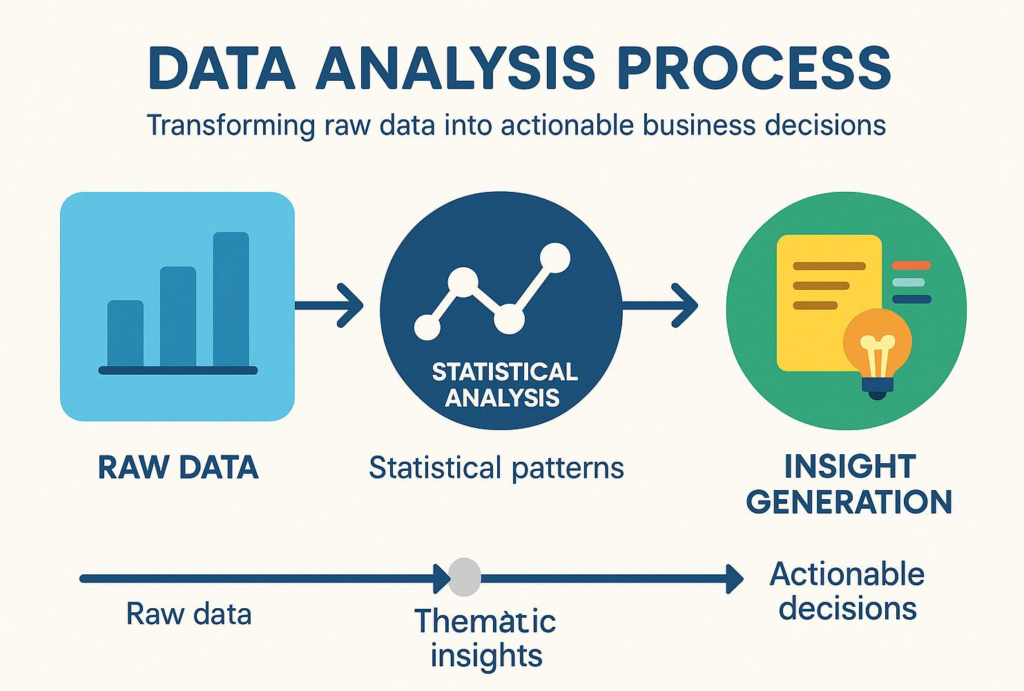
A useful conceptual diagram is:
                    DATA
                      │
          ┌───────────┼───────────┐
          ▼           ▼           ▼
     LINEAR ALGEBRA  PROBABILITY  STATISTICS
          │           │           │
          ▼           ▼           ▼
    Representation  Uncertainty   Evidence
          │           │           │
          └───────────┼───────────┘
                      ▼
               DATA SCIENCE
                      │
          ┌───────────┼───────────┐
          ▼           ▼           ▼
      Prediction   Decisions   Insights
Core Concepts at a Glance
| Concept | Intuitive Meaning | Practical Example |
|---|---|---|
| Vector | Collection of values | Customer features |
| Matrix | Organized collection of values | Training dataset |
| Mean | Typical central value | Average sales |
| Median | Middle observation | Typical income |
| Variance | Degree of spread | Sales variability |
| Probability | Degree of uncertainty | Fraud likelihood |
| Distribution | Pattern of possible values | Customer ages |
| Correlation | Relationship between variables | Advertising and sales |
| Sampling | Selecting part of a population | Survey participants |
Practical Examples 💡
Example 1: Customer Churn
Imagine a telecommunications company wants to predict which customers might leave.
Linear algebra allows the company to represent each customer using features such as:
- Contract duration
- Monthly spending
- Number of support calls
- Internet usage
- Payment history
Probability can then help describe the likelihood of churn.
Statistics can reveal which customer characteristics are associated with higher churn rates.
The three mathematical areas work together.
Example 2: Online Advertising
Suppose an advertising platform displays different advertisements to visitors.
Statistics can compare performance between advertising strategies.
Probability can help estimate the likelihood that a visitor clicks an advertisement.
Linear algebra can represent visitors, advertisements, and behavioral characteristics in a machine learning system.
Example 3: Predictive Maintenance
A manufacturing company collects sensor measurements from industrial machines.
Statistics can identify unusual measurements.
Probability can estimate the likelihood of equipment failure.
Machine learning models can use vectorized sensor information to identify potential failures before they happen.
Real-World Applications 🌍
Mathematical foundations appear throughout modern technology.
Healthcare
Data scientists can analyze patient information, identify risk factors, and develop predictive models.
Statistics helps determine whether observed medical patterns are meaningful.
Probability supports risk estimation.
Linear algebra supports many machine learning systems used for medical imaging and classification.
Finance 💰
Financial organizations use mathematical concepts for:
- Fraud detection
- Credit scoring
- Risk analysis
- Portfolio analysis
- Forecasting
Probability is particularly important because financial decisions involve uncertainty.
Engineering ⚙️
Engineers increasingly use data science to analyze sensors, production systems, structures, and equipment.
Linear algebra helps process multidimensional engineering data.
Statistics helps evaluate experimental results.
Probability supports reliability and risk analysis.
E-Commerce 🛒
Online retailers analyze customer behavior to recommend products.
A customer’s preferences can be represented using vectors, while statistical and probabilistic methods can help estimate what the customer might purchase next.
Artificial Intelligence 🤖
Modern AI systems rely heavily on mathematical structures.
Neural networks manipulate large collections of numerical values. Statistical learning methods identify patterns, while probability is frequently used to interpret uncertain predictions.
Common Mistakes 🚨
Trying to Learn Everything at Once
A common mistake is attempting to master advanced mathematics before understanding basic concepts.
Start with fundamentals and progressively increase difficulty.
Memorizing Without Understanding
Memorizing statistical definitions is less useful than understanding what they mean.
For example, knowing the definition of standard deviation is not enough. You should understand what a large or small amount of variation tells you about a dataset.
Ignoring Visualization
Mathematical concepts often become much easier when visualized.
Plot distributions.
Visualize vectors.
Inspect correlations.
Create scatter plots.
Use dimensionality reduction to explore complex datasets.
Treating Correlation as Causation
Two variables can move together without one causing the other.
This is one of the most important statistical lessons for data scientists.
Depending Completely on Libraries
Python libraries can calculate statistical quantities almost instantly.
However, using a function without understanding its meaning can lead to incorrect conclusions.
Challenges and Solutions 🛠️
| Challenge | Solution |
|---|---|
| Mathematics feels abstract | Connect every concept to a dataset |
| Probability seems confusing | Start with everyday uncertainty |
| Statistics has many terms | Learn concepts through visual examples |
| Linear algebra feels difficult | Practice vectors and matrices gradually |
| Too many formulas | Focus first on interpretation |
| Machine learning seems overwhelming | Build mathematical foundations first |
Build Conceptual Understanding First
Instead of asking:
“How do I memorize this formula?”
Ask:
“What problem does this concept solve?”
That question changes the way you learn mathematics.
Use Python as a Learning Laboratory
Python can make mathematics interactive.
Useful tools include:
- NumPy
- Pandas
- Matplotlib
- SciPy
- Scikit-learn
The objective is not to let software replace mathematical understanding. Instead, use software to experiment with concepts.
Case Study: Predicting Customer Churn 📈
Consider a subscription-based software company with thousands of customers.
The company wants to identify customers who are likely to cancel.
Data Collection
The company collects:
- Login frequency
- Subscription age
- Support requests
- Monthly usage
- Payment history
- Feature usage
Linear Algebra Perspective
Each customer can be represented as a vector containing these characteristics.
The complete customer dataset becomes a matrix.
This representation allows machine learning algorithms to process many customers simultaneously.
Statistical Perspective
The company examines historical customers.
It may discover that customers with very low product usage tend to cancel more frequently.
Statistical analysis helps determine whether this relationship is consistent rather than simply a coincidence in a small sample.
Probability Perspective
The prediction system can estimate the likelihood that an individual customer will churn.
The company can then prioritize customers for retention campaigns.
Business Result
Instead of contacting every customer, the company can focus resources on customers with stronger indications of potential churn.
This example demonstrates why mathematical concepts are not merely academic. They directly support business decisions.
Essential Tips for Learning Data Science Mathematics ⭐
Start With Intuition
Understand what a concept means before worrying about advanced notation.
Practice With Real Data
Use datasets involving:
- Housing
- Sales
- Weather
- Energy
- Transportation
- Customer behavior
Real data makes mathematical concepts much easier to remember.
Learn Linear Algebra Incrementally
A useful progression is:
Scalars → Vectors → Matrices → Matrix Operations → Transformations → Eigen Concepts
You do not need to master every advanced topic immediately.
Build Statistical Thinking
Learn to ask:
- What does the data actually show?
- How reliable is the conclusion?
- How much variation exists?
- Could the pattern be random?
- Is the sample representative?
Understand Probability Through Scenarios
Think about probability in terms of:
- Risk
- Prediction
- Uncertainty
- Events
- Conditional information
This makes abstract concepts more intuitive.
Connect Everything to Machine Learning
Whenever you learn a mathematical concept, ask:
“Where does this appear in a real machine learning workflow?”
That connection makes learning much more meaningful.
FAQs ❓
Is advanced mathematics required to become a data scientist?
No. You can begin data science with basic mathematics. However, stronger mathematical knowledge becomes increasingly valuable as you move toward advanced machine learning, research, optimization, and AI.
Should I learn statistics or linear algebra first?
For many beginners, basic statistics can provide an intuitive starting point. After that, learning vectors and matrices gives you a strong foundation for understanding machine learning algorithms.
Do I need to memorize mathematical formulas?
Not necessarily. You should understand the meaning and purpose of important formulas. Tools can calculate many quantities, but you need to interpret their results correctly.
How important is probability for machine learning?
Very important. Many machine learning problems involve uncertainty, classification, prediction, risk estimation, or probabilistic interpretation.
Why are matrices important in AI?
Matrices provide an efficient way to organize and manipulate large amounts of numerical information. Many machine learning and neural-network operations can be represented through matrix-based computation.
Can I learn data science mathematics without being good at math?
Yes. Begin with practical intuition and visualization rather than advanced theory. Mathematics becomes much easier when every concept is connected to a real data problem.
How long does it take to learn the essential mathematics?
The timeline depends on your background and study schedule. A learner who consistently practices the fundamentals can develop a useful working understanding within several weeks or months, while advanced mastery takes much longer.
What should I learn after these mathematical foundations?
Once you are comfortable with the fundamentals, consider learning calculus, optimization, machine learning algorithms, data visualization, and deeper statistical inference.
Conclusion 🚀
Mathematics is one of the hidden foundations of modern data science.
Linear algebra provides a language for representing complex datasets and performing large-scale numerical operations.
Probability gives data scientists a framework for uncertainty and prediction.
Statistics provides the tools needed to summarize information, evaluate evidence, identify relationships, and make reliable conclusions.
You do not need to become a theoretical mathematician to use these ideas effectively. The most valuable approach is to develop mathematical intuition alongside practical programming and data analysis skills.
When you understand what vectors, matrices, distributions, probability, variation, correlation, and statistical evidence actually mean, machine learning becomes less of a collection of mysterious algorithms and more of a logical system.
Ultimately, mathematics gives data scientists something extremely valuable: control over the reasoning behind their models. 🧠📊
Whether you are a student beginning your journey or a professional expanding into AI and machine learning, mastering these fundamentals can transform the way you understand data—and the way you build intelligent systems.