🌍 Introduction 🚀
Structural engineering is the backbone of modern civilization. Every bridge you cross, every building you enter, and every tower that shapes a skyline exists because structural engineers correctly applied engineering formulas to ensure safety, stability, and efficiency.
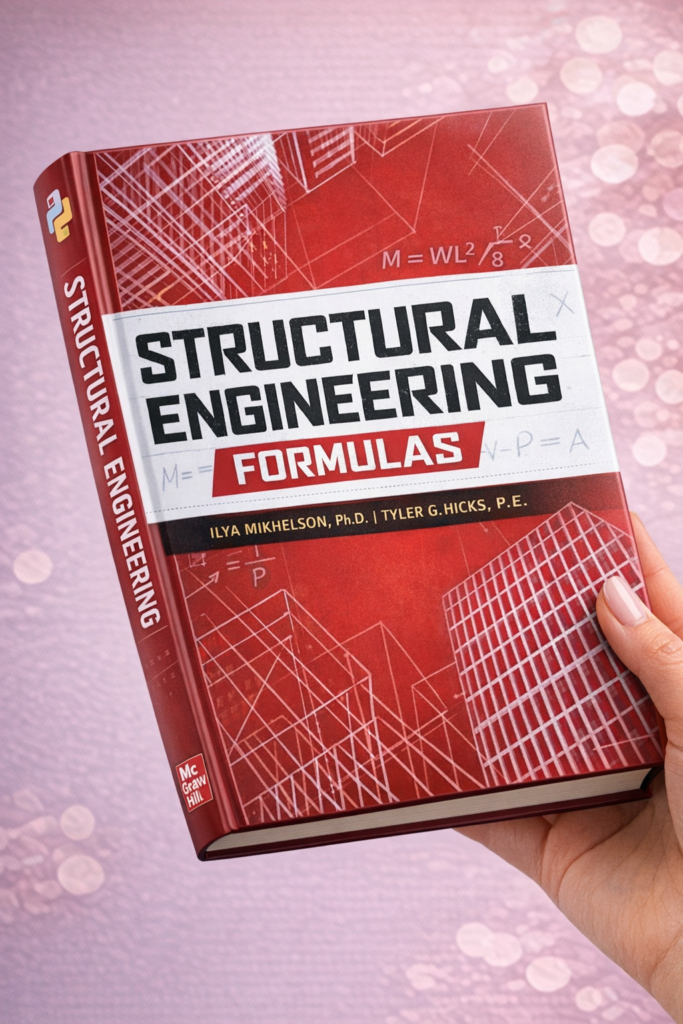
The Structural Engineering Formulas – 2nd Edition concept represents a modern, improved, and practical approach to understanding and applying the most essential formulas used in structural design today. This guide is written to serve both beginners and advanced professionals, bridging the gap between academic theory and real-world practice.
Whether you are:
🎓 A civil or structural engineering student
🧑💼 A practicing engineer
🏢 A consultant or site engineer
📐 A designer working with international codes
This article will give you clear explanations, practical steps, comparisons, examples, and case studies relevant to the USA, UK, Canada, Australia, and Europe.
🧠 Background Theory 📚
🔹 Why Structural Formulas Matter
Structural engineering formulas are mathematical expressions that describe how structures behave under loads such as:
Dead loads (self-weight)
Live loads (people, furniture)
Wind loads
Earthquake forces
Temperature effects
These formulas allow engineers to:
Predict stresses and deformations
Ensure safety and serviceability
Optimize material usage
Comply with building codes
🔹 Evolution from First to Second Edition Thinking
The 2nd Edition mindset emphasizes:
Limit State Design (LSD)
Load combinations based on probability
Computer-aided verification
Sustainable and optimized design
Older approaches relied heavily on allowable stress methods, while modern engineering uses factored loads and resistance factors.
📐 Technical Definition 🧩
🧮 What Are Structural Engineering Formulas?
Structural Engineering Formulas are mathematical relationships used to calculate:
Forces (axial, shear, bending)
Stresses and strains
Deflections
Stability and buckling
Load combinations and safety factors
They are derived from:
Mechanics of materials
Structural analysis
Elasticity theory
Empirical testing
🛠️ Step-by-Step Explanation 🔢
🧱 Step 1: Identify Structural System
Common systems include:
Beams
Columns
Trusses
Frames
Slabs
Shell structures
Each system has specific governing formulas.
📊 Step 2: Determine Applied Loads
Typical load categories:
Dead Load (DL) = self-weight of structure
Live Load (LL) = occupancy loads
Wind Load (WL)
Seismic Load (EQ)
📌 Example Load Combination (US Codes):
1.2 DL + 1.6 LL
🧮 Step 3: Apply Core Formulas
🔸 Stress Formula
σ=F/A
Where:
σ = stress
F = force
A = area
🔸 Bending Stress Formula
σ=M⋅y/I
🔸 Deflection Formula (Simply Supported Beam)
δ=5wL4/384EI
🧪 Step 4: Check Serviceability
Deflection limits
Crack width
Vibration control
🛡️ Step 5: Apply Safety Factors
Modern design uses:
Load factors
Resistance factors
Partial safety coefficients
⚖️ Comparison: Traditional vs Modern Approach 🔄
| Feature | Traditional Method | 2nd Edition Approach |
|---|---|---|
| Design Philosophy | Allowable Stress | Limit State Design |
| Load Handling | Single value | Load combinations |
| Safety | Global factor | Partial factors |
| Tools | Manual | Software + verification |
| Sustainability | Limited | Optimized design |
🧪 Detailed Examples 🧠
🧱 Example 1: Concrete Beam Design
Given:
Span = 6 m
Uniform Load = 15 kN/m
Bending Moment:
M=wL2/8=15×62/8=67.5 kNm
This value is then used for reinforcement design.
🏗️ Example 2: Steel Column Buckling
Euler Buckling Formula:
Pcr=π2EI/(KL)2
Used to determine critical load before buckling occurs.
🌉 Example 3: Bridge Girder Load Check
Dead Load: 40 kN/m
Live Load: 60 kN/m
Factored Load:
1.25DL+1.5LL
🌍 Real-World Applications in Modern Projects 🏙️
🏢 High-Rise Buildings
Structural formulas help:
Control lateral drift
Design shear walls
Optimize core systems
🌉 Bridges & Infrastructure
Used to:
Calculate bending moments
Design prestressed members
Check fatigue limits
🏭 Industrial Structures
Formulas ensure:
Equipment vibration control
Heavy load resistance
Thermal stress management
🌱 Sustainable Construction
Material optimization
Reduced carbon footprint
Efficient cross-sections
❌ Common Mistakes Engineers Make ⚠️
Ignoring load combinations
Using incorrect units
Neglecting serviceability checks
Over-reliance on software
Misinterpreting boundary conditions
🚧 Challenges & Solutions 🧠
🔹 Challenge: Complex Load Paths
✅ Solution:
Use simplified models and verify with finite element analysis.
🔹 Challenge: Code Differences
✅ Solution:
Understand the philosophy behind codes (ACI, Eurocode, BS, AS).
🔹 Challenge: Software Dependency
✅ Solution:
Always validate results using hand calculations.
📊 Case Study: Mid-Rise Office Building 🏢
📍 Project Overview
Location: Europe
Height: 10 floors
Structure: RC frame
🧮 Applied Formulas
Bending stress checks
Column axial load formula
Slab deflection control
📈 Results
12% material savings
Improved safety margins
Faster approval process
💡 Tips for Engineers 🧠
✔ Master fundamentals before software
✔ Always sketch free-body diagrams
🎯 Double-check units
✔ Learn code intent, not just equations
✔ Document assumptions
❓ FAQs – Structural Engineering Formulas 🤔
1️⃣ Are these formulas universal across countries?
Most are universal, but safety factors differ by code.
2️⃣ Do I need advanced math to use them?
Basic calculus and algebra are sufficient for most applications.
3️⃣ Can software replace manual calculations?
No. Software supports design but does not replace engineering judgment.
4️⃣ Are these formulas suitable for beginners?
Yes, when taught step-by-step with practical examples.
5️⃣ How often should formulas be updated?
Core formulas remain constant, but application methods evolve.
6️⃣ Which codes use similar principles?
ACI, Eurocode, BS, CSA, and AS share similar limit-state concepts.
7️⃣ Are these formulas used in seismic design?
Yes, combined with dynamic and response spectrum methods.
🏁 Conclusion 🎯
The Structural Engineering Formulas – 2nd Edition approach represents more than equations—it reflects modern engineering thinking. By understanding the theory, applying formulas step-by-step, learning from real-world examples, and avoiding common mistakes, engineers can design safer, smarter, and more efficient structures.
Whether you’re a student building your foundation or a professional refining your expertise, mastering these formulas is essential for success in today’s global engineering environment.
🏗️ Engineering is not about memorizing formulas—it’s about understanding how structures breathe, move, and survive.