Hands-On Machine Learning with Scikit-Learn and PyTorch: Concepts, Tools, and Techniques to Build Intelligent Systems
Introduction
Machine learning has evolved from a specialized research field into one of the most important engineering technologies of the modern digital economy. Today, engineers, developers, researchers, and students use machine learning to create systems that can recognize patterns, classify information, predict outcomes, understand language, analyze images, and automate complex decisions. 🤖⚙️
Two technologies are particularly valuable for learning and implementing machine learning: Scikit-Learn and PyTorch. Scikit-Learn provides a practical ecosystem for traditional machine learning, while PyTorch offers a flexible framework for developing neural networks and modern deep-learning systems.


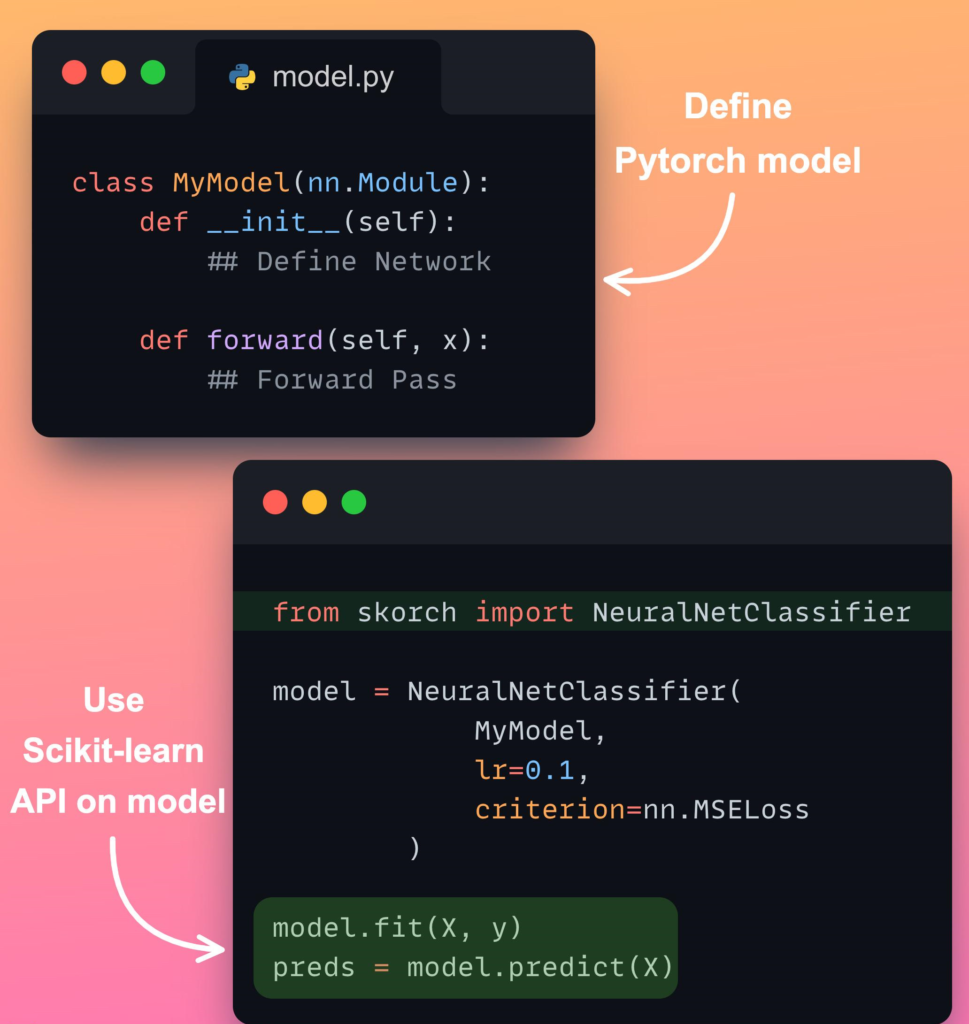
The real power comes from understanding when and how to use each tool rather than treating them as competing technologies. A well-designed engineering workflow may use Scikit-Learn for preprocessing and conventional models while relying on PyTorch for sophisticated neural-network architectures.
This article presents a practical journey through machine learning concepts, tools, techniques, examples, engineering challenges, and real-world applications. 🚀
Background Theory
What Is Machine Learning?
Machine learning is a branch of artificial intelligence in which computer systems learn useful patterns from data rather than relying entirely on manually programmed rules.
Traditional software generally follows:
Input → Rules → Output
A machine-learning system instead follows:
Data → Learning Algorithm → Trained Model → Prediction
The model discovers relationships within training data and uses those relationships to make predictions about new information.
The Three Major Learning Paradigms
Supervised Learning
Supervised learning uses labeled examples.
For example, an engineering organization might provide historical machine measurements labeled as:
- Normal operation
- Warning
- Failure
The algorithm learns the relationship between sensor information and these categories.
Common supervised tasks include:
- Classification
- Regression
- Prediction
Scikit-Learn is particularly strong for these conventional machine-learning problems.
Unsupervised Learning
Unsupervised learning works with data without predefined labels.
A system might analyze thousands of customer records and discover groups of customers with similar behavior.
Typical applications include:
- Clustering
- Dimensionality reduction
- Anomaly detection
- Pattern discovery
Deep Learning
Deep learning uses multi-layer neural networks to learn increasingly complex representations.
PyTorch is widely used for designing and training such systems.
Deep-learning applications include:
- Computer vision 👁️
- Natural language processing
- Speech recognition
- Recommendation systems
- Generative AI
- Robotics
Definition
Scikit-Learn
Scikit-Learn is a Python machine-learning library designed around practical algorithms and reusable workflows.
It provides tools for:
- Data preprocessing
- Classification
- Regression
- Clustering
- Model selection
- Feature engineering
- Evaluation
- Dimensionality reduction
Its consistent API makes it especially useful for students and engineers who want to quickly experiment with machine-learning algorithms.
PyTorch
PyTorch is a machine-learning and deep-learning framework centered around tensors, automatic differentiation, neural networks, and hardware acceleration.
It allows developers to construct customized neural architectures and training procedures.
The framework is useful when a problem requires:
- Deep neural networks
- Custom architectures
- GPU acceleration
- Computer vision
- Natural-language processing
- Advanced research experimentation
The Engineering Relationship
Scikit-Learn and PyTorch should not necessarily be viewed as alternatives.
Instead:
Scikit-Learn → Classical Machine Learning
PyTorch → Deep Learning and Neural Networks
A professional workflow may use both.
Step-by-Step Machine Learning Workflow
Step 1: Define the Engineering Problem
Before selecting an algorithm, define the actual problem.
Ask:
- What needs to be predicted?
- What data is available?
- What constitutes success?
- How quickly must predictions be generated?
- What are the consequences of incorrect predictions?
For example, “use AI to improve manufacturing” is too broad.
A better definition is:
Detect abnormal machine behavior from vibration and temperature measurements before equipment failure occurs.
That definition provides a measurable engineering objective.
Step 2: Collect Data
Machine-learning systems depend heavily on data quality.
Possible sources include:
- Sensors
- Databases
- Images
- Text documents
- Customer interactions
- Transaction records
- Scientific experiments
- Industrial monitoring systems
Poor data can produce poor models even when sophisticated algorithms are used.
Step 3: Clean the Data
Raw data frequently contains:
- Missing values
- Duplicate records
- Incorrect measurements
- Outliers
- Inconsistent units
- Incorrect labels
Data preparation can therefore consume a significant portion of a machine-learning project.
Step 4: Explore the Dataset
Exploratory data analysis helps engineers understand what they actually have.
Useful questions include:
- Which variables are important?
- Are some features strongly correlated?
- Are classes balanced?
- Are there unusual observations?
- Are measurements distributed consistently?


Step 5: Prepare Features
Features are the information supplied to the machine-learning model.
For a predictive-maintenance application, features might include:
- Temperature
- Vibration
- Pressure
- Rotational speed
- Operating duration
- Load conditions
Feature engineering transforms raw measurements into information that models can use effectively.
Step 6: Select a Baseline Model
A common engineering mistake is starting with the most complicated model available.
Instead, begin with a simple baseline.
Scikit-Learn provides many excellent options for this stage.
Possible models include:
- Linear models
- Decision trees
- Random forests
- Gradient boosting
- Support vector machines
- Nearest-neighbor algorithms
A baseline provides a reference point for later improvements.
Step 7: Evaluate the Model
Evaluation should reflect the actual engineering objective.
Common classification metrics include:
- Accuracy
- Precision
- Recall
- F1 score
- ROC-AUC
For regression tasks, engineers may consider:
- Mean absolute error
- Mean squared error
- Root mean squared error
- Coefficient of determination
A model should not be judged by one metric automatically.
Step 8: Move to PyTorch When Necessary
If the problem involves complex unstructured data, a neural network may be more appropriate.
For example:
Images → Convolutional Neural Network
Text → Transformer or other neural architecture
Sequential sensor data → Recurrent or transformer-based architecture
PyTorch provides the flexibility required to construct and train such models.
Step 9: Deploy the System
A trained model has limited value if nobody can use it.
Deployment may involve:
- Web APIs
- Cloud services
- Edge devices
- Industrial computers
- Mobile applications
- Embedded systems
The final system should also include monitoring so engineers can detect performance degradation.
Comparison
Scikit-Learn vs PyTorch
| Feature | Scikit-Learn | PyTorch |
|---|---|---|
| Main focus | Traditional machine learning | Deep learning |
| Learning curve | Generally easier | Moderate to advanced |
| Neural networks | Limited | Excellent |
| Classical algorithms | Excellent | Not its primary purpose |
| GPU training | Limited compared with PyTorch | Strong |
| Custom architectures | Limited | Excellent |
| Data preprocessing | Strong | Often combined with other tools |
| Model experimentation | Fast | Highly flexible |
| Computer vision | Basic ecosystem support | Excellent |
| NLP | Limited compared with deep-learning ecosystems | Excellent |
| Production flexibility | High | High |
Which Should Beginners Learn First?
For many beginners, Scikit-Learn provides a smoother introduction because it allows them to focus on fundamental concepts without immediately dealing with neural-network architecture and training mechanics.
After learning:
Data → Features → Model → Evaluation
students can move toward PyTorch and understand why neural networks are useful.
Diagrams and Technical Architecture
Classical Machine-Learning Pipeline
Raw Data
   │
   ▼
Data Cleaning
   │
   ▼
Feature Engineering
   │
   ▼
Train/Test Split
   │
   ▼
Scikit-Learn Model
   │
   ▼
Evaluation
   │
   ▼
Deployment
Deep-Learning Pipeline
Raw Data
   │
   ▼
Preprocessing
   │
   ▼
Tensor Representation
   │
   ▼
PyTorch Neural Network
   │
   ▼
Training
   │
   ▼
Validation
   │
   ▼
Inference


A Practical Technology Stack
| Layer | Example Technology |
|---|---|
| Programming | Python |
| Data manipulation | NumPy / pandas |
| Classical ML | Scikit-Learn |
| Deep learning | PyTorch |
| Visualization | Matplotlib |
| Experiment tracking | ML experiment platforms |
| Deployment | APIs / Cloud / Edge |
| Monitoring | Logs and model metrics |
Practical Examples
Example 1: Predicting House Prices
Imagine a dataset containing:
- Property size
- Number of bedrooms
- Location
- Building age
- Property condition
A regression model can learn relationships between these features and historical selling prices.
The engineer can begin with a Scikit-Learn regression model and evaluate its predictions.
The important lesson is not the algorithm itself. It is the complete workflow from reliable data to meaningful evaluation.
Example 2: Email Classification
An organization may want to classify incoming messages as:
- Important
- General
- Promotional
- Suspicious
Traditional machine-learning techniques can provide a useful starting point.
For more complex language understanding, neural networks implemented with PyTorch can become more attractive.
Example 3: Industrial Image Inspection
A factory may photograph manufactured components and ask an AI system to identify visible defects.
Traditional image-processing approaches may work for simple defects.
However, if the defects vary significantly in shape, position, texture, and lighting, a deep-learning computer-vision model may provide greater flexibility.
Real-World Applications
Predictive Maintenance
Factories use machine-learning systems to analyze sensor data and identify early indicators of equipment problems.
Instead of waiting for failure, engineers can schedule maintenance based on predicted risk.
⚙️ Result: potentially lower downtime and better maintenance planning.
Autonomous Systems
Robotics systems can combine traditional machine learning with deep neural networks.
PyTorch can support perception systems that process:
- Camera images
- Depth information
- Sensor measurements
- Audio
Financial Technology
Machine learning can support:
- Fraud detection
- Risk analysis
- Customer segmentation
- Transaction classification
However, financial systems require strong validation, security, explainability, and monitoring.
Healthcare Engineering
AI can assist with medical image analysis, signal processing, and research workflows.
Such systems require particularly careful validation because incorrect predictions can have serious consequences.
Energy Systems
Machine learning can analyze:
- Electricity demand
- Renewable-energy generation
- Equipment conditions
- Consumption patterns
This can support better resource planning and operational efficiency.
Common Mistakes
Choosing a Complex Model Too Early
A sophisticated neural network does not automatically produce better results.
Better approach: establish a simple baseline first.
Ignoring Data Leakage
Data leakage occurs when information unavailable at prediction time accidentally enters the training process.
This can produce impressive test results that fail in production.
Training and Testing on Similar Records
If highly related records appear in both training and testing datasets, evaluation may become misleading.
Optimizing Only for Accuracy
Accuracy can be misleading when classes are highly imbalanced.
For example, a system detecting rare equipment failures may achieve high accuracy by almost always predicting “normal.”
Forgetting Deployment Constraints
A model may be accurate but too slow or expensive for the intended hardware.
Treating Data Preparation as an Afterthought
Machine learning is not simply:
Import Library → Train Model → Done
The quality of preprocessing, labels, features, and evaluation often determines the outcome.
Challenges & Solutions
Challenge: Limited Training Data
Solution: improve data collection, use augmentation where appropriate, apply transfer learning when suitable, or choose a model appropriate for the available dataset.
Challenge: Overfitting
Overfitting occurs when a model performs well on training data but poorly on unseen examples.
Solutions include:
- Better validation
- Regularization
- Simpler models
- Data augmentation
- More representative data
Challenge: Computational Requirements
Large neural networks can require substantial computational resources.
Solution: optimize model architecture, use suitable accelerators, reduce unnecessary complexity, and consider efficient inference techniques.
Challenge: Model Drift
Real-world data can change.
A model trained on historical customer behavior may become less accurate as customer behavior evolves.
Solution: continuously monitor performance and establish retraining procedures.
Case Study: Intelligent Factory Monitoring
The Problem
Consider a manufacturing plant operating several rotating machines.
Unexpected equipment failures interrupt production and create expensive downtime.
The engineering team decides to develop an intelligent monitoring system.
Stage One: Data Collection
Sensors collect:
- Temperature
- Vibration
- Rotation information
- Load conditions
- Operating status
Historical maintenance records provide information about previous failures.
Stage Two: Initial Model
The team prepares the dataset and creates a baseline model using Scikit-Learn.
The goal is to determine whether sensor patterns can distinguish between normal and abnormal operation.
Stage Three: Improved Modeling
After establishing a baseline, the engineering team notices that vibration patterns contain complex temporal structures.
They experiment with a PyTorch neural network capable of learning more sophisticated representations.
Stage Four: Deployment
The model is integrated into the monitoring system.
New sensor data is analyzed continuously.
When the system detects an unusual pattern, engineers receive an alert.
Stage Five: Human Validation
The AI does not automatically shut down equipment.
Instead, engineers investigate high-risk alerts.
This human-in-the-loop design reduces the risk of blindly trusting predictions.
Engineering Lesson
The most valuable part of the project is not simply selecting PyTorch or Scikit-Learn.
The real success comes from combining:
Reliable Data + Appropriate Models + Evaluation + Engineering Judgment + Monitoring
Essential Tips
Start With Fundamentals 🧠
Understand:
- Features
- Labels
- Training
- Validation
- Testing
- Overfitting
- Generalization
- Model evaluation
These concepts remain important regardless of the framework.
Build Small Projects
Start with manageable datasets.
Examples include:
- Customer classification
- House-price prediction
- Image classification
- Sensor anomaly detection
Compare Multiple Models
Do not assume one algorithm is always superior.
Build a baseline and compare alternatives under the same evaluation methodology.
Learn Python Properly
A strong Python foundation makes machine-learning development considerably easier.
Pay attention to:
- Functions
- Classes
- Lists and dictionaries
- NumPy arrays
- pandas DataFrames
- File handling
- Virtual environments
Understand Your Data
A machine-learning engineer should not treat datasets as mysterious collections of numbers.
Domain knowledge can reveal why a model behaves unexpectedly.
Monitor Production Models
Deployment is not the end.
Monitor:
- Prediction quality
- Data distribution
- Latency
- Resource consumption
- Failure rates
Combine Tools Strategically 🚀
A modern machine-learning workflow can combine multiple technologies.
For example:
Python → pandas → Scikit-Learn → PyTorch → API → Cloud/Edge
Each component solves a different engineering problem.
FAQs
Is Scikit-Learn easier than PyTorch?
Generally, yes. Scikit-Learn offers a relatively simple interface for many classical machine-learning algorithms. PyTorch introduces additional concepts related to tensors, neural networks, automatic differentiation, and training loops.
Should I learn Scikit-Learn before PyTorch?
For beginners, this is often a sensible path. Scikit-Learn can help establish fundamental machine-learning concepts before moving into deep learning.
Can Scikit-Learn be used for deep learning?
Scikit-Learn is not primarily designed for modern deep-learning architectures. PyTorch is generally more appropriate when developing sophisticated neural networks.
Is PyTorch only for researchers?
No. PyTorch is used for research as well as practical AI development, including computer vision, language processing, recommendation systems, and other applications.
Do I need a powerful GPU to learn machine learning?
No. Many Scikit-Learn projects can run comfortably on ordinary computers. Small PyTorch neural networks can also be developed without specialized hardware.
Which framework is better for computer vision?
For modern deep-learning computer vision, PyTorch is generally the more suitable choice because it provides flexible neural-network development and hardware acceleration.
Can both frameworks be used in the same project?
Absolutely. A project may use Scikit-Learn for preprocessing, feature engineering, classical modeling, or evaluation while using PyTorch for deep-learning components.
What is the most important machine-learning skill?
Understanding the entire problem-solving process is more important than memorizing algorithms.
A strong engineer can identify the problem, understand the data, select an appropriate model, evaluate it correctly, deploy it responsibly, and monitor its behavior.
Conclusion
Hands-on machine learning is fundamentally an engineering discipline built around data, experimentation, algorithms, evaluation, and deployment. Scikit-Learn and PyTorch provide complementary capabilities that allow developers to progress from straightforward predictive models to sophisticated intelligent systems.
Scikit-Learn is an excellent environment for learning classical machine learning and developing practical models quickly. PyTorch provides the flexibility needed for modern deep-learning applications, particularly when neural networks must process complex images, text, audio, or sequential data.
The most effective learning strategy is therefore not to ask, “Which framework is better?” Instead, ask:
“What engineering problem am I solving, what data do I have, and which technology provides the right capabilities?”
That mindset leads to better models, cleaner systems, and more reliable AI applications. ⚙️🤖🚀
Whether you are a student building your first classifier or a professional designing an intelligent industrial system, mastering the progression from data → model → evaluation → deployment → monitoring provides a foundation that remains valuable across the rapidly changing machine-learning landscape.