Learn AI with Python: Machine Learning & Deep Learning Techniques for Building Smart AI Systems
Introduction
Artificial intelligence (AI) has moved from research laboratories into everyday engineering, business, healthcare, finance, transportation, cybersecurity, and software development. Today, engineers and students can build intelligent applications without designing every algorithm from scratch. Python provides an accessible ecosystem for experimenting with machine learning, deep learning, natural language processing, and neural networks. 🐍🤖
One of Python’s greatest advantages for AI development is its extensive collection of specialized libraries. Scikit-Learn provides practical machine-learning algorithms, NLTK supports natural-language processing, Keras simplifies deep-learning development, and NeuroLab can be used for experimenting with neural-network architectures.
Learning these technologies together creates a useful progression:
Python → Data → Machine Learning → Neural Networks → Deep Learning → Intelligent Applications
The important idea is that AI is not a single technology. It is an engineering discipline involving data, algorithms, software, computing resources, evaluation, and continuous improvement. ⚙️


This article explains how beginners can enter AI development while also giving professionals a structured overview of the engineering concepts behind modern intelligent systems.
Background Theory
From Traditional Programming to Artificial Intelligence
Traditional software generally follows an explicit logic:
Input + Rules → Output
For example, a conventional program might receive a temperature measurement and follow predefined rules to determine whether a machine should trigger an alarm.
Machine learning changes this approach:
Data + Learning Algorithm → Model
Instead of manually writing every rule, an algorithm discovers useful patterns from examples.
Deep learning extends this concept by using neural networks containing multiple processing layers. These networks can automatically learn increasingly sophisticated representations from large datasets.
The AI Technology Stack
A practical Python AI workflow may contain several layers:
| Layer | Purpose | Typical Python Technology |
|---|---|---|
| Programming | Application logic | Python |
| Data preparation | Cleaning and transformation | NumPy, pandas |
| Machine learning | Prediction and classification | Scikit-Learn |
| NLP | Text processing | NLTK |
| Neural networks | Experimental modeling | NeuroLab |
| Deep learning | Advanced neural models | Keras |
| Visualization | Understanding data/results | Matplotlib |
| Deployment | Delivering applications | APIs, web applications, cloud platforms |
The exact combination depends on the project.
Why Python Is Important for AI
Python has become particularly attractive for AI engineering because its syntax is relatively easy to understand while its ecosystem supports sophisticated computational workflows.
Students can start with a small classification project and gradually move toward neural networks, computer vision, language processing, recommendation systems, and other advanced applications.
Professionals benefit from the same ecosystem because Python can connect data pipelines, machine-learning models, APIs, databases, cloud services, and production applications.
Definition
What Is Artificial Intelligence?
Artificial intelligence is the field of computing concerned with creating systems capable of performing tasks that normally require aspects of human intelligence, such as recognizing patterns, understanding language, making predictions, reasoning from information, or supporting decisions.
What Is Machine Learning?
Machine learning (ML) is an approach in which computational models learn useful patterns from data rather than relying exclusively on manually programmed rules.
Common machine-learning categories include:
- Supervised learning 🎯
- Unsupervised learning 🔍
- Semi-supervised learning
- Reinforcement learning
- Ensemble learning
What Is Deep Learning?
Deep learning uses neural networks with multiple computational layers to learn complex representations from data.
Deep-learning systems are especially useful for problems involving:
- Images
- Speech
- Text
- Video
- Time-series information
- High-dimensional datasets
What Is Scikit-Learn?
Scikit-Learn is a Python machine-learning library designed around practical algorithms and workflows. It is commonly used for classification, regression, clustering, preprocessing, model evaluation, dimensionality reduction, and related tasks.
What Is NLTK?
NLTK, or Natural Language Toolkit, is a Python framework for working with human language data. It provides tools for activities such as tokenization, text processing, linguistic analysis, and educational NLP experimentation.
What Is NeuroLab?
NeuroLab is a Python-oriented environment for experimenting with neural-network models. It can help learners understand neural-network concepts and experiment with architectures.
What Is Keras?
Keras is a high-level deep-learning API that makes it easier to construct, train, evaluate, and experiment with neural networks. Modern Keras workflows can work with established machine-learning backends and are widely used for deep-learning development.
Step-by-Step AI Development Process
Step 1: Define the Engineering Problem
Before writing Python code, identify what the AI system should accomplish.
Examples include:
- Predict equipment failure
- Classify customer messages
- Detect unusual transactions
- Categorize documents
- Recognize objects
- Predict customer behavior
- Analyze technical text
A vague problem usually produces a vague model.
Step 2: Collect Relevant Data
AI models depend heavily on data quality.
Potential sources include:
- Databases
- Sensors
- Application logs
- Surveys
- Public datasets
- Documents
- Images
- Audio recordings
- Business transactions
The objective is not simply to collect as much data as possible. The dataset should represent the real environment in which the model will operate.
Step 3: Clean and Prepare the Dataset
Raw data commonly contains:
- Missing values
- Duplicate records
- Incorrect labels
- Outliers
- Inconsistent formats
- Irrelevant features
For text applications, additional preparation may involve tokenization, normalization, stop-word processing, and other linguistic transformations.
Step 4: Explore the Data
Data exploration helps engineers understand what they are working with.
Useful questions include:
- Which features appear important?
- Are some categories extremely rare?
- Are there missing observations?
- Are there unusual patterns?
- Is the dataset balanced?
- Does the data contain potential leakage?
Visualization can reveal problems that are difficult to detect from raw tables.
Step 5: Establish a Machine-Learning Baseline
A good engineering strategy is to begin with a relatively simple model.
Scikit-Learn provides many useful algorithms for this stage.
For example, an engineer might compare:
Logistic Regression → Decision Tree → Random Forest → Gradient-Based Models
The goal is not necessarily to select the most complicated algorithm. The goal is to establish a reliable baseline.
Step 6: Evaluate the Model
A model should be evaluated using data that was not used to train it.
Depending on the application, useful metrics may include:
- Accuracy
- Precision
- Recall
- F1 score
- ROC-AUC
- Mean absolute error
- Mean squared error
The appropriate metric depends on the engineering problem.
Step 7: Move Toward Neural Networks
If traditional machine-learning approaches are insufficient, neural networks may provide another direction.
Neural networks contain interconnected computational units that transform information through multiple processing stages.
A conceptual architecture may look like:
Input Data → Input Layer → Hidden Layer → Hidden Layer → Output Layer
Step 8: Build a Deep-Learning Model
Keras can simplify the process of creating neural-network architectures.
A typical workflow involves:
Dataset → Preprocessing → Neural Network → Training → Validation → Testing → Deployment
The architecture should match the problem rather than being selected simply because it is sophisticated.
Step 9: Test Under Realistic Conditions
A model that performs well in a controlled experiment may behave differently in production.
Test for:
- New data distributions
- Unexpected inputs
- Missing information
- Performance degradation
- Latency
- Resource consumption
- Security issues
Step 10: Deploy and Monitor
AI development does not end when training finishes.
A production system should be monitored for:
- Prediction quality
- Data drift
- Model drift
- Response time
- Infrastructure failures
- Unexpected user behavior

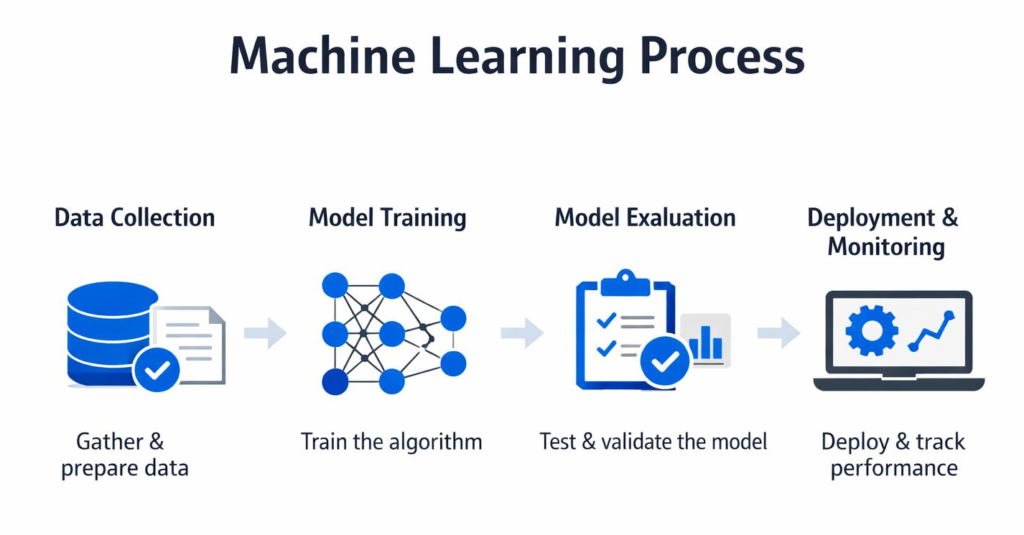


Comparison of Python AI Technologies
Scikit-Learn vs NLTK vs NeuroLab vs Keras
| Technology | Primary Purpose | Best For | Difficulty |
|---|---|---|---|
| Scikit-Learn | Machine learning | Classification, regression, clustering | Beginner–Intermediate |
| NLTK | Natural-language processing | Text analysis and linguistic processing | Beginner–Intermediate |
| NeuroLab | Neural networks | Neural-network experimentation | Intermediate |
| Keras | Deep learning | Neural networks and deep-learning applications | Intermediate–Advanced |
Traditional Machine Learning vs Deep Learning
| Characteristic | Machine Learning | Deep Learning |
|---|---|---|
| Data requirement | Often moderate | Often larger |
| Feature engineering | Frequently important | Can be reduced through representation learning |
| Hardware | CPU often sufficient | GPU/accelerator frequently useful |
| Training complexity | Usually lower | Often higher |
| Interpretability | Can be relatively accessible | May be more difficult |
| Typical applications | Business prediction, classification | Vision, speech, advanced language tasks |
The best technology is determined by the problem, data, resources, and operational requirements.
Diagrams and AI Architecture
Basic Machine-Learning Architecture
        ┌──────────────────┐
        │     Raw Data     │
        └────────┬─────────┘
                 ↓
        ┌──────────────────┐
        │ Data Preparation │
        └────────┬─────────┘
                 ↓
        ┌──────────────────┐
        │ Feature Creation │
        └────────┬─────────┘
                 ↓
        ┌──────────────────┐
        │ ML Model Training│
        └────────┬─────────┘
                 ↓
        ┌──────────────────┐
        │ Model Evaluation │
        └────────┬─────────┘
                 ↓
        ┌──────────────────┐
        │    Prediction    │
        └──────────────────┘
NLP Pipeline
Text
  ↓
Cleaning
  ↓
Tokenization
  ↓
Text Representation
  ↓
Machine Learning / Neural Network
  ↓
Classification or Prediction
Deep-Learning Pipeline
Data
  ↓
Preprocessing
  ↓
Neural Network
  ↓
Training
  ↓
Validation
  ↓
Testing
  ↓
Production
  ↓
Continuous Monitoring


Practical Examples
Example 1: Email Classification
Imagine an organization receiving thousands of incoming emails.
An AI system could classify messages into categories such as:
- Technical support
- Sales
- Billing
- General questions
- Urgent requests
NLTK can assist with text preprocessing, while machine-learning techniques can be used to build the classification system.
Example 2: Equipment Failure Prediction
An industrial facility may collect information from machines.
The AI system could learn patterns associated with:
Normal Operation → Warning Pattern → Potential Failure
Engineers could then investigate suspicious equipment before a major interruption occurs.
Example 3: Customer Sentiment Analysis
A company can analyze written feedback and categorize comments as:
😊 Positive
😐 Neutral
😞 Negative
NLP techniques can prepare the text, while a trained model can perform classification.
Example 4: Image Recognition
A deep-learning system can process images and identify objects or categories.
This technology can support:
- Manufacturing inspection
- Medical research
- Agriculture
- Autonomous systems
- Security analysis
Real-World Applications
Engineering and Manufacturing
AI can support predictive maintenance, quality inspection, process optimization, and anomaly detection.
Instead of waiting for equipment to fail, organizations can analyze sensor information and identify patterns associated with potential problems.
Finance
Machine learning can support:
- Fraud detection
- Risk analysis
- Customer segmentation
- Transaction monitoring
- Forecasting
However, financial AI systems require strong validation and appropriate governance.
Healthcare
AI can assist with medical-image analysis, administrative automation, research, and clinical decision-support workflows.
Human expertise remains essential, particularly for high-impact decisions.
Cybersecurity
Machine-learning models can analyze network behavior and identify unusual patterns.
Potential applications include:
🔐 Threat detection
🛡️ Anomaly detection
📊 User behavior analysis
🚨 Security-event classification
Education
AI systems can support personalized learning, automated content classification, student-support tools, and educational analytics.
Common Mistakes
Starting With Deep Learning Too Early
A neural network is not automatically better than a traditional machine-learning model.
Start with a baseline and demonstrate that a more complex architecture provides meaningful improvement.
Ignoring Data Quality
A sophisticated algorithm cannot reliably compensate for fundamentally poor data.
Better data → Better learning opportunities
Using the Wrong Evaluation Metric
Accuracy may appear impressive when one class dominates the dataset.
For many applications, precision, recall, F1 score, or other metrics may provide a more informative evaluation.
Training and Testing on the Same Data
This can produce misleadingly strong results.
Always maintain a proper evaluation strategy.
Overfitting
Overfitting occurs when a model learns training-specific patterns that do not generalize well to new data.
Warning signs include excellent training performance combined with substantially weaker validation or test performance.
Ignoring Deployment
A model that works in a notebook is not necessarily ready for production.
Production engineering requires attention to:
- APIs
- Security
- Monitoring
- Versioning
- Infrastructure
- Reliability
Challenges and Solutions
| Challenge | Possible Solution |
|---|---|
| Insufficient data | Collect more representative data |
| Poor-quality labels | Improve labeling procedures |
| Overfitting | Use validation, regularization, and suitable model complexity |
| Slow training | Optimize preprocessing and consider accelerators |
| Poor generalization | Improve dataset diversity |
| Difficult debugging | Track experiments systematically |
| Model drift | Continuously monitor production data |
| Unclear requirements | Define measurable business/engineering objectives |
The Data Challenge
One of the most important AI engineering lessons is that model performance depends on the relationship between data and the real-world problem.
A model trained using data that does not represent production conditions may perform poorly even when the training process appears successful.
Case Study: Intelligent Equipment Monitoring
The Problem
Consider a manufacturing facility containing industrial pumps.
Unexpected pump failures interrupt production and increase maintenance costs.
The engineering team wants to identify early warning patterns.
Data Collection
The system gathers information such as:
- Temperature
- Vibration
- Operating state
- Pressure
- Maintenance history
- Operating duration
Machine-Learning Stage
The team begins with Scikit-Learn and evaluates several classification approaches.
The objective is to distinguish normal operating behavior from situations requiring investigation.
Neural-Network Stage
If the available information is sufficiently complex, the team can experiment with neural-network approaches using Keras.
The neural network may discover nonlinear relationships that are difficult to represent through manually designed rules.
Deployment
The trained system is integrated into a monitoring application.
When the model identifies an unusual pattern, the application can generate an alert for maintenance personnel.
Engineering Outcome
The greatest value does not come from the AI model alone.
The complete solution consists of:
Sensors + Data Pipeline + AI Model + Monitoring + Human Expertise
This illustrates an important principle: successful AI is usually a system-engineering problem, not simply a machine-learning problem.
Essential Tips for Learning AI With Python
Build Projects Instead of Only Reading Theory
Start with small projects:
- Dataset classification
- Customer-text classification
- Sentiment analysis
- Predictive maintenance
- Neural-network classification
- Deep-learning image project
Each project should introduce one new concept.
Learn Python Fundamentals First
You should be comfortable with:
- Variables
- Functions
- Lists and dictionaries
- Classes
- Modules
- File handling
- Exceptions
- Virtual environments
Understand Data Before Algorithms
Learn how to inspect, clean, transform, and visualize datasets.
AI engineers spend significant time working with data rather than simply selecting algorithms.
Learn Model Evaluation
Understanding why a model succeeds or fails is more valuable than simply knowing how to train it.
Keep Experiments Reproducible
Record:
- Dataset version
- Features
- Model architecture
- Training configuration
- Evaluation metrics
- Software environment
Reproducibility becomes increasingly important as projects grow.
Combine Theory With Implementation
A strong AI developer understands both what an algorithm does and when it should be used.
📚 Theory provides understanding.
💻 Programming provides implementation.
🧪 Experiments provide evidence.
⚙️ Engineering turns the model into a useful system.
Frequently Asked Questions
Is Python good for learning artificial intelligence?
Yes. Python provides a broad ecosystem for data processing, machine learning, NLP, neural networks, visualization, experimentation, and deployment.
Should beginners start with Scikit-Learn or Keras?
For most beginners, Scikit-Learn is a useful starting point because it introduces core machine-learning concepts without immediately requiring complex neural-network architectures.
What is the role of NLTK in AI?
NLTK provides tools for processing and analyzing human language. It is particularly useful for learning fundamental NLP concepts and developing text-processing workflows.
Is deep learning the same as machine learning?
No. Deep learning is a specialized area within machine learning that uses multilayer neural networks to learn complex representations.
Do I need a powerful GPU to learn AI?
Not necessarily. Many introductory machine-learning projects can run comfortably on a CPU. Larger deep-learning experiments may benefit substantially from GPUs or other accelerators.
How long does it take to learn AI with Python?
The timeframe depends on previous programming and mathematics experience. A beginner can learn basic concepts relatively quickly, while professional-level AI engineering requires continuous study and practical experience.
Is mathematics necessary for AI?
Mathematics is valuable for understanding AI deeply, particularly linear algebra, probability, statistics, optimization, and calculus. However, beginners can initially build useful projects while gradually strengthening their mathematical foundation.
Which should I learn first: machine learning or deep learning?
Generally, learn the fundamentals of machine learning first. Understanding data preparation, training, validation, evaluation, and generalization makes deep learning considerably easier to understand.
Conclusion
Learning AI with Python is best approached as a progressive engineering journey rather than a race toward the most complicated neural network. 🐍🤖
Start with Python fundamentals, learn how data is represented and prepared, and then use tools such as Scikit-Learn to understand practical machine learning. NLTK provides a useful entry point into natural-language processing, while neural-network frameworks such as NeuroLab can help learners explore neural architectures. Keras provides a more powerful pathway into modern deep-learning development.
The most important progression is:
Python → Data → Machine Learning → NLP → Neural Networks → Deep Learning → Deployment
For students, this pathway creates a foundation for academic projects and future AI careers. For professionals, it provides a framework for developing intelligent systems that can solve practical engineering and business problems.
Ultimately, successful AI is not simply about writing Python code or choosing a sophisticated algorithm. It is about understanding the problem, obtaining representative data, selecting an appropriate approach, evaluating results honestly, deploying responsibly, and continuously improving the system.
🚀 Learn the fundamentals. Build projects. Test your assumptions. Study the results. Then turn your models into reliable intelligent systems.