The Algorithm Design Manual 3rd Edition: The Complete Engineering Guide to Algorithm Design, Analysis, and Real-World Problem Solving 📘⚡
Introduction 🚀
Algorithms are the invisible engines behind every modern technology. Whether you search Google, stream Netflix, navigate with GPS, train an artificial intelligence model, or secure online banking, algorithms make these systems efficient, reliable, and scalable.
Among the countless books available on algorithms, The Algorithm Design Manual 3rd Edition by Steven S. Skiena has earned a reputation as one of the most practical and engaging resources for both students and professional engineers.
Unlike many traditional textbooks that focus heavily on mathematical proofs, this book emphasizes practical problem-solving, engineering intuition, algorithm selection, and real-world applications.
Whether you’re:
- 🎓 Computer Science student
- 👨💻 Software Engineer
- 🤖 AI Engineer
- 📊 Data Scientist
- 🔬 Researcher
- ⚙️ Robotics Engineer
- ☁️ Cloud Developer
this guide explains why this book has become a favorite across universities and technology companies in the USA, UK, Canada, Australia, and Europe.


Background Theory 📚
Algorithms have existed for thousands of years.
The word algorithm originates from Persian mathematician Muhammad ibn Musa al-Khwarizmi, whose work introduced systematic procedures for solving mathematical problems.
Modern computer algorithms evolved alongside computer science during the twentieth century.
Major milestones include:
| Year | Development | Impact |
|---|---|---|
| 1940s | Early computing algorithms | Machine calculations |
| 1950s | Sorting algorithms | Efficient data organization |
| 1960s | Graph algorithms | Network optimization |
| 1970s | Dynamic Programming | Complex optimization |
| 1980s | Computational Geometry | Graphics and CAD |
| 1990s | Internet Algorithms | Search engines |
| 2000s | Big Data Algorithms | Massive datasets |
| Today | AI Algorithms | Machine learning and automation |
The third edition integrates decades of practical algorithm engineering into one comprehensive reference.
What Is The Algorithm Design Manual? 📖
The Algorithm Design Manual (3rd Edition) is a practical engineering textbook that teaches:
- ✅ How algorithms work
- ✅ When to use each algorithm
- ⚡ How to compare algorithms
- ✅ Computational complexity
- ✅ Problem-solving strategies
- ⚡ Data structures
- ✅ Real engineering applications
Unlike theory-heavy textbooks, it answers the engineer’s most common question:
“Which algorithm should I use for this problem?”
Key Topics Covered 🧠
The book explores nearly every essential algorithmic concept, including:
Algorithm Analysis
- Time Complexity
- Space Complexity
- Big O Notation
- Performance Evaluation
Fundamental Data Structures
- Arrays
- Linked Lists
- Stacks
- Queues
- Trees
- Binary Search Trees
- Hash Tables
- Graphs
- Heaps
Sorting Algorithms
- Bubble Sort
- Selection Sort
- Insertion Sort
- Merge Sort
- Heap Sort
- Quick Sort
- Radix Sort
Searching Algorithms
- Binary Search
- Depth First Search
- Breadth First Search
Graph Algorithms
- Dijkstra
- Prim
- Kruskal
- Floyd-Warshall
- Bellman-Ford
Optimization Techniques
- Divide and Conquer
- Dynamic Programming
- Greedy Algorithms
- Backtracking
- Branch and Bound
Computational Geometry
- Convex Hull
- Line Intersection
- Polygon Algorithms
NP-Complete Problems
One of the strongest sections of the book explains:
- P Problems
- NP Problems
- NP-Complete Problems
- Approximation Algorithms
Step-by-Step Algorithm Design Process ⚙️


Step 1 — Understand the Problem 🔍
Never start coding immediately.
Instead:
- Identify inputs
- Identify outputs
- Determine constraints
- Understand edge cases
Step 2 — Choose the Correct Data Structure 🏗️
Examples include:
| Problem | Best Structure |
|---|---|
| Fast lookup | Hash Table |
| Priority scheduling | Heap |
| Networking | Graph |
| Ordered data | Tree |
Step 3 — Select an Algorithm ⚡
Possible choices include:
- Sorting
- Searching
- Dynamic Programming
- Greedy
- Divide & Conquer
- Graph Algorithms
Step 4 — Analyze Complexity 📈
Evaluate:
- Running Time
- Memory Usage
- Scalability
Step 5 — Test Edge Cases 🧪
Examples:
- Empty input
- Large datasets
- Duplicate values
- Negative numbers
Step 6 — Optimize Performance 🚀
Common optimization methods:
- Better data structures
- Cache optimization
- Parallel processing
- Reduced recursion
- Efficient memory allocation
Comparison of Popular Algorithm Books ⚖️
| Feature | Algorithm Design Manual | CLRS | Grokking Algorithms |
|---|---|---|---|
| Beginner Friendly | ⭐⭐⭐⭐⭐ | ⭐⭐ | ⭐⭐⭐⭐⭐ |
| Engineering Focus | ⭐⭐⭐⭐⭐ | ⭐⭐⭐ | ⭐⭐⭐ |
| Mathematical Depth | ⭐⭐⭐ | ⭐⭐⭐⭐⭐ | ⭐ |
| Practical Examples | ⭐⭐⭐⭐⭐ | ⭐⭐ | ⭐⭐⭐⭐ |
| Interview Preparation | ⭐⭐⭐⭐⭐ | ⭐⭐⭐⭐ | ⭐⭐⭐⭐ |
| Real Projects | ⭐⭐⭐⭐⭐ | ⭐⭐ | ⭐⭐⭐ |
Visual Algorithm Concepts 📊
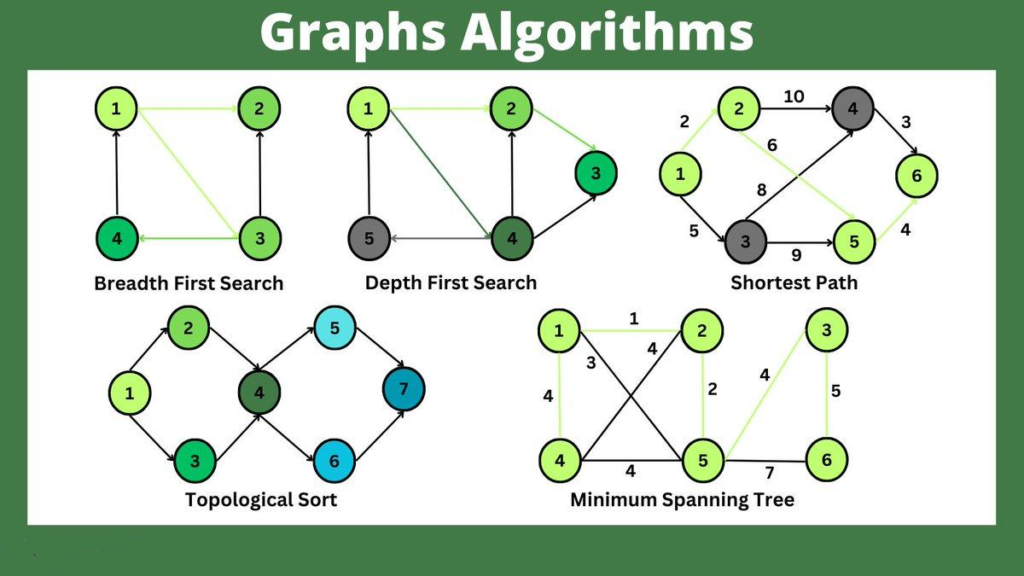


Algorithm Categories
| Category | Examples | Typical Use |
|---|---|---|
| Sorting | Merge Sort | Organizing data |
| Searching | Binary Search | Fast lookup |
| Graph | Dijkstra | Navigation |
| Dynamic Programming | Knapsack | Optimization |
| Greedy | Huffman | Compression |
| Divide & Conquer | Quick Sort | Large datasets |
Time Complexity Comparison
| Algorithm | Best | Average | Worst |
|---|---|---|---|
| Bubble Sort | O(n) | O(n²) | O(n²) |
| Merge Sort | O(n log n) | O(n log n) | O(n log n) |
| Quick Sort | O(n log n) | O(n log n) | O(n²) |
| Heap Sort | O(n log n) | O(n log n) | O(n log n) |
Engineering Examples 💻
Example 1 — GPS Navigation 🛰️
Google Maps computes the shortest driving route using graph algorithms such as Dijkstra or A*.
Example 2 — Search Engines 🔎
Search engines rank billions of webpages using graph analysis, indexing, and advanced ranking algorithms.
Example 3 — Netflix Recommendations 🎬
Recommendation systems compare millions of user preferences using machine learning algorithms.
Example 4 — Banking Systems 💳
Banks use algorithms for:
- Fraud detection
- Credit scoring
- Risk prediction
Example 5 — Robotics 🤖
Robots rely on:
- Path planning
- Object detection
- Motion control
- Sensor fusion
Real-World Applications 🌍
The concepts from this book appear in nearly every engineering discipline.
| Industry | Applications |
|---|---|
| Artificial Intelligence | Model optimization |
| Robotics | Navigation |
| Aerospace | Flight planning |
| Finance | Trading systems |
| Healthcare | Medical imaging |
| Manufacturing | Production optimization |
| Telecommunications | Routing |
| Cybersecurity | Encryption |
| Automotive | Autonomous vehicles |
| Cloud Computing | Load balancing |
Common Mistakes ❌
Many engineers make avoidable errors when designing algorithms.
Ignoring Complexity
A solution that works for 100 records may fail for 100 million.
Using the Wrong Data Structure
Choosing a linked list instead of a hash table can drastically reduce performance.
Premature Optimization
Optimize only after identifying actual performance bottlenecks.
Ignoring Edge Cases
Unexpected inputs often cause production failures.
Not Measuring Performance
Benchmarking should accompany every optimization effort.
Challenges and Practical Solutions 🛠️
| Challenge | Solution |
|---|---|
| Large datasets | Efficient indexing |
| High memory use | Better data structures |
| Slow execution | Parallel algorithms |
| Complex graphs | Heuristic search |
| Real-time systems | Greedy algorithms |
| NP-hard problems | Approximation algorithms |
Engineering Case Study 🏢
Problem
An online retailer experiences slow product searches across a catalog of 50 million items.
Initial Solution
- Linear Search
Performance:
- Extremely slow
- High server load
Improved Design
Engineers implemented:
- Hash Tables
- Balanced Trees
- Efficient indexing
- Binary Search
Results
✔ Search latency reduced dramatically.
✔ Improved scalability during peak traffic.
⚡ Lower infrastructure costs.
✔ Better user experience and customer satisfaction.
This illustrates one of the central lessons of The Algorithm Design Manual: selecting the right algorithm and data structure often provides greater performance gains than upgrading hardware.
Essential Tips for Learning Algorithms 💡
Start Small
Master arrays, lists, and sorting before advanced topics.
Practice Every Day
Solve algorithmic challenges regularly to strengthen problem-solving skills.
Draw Diagrams
Visualizing trees, graphs, and recursion often reveals solutions more quickly.
Analyze Complexity
Estimate time and space complexity before writing code.
Compare Multiple Solutions
There is rarely a single “perfect” algorithm. Evaluate trade-offs in speed, memory, implementation complexity, and scalability.
Build Real Projects
Apply algorithms in:
- Web applications
- Mobile apps
- AI systems
- Robotics
- Game development
- Data engineering
Review Classic Problems
Revisit foundational problems such as shortest paths, sorting, and dynamic programming. Repetition builds intuition.
Frequently Asked Questions ❓
1. Is this book suitable for beginners?
Yes. While some mathematical background helps, the book emphasizes intuition, practical examples, and engineering decision-making, making it accessible to motivated beginners.
2. Is it useful for coding interviews?
Absolutely. It covers many of the algorithmic techniques commonly tested in technical interviews at major technology companies.
3. Which programming language does the book use?
The concepts are language-independent. Readers can implement the algorithms in Python, Java, C++, C#, JavaScript, Go, Rust, or other languages.
4. Do I need advanced mathematics?
No. Basic discrete mathematics and logical thinking are sufficient for most chapters. More advanced mathematical ideas are introduced gradually where needed.
5. Is it better than purely theoretical algorithm books?
It depends on your goals. If you want practical engineering guidance and real-world problem-solving strategies, The Algorithm Design Manual is widely regarded as one of the best choices.
6. Can data scientists benefit from this book?
Yes. Efficient algorithms are fundamental to data preprocessing, optimization, machine learning pipelines, and large-scale analytics.
7. Does the book cover modern applications?
Yes. Although the focus is on timeless algorithmic principles, the techniques directly support modern fields such as AI, cloud computing, robotics, cybersecurity, and big data.
Conclusion 🎯
The Algorithm Design Manual (3rd Edition) stands out as one of the most practical and engineer-friendly books on algorithms available today. Rather than presenting algorithms as abstract mathematical exercises, it teaches readers how to think like engineers—evaluating trade-offs, selecting suitable data structures, analyzing complexity, and solving real-world problems efficiently.
For students, it builds a solid foundation in algorithmic thinking. For professionals, it serves as a dependable reference for designing scalable software, optimizing performance, and tackling complex engineering challenges. Whether your work involves artificial intelligence, cloud infrastructure, embedded systems, cybersecurity, robotics, or enterprise software, the principles presented in this book remain relevant and valuable.
Mastering the ideas in this resource will not only improve your coding skills but also strengthen your ability to design robust, maintainable, and high-performance systems—an essential capability for engineers across the USA, UK, Canada, Australia, Europe, and beyond. 🚀