
Statistics for Absolute Beginners 2nd Edition: A Complete Guide for data scientists and students
Introduction
Statistics is one of the most important foundations of data science. Whenever a data scientist collects information, cleans a dataset, builds a machine-learning model, evaluates performance, or communicates findings, statistics is working behind the scenes.
You do not need to become a professional mathematician before learning statistics. In fact, absolute beginners can approach statistics as a practical language for understanding data: What is typical? How much does data vary? What patterns are reliable? What might happen next?
For engineers, students, analysts, programmers, and machine-learning professionals, statistics provides a structured way to turn raw observations into useful evidence. The National Institute of Standards and Technology (NIST) maintains an engineering statistics handbook covering exploratory analysis, process modelling, experimentation, monitoring, comparison, and reliability—showing how broadly statistical thinking is used in technical work.


Statistics becomes especially powerful when combined with programming languages such as Python and R, databases, visualization tools, and machine-learning algorithms.


The goal of this guide is simple: build your statistical intuition from zero and gradually connect it to modern data science.
Background Theory
Before learning individual statistical techniques, it helps to understand the basic idea behind statistical thinking.
Imagine an engineering company manufacturing thousands of components every day. Engineers cannot manually inspect every possible characteristic of every component. Instead, they collect measurements from representative units and use statistics to understand the entire production process.
The same principle appears in data science.
A company may have millions of customers but analyze a carefully selected sample. A website may have millions of visits but use statistical summaries to understand visitor behaviour. A machine-learning engineer may evaluate thousands of predictions rather than inspecting every prediction individually.
Statistics therefore provides a bridge between:
Raw data → Information → Evidence → Decision
NIST describes statistical analysis as an important component of scientific and engineering investigations, including data collection, analysis, experimentation, uncertainty evaluation, and drawing conclusions.
Population and Sample
A population represents the complete group we are interested in.
Examples include:
- Every customer of an online service
- Every bridge inspected by an engineering company
- Every transaction processed by a bank
- Every student enrolled at a university
A sample is a smaller portion of that population.
For example, if an organisation has one million customers and surveys 5,000 of them, the 5,000 customers form the sample.
The fundamental challenge is making sure that the sample provides useful information about the larger population.
Variables
A variable is a characteristic that can take different values.
Examples include:
- Age
- Temperature
- Pressure
- Salary
- Product weight
- Number of website visits
- Customer satisfaction
- Machine operating time
Understanding the type of variable is important because different statistical methods are appropriate for different types of data.
Definition
Statistics for data science is the use of statistical concepts and methods to collect, organise, describe, analyse, interpret, and communicate information contained in data.
At a beginner level, statistics can be divided into two major areas:
Descriptive Statistics
Descriptive statistics summarises data that has already been collected.
Common tools include:
- Mean
- Median
- Mode
- Minimum
- Maximum
- Range
- Variance
- Standard deviation
- Percentiles
- Frequency distributions
- Histograms
- Box plots
Descriptive statistics can turn thousands of observations into a compact and understandable summary. NIST similarly describes descriptive statistics as methods for reducing large collections of values into manageable summaries using graphical, tabular, or numerical representations.
Inferential Statistics
Inferential statistics goes one step further.
Instead of simply describing the available data, we use a sample to make conclusions or estimates about a broader population.
Examples include:
- Confidence intervals
- Hypothesis testing
- Statistical significance
- Regression
- Analysis of variance
- Prediction
- Estimation
This distinction is extremely important in data science.
Descriptive statistics asks:
“What does my dataset look like?”
Inferential statistics asks:
“What can my dataset tell me about something larger?”
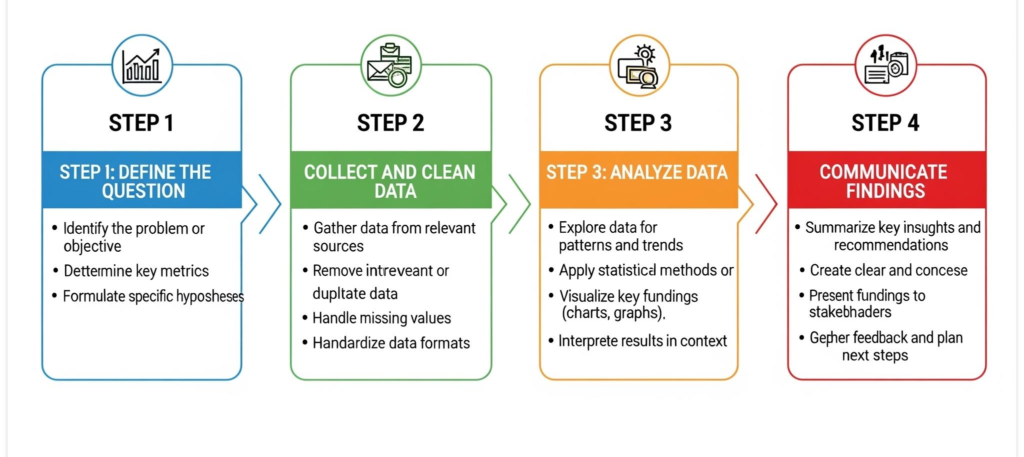
Step-by-Step Explanation: Learning Statistics for Data Science
Learning statistics becomes much easier when you follow a logical sequence instead of trying to memorise dozens of formulas.


Step 1: Understand the Data
Start by asking:
- What does each row represent?
- What does each column represent?
- Which variables are numerical?
- Which variables are categorical?
- Are there missing values?
- Are there unusual observations?
Never begin statistical analysis before understanding what the data actually represents.
Step 2: Classify the Variables
Numerical variables contain measurable quantities.
Examples:
- Height
- Weight
- Temperature
- Revenue
Categorical variables describe groups or categories.
Examples:
- Country
- Product type
- Device type
- Customer segment
There are also discrete and continuous numerical variables.
A discrete variable commonly represents countable quantities, such as the number of machines operating.
A continuous variable can take values across a range, such as temperature or pressure.
Step 3: Summarise the Data
Calculate or inspect basic descriptive statistics.
For example, imagine an engineering team records the operating temperatures of machines.
Instead of examining every individual measurement, the team can investigate the typical temperature, the spread of temperatures, and whether unusually high values exist.
Step 4: Visualise the Distribution
Graphs often reveal patterns that numbers hide.
Useful visualisations include:
- Histograms
- Box plots
- Scatter plots
- Bar charts
- Line charts
- Density plots
A histogram can reveal whether observations are concentrated around a central region or spread across many values.
Step 5: Investigate Relationships
Suppose a data scientist wants to determine whether advertising expenditure is associated with website traffic.
A scatter plot can provide an initial visual indication of the relationship.
This does not automatically prove causation.
That distinction is fundamental.
A relationship between two variables does not necessarily mean that one variable caused the other.
Step 6: Consider Probability
Probability provides a framework for dealing with uncertainty.
Data science frequently involves uncertain outcomes:
- Will a customer purchase a product?
- Will a machine fail?
- Will a transaction be fraudulent?
- Will a model classify an image correctly?
Probability helps quantify uncertainty rather than pretending uncertainty does not exist.
Step 7: Learn Sampling
In many situations, studying the entire population is impractical.
Sampling allows analysts to work with a smaller dataset.
However, sampling must be performed carefully.
A poorly selected sample can produce misleading conclusions even when the statistical calculations themselves are correct.
Step 8: Move Toward Inference
Once you understand descriptive statistics, probability, and sampling, you can begin studying:
- Confidence intervals
- Hypothesis tests
- Regression
- Experimental design
- Statistical modelling
This is where statistics becomes particularly powerful for professional data science.
Comparison: Important Statistical Concepts
| Concept | Main Purpose | Beginner Example |
|---|---|---|
| Mean | Find the average | Average temperature |
| Median | Find the middle observation | Typical house price |
| Mode | Find the most common value | Most common product |
| Range | Show basic spread | Difference between highest and lowest |
| Standard deviation | Describe variability | Variation in measurements |
| Percentile | Locate a value within a distribution | Top 10% of customers |
| Probability | Describe uncertainty | Chance of an event |
| Correlation | Measure association | Relationship between two variables |
| Regression | Model relationships | Predicting sales |
| Hypothesis testing | Evaluate evidence | Comparing two processes |


Diagrams & Tables
A useful mental model for statistics is:
                RAW DATA
                    │
                    ▼
             Data Cleaning
                    │
                    ▼
          Exploratory Analysis
                    │
          ┌─────────┴─────────┐
          ▼                   ▼
   Descriptive             Visualisation
   Statistics                  │
          │                    │
          └─────────┬──────────┘
                    ▼
              Probability
                    │
                    ▼
                Sampling
                    │
                    ▼
              Inference
                    │
                    ▼
          Statistical Model
                    │
                    ▼
              Data-Driven
               Decision
Distribution Shapes
Data does not always follow the same shape.
A distribution might be:
- Symmetrical
- Skewed to the left
- Skewed to the right
- Concentrated around multiple groups
- Almost uniformly distributed
- Dominated by extreme observations
Recognising these shapes helps analysts select appropriate methods.
Measures of Central Tendency
Three beginner-friendly concepts are particularly important.
Mean: the arithmetic average.
Median: the middle value after observations are ordered.
Mode: the most frequently occurring value.
The median can be particularly useful when extreme observations are present.
For example, house prices in a city may contain a small number of extremely expensive properties. The mean can be pulled upward by these extreme observations, while the median may better represent a typical property.
Examples
Example 1: Website Analytics
Imagine an online educational website receives visitors from different countries.
A data scientist could use statistics to determine:
- Average session duration
- Typical number of pages viewed
- Most common device
- Distribution of visitors by country
- Variation in engagement
- Relationship between page views and conversions
The statistical analysis can then support decisions about content and advertising.
Example 2: Manufacturing
An engineering company measures the dimensions of manufactured components.
Statistics can help identify:
- Normal production variation
- Unusual measurements
- Changes in process behaviour
- Differences between machines
- Quality problems
Statistical process analysis is widely relevant to engineering, manufacturing, measurement, and quality control.
Example 3: Machine Learning
Suppose a classification model predicts whether an email is spam.
Statistics can help evaluate:
- Accuracy
- Precision
- Recall
- Error patterns
- Class distribution
- Model stability
The machine-learning algorithm may generate predictions, but statistical thinking helps determine whether those predictions are meaningful and reliable.
Real-World Applications
Statistics appears throughout modern engineering and technology.
Engineering
Engineers use statistics for:
- Quality control
- Reliability analysis
- Experimental design
- Measurement uncertainty
- Process optimisation
- Failure analysis
Reliability analysis is particularly important when engineers need to understand equipment lifetime, failure behaviour, and system performance.
Business
Companies use statistics for:
- Customer analysis
- Sales forecasting
- Market research
- A/B testing
- Pricing analysis
- Demand forecasting
Healthcare
Statistical methods help researchers analyse clinical data, compare treatments, investigate risk factors, and evaluate research findings.
Finance
Financial institutions use statistical models for:
- Risk analysis
- Fraud detection
- Portfolio analysis
- Credit assessment
- Forecasting
Artificial Intelligence
AI systems rely heavily on data.
Statistics supports:
- Model evaluation
- Uncertainty estimation
- Feature analysis
- Experimental comparison
- Data sampling
- Error analysis
Common Mistakes
Mistake 1: Thinking Average Means Typical
The mean is not always representative of a dataset.
Extreme observations can significantly influence it.
Mistake 2: Confusing Correlation With Causation
Two variables can move together without one directly causing the other.
This is one of the most common statistical reasoning errors.
Mistake 3: Ignoring Outliers
An unusual observation might be:
- A measurement error
- A data-entry mistake
- A genuine extreme event
It should be investigated rather than automatically deleted.
Mistake 4: Using a Biased Sample
If the sample does not adequately represent the population, conclusions may be misleading.
Mistake 5: Focusing Only on Statistical Significance
A statistically detectable difference is not automatically important from an engineering, business, or practical perspective.
Mistake 6: Trusting a Graph Without Understanding the Data
A beautiful visualisation can still communicate the wrong message if the underlying data or scale is inappropriate.
Challenges & Solutions
| Challenge | Practical Solution |
|---|---|
| Statistics seems mathematical | Focus first on concepts and interpretation |
| Too many statistical terms | Learn them gradually through examples |
| Difficult datasets | Start with small datasets |
| Confusing methods | Ask what question the method answers |
| Unusual observations | Investigate outliers before removing them |
| Biased samples | Examine how data was collected |
| Poor visualisation | Choose charts based on the variable types |
| Overconfidence in results | Consider uncertainty and assumptions |
One of the best approaches for beginners is to connect every statistical technique to a practical question.
Instead of memorializing a formula, ask:
“What problem does this method solve?”
That question makes statistics much easier to understand.
Case Study: Predicting Customer Churn
Consider a subscription-based software company.
The company wants to understand why some customers cancel their subscriptions.
Data Collection
The data science team collects information such as:
- Subscription duration
- Number of logins
- Customer support interactions
- Product usage
- Subscription type
- Country
- Whether the customer cancelled
Descriptive Analysis
The team first examines the data.
They discover that customers who cancel tend to have lower product engagement.
However, this is only an observation.
Visual Analysis
The analysts create charts comparing engagement patterns between customers who stayed and customers who left.
The visualisation reveals a noticeable difference between the groups.
Statistical Investigation
The team then uses appropriate statistical methods to determine whether the observed differences are likely to represent a meaningful pattern rather than random variation.
Business Action
The company introduces an early-warning system.
Customers showing declining engagement receive educational resources and targeted support.
The result is a practical example of the statistics workflow:
Data → Description → Visualisation → Investigation → Decision
This problem-oriented approach mirrors the philosophy behind NIST’s engineering statistics resources, which emphasise practical statistical analysis and case studies rather than theory alone.
Essential Tips for Beginners
Build Statistical Intuition First
Do not rush into advanced probability distributions.
Understand:
data → variation → distribution → uncertainty → inference
first.
Learn With Real Datasets
Working with actual data makes abstract concepts much easier.
Good beginner projects include:
- Weather analysis
- House-price analysis
- Student performance
- E-commerce sales
- Customer behaviour
- Engineering measurements
Combine Statistics With Python
Once the concepts are clear, Python can automate calculations and visualisations.
Common tools include:
- NumPy
- pandas
- Matplotlib
- SciPy
- scikit-learn
Always Visualise
A statistical summary may tell you that two datasets have similar averages.
A graph may reveal that their distributions are completely different.
Understand Uncertainty
Data is rarely perfect.
Measurements contain variation, samples may be incomplete, and observations may contain noise.
Good data scientists communicate this uncertainty instead of hiding it.
Ask Better Questions
Statistics becomes much easier when you start with a clear question.
For example:
❌ “I need to use regression.”
✅ “I want to understand whether these variables are associated and whether one can help predict another.”
The second approach naturally leads to the appropriate statistical method.
FAQs
What statistics should a beginner learn for data science?
Start with descriptive statistics, probability, distributions, sampling, correlation, regression, confidence intervals, and hypothesis testing. You should also learn how to interpret statistical results rather than simply calculate them.
Do I need advanced mathematics to learn statistics?
No. Basic arithmetic and an understanding of percentages, averages, graphs, and simple algebra are enough to begin. More advanced mathematics can be introduced as your knowledge develops.
Is statistics more important than programming for data science?
They serve different purposes. Programming helps you manipulate and analyse data efficiently, while statistics helps you understand whether patterns and conclusions are meaningful.
Should I learn Python or statistics first?
A practical approach is to learn them together. Learn a statistical concept, then implement it using a small Python dataset. This reinforces both skills.
What is the difference between descriptive and inferential statistics?
Descriptive statistics summarises the data you have. Inferential statistics uses data—often from a sample—to draw conclusions or estimates about a wider population.
Why is probability important in data science?
Probability provides a way to reason about uncertain events. Data science frequently deals with uncertainty in predictions, measurements, classifications, and future outcomes.
What statistical topics are important for machine learning?
Important topics include probability, distributions, sampling, correlation, regression, estimation, hypothesis testing, experimental design, model evaluation, and uncertainty.
Can engineers use statistics without becoming statisticians?
Absolutely. Engineers routinely use statistics for measurement, quality control, reliability, experimentation, process monitoring, and decision-making. NIST specifically provides statistical resources designed for engineers and scientists who need practical statistical methods.
Conclusion
Statistics for data science is not simply a collection of formulas. It is a way of thinking about information, variation, uncertainty, and evidence.
For absolute beginners, the best learning path is progressive:
Understand data → summarise data → visualise data → understand probability → learn sampling → make statistical inferences → build models → communicate conclusions.
The most valuable skill is not calculating a statistical quantity—it is understanding what that quantity means and when it should be trusted.
As your skills develop, statistics becomes a powerful foundation for Python programming, machine learning, artificial intelligence, engineering analytics, business intelligence, and scientific research.
The key lesson is simple:
Data tells you what happened. Statistics helps you understand what it means. 📊🧠
For further engineering-oriented study, the NIST/SEMATECH Statistical Methods Handbook provides a practical reference covering exploratory data analysis, process characterisation, modelling, improvement, monitoring, comparisons, and reliability.
Start small, practise with real data, visualise everything you can, and learn to question your conclusions. 🚀📈




