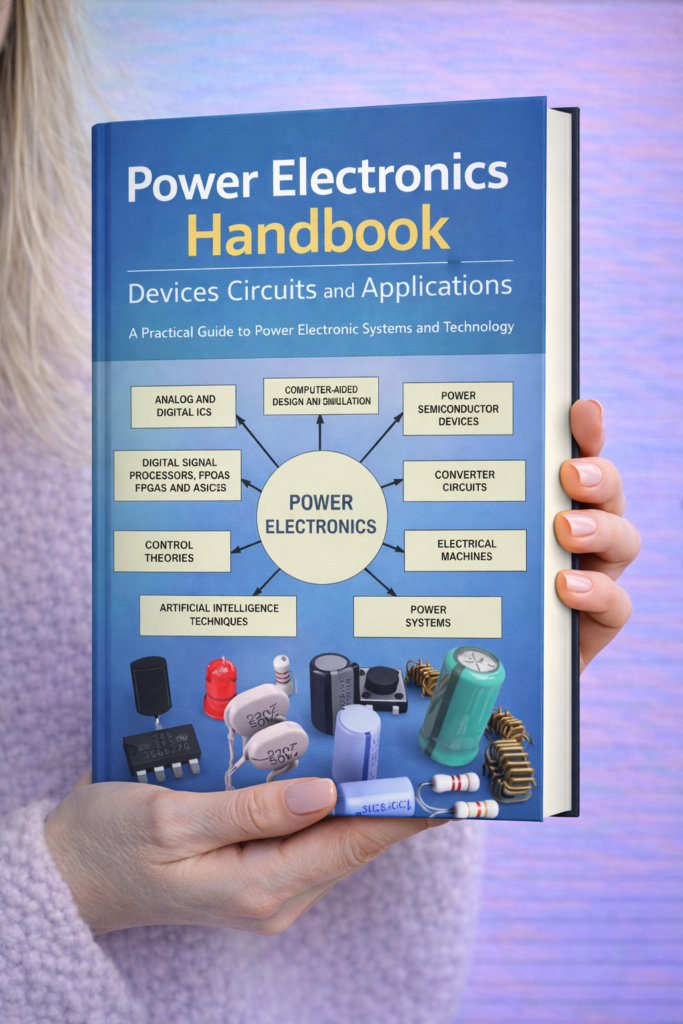
Power Electronics Handbook Devices Circuits and Applications
Introduction
Power electronics is the cornerstone of modern electrical engineering, enabling efficient control and conversion of electrical energy. From renewable energy systems to electric vehicles, its applications are vast and rapidly evolving. Power electronics combines elements of power engineering, electronics, and control systems to optimize how energy is produced, managed, and utilized.
This article expands on key aspects of power electronics, incorporating insights from authoritative sources such as Muhammad H. Rashid’s Power Electronics Handbook, and explores how this field underpins major innovations in energy and automation.
The Evolution and Foundation of Power Electronics
Historical Context
The development of power electronics is closely tied to the evolution of semiconductor technology. Early systems used electromechanical components like relays and motor-generators. These were bulky, inefficient, and slow. The advent of semiconductor devices—starting with the diode in the early 20th century—revolutionized the field.
As solid-state devices became smaller, faster, and more efficient, the capabilities of power electronics expanded. Today’s power systems use compact, high-speed switches and integrated control systems that can handle kilowatts or even megawatts of power with precision.
What Is Power Electronics?
Power electronics is the study and application of electronic devices for the conversion and control of electrical energy. It involves modifying voltage, current, frequency, or form (AC ↔ DC) to meet system requirements. Typical operations include:
-
Rectification – Converting AC to DC
-
Inversion – Converting DC to AC
-
Voltage conversion – Stepping voltage up or down within the same type (DC-DC or AC-AC)
Core Components and Circuit Topologies
Power Semiconductor Devices
Power electronic systems rely on semiconductor devices for switching and signal control. These components must operate efficiently under high voltage and current conditions.
Diodes
Diodes allow current to flow in only one direction. They are foundational in rectifier circuits and serve to convert AC input into usable DC output.
Thyristors
Thyristors, such as Silicon Controlled Rectifiers (SCRs), are used in AC power control where high voltage and current handling is necessary. They can be triggered into conduction with a small input signal and remain on until the current falls below a certain threshold.
MOSFETs (Metal-Oxide-Semiconductor Field-Effect Transistors)
MOSFETs are widely used in low to medium power applications. Their fast switching speed makes them ideal for high-frequency converters and switching regulators.
IGBTs (Insulated Gate Bipolar Transistors)
IGBTs combine the efficiency of MOSFETs with the high-current capacity of bipolar transistors. They are preferred for high-power applications such as industrial drives and electric vehicle inverters.
Converter Topologies
Power converters manipulate electrical energy to suit specific load requirements. They are categorized by input-output characteristics:
AC-DC Converters (Rectifiers)
These convert alternating current to direct current. Common in battery chargers, power supplies, and DC motor drives. Controlled rectifiers allow adjustable DC output.
DC-AC Converters (Inverters)
Inverters transform DC into AC, used extensively in solar energy systems and uninterruptible power supplies (UPS). They often include pulse-width modulation (PWM) for fine control.
DC-DC Converters
These step voltage up (boost), down (buck), or both (buck-boost). They are critical in portable electronics, EVs, and power distribution in aerospace systems.
AC-AC Converters
These change voltage, frequency, or phase of an AC signal. Applications include lighting control, motor speed variation, and power conditioning.
Practical Applications of Power Electronics Handbook
Renewable Energy Integration
The shift toward renewable energy would be impossible without power electronics, which ensures that energy from variable sources is compatible with grid standards.
Solar Power Systems
Photovoltaic (PV) panels generate DC electricity. Inverters convert it into grid-compatible AC. Maximum Power Point Tracking (MPPT) algorithms optimize energy harvesting.
Wind Energy Systems
Wind turbines produce variable frequency AC. Power electronics systems convert this into constant-frequency AC suitable for the grid, while also regulating voltage and reactive power.
Electric Vehicles (EVs)
Power electronics control every major energy flow in EVs, including propulsion, braking, and charging.
Motor Drives
Electric motors require variable voltage and frequency for smooth operation. Inverters enable this by converting battery DC to variable-frequency AC.
Battery Management and Charging
Sophisticated chargers use power electronics to optimize charging rates, improve battery life, and support fast charging with active thermal and voltage regulation.
Industrial Automation and Control
Factories use power electronic systems for precise process control, energy savings, and equipment protection.
Variable Frequency Drives (VFDs)
VFDs adjust the speed of AC motors by varying frequency and voltage. This enhances efficiency in pumps, fans, conveyors, and compressors.
Robotics and CNC Machines
Power electronics enables accurate motion control and energy efficiency in robotic actuators and computer-controlled manufacturing systems.
Emerging Trends and Innovations
Wide Bandgap Semiconductors
Materials like Silicon Carbide (SiC) and Gallium Nitride (GaN) are replacing traditional silicon in high-performance systems. Their benefits:
-
Higher efficiency
-
Greater thermal tolerance
-
Faster switching speeds
-
Smaller, lighter systems
SiC and GaN are crucial for high-frequency converters, fast chargers, and space-constrained applications.
Integration with Digital Control
Digital signal processors (DSPs) and microcontrollers enhance the performance of power electronic systems by enabling:
-
Real-time feedback and control
-
Predictive maintenance via sensors and diagnostics
-
Smart grid and IoT integration
Technical Challenges and Engineering Solutions
Heat Management and Thermal Design
Power components generate significant heat, especially in compact or high-power systems. Without proper thermal control, devices may degrade or fail.
Cooling Solutions
-
Heat sinks – Passive dissipation through metal fins
-
Forced air – Fans or blowers to increase airflow
-
Liquid cooling – Used in EVs, data centers, and high-power industrial systems
Electromagnetic Interference (EMI)
Fast switching leads to high-frequency noise that can interfere with other systems. Effective strategies include:
-
Shielded enclosures
-
Snubber circuits
-
EMI filters
Ensuring System Reliability
Design for Fault Tolerance
Modern systems often include:
-
Redundant paths or components
-
Soft-start and overcurrent protection
-
Monitoring for voltage, temperature, and load
Standards and Certifications
Compliance with standards such as IEC, IEEE, and UL ensures safety, interoperability, and performance under various conditions.
Case Study: Smart Grid Integration
Smart grids combine digital communications and power electronics to transform traditional electrical networks into dynamic, responsive systems.
Role of Power Electronics in Smart Grids
-
Real-time load balancing
-
Integration of solar, wind, and storage
-
Voltage and frequency regulation
Advanced converters and inverters allow bidirectional power flow, enabling homes and businesses to become both consumers and producers (prosumers).
Benefits
-
Improved efficiency and reduced losses
-
Greater resilience during outages
-
Better load forecasting and energy management
Tips for Engineers and Practitioners
Stay Technically Informed
Power electronics is a fast-moving field. Regular engagement with academic journals, conferences (like APEC or PCIM), and vendor webinars is essential.
Use Simulation Tools
Software such as:
-
MATLAB/Simulink – For modeling and control simulation
-
PSpice or LTspice – For circuit simulation and transient analysis
These help validate designs before prototyping.
Choose the Right Components
Key factors to consider:
-
Voltage and current ratings
-
Thermal performance
-
Switching frequency
-
Cost and availability
Always consult datasheets and application notes.
Prototype and Iterate
Physical testing uncovers issues like parasitic inductance, EMI problems, and thermal bottlenecks. Rapid prototyping helps optimize real-world performance.
FAQs About Power Electronics Handbook Devices Circuits and Applications
What is the significance of power electronics in renewable energy?
Power electronics is essential for making variable and intermittent renewable sources compatible with stable grid systems. It regulates voltage, frequency, and synchronizes power injection into the grid.
How do I choose between MOSFETs and IGBTs?
-
Use MOSFETs for low- to medium-power applications and high-frequency operation (e.g., up to 100 kHz).
-
Use IGBTs for high-power, lower-frequency scenarios such as industrial drives or high-voltage solar inverters.
What are the common causes of power electronics failure?
-
Thermal overload
-
Improper layout or insufficient filtering
-
Aging or poor-quality components
Preventive design and proper testing are key to system longevity.
Conclusion
Power electronics plays a critical role in shaping the future of energy and automation. Whether it’s making electric vehicles viable, optimizing renewable energy systems, or enabling smart grids, this field is foundational to innovation. By mastering its core principles and staying ahead of technical challenges, engineers can build systems that are not only efficient and reliable but also transformative for society.