Geotechnical Aspects of Underground Construction in Soft Ground


Introduction
Underground construction is one of the most demanding branches of modern geotechnical engineering. Building tunnels, metro systems, underground stations, utility corridors, basements, and deep foundations becomes particularly challenging when construction takes place in soft ground.
Soft ground may consist of soft clay, loose silt, organic soil, peat, loose saturated deposits, or other materials with relatively low strength and high compressibility. These soils can deform significantly when excavated or loaded. The presence of groundwater can make the situation even more complicated by reducing effective stress, increasing instability risks, and creating seepage problems. 🌍🏗️
For students and practicing engineers, understanding the behavior of soft ground is essential because underground construction is not simply about removing soil and installing a structure. The surrounding ground is part of the engineering system. Excavation changes stresses, groundwater conditions, deformation patterns, and load-transfer mechanisms.
A successful project therefore requires a combination of site investigation, geological interpretation, soil mechanics, groundwater control, excavation support, construction monitoring, and risk management.


Background Theory
Behavior of Soft Ground
Soft ground generally has limited resistance to deformation. Saturated fine-grained soils can behave very differently from dense granular materials because drainage occurs slowly.
When an underground excavation is created, the original stress condition within the ground is disturbed. Soil surrounding the excavation may move toward the opening, while nearby structures may experience settlement or lateral movement.
The engineering response depends on several factors:
- Soil type and geological history
- Groundwater conditions
- Excavation depth
- Tunnel diameter or excavation width
- Construction sequence
- Support stiffness
- Distance from existing structures
- Duration of construction
- Surface loading
- Quality of workmanship
Effective Stress and Groundwater
Groundwater is one of the most important factors in soft-ground construction. Saturated soils can lose stability when water pressures become significant.
Excavation may cause groundwater to flow toward the construction zone. If water is removed too aggressively, surrounding soils may experience changes in effective stress and potentially consolidate.
This can result in:
Groundwater control → stress changes → soil deformation → surface settlement
For this reason, groundwater management must be considered together with excavation support rather than treated as a separate construction activity.
Consolidation and Settlement
Soft clay can experience substantial consolidation under loading or following changes in groundwater conditions.
Unlike immediate deformation, consolidation develops over time. This is particularly important for underground construction because surface settlement may continue after excavation has progressed.
Engineers therefore need to consider both:
- Short-term construction deformation
- Long-term consolidation behavior
Definition
What Is Soft Ground?
Soft ground refers to soil or geological material that has relatively low shear strength and/or high compressibility, making it susceptible to significant deformation during excavation or construction.
Typical soft-ground materials include:
- Soft clay
- Marine clay
- Organic soil
- Peat
- Very loose silty deposits
- Loose saturated sand
- Reclaimed land deposits
- Highly compressible alluvial sediments
Soft ground does not necessarily mean that construction is impossible. Instead, it means that the construction method must be carefully selected to control deformation and maintain stability.
What Is Underground Construction?
Underground construction involves creating structures below the natural ground surface. Examples include:
- Road tunnels
- Railway tunnels
- Metro systems
- Underground stations
- Sewer tunnels
- Utility tunnels
- Underground parking structures
- Deep basements
- Storage facilities
When these structures are built in soft ground, geotechnical design becomes a central part of the project rather than simply a supporting discipline.
Step-by-Step Explanation
Step 1: Conduct a Detailed Site Investigation
The first stage is understanding what exists below the surface.
A site investigation should establish:
- Soil stratification
- Groundwater levels
- Soil strength
- Compressibility
- Permeability
- Geological discontinuities
- Existing foundations
- Buried utilities
- Potential contamination
- Historical ground disturbance
Boreholes, sampling, laboratory testing, in-situ testing, groundwater monitoring, and geophysical techniques can all contribute to the ground model.
Step 2: Develop the Ground Model
The investigation data should be converted into a three-dimensional understanding of the subsurface.
The ground model should identify potentially problematic zones such as:
- Very soft clay layers
- Loose saturated sand
- Buried channels
- Fill materials
- Variable groundwater conditions
- Organic deposits
- Weak interfaces between geological units
A reliable ground model helps engineers anticipate changes before excavation begins.
Step 3: Assess Excavation-Induced Movement
Engineers then evaluate how excavation could affect the surrounding soil.
Potential movements include:
Vertical movement: settlement or heave.
Horizontal movement: soil movement toward the excavation.
Groundwater movement: changes in pore-water pressure and seepage.
Structural movement: distortion of nearby buildings, roads, railways, or utilities.
Step 4: Select an Appropriate Construction Method
The construction method must match the ground conditions.
Possible approaches include:
- Earth Pressure Balance tunneling
- Slurry shield tunneling
- Cut-and-cover construction
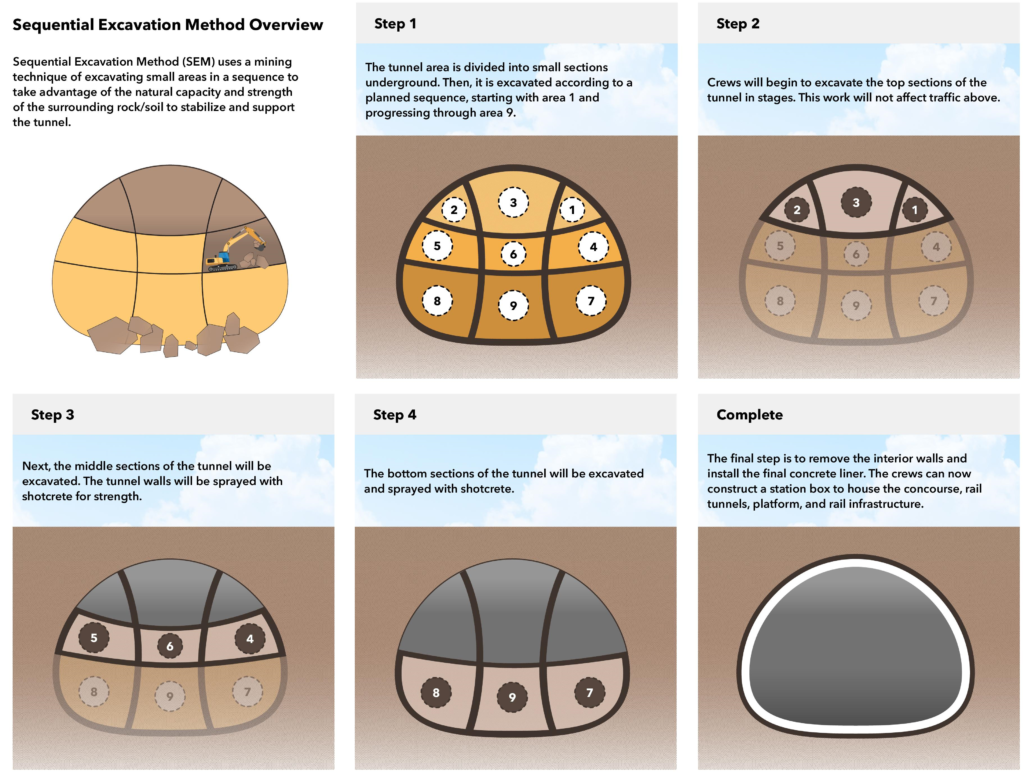
- Sequential excavation
- Diaphragm-wall-supported excavation
- Secant pile walls
- Sheet-pile systems
- Ground improvement
- Jet grouting
- Deep mixing
- Artificial ground freezing for specialized situations
Step 5: Install Ground and Structural Support
Support systems must control ground deformation while maintaining construction safety.
For deep excavations, engineers may use retaining walls with internal struts or ground anchors.
For tunnels, temporary or permanent lining systems can provide support and limit deformation.
Step 6: Control Groundwater
Groundwater control can involve:
- Wellpoints
- Deep wells
- Cutoff walls
- Grouting
- Waterproof membranes
- Pumping systems
- Recharge systems where necessary
The objective is not simply to remove water. The objective is to create acceptable groundwater conditions without causing damaging effects outside the excavation.
Step 7: Monitor Construction
Instrumentation provides information about what is actually happening.
Typical monitoring systems include:
- Settlement markers
- Inclinometers
- Piezometers
- Extensometers
- Structural crack monitoring
- Survey prisms
- Automated monitoring systems
Modern projects increasingly combine automated sensors with real-time data platforms. 📡
Step 8: Adjust Construction When Necessary
The observational approach is especially valuable in soft ground.
If monitoring shows unexpected movement, engineers may:
- Reduce excavation rates
- Modify support installation
- Adjust tunnel pressure
- Improve groundwater control
- Increase monitoring frequency
- Introduce additional ground treatment
- Change construction sequencing


Comparison
Soft Ground vs. Competent Ground
| Factor | Soft Ground | Competent Ground |
|---|---|---|
| Deformation | Often significant | Generally lower |
| Settlement risk | High | Usually lower |
| Groundwater sensitivity | Often high | Variable |
| Excavation stability | Challenging | Often easier |
| Ground improvement | Frequently considered | Less frequently required |
| Monitoring | Critical | Important but may be less intensive |
| Construction tolerance | Often limited | Generally more forgiving |
| Support requirements | Usually substantial | Depends on rock/soil conditions |
Open Excavation vs. Tunnel Boring
| Feature | Open/Cut-and-Cover | Tunnel Boring |
|---|---|---|
| Surface disruption | High | Lower |
| Depth suitability | Moderate | High |
| Groundwater management | Important | Highly important |
| Urban application | Can be disruptive | Often advantageous |
| Initial complexity | Moderate | High |
| Settlement control | Depends on support | Highly dependent on machine operation |
Diagrams & Tables
Typical Soft-Ground Underground Construction System
             EXISTING BUILDINGS
        🏢       🏢       🏢
          ↓ settlement monitoring ↓

────────────────────────────────────
          Ground Surface
────────────────────────────────────
       Soft Clay / Soft Silt
        ↓      ↓      ↓
     [Retaining Support]
          │      │
          │ TUNNEL│
          │  🚇   │
          │______│
────────────────────────────────────
       Dense / Stronger Layer
────────────────────────────────────
        Groundwater Zone 💧
Major Geotechnical Risk Matrix
| Risk | Typical Impact | Control Strategy |
|---|---|---|
| Excessive settlement | Building damage | Controlled excavation and monitoring |
| Face instability | Collapse | Pressure-controlled excavation |
| Groundwater inflow | Flooding | Dewatering, cutoff, or slurry systems |
| Excessive lateral movement | Utility damage | Stiff retaining systems |
| Soil consolidation | Long-term settlement | Ground improvement and staged construction |
| Loss of fines | Voids and settlement | Filtration and controlled pumping |
Ground–Structure Interaction
      Surface Structure 🏢
             ↓
      Ground Movement
        ↙       ↘
   Soil Deformation
          ↓
   ┌──────────────┐
   │ Underground  │
   │   Structure  │
   └──────────────┘
          ↓
   Support + Lining
Examples
Example 1: Metro Tunnel Through Soft Clay
Imagine a metro tunnel passing beneath a densely populated urban district containing soft clay.
The primary concern is not only tunnel stability. Engineers must also prevent excessive settlement at the surface.
A tunnel boring machine can maintain controlled pressure at the excavation face while continuously installing lining segments.
Monitoring equipment above the tunnel can detect small ground movements. If movement becomes greater than expected, construction parameters can be adjusted.
Example 2: Deep Basement in Saturated Soil
Consider a high-rise building requiring several basement levels in a city with a high groundwater table.
A diaphragm wall can be constructed around the excavation before soil removal begins. Internal bracing can then provide support as excavation progresses.
Groundwater monitoring is essential because excessive pumping could affect neighboring buildings.
Example 3: Utility Tunnel Under a Highway
A utility tunnel constructed beneath a busy highway must minimize surface disruption.
A trenchless technique can allow construction without removing the entire road surface. However, the soft soil may increase the possibility of settlement.
Careful control of excavation and continuous monitoring can reduce this risk.
Real World Application
Urban Metro Systems
Many major cities depend on underground railways because surface transportation corridors are limited.
Soft-ground metro construction is common in areas containing young alluvial or marine deposits. Engineers must coordinate tunneling with:
- Existing foundations
- Utility networks
- Roads
- Railways
- Historic buildings
- Groundwater systems
Underground Road Tunnels
Road tunnels can reduce congestion and improve urban connectivity. However, tunnel portals and deep approaches can involve significant excavation in soft soil.
Retaining systems, groundwater control, and settlement management become particularly important.
Sewer and Utility Tunnels
Underground utility systems often cross residential and commercial areas.
Their relatively small diameter does not eliminate geotechnical risk. Even a small tunnel can cause settlement if excavation is poorly controlled.
Underground Buildings
Basements and underground structures require temporary excavation support followed by permanent structural systems.
In soft ground, engineers must carefully consider construction staging because the final building may interact with the surrounding soil differently from the temporary excavation.
Common Mistakes
Ignoring Ground Variability
A project may encounter significantly different soil conditions within a short distance.
Using one generalized soil profile can produce unsafe or unnecessarily conservative designs.
Treating Groundwater as a Secondary Issue
Groundwater can fundamentally change excavation behavior.
Ignoring it until construction begins can create serious delays and unexpected costs.
Excessive Dewatering
Aggressive pumping can change groundwater conditions outside the excavation and potentially contribute to settlement.
Inadequate Monitoring
Instrumentation is valuable only when measurements are collected, reviewed, and linked to predefined actions.
Poor Construction Sequencing
Even a well-designed support system can perform poorly if excavation proceeds faster than support installation.
Assuming Numerical Models Are Perfect
Finite-element and other numerical models are powerful tools, but they depend on assumptions about soil properties, groundwater, boundary conditions, and construction behavior.
Engineering judgment remains essential.
Challenges & Solutions
Challenge: Excessive Settlement
Solution: Use controlled excavation, appropriate tunnel-face pressure, stiff support systems, ground improvement, and continuous monitoring.
Challenge: Groundwater Inflow
Solution: Combine cutoff systems, controlled pumping, grouting, or specialized tunneling techniques according to site conditions.
Challenge: Existing Buildings
Solution: Conduct foundation surveys, establish movement thresholds, monitor structures, and use construction techniques designed for low ground disturbance.
Challenge: Highly Variable Soil
Solution: Improve the ground model through additional investigation and use adaptive construction procedures.
Challenge: Construction Uncertainty
Solution: Apply observational methods, contingency plans, instrumentation, and trigger-action-response systems.
Case Study
Soft-Ground Urban Tunnel Scenario
Consider a hypothetical underground railway project beneath a European city.
The proposed tunnel crosses a sequence of soft clay and silty deposits. Several older buildings are located close to the planned alignment, and groundwater exists relatively close to the tunnel crown.
The engineering team identifies three major risks:
- Tunnel-face instability
- Surface settlement
- Groundwater disturbance
The project adopts a pressurized tunnel boring approach. The excavation process is carefully controlled to maintain suitable support at the tunnel face.
Before tunneling begins, engineers establish baseline measurements for nearby structures and install settlement markers and groundwater monitoring instruments.
During construction, monitoring shows a localized increase in settlement near one building. Instead of continuing with the original production rate, the construction team reduces the excavation rate and reviews machine operating conditions.
Additional ground treatment is introduced around the sensitive section. Monitoring subsequently indicates that movements have returned to acceptable levels.
The important lesson is that successful soft-ground construction does not depend on one technology alone. It depends on the interaction between investigation, design, construction control, monitoring, and rapid engineering response.
Essential Tips
For Students 🎓
Focus on understanding the relationship between:
Soil properties → excavation → stress redistribution → deformation → structural response
Do not memorize construction methods without understanding why they are selected.
For Engineers 🏗️
Always develop a realistic ground model and identify uncertainty explicitly.
Design should consider not only the final underground structure but also temporary construction conditions.
For Site Teams
Construction sequence matters enormously in soft ground.
Follow approved excavation stages, install support promptly, monitor groundwater, and communicate unexpected conditions immediately.
For Project Managers
Budget for investigation and monitoring.
Reducing investigation costs may appear economical initially, but inadequate geotechnical information can produce major construction risks later.
For Digital Engineering Teams 💻
Use automated monitoring where appropriate. Combining sensor data with dashboards, alerts, BIM environments, and numerical models can improve decision-making.
However, automated alerts should support engineering judgment rather than replace it.
FAQs
What makes soft ground difficult for underground construction?
Soft ground can have low strength and high compressibility. Excavation may therefore produce significant deformation, settlement, or instability, particularly when groundwater is present.
Which soils are commonly considered soft ground?
Soft clay, marine clay, peat, organic deposits, loose silts, and some loose saturated sands can create soft-ground construction conditions.
Why is groundwater important in underground construction?
Groundwater affects pore-water pressure, soil strength, excavation stability, seepage, and long-term settlement. Poor groundwater management can also affect nearby structures.
What is ground improvement?
Ground improvement involves modifying soil properties to increase strength, reduce compressibility, control permeability, or improve construction performance. Techniques include grouting, deep mixing, and other specialized methods.
Which tunnel boring machine is suitable for soft ground?
The appropriate machine depends on the specific soil and groundwater conditions. Earth Pressure Balance and slurry-based systems are commonly considered for many soft-ground environments, but selection must be based on detailed geotechnical and project requirements.
How can settlement be controlled?
Settlement can be reduced through appropriate excavation control, ground improvement, suitable support systems, groundwater management, careful construction sequencing, and continuous monitoring.
Why is monitoring important?
Monitoring allows engineers to compare actual ground and structural behavior with predicted behavior. Early detection of unexpected movement provides an opportunity to intervene before problems become severe.
Can underground construction be performed safely in very soft soil?
Yes. Challenging soft ground can be successfully managed when the project uses appropriate investigation, design, construction technology, groundwater control, monitoring, and risk-management procedures.
Conclusion
Underground construction in soft ground represents a complex interaction between soil, groundwater, structures, and construction processes. 🌍🏗️
The most important principle is that the ground cannot be treated as a passive material. Excavation changes the existing stress environment, and the resulting deformation can affect tunnels, buildings, roads, utilities, and groundwater systems.
Successful projects begin with a reliable geotechnical investigation and a realistic ground model. Engineers then select excavation and support methods according to soil behavior, groundwater conditions, project geometry, and surrounding infrastructure.
Modern techniques such as pressurized tunneling, ground improvement, advanced retaining systems, automated instrumentation, and numerical modeling have greatly expanded the ability to construct underground infrastructure in difficult ground.
Nevertheless, technology alone is not enough. Good engineering judgment, disciplined construction, accurate monitoring, and rapid response to unexpected conditions remain fundamental.
For students entering geotechnical engineering and professionals working on underground infrastructure, soft-ground construction offers an excellent example of engineering as a continuous process: investigate → predict → design → construct → monitor → adapt. 🔧📡
That mindset is essential for creating underground structures that are safe, durable, economical, and compatible with the increasingly dense cities of the United States, Canada, the United Kingdom, Australia, and Europe.