Principles of Geotechnical Engineering 7th Edition: A Practical Guide to Soil, Foundations, and Ground Behavior
Introduction 🌍🏗️
Geotechnical engineering is the branch of civil engineering that studies how soil, rock, groundwater, and underground conditions interact with structures. Every building, bridge, road, retaining wall, tunnel, dam, and foundation ultimately depends on the ground beneath or around it.
Unlike manufactured construction materials, soil is naturally variable. Two locations only a short distance apart can contain different layers, groundwater conditions, densities, or strengths. This variability is why understanding the ground is one of the most important parts of safe and economical engineering. A proper site investigation helps engineers develop a realistic picture of subsurface conditions before selecting foundations or construction methods.


Think of geotechnical engineering as the conversation between a structure and the Earth. 🏢 ↔️ 🌎
A structural engineer may determine how a building carries its loads, but the geotechnical engineer must determine how those loads are transferred into the ground and how the ground will respond.
This article introduces the fundamental principles of geotechnical engineering for students, practicing engineers, construction professionals, and anyone interested in foundation engineering.
Background Theory 🧱
The Ground Is an Engineering Material
Soil is not simply “dirt.” From an engineering perspective, it is a complex natural material made from mineral particles, organic matter, water, and air.
The proportions of these components strongly influence soil behavior.
For example:
- Gravel generally provides good drainage and can support substantial loads when properly placed and compacted.
- Sand is usually frictional and responds strongly to density and drainage conditions.
- Silt can be sensitive to water and may present challenging compressibility or erosion characteristics.
- Clay can exhibit significant compressibility, plasticity, swelling, shrinkage, and time-dependent behavior.
- Organic soils can be highly compressible and often require special treatment.
The engineer therefore needs to understand not only what soil is present but also how that soil behaves under loading and environmental changes.
Soil, Water, and Air
A soil mass normally contains three phases:
Solid particles + water + air = soil system
When groundwater conditions change, soil behavior can change dramatically.
Water can influence:
- Strength
- Settlement
- Drainage
- Pore pressure
- Slope stability
- Excavation conditions
- Foundation performance
This is why groundwater investigation is an essential part of many geotechnical projects. Site investigations are used to determine soil stratification, groundwater conditions, engineering properties, foundation requirements, and potential construction problems.
Definition 📘
What Is Geotechnical Engineering?
Geotechnical engineering is the application of soil mechanics, rock mechanics, geology, and engineering principles to understand and safely design structures interacting with the ground.
Its major areas include:
- Soil classification
- Site investigation
- Foundation engineering
- Bearing capacity
- Settlement analysis
- Slope stability
- Retaining structures
- Excavation support
- Groundwater control
- Soil improvement
- Earthquake-related ground behavior
- Geotechnical construction monitoring
What Is Soil Mechanics?
Soil mechanics focuses on the engineering behavior of soil.
Important properties include:
| Property | Engineering Importance |
|---|---|
| Grain size | Influences drainage and classification |
| Density | Influences strength and compressibility |
| Moisture content | Affects consistency and behavior |
| Plasticity | Important for cohesive soils |
| Permeability | Controls water movement |
| Shear strength | Important for stability |
| Compressibility | Influences settlement |
| Unit weight | Influences loads and earth pressure |
A successful geotechnical design combines these properties with geological information and engineering judgment.
Step-by-Step Principles of Geotechnical Engineering 🔎
Step 1: Understand the Project
Before investigating soil, the engineer must understand the proposed structure.
Important questions include:
- What type of structure is planned?
- How large is it?
- What loads will it apply?
- Will there be basements?
- Are deep excavations required?
- Is the site on a slope?
- Are nearby structures sensitive to movement?
A small residential building and a high-rise tower do not require identical geotechnical investigation programs.
Step 2: Perform a Site Investigation
The investigation typically begins with available geological information, historical records, maps, aerial information, and a physical inspection of the site.
Field exploration can then involve:
- Boreholes
- Trial pits
- Soil sampling
- In-situ testing
- Groundwater observations
- Geophysical surveys
Modern geotechnical practice combines field observations, testing, geological interpretation, and engineering judgment to establish a useful ground model.


Step 3: Identify Soil and Rock Layers
The ground is rarely a single uniform material.
A typical site might contain:
Fill → Soft clay → Dense sand → Weathered rock → Bedrock
The engineer creates a geotechnical model representing the significant engineering layers.
The objective is not to create an unnecessarily complicated model. Instead, the engineer seeks a model that is sufficiently detailed to represent the actual behavior of the ground.
Step 4: Conduct Laboratory and Field Testing
Laboratory tests can provide information about:
- Grain-size distribution
- Moisture
- Plasticity
- Density
- Strength
- Consolidation
- Permeability
- Chemical characteristics
Field tests provide complementary information about actual ground conditions.
Common in-situ methods include:
- Standard Penetration Testing
- Cone Penetration Testing
- Pressuremeter testing
- Vane shear testing
- Plate load testing
- Geophysical investigation
Step 5: Evaluate Foundation Requirements
The engineer then considers whether the proposed structure can be safely supported by the ground.
Possible solutions include:
Shallow foundations
- Strip foundations
- Pad foundations
- Raft foundations
Deep foundations
- Driven piles
- Bored piles
- Drilled shafts
- Other deep foundation systems
The decision depends on soil conditions, structural loads, groundwater, settlement requirements, construction constraints, and economics.
Step 6: Evaluate Ground Movement
A foundation can have adequate strength but still experience unacceptable movement.
This is a critical principle:
A foundation must be safe against failure and sufficiently serviceable against excessive movement.
Settlement can be influenced by soil type, loading, drainage, consolidation, groundwater, construction sequence, and soil improvement.
Step 7: Consider Construction Conditions
Geotechnical engineering does not stop when design drawings are completed.
Construction may expose conditions that were not fully visible during investigation.
Engineers may therefore monitor:
- Excavation walls
- Groundwater
- Settlement
- Lateral movement
- Pile installation
- Ground improvement
- Slope movement
This connection between design and construction is essential for managing uncertainty.
Comparison: Major Soil Types ⚖️
| Soil Type | Typical Behavior | Drainage | Main Concern |
|---|---|---|---|
| Gravel | Strong and relatively stable when dense | Excellent | Migration or poor compaction |
| Sand | Frictional and density-dependent | Good | Loose-state settlement or liquefaction |
| Silt | Variable and moisture-sensitive | Moderate | Erosion and compressibility |
| Clay | Cohesive and often compressible | Poor | Settlement, swelling, shrinkage |
| Organic Soil | Highly compressible | Variable | Large long-term deformation |
Shallow vs Deep Foundations
| Feature | Shallow Foundation | Deep Foundation |
|---|---|---|
| Load transfer | Near surface | Deeper ground |
| Construction | Usually simpler | Usually more specialized |
| Typical use | Competent near-surface soils | Weak surface soils or high loads |
| Cost | Often lower | Often higher |
| Examples | Pad, strip, raft | Pile, drilled shaft |
The choice should never be based simply on whether one system is “stronger.” It should be based on the actual ground conditions and project requirements.
Diagrams and Engineering Concepts 📊
Conceptual Ground Profile
              STRUCTURE
          ┌───────────────┐
          │   Building    │
          └──────┬────────┘
                 │
          ┌──────┴──────┐
          │   Fill      │
          ├─────────────┤
          │    Sand     │  ← Possible bearing layer
          ├─────────────┤
          │ Soft Clay   │  ← Settlement concern
          ├─────────────┤
          │ Dense Sand  │  ← Stronger layer
          ├─────────────┤
          │   Rock      │
          └─────────────┘
This simplified profile demonstrates why investigating only the surface soil can be dangerous.
Foundation Load Transfer
             COLUMN
               │
               ▼
          ┌─────────┐
          │ FOOTING │
          └─────────┘
        ↙     ↓      ↘
      ↙       ↓        ↘
   Soil stress spreads into ground
             ↓
       Deeper soil layers
A foundation does not simply “sit” on the soil. It transfers stress into a volume of ground beneath and around it.




Settlement Concept
Settlement may occur immediately after loading or develop gradually over time.
For example, a building constructed over soft clay may initially appear stable while continuing to experience deformation as water slowly leaves the soil structure.
That is why time is an important variable in geotechnical engineering.
Examples 🏗️
Example 1: Residential Building
Imagine a two-storey house planned on apparently firm ground.
A superficial inspection may suggest that the site is suitable for shallow foundations. However, a borehole could reveal a layer of soft clay several metres below the surface.
The engineer must then determine whether the proposed foundation will transfer enough stress into that layer to cause excessive settlement.
Possible solutions could include:
- Modifying foundation dimensions
- Using a raft foundation
- Removing unsuitable material
- Improving the soil
- Using deep foundations
Example 2: Highway Embankment
A highway embankment constructed over soft ground may gradually deform.
The engineering team may need to consider:
- Staged construction
- Drainage
- Ground improvement
- Settlement monitoring
- Temporary surcharge loading
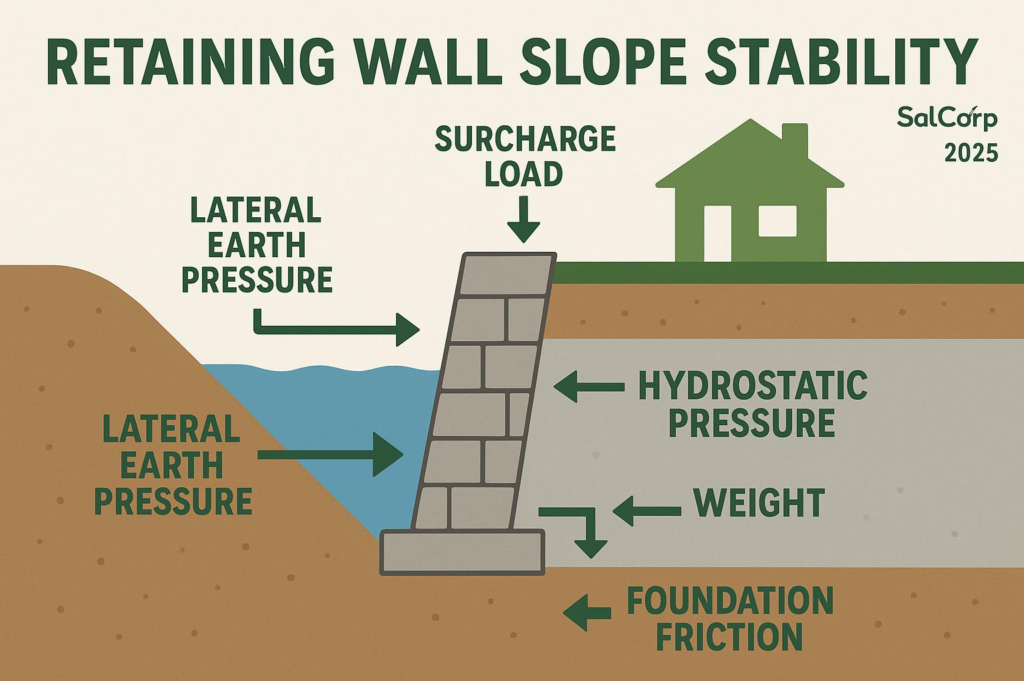
Example 3: Retaining Wall
A retaining wall must resist the lateral effects of soil behind it.
Poor drainage can create additional water pressure, increasing the demand on the wall.
Consequently, drainage is not merely a construction detail—it is part of the geotechnical design philosophy.
Real-World Applications 🌎
Buildings and Foundations
Geotechnical engineers help determine appropriate foundation systems for:
- Residential buildings
- Commercial buildings
- Industrial facilities
- High-rise structures
- Hospitals
- Schools
Bridges
Bridge foundations must account for:
- Soil strength
- Settlement
- Scour
- Groundwater
- Lateral loading
- Construction effects
Roads and Railways
Transportation infrastructure depends heavily on ground performance.
Geotechnical engineering supports:
- Pavement subgrades
- Railway formations
- Embankments
- Cut slopes
- Drainage systems
- Ground improvement
Tunnels and Underground Construction
Tunnel projects require understanding:
- Rock and soil behavior
- Groundwater
- Excavation stability
- Surface settlement
- Support systems
Dams and Earth Structures
Geotechnical principles are essential when designing:
- Earth dams
- Levees
- Embankments
- Reservoir structures
- Flood protection systems
Coastal and Urban Development
Modern projects increasingly use geophysical and geotechnical techniques together to characterize complex subsurface conditions. Recent investigations in Egypt, for example, have combined electrical resistivity, seismic refraction, and MASW methods to characterize foundation sublayers.
Common Mistakes ⚠️
Ignoring Ground Variability
Assuming the entire site has identical soil conditions can lead to incorrect foundation decisions.
Investigating Too Little
A limited number of boreholes may fail to identify weak layers, buried structures, uncontrolled fill, or groundwater conditions.
Treating Soil Like Concrete
Concrete is manufactured under controlled conditions. Natural soil is not.
Its properties may vary horizontally and vertically.
Ignoring Groundwater
Water can influence strength, effective stress, settlement, excavation stability, and earth pressure.
Focusing Only on Bearing Capacity
A foundation may have adequate ultimate strength while still producing excessive settlement.
Poor Construction Control
Even an excellent geotechnical design can perform poorly if:
- Fill is inadequately compacted
- Drainage is blocked
- Excavations are poorly supported
- Ground improvement is incomplete
- Construction differs significantly from the design assumptions
Challenges and Solutions 🛠️
| Challenge | Practical Solution |
|---|---|
| Variable soil | Increase investigation coverage |
| Soft clay | Evaluate settlement and consider improvement |
| High groundwater | Design drainage and groundwater control |
| Expansive soil | Characterize volume-change behavior |
| Loose sand | Assess density and seismic behavior |
| Steep slopes | Perform stability assessment |
| Limited site access | Combine appropriate investigation techniques |
| Unexpected ground conditions | Use monitoring and observational methods |
Managing Uncertainty
One of the biggest challenges in geotechnical engineering is that engineers cannot directly observe every cubic metre of underground material.
The solution is not to pretend uncertainty does not exist.
Instead, engineers manage it through:
Investigation → Testing → Interpretation → Design → Monitoring → Adjustment
This is one of the defining characteristics of professional geotechnical practice.
Case Study: Foundation Problems on Variable Ground 🔍
Consider a hypothetical commercial building planned on an urban site.
Historical records indicate that the site had previously been used for light industrial activities. Initial surface observations show relatively level ground, and the developer expects a conventional shallow foundation system.
A preliminary investigation, however, identifies inconsistent fill.
Further investigation reveals:
- Variable fill thickness
- A soft compressible layer beneath part of the site
- Different groundwater conditions across the property
- Stronger natural soil at greater depth
The geotechnical team develops a ground model and compares several foundation strategies.
Instead of assuming that one foundation solution will work everywhere, the project team divides the site into engineering zones.
The final approach could involve:
- Improved ground in selected areas
- Different foundation dimensions
- Localized deeper foundations
- Controlled excavation
- Drainage measures
- Construction monitoring
The key lesson is important:
The most economical geotechnical solution is not always the simplest-looking solution.
Spending more during investigation can prevent much larger costs during construction and building operation.
Essential Tips for Students and Professionals 🎓
Build Strong Soil Mechanics Fundamentals
Understand:
- Effective stress
- Shear strength
- Consolidation
- Permeability
- Compaction
- Stress distribution
- Soil classification
These concepts form the foundation of advanced geotechnical engineering.
Learn to Read Borehole Logs
A borehole log is one of the most valuable documents in geotechnical engineering.
Learn how to interpret:
- Soil descriptions
- Layer boundaries
- Groundwater levels
- Sampling information
- Field test results
- Rock descriptions
Develop Engineering Judgment
Geotechnical engineering is not simply a matter of entering numbers into software.
Computer models can be powerful, but the quality of the result depends heavily on the quality of the ground model and input assumptions.
Connect Theory With Construction
Visit construction sites whenever possible.
Observe:
- Excavation
- Foundation preparation
- Soil compaction
- Pile installation
- Groundwater control
- Retaining systems
Seeing soil behavior in practice makes classroom concepts much easier to understand.
Always Think About Water 💧
Whenever you evaluate a geotechnical problem, ask:
Where is the water?
Then ask:
How could the water level change?
This simple habit can reveal important design considerations.
FAQs ❓
What is the main purpose of geotechnical engineering?
Its main purpose is to understand and predict the behavior of soil and rock so structures can be designed and constructed safely, economically, and with acceptable performance.
Why is site investigation important?
Site investigation identifies subsurface conditions, soil and rock properties, groundwater conditions, and potential construction problems. This information supports foundation selection and other geotechnical decisions.
What is the difference between soil mechanics and geotechnical engineering?
Soil mechanics focuses primarily on understanding soil behavior and properties. Geotechnical engineering applies that knowledge to practical engineering problems such as foundations, slopes, retaining walls, excavations, and earth structures.
Why can buildings settle?
Buildings settle because the soil beneath their foundations deforms under loading. Settlement can be influenced by soil type, density, groundwater, compressibility, drainage, and construction conditions.
Are shallow foundations always cheaper than deep foundations?
Not necessarily. Shallow foundations are often simpler, but weak near-surface soil may require extensive improvement or large foundation dimensions. A deep foundation can sometimes provide a more practical overall solution.
Why is groundwater important in geotechnical engineering?
Groundwater affects pore pressure, effective stress, soil strength, settlement, excavation stability, seepage, and earth pressures.
Can software replace a geotechnical engineer?
No. Software can perform sophisticated calculations and simulations, but engineers must establish appropriate soil models, select realistic parameters, evaluate uncertainty, interpret results, and make engineering decisions.
What should a beginner study first?
Start with soil classification, phase relationships, compaction, permeability, effective stress, shear strength, consolidation, site investigation, and foundation fundamentals. Then progress toward slope stability, advanced foundation analysis, numerical modeling, and earthquake geotechnics.
Conclusion 🏁
The principles of geotechnical engineering provide the foundation for understanding how structures interact with the natural ground.
The discipline combines geology, soil mechanics, field investigation, laboratory testing, engineering judgment, structural requirements, groundwater analysis, and construction knowledge.
The most important lesson is simple:
Every structure depends on the ground, and the ground must be understood before it can be trusted. 🌍🏗️
A successful geotechnical engineer therefore does more than calculate foundation capacity. They investigate the site, understand soil variability, evaluate groundwater, anticipate settlement, assess stability, consider construction conditions, and manage uncertainty.
For students, mastering these fundamentals creates a pathway toward foundation engineering, structural support systems, transportation infrastructure, tunnelling, environmental engineering, and advanced geotechnical analysis.
For professionals, the same principles remain relevant even as projects become larger and analytical tools become more sophisticated.
Ultimately, good geotechnical engineering is a balance between science, observation, analysis, experience, and practical construction judgment. When these elements work together, engineers can create safer foundations, more reliable infrastructure, and structures capable of performing successfully for decades. 🌎🔧