Fundamentals of Electronics: Book 1: Electronic Devices and Circuit Applications: A Complete Beginner-to-Professional Guide
🚀 Introduction
Electronics is one of the most influential branches of engineering, powering nearly every aspect of modern life. From smartphones 📱 and laptops 💻 to satellites 🛰️, electric vehicles 🚗, medical equipment 🏥, and industrial automation 🤖, electronic systems form the foundation of today’s technology-driven society.
One of the most respected learning resources in this field is Fundamentals of Electronics: Book 1 – Electronic Devices and Circuit Applications. It introduces readers to semiconductor physics, electronic components, and circuit design principles while providing practical applications used by professional engineers.
Whether you are:
- 🎓 Engineering student
- 🔬 Electronics hobbyist
- ⚡ Electrical technician
- 💼 Professional engineer
- 🤖 Robotics or IoT developer
this guide provides an excellent foundation for understanding how electronic devices work and how they are applied in real-world systems.


📘 Background Theory
Modern electronics began with the invention of the vacuum tube in the early 20th century. Although vacuum tubes revolutionized communications, they were large, fragile, and consumed significant power.
Everything changed in 1947 with the invention of the transistor at Bell Laboratories.
This invention eventually led to:
- 💻 Personal computers
- 📱 Smartphones
- 🌐 Internet infrastructure
- 🚀 Space exploration
- 🤖 Artificial Intelligence hardware
- 🛰️ Satellite communications
Today’s electronic systems rely on semiconductor materials such as:
- Silicon
- Germanium
- Gallium Arsenide
- Silicon Carbide
These materials allow engineers to precisely control electrical current.
📖 Definition
Fundamentals of Electronics refers to the study of electronic components, semiconductor devices, and electrical circuits used to control, amplify, process, and transmit electrical signals.
The subject includes:
- Semiconductor Physics
- Diodes
- Transistors
- Amplifiers
- Digital Electronics
- Power Electronics
- Analog Circuits
- Integrated Circuits (ICs)
🔍 Understanding Electronic Devices Step by Step


Step 1 — Learn Basic Electrical Quantities
Every electronic circuit starts with three fundamental quantities:
| Quantity | Symbol | Unit |
|---|---|---|
| Voltage | V | Volt |
| Current | I | Ampere |
| Resistance | R | Ohm |
Understanding the relationship among these variables is essential.
Step 2 — Study Semiconductor Materials
Unlike conductors and insulators, semiconductors have controlled conductivity.
The most common materials include:
- Silicon
- Germanium
Doping creates:
- N-Type material
- P-Type material
These materials form the basis of nearly every electronic device.
Step 3 — Understand PN Junctions
When P-type and N-type materials are joined, they form a PN Junction.
This allows current to flow primarily in one direction.
Applications include:
- Rectifiers
- Signal detectors
- Voltage regulation
- Switching circuits
Step 4 — Learn Diodes
Diodes are the simplest semiconductor devices.
Common types include:
- Rectifier Diodes
- Zener Diodes
- Schottky Diodes
- LED
- Photodiodes
- Laser Diodes
Each serves different purposes.
Step 5 — Learn Transistors
Transistors revolutionized electronics.
Their primary functions are:
✅ Switching
✅ Amplification
Types include:
- BJT
- MOSFET
- JFET
- IGBT
Step 6 — Build Simple Circuits
After understanding components, engineers begin building circuits.
Examples include:
- LED circuits
- Amplifiers
- Oscillators
- Voltage regulators
- Timers
⚖️ Comparison of Major Electronic Devices
| Device | Main Function | Speed | Power Handling | Common Applications |
|---|---|---|---|---|
| Diode | Current Control | High | Medium | Rectifiers |
| BJT | Amplification | Medium | Medium | Audio Amplifiers |
| MOSFET | Switching | Very High | High | SMPS, CPUs |
| IGBT | High Power Switching | Medium | Very High | Electric Vehicles |
| SCR | Controlled Rectification | Medium | Very High | Motor Drives |
| TRIAC | AC Switching | Medium | High | Light Dimmers |
📊 Circuit Diagrams and Electronic Concepts


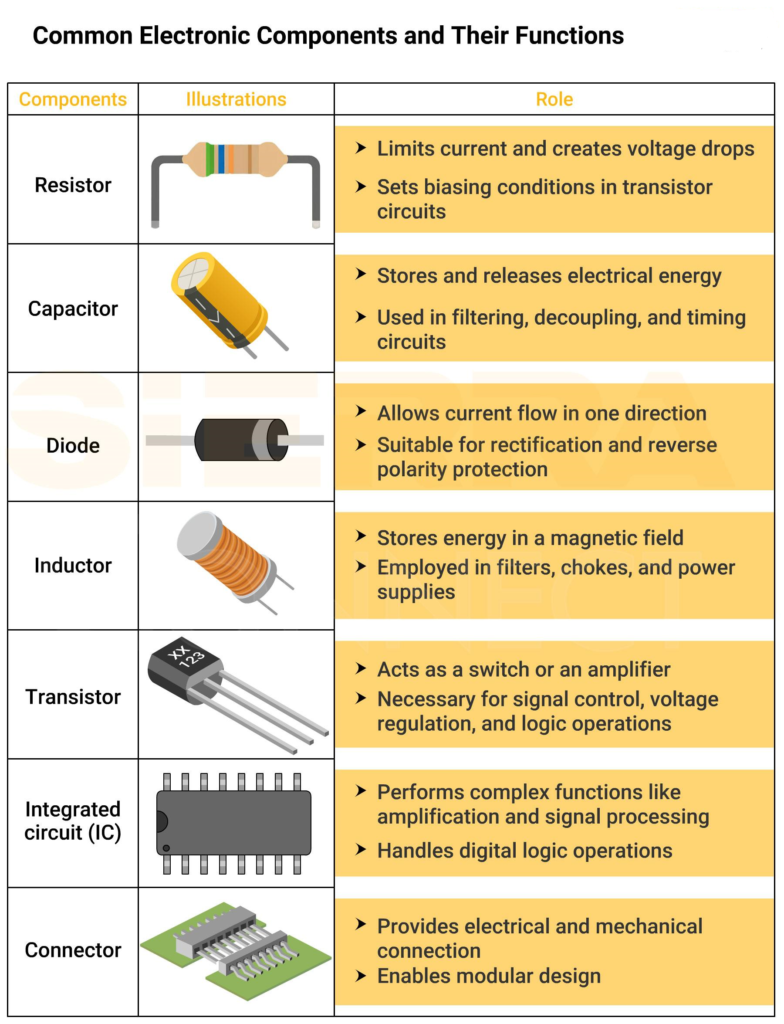
Typical Electronic Circuit Flow
Power Supply
      │
      ▼
 Input Stage
      │
      ▼
 Signal Processing
      │
      ▼
 Amplifier
      │
      ▼
 Output Device
Basic Electronic Component Table
| Component | Symbol | Purpose |
|---|---|---|
| Resistor | R | Limits current |
| Capacitor | C | Stores energy |
| Inductor | L | Magnetic storage |
| Diode | D | One-way current |
| Transistor | Q | Amplification |
| IC | U | Integrated functions |
Semiconductor Device Categories
| Category | Examples |
|---|---|
| Passive Components | R, C, L |
| Active Components | BJT, MOSFET |
| Power Devices | SCR, IGBT |
| Optoelectronics | LED, Photodiode |
| Logic Devices | NAND, NOR ICs |
💡 Practical Examples
Example 1 – LED Flashlight
Components:
- Battery
- Switch
- LED
- Resistor
Operation:
Current flows through the resistor into the LED, producing light.
Example 2 – Smartphone Charger
Contains:
- Rectifier
- Transformer
- MOSFET
- PWM Controller
- Capacitors
Purpose:
Converts AC power into regulated DC voltage.
Example 3 – Temperature Sensor
Uses:
- Thermistor
- Amplifier
- ADC
- Microcontroller
Applications:
- HVAC
- Medical Devices
- Smart Homes
🌍 Real-World Applications
Electronics are found almost everywhere.
Automotive 🚗
- Engine Control Units
- ABS Systems
- Airbags
- Battery Management
- Electric Vehicles
Medical 🏥
- MRI Machines
- ECG Systems
- X-Ray Equipment
- Pacemakers
Aerospace 🚀
- Flight Controllers
- Satellite Systems
- Navigation Electronics
- Radar
Telecommunications 📡
- Cellular Towers
- Fiber Optics
- Routers
- 5G Infrastructure
Consumer Electronics 📱
- TVs
- Smart Watches
- Gaming Consoles
- Tablets
- Cameras
Industrial Automation 🤖
- PLC Systems
- CNC Machines
- Industrial Robots
- Motor Controllers
❌ Common Mistakes
Many beginners encounter similar problems.
Ignoring Component Ratings
Using incorrect voltage or current ratings often damages components.
Incorrect Polarity
Reversing:
- Diodes
- LEDs
- Electrolytic Capacitors
may permanently destroy them.
Poor Soldering
Cold solder joints increase resistance and reduce reliability.
Missing Ground Connections
A missing ground often prevents circuits from functioning correctly.
No Heat Management
Power devices require proper heat sinks and cooling.
⚠️ Challenges and Solutions
| Challenge | Solution |
|---|---|
| Component Failure | Select proper ratings |
| Electrical Noise | Shielding and filtering |
| Heat Generation | Heat sinks and cooling fans |
| PCB Errors | Simulation before fabrication |
| Voltage Spikes | Protection circuits |
| EMI | Proper PCB layout |
🏆 Case Study – Designing a Solar Battery Charger
Objective
Develop a portable charger for remote environments.
Components Used
- Solar Panel ☀️
- MPPT Controller
- MOSFET
- Battery
- Protection Circuit
- Microcontroller
Engineering Process
- Capture solar energy.
- Convert power efficiently.
- Charge the battery safely.
- Monitor battery voltage.
- Protect against overcharging.
Results
- Higher charging efficiency
- Longer battery lifespan
- Improved reliability
- Reduced energy loss
This project demonstrates how semiconductor devices, power electronics, and intelligent control combine in practical engineering.
⭐ Essential Tips
✔ Always understand the theory before building circuits.
✔ Practice using breadboards before designing PCBs.
🚀 Read datasheets carefully.
✔ Use simulation software such as LTspice or Multisim.
✔ Learn proper soldering techniques.
🚀 Organize components using labeled storage.
✔ Use multimeters and oscilloscopes regularly.
✔ Keep safety as the highest priority when working with electricity.
🚀 Document every project for troubleshooting and future improvements.
✔ Continue learning about modern topics like IoT, embedded systems, and power electronics.
❓ Frequently Asked Questions (FAQs)
1. Is this book suitable for complete beginners?
Yes. It starts with basic electrical concepts and gradually introduces semiconductor devices and circuit applications.
2. Do I need advanced mathematics?
No. Basic algebra and elementary physics are sufficient for the introductory concepts, though advanced circuit analysis later benefits from calculus and differential equations.
3. What software is useful for practicing electronics?
Popular choices include LTspice, Multisim, Proteus, KiCad, and Altium Designer for simulation and PCB design.
4. What is the difference between electrical and electronic engineering?
Electrical engineering mainly deals with power generation, transmission, and high-voltage systems, while electronics focuses on low-power devices, signal processing, communication systems, and semiconductor technologies.
5. Why are transistors considered so important?
Transistors act as switches and amplifiers. Modern computers, smartphones, and digital systems contain billions of them integrated into microchips.
6. What laboratory tools should beginners own?
A digital multimeter, breadboard, jumper wires, power supply, soldering iron, wire cutters, and a basic assortment of resistors, capacitors, diodes, and transistors are excellent starting tools.
7. How can I improve my electronics skills?
Build hands-on projects, read datasheets, analyze existing circuits, practice troubleshooting, and work through progressively more challenging designs.
🎯 Conclusion
Fundamentals of Electronics: Book 1 – Electronic Devices and Circuit Applications provides a solid foundation for anyone seeking to understand modern electronic systems. By mastering semiconductor theory, electronic components, circuit analysis, and practical design techniques, readers develop the knowledge required to create reliable and efficient electronic solutions.
From simple LED circuits to advanced industrial automation, the same core principles apply. Consistent practice, careful experimentation, and a willingness to explore new technologies will help students and professionals build strong engineering skills that remain valuable across industries including telecommunications, robotics, automotive electronics, renewable energy, aerospace, healthcare, and embedded systems. As electronic technology continues to evolve, a firm grasp of these fundamentals remains one of the most important investments an engineer can make.