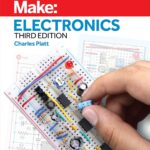
⚡ Electronics For Dummies 3rd Edition: Electronics for Beginners and Professionals: A Complete Engineering Guide 🔬
📘 Introduction
Electronics is one of the most important foundations of modern technology. From smartphones and laptops to satellites and electric vehicles, nearly every modern system relies on electronic circuits and components. Understanding electronics allows engineers, students, hobbyists, and professionals to design, build, troubleshoot, and innovate technological systems.
Many learners find electronics intimidating at first. Circuit diagrams, unfamiliar symbols, mathematical equations, and tiny electronic components can feel overwhelming. However, once the core principles are understood, electronics becomes a logical and fascinating discipline.
This guide presents a comprehensive engineering explanation inspired by the educational approach of beginner-friendly electronics learning resources. It is written for:
🎓 Engineering students
🛠 Electronics hobbyists
👨💻 Technology professionals
🔬 Researchers and innovators
The article gradually moves from beginner concepts to more advanced engineering perspectives, making it useful for both newcomers and experienced engineers.
You will learn:
Fundamental electronics theory
Essential electronic components
Circuit design basics
Real-world engineering applications
Common mistakes beginners make
Professional engineering insights
By the end of this article, you will have a strong conceptual and practical understanding of electronics systems.
⚡ Background Theory of Electronics
Electronics is built on the behavior and control of electrons, which are tiny negatively charged particles that move through materials.
Electronic systems manipulate this movement to perform useful tasks such as:
Processing information
Amplifying signals
Storing data
Controlling machines
Communicating wirelessly
🔋 Electricity vs Electronics
Although the terms are often used interchangeably, there is an important distinction.
| Concept | Description | Example |
|---|---|---|
| Electricity | Movement of electrical energy for power | Power grid, lighting |
| Electronics | Control and manipulation of electrons for information and computation | Computers, radios |
Electricity focuses mainly on power delivery, while electronics focuses on signal control.
⚙️ Fundamental Electrical Quantities
Understanding electronics begins with three key electrical quantities.
Voltage (V)
Voltage represents electrical pressure that pushes electrons through a circuit.
Example sources:
Batteries
Power supplies
Solar panels
Higher voltage means stronger potential energy pushing electrons.
Current (I)
Current is the flow rate of electrons through a conductor.
Measured in amperes (A).
Example:
If many electrons flow quickly through a wire, the current is high.
Resistance (R)
Resistance opposes the flow of current.
Measured in ohms (Ω).
Different materials resist electron movement differently.
Examples:
Copper → low resistance
Rubber → high resistance
📐 Ohm’s Law
One of the most important equations in electronics.
V=I×R
Where:
V = Voltage
I = Current
R = Resistance
This simple equation allows engineers to calculate how circuits behave.
⚡ Power in Electronics
Power represents the rate of energy consumption.
P=V×I
Where:
P = Power (Watts)
V = Voltage
I = Current
Example:
A 12-volt device drawing 2 amps consumes:
P=12×2=24W
🔬 Technical Definition of Electronics
Electronics is the branch of engineering that studies the design, analysis, and application of circuits that control the flow of electrons using active and passive components.
These components include:
Resistors
Capacitors
Diodes
Transistors
Integrated circuits
Electronics systems convert electrical energy into:
Signals
Data
Computation
Control mechanisms
Modern electronics engineering combines several disciplines:
Electrical engineering
Computer engineering
Physics
Materials science
🧩 Basic Electronic Components
Understanding electronics requires familiarity with the main components used in circuits.
🔹 Resistors
Resistors limit current flow.
Symbol:
Functions:
Protect components
Control voltage
Divide signals
Example applications:
LED current control
Voltage dividers
🔹 Capacitors
Capacitors store electrical energy temporarily.
Symbol:
Uses:
Filtering signals
Energy storage
Timing circuits
Example:
Capacitors smooth power supply fluctuations.
🔹 Diodes
Diodes allow current to flow in one direction only.
Symbol:
Applications:
Rectifiers
Protection circuits
Signal demodulation
🔹 Transistors
Transistors act as electronic switches or amplifiers.
Symbol example (NPN transistor):
Transistors form the basis of:
Amplifiers
Logic gates
Microprocessors
🔹 Integrated Circuits (ICs)
Integrated circuits combine thousands or billions of transistors into one chip.
Examples include:
Microcontrollers
CPUs
Memory chips
Amplifiers
ICs revolutionized electronics by making devices smaller and more powerful.
🔧 Step-by-Step Explanation: How a Simple Circuit Works
Let’s understand a simple LED circuit.
Step 1: Power Source
A battery provides voltage.
Example:
9V battery.
Step 2: Current Limiting Resistor
A resistor prevents excessive current that could damage the LED.
Example:
330Ω resistor.
Step 3: LED Component
An LED converts electrical energy into light.
Step 4: Circuit Completion
The circuit must form a closed loop.
Diagram:
When the loop closes:
1️⃣ Voltage pushes electrons
2️⃣ Current flows through resistor
3️⃣ LED emits light
Step 5: Circuit Calculation
Example calculation:
Voltage source: 9V
LED drop: 2V
Remaining voltage:
9−2=7V
Current desired: 20mA
Resistor value:
R=V/I
R=7/0.02=350Ω
Closest resistor: 330Ω
⚖️ Comparison: Analog vs Digital Electronics
Electronics systems fall into two major categories.
| Feature | Analog Electronics | Digital Electronics |
|---|---|---|
| Signal Type | Continuous | Discrete (0 or 1) |
| Examples | Amplifiers, radios | Computers, microcontrollers |
| Accuracy | Sensitive to noise | More robust |
| Components | Transistors, op-amps | Logic gates, processors |
Most modern devices combine both analog and digital systems.
Example:
Smartphone:
Analog → microphone signals
Digital → CPU processing
📊 Circuit Diagram Symbols
Common electronics symbols used by engineers.
| Component | Symbol Representation |
|---|---|
| Resistor | //// |
| Capacitor | |
| Diode | |
| Transistor | NPN / PNP |
| Battery | + |
Understanding these symbols is essential for reading circuit diagrams.
🔍 Practical Examples
Example 1: LED Flashlight Circuit
Components:
Battery
Switch
LED
Resistor
Purpose:
Portable lighting device.
Example 2: Audio Amplifier
Components:
Transistors
Capacitors
Resistors
Purpose:
Amplify weak audio signals.
Used in:
Speakers
Radios
Home audio systems
Example 3: Temperature Sensor Circuit
Components:
Thermistor
Microcontroller
ADC converter
Application:
Smart thermostats.
🌍 Real World Applications of Electronics
Electronics power nearly every modern industry.
🏥 Medical Technology
Applications include:
ECG machines
MRI scanners
insulin pumps
wearable health monitors
Electronics allow doctors to monitor patients accurately.
🚗 Automotive Systems
Modern vehicles contain over 100 electronic control units (ECUs).
Examples:
Engine control systems
Anti-lock braking systems
Autonomous driving sensors
🛰 Telecommunications
Electronics enable global communication.
Examples:
Smartphones
Satellites
Fiber optic networks
Internet routers
🏭 Industrial Automation
Factories rely heavily on electronics.
Applications:
Programmable Logic Controllers (PLC)
Robotics
Sensors
Conveyor systems
These systems improve efficiency and reduce human error.
⚠️ Common Mistakes Beginners Make
Learning electronics involves trial and error. Beginners often make these mistakes.
1️⃣ Ignoring Ohm’s Law
Many beginners connect components without calculating current.
Result:
Burned LEDs or components.
2️⃣ Incorrect Polarity
Components like:
LEDs
Diodes
Capacitors
Must be connected in correct direction.
Incorrect polarity can destroy them.
3️⃣ Poor Breadboard Connections
Loose connections cause circuits to malfunction.
Always check wiring carefully.
4️⃣ Power Supply Mistakes
Applying too much voltage can destroy sensitive electronics.
Always verify power ratings.
🚧 Challenges & Solutions in Electronics Design
Engineering electronics systems involves several challenges.
Challenge 1: Noise and Interference
Electronic circuits often experience unwanted signals.
Solution:
Shielding
Filtering
Grounding
Challenge 2: Heat Dissipation
High power circuits produce heat.
Solution:
Heat sinks
Cooling fans
Thermal design
Challenge 3: Component Failure
Electronics can fail due to:
Overvoltage
Manufacturing defects
Aging
Solution:
Use protective components:
Fuses
Surge protectors
Voltage regulators
🧠 Case Study: Designing a Portable Phone Charger
Let’s examine a practical engineering design.
Problem
Users need portable power for smartphones.
Engineering Solution
Design a power bank using:
Lithium battery
Voltage regulator
USB output
Charging circuit
Design Components
| Component | Function |
|---|---|
| Lithium battery | Energy storage |
| Boost converter | Increase voltage |
| Charging IC | Battery protection |
| USB port | Device interface |
Design Process
1️⃣ Select battery capacity
2️⃣ Design voltage regulation
3️⃣ Add safety circuits
4️⃣ Build prototype
5️⃣ Test efficiency
Results
Portable chargers are now widely used worldwide.
They demonstrate how simple electronics concepts scale into real products.
🛠 Tips for Engineers and Students
Here are practical tips for mastering electronics.
📚 Learn the Fundamentals First
Strong understanding of:
Ohm’s law
Kirchhoff’s laws
Basic components
Forms the foundation of all electronics.
🔬 Practice with Breadboards
Hands-on experimentation helps reinforce theory.
Try building:
LED circuits
timers
small amplifiers
💻 Use Simulation Tools
Software tools allow engineers to test circuits before building them.
Examples include:
SPICE simulators
circuit modeling tools
📖 Study Datasheets
Component datasheets provide critical information:
Voltage limits
Current ratings
Operating conditions
Engineers rely heavily on datasheets.
🧠 Think Systematically
Engineering is problem solving.
Always analyze:
Inputs
outputs
power requirements
failure modes
❓ Frequently Asked Questions (FAQs)
1️⃣ What is the easiest way to start learning electronics?
Start with simple circuits such as LED circuits and gradually move to more complex designs. Use breadboards and educational kits.
2️⃣ Do engineers still use discrete components today?
Yes. Even though integrated circuits dominate modern electronics, discrete components are still widely used for power regulation, signal conditioning, and protection circuits.
3️⃣ Is mathematics required for electronics engineering?
Yes. Mathematics is essential for understanding circuit analysis, signal processing, and system design.
However, beginners can start with simple formulas like Ohm’s Law.
4️⃣ What tools are essential for beginners?
Basic tools include:
Multimeter
Breadboard
soldering iron
wire cutters
power supply
5️⃣ What is the difference between electrical engineering and electronics engineering?
Electrical engineering focuses mainly on power systems and large-scale electricity, while electronics engineering focuses on circuits, signals, and electronic devices.
6️⃣ Why are transistors so important?
Transistors are the building blocks of modern electronics. They enable switching and amplification and form the foundation of microprocessors and digital circuits.
7️⃣ How long does it take to master electronics?
Basic understanding may take months, but mastering electronics engineering typically requires several years of study and practical experience.
🧾 Conclusion
Electronics is one of the most transformative engineering fields in human history. It powers modern civilization—from communication networks and computers to medical equipment and space exploration.
By understanding the fundamentals of:
Voltage
Current
Resistance
Components
Circuit design
students and professionals gain the ability to design innovative technological solutions.
Learning electronics does not require advanced knowledge at the beginning. With curiosity, experimentation, and continuous learning, anyone can build strong skills in this field.
Whether you are:
A student starting your engineering journey
A hobbyist exploring circuits
A professional expanding technical knowledge
electronics offers endless opportunities for creativity, innovation, and technological impact.
⚡ The future of technology depends on engineers who understand how electrons move—and how to control them.