Data Structures and Algorithms in Python: The Complete Engineering Guide for Efficient Programming 🚀🐍
Introduction 🚀
Modern software engineering depends on efficient data management and problem-solving techniques. Whether you’re developing artificial intelligence systems, web applications, cybersecurity tools, robotics software, or scientific simulations, Data Structures and Algorithms (DSA) form the backbone of high-performance programming.
Python has become one of the world’s most popular programming languages because of its simplicity, readability, and powerful built-in libraries. However, writing Python code is only part of becoming an excellent developer. Understanding how data is organized and how algorithms manipulate that data is what separates beginner programmers from skilled software engineers.
Imagine searching through one million records.
- ❌ Poor algorithm: several minutes
- ✅ Optimized algorithm: milliseconds
That enormous difference comes from selecting the proper data structure and algorithm.
This comprehensive guide explores Python Data Structures and Algorithms from an engineering perspective, making it suitable for both beginners and experienced developers across the USA, UK, Canada, Australia, and Europe.

Background Theory 📚
Computer programs perform three primary operations:
- Store data
- Process data
- Retrieve data
The efficiency of these operations determines software performance.
A Data Structure determines how information is stored.
An Algorithm determines how information is processed.
Think of them like this:
- 📦 Data Structure = Storage System
- ⚙️ Algorithm = Processing Machine
Together they solve computational problems efficiently while minimizing:
- CPU usage
- Memory consumption
- Execution time
- Energy usage
Engineering software systems—from autonomous vehicles to cloud computing—depend heavily on optimized DSA.
Definition 📖
What is a Data Structure?
A data structure is a specialized format used for organizing, storing, and managing data efficiently.
It allows programmers to:
- Insert data
- Delete data
- Update information
- Search quickly
- Sort efficiently
Examples include:
- Arrays
- Lists
- Stacks
- Queues
- Trees
- Graphs
- Hash Tables
What is an Algorithm?
An algorithm is a finite sequence of instructions designed to solve a specific computational problem.
Good algorithms are:
✅ Correct
✅ Efficient
🚀 Scalable
✅ Easy to understand
Types of Data Structures 🏗️
Linear Data Structures
Elements are arranged sequentially.
Examples:
- Lists
- Arrays
- Stacks
- Queues
- Linked Lists
Advantages:
- Easy traversal
- Simple implementation
- Low learning curve
Non-linear Data Structures
Elements connect in hierarchical or network relationships.
Examples:
- Trees
- Graphs
- Heaps
- Hash Tables
Advantages:
- Faster searching
- Better scalability
- Efficient organization
Step-by-Step Explanation 🛠️


Step 1 — Create a List
numbers = [5, 10, 15]
Lists are dynamic arrays.
Step 2 — Add Elements
numbers.append(20)
Result
[5,10,15,20]
Step 3 — Remove Elements
numbers.remove(10)
Result
[5,15,20]
Step 4 — Search
if 15 in numbers:
    print("Found")
Step 5 — Sort
numbers.sort()
Output
[5,15,20]
Step 6 — Reverse
numbers.reverse()
Output
[20,15,5]
Popular Python Data Structures 📦
Lists
Best for:
- Dynamic collections
- General programming
Time Complexity
| Operation | Complexity |
|---|---|
| Access | O(1) |
| Search | O(n) |
| Insert End | O(1) |
| Delete | O(n) |
Tuples
Immutable collections.
Advantages:
- Faster
- Memory efficient
- Safe
Dictionaries
Store key-value pairs.
Example
student = {
    "Name":"Alice",
    "Age":22
}
Searching is usually:
O(1)
Sets
Useful for:
- Removing duplicates
- Membership testing
- Mathematical operations
Stacks
LIFO
Last In First Out
Example:
Push

1
2
3

Pop

3
Applications:
- Undo feature
- Browser history
- Expression evaluation
Queues
FIFO
First In First Out
Applications:
- Printer scheduling
- Customer service
- Task processing
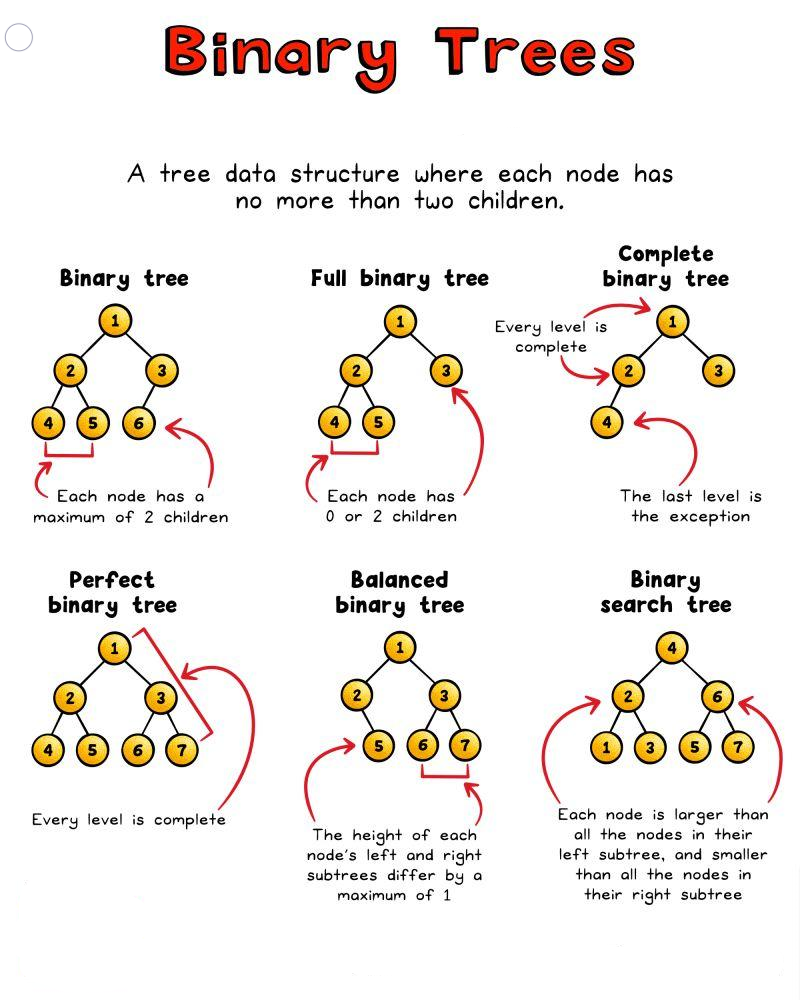
Trees
Hierarchical structures.
Applications:
- File systems
- Databases
- Search engines
Graphs
Represent relationships.
Applications:
- GPS navigation
- Social media
- Network routing
Common Algorithms ⚙️
Searching Algorithms
- Linear Search
- Binary Search
Binary Search complexity
O(log n)
Sorting Algorithms
Popular methods:
- Bubble Sort
- Selection Sort
- Merge Sort
- Quick Sort
- Heap Sort
Graph Algorithms
Examples:
- BFS
- DFS
- Dijkstra
- A*
Dynamic Programming
Used when problems contain overlapping subproblems.
Examples:
- Fibonacci
- Knapsack
- Longest Common Subsequence
Greedy Algorithms
Examples:
- Huffman Coding
- Activity Selection
- Minimum Spanning Tree
Comparison ⚖️
| Data Structure | Fast Search | Fast Insert | Ordered | Memory |
|---|---|---|---|---|
| List | No | Yes | Yes | Medium |
| Tuple | Medium | No | Yes | Low |
| Dictionary | Excellent | Excellent | Yes* | Medium |
| Set | Excellent | Excellent | No | Medium |
| Stack | Good | Excellent | Yes | Low |
| Queue | Good | Excellent | Yes | Low |
| Tree | Excellent | Good | Yes | Medium |
| Graph | Depends | Good | No | High |
Diagrams & Tables 📊


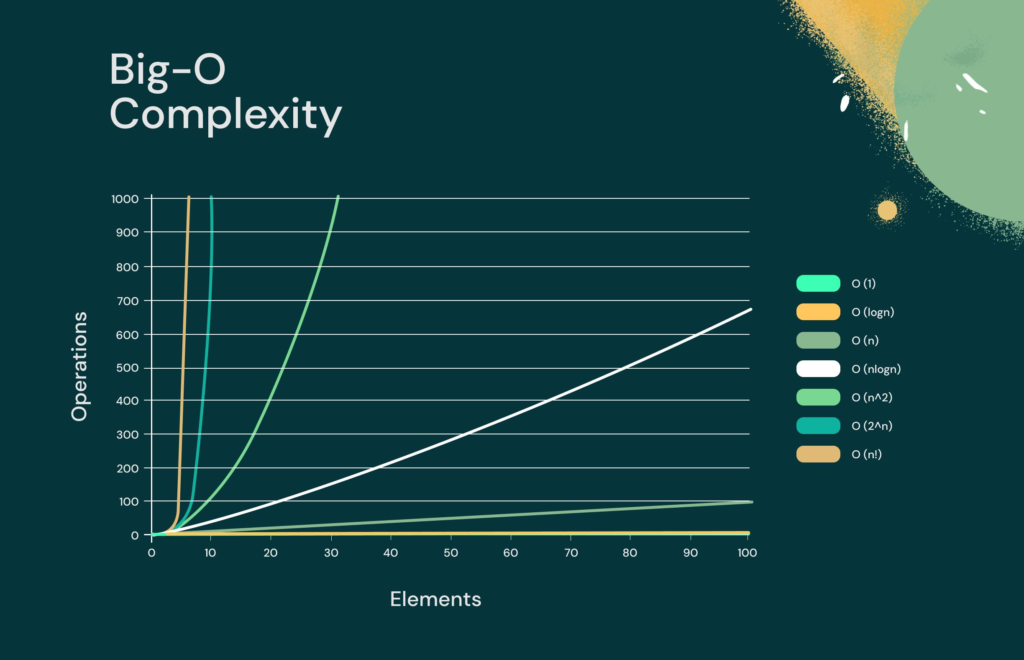


Big-O Complexity Table
| Algorithm | Best | Average | Worst |
|---|---|---|---|
| Linear Search | O(1) | O(n) | O(n) |
| Binary Search | O(1) | O(log n) | O(log n) |
| Bubble Sort | O(n) | O(n²) | O(n²) |
| Merge Sort | O(n log n) | O(n log n) | O(n log n) |
| Quick Sort | O(n log n) | O(n log n) | O(n²) |
| Heap Sort | O(n log n) | O(n log n) | O(n log n) |
Stack Diagram
Top
│ 7 │
│ 5 │
│ 2 │
─────
Queue Diagram
Front

1 → 2 → 3 → 4

Rear
Examples 💻
Example 1 — Binary Search
def binary_search(arr,target):
    left=0
    right=len(arr)-1

    while left<=right:
        mid=(left+right)//2

        if arr[mid]==target:
            return mid

        elif arr[mid]<target:
            left=mid+1

        else:
            right=mid-1

    return -1
Example 2 — Stack
stack=[]

stack.append(10)
stack.append(20)

print(stack.pop())
Output
20
Example 3 — Dictionary
prices={
    "Laptop":1200,
    "Mouse":25
}

print(prices["Laptop"])
Real-World Applications 🌍
Data Structures and Algorithms are used in almost every engineering discipline.
Artificial Intelligence 🤖
- Neural networks
- Machine learning
- Recommendation systems
Robotics 🤖
- Motion planning
- Sensor fusion
- Path optimization
Cybersecurity 🔒
- Encryption
- Malware detection
- Digital forensics
Web Development 🌐
- Caching
- Database indexing
- API optimization
Data Science 📈
- Data preprocessing
- Statistical analysis
- Large-scale computation
Game Development 🎮
- Collision detection
- AI pathfinding
- Physics engines
Cloud Computing ☁️
- Distributed databases
- Load balancing
- Resource scheduling
Common Mistakes ❌
Many beginners struggle with DSA because they focus only on making code work instead of making it efficient. Common mistakes include:
- 🚫 Choosing a list when a dictionary provides faster lookups.
- 🚫 Ignoring algorithm complexity.
- 🚀Writing deeply nested loops without considering performance.
- 🚫 Using recursion without a proper base case.
- 🚫 Sorting data repeatedly instead of maintaining order.
- 🚀 Not testing edge cases such as empty inputs or duplicate values.
- 🚫 Overlooking Python’s built-in optimized data structures from the
collectionsmodule.
Avoiding these mistakes leads to faster, cleaner, and more maintainable software.
Challenges & Solutions 🛡️
| Challenge | Solution |
|---|---|
| Slow execution | Use efficient algorithms |
| High memory usage | Choose compact data structures |
| Large datasets | Apply indexing and hashing |
| Poor scalability | Analyze Big-O complexity |
| Complex code | Break problems into smaller functions |
| Frequent searches | Use dictionaries or balanced trees |
| Repeated calculations | Apply memoization or dynamic programming |
Case Study 🏢
Optimizing an Online Bookstore Search Engine
An engineering team developed an online bookstore containing over 5 million books. Initially, product searches relied on a simple linear search through every record, resulting in average response times of 4–6 seconds during peak traffic.
To improve performance, the team redesigned the search system:
- Product information was indexed using hash tables (Python dictionaries) for direct key-based access.
- Categories were organized with tree-like structures to speed up hierarchical browsing.
- Frequently searched items were cached in memory.
- Product rankings were maintained using efficient sorting algorithms instead of repeated full sorts.
After deployment, average search time dropped to under 100 milliseconds, significantly improving user experience and reducing server load. This case demonstrates how selecting the right data structures and algorithms can transform application performance at scale.
Essential Tips 💡
- 📘 Learn Big-O notation before memorizing algorithms.
- 🧩 Understand why a data structure fits a problem, not just how to use it.
- 🐍 Practice implementing structures manually instead of relying only on Python libraries.
- 🧪 Test your solutions with large datasets and edge cases.
- 📊 Profile your code to identify bottlenecks before optimizing.
- 🔄 Compare multiple algorithmic approaches for the same problem.
- 🏗️ Build small projects—such as search engines, inventory systems, or route planners—to reinforce concepts.
- 📚 Solve coding challenges regularly to strengthen problem-solving skills.
Frequently Asked Questions ❓
1. Why are Data Structures and Algorithms important?
They improve software efficiency, reduce execution time, optimize memory usage, and enable applications to scale effectively.
2. Is Python suitable for learning DSA?
Yes. Python’s clear syntax allows learners to focus on algorithmic thinking while still providing powerful built-in data structures.
3. What is Big-O notation?
Big-O notation measures how an algorithm’s time or memory requirements grow as the input size increases, helping engineers compare efficiency.
4. Which Python data structure is fastest for searching?
A dictionary generally offers average O(1) lookup time, making it one of the fastest options for key-based searches.
5. What algorithms should beginners learn first?
Start with linear search, binary search, bubble sort, insertion sort, recursion, stacks, queues, and basic tree traversals before moving to advanced topics.
6. Are Data Structures and Algorithms required for AI and Machine Learning?
Absolutely. Efficient data handling, graph processing, optimization, and search algorithms are fundamental to many AI and machine learning workflows.
7. How can I improve my DSA skills?
Practice consistently, analyze time complexity, solve real-world problems, participate in coding challenges, and review different algorithmic approaches.
Conclusion 🎯
Data Structures and Algorithms in Python are the foundation of efficient software engineering. They empower developers to organize information intelligently, solve computational problems effectively, and build applications that remain fast and reliable as they grow. From simple lists and dictionaries to advanced trees, graphs, and dynamic programming techniques, mastering DSA equips both students and professionals with the skills needed for modern engineering challenges.
Whether you’re developing web platforms, AI systems, robotics software, cloud services, or scientific applications, investing time in understanding Data Structures and Algorithms will significantly improve your programming expertise, code quality, and career opportunities. By combining Python’s expressive syntax with sound algorithmic thinking, you can create solutions that are not only functional but also scalable, maintainable, and ready for real-world engineering demands. 🚀