A Common-Sense Guide to Data Structures and Algorithms in Python, Volume 1: The Beginner-to-Professional Handbook for Writing Faster, Smarter Code 🚀
Introduction 🧠
Every software application—from Google Search and Amazon recommendations to banking systems and self-driving cars—relies on Data Structures and Algorithms (DSA).
Many beginners believe DSA is difficult because textbooks often focus heavily on mathematics and theory. However, the reality is much simpler.
Think of a data structure as the way you organize your toolbox 🧰.
Think of an algorithm as the instructions you follow to complete a task efficiently.
Python makes learning DSA easier than almost any programming language because it provides powerful built-in structures while allowing developers to understand what’s happening behind the scenes.
Whether you’re:
- 🎓 Computer Science student
- 💻 Python developer
- 🤖 AI engineer
- 📊 Data scientist
- ☁️ Cloud engineer
- 🔧 Software professional
understanding DSA will dramatically improve your programming skills.
In this guide, we’ll explore the foundations of Data Structures and Algorithms using practical Python examples suitable for both beginners and experienced engineers.


Background Theory 📚
Before computers existed, mathematicians were already studying efficient methods for solving problems.
As computers became faster, software engineers realized something important:
Hardware becomes faster every year.
Bad algorithms stay slow forever.
Imagine searching for one name inside:
- 📒 A notebook with 100 names
- 📚 A phone book with 1 million names
The way information is organized determines how quickly you find it.
This is exactly why data structures exist.
Algorithms are the logical procedures that operate on these structures to solve problems efficiently.
Together they form the foundation of:
- Artificial Intelligence
- Database Systems
- Operating Systems
- Search Engines
- Machine Learning
- Robotics
- Web Development
- Cybersecurity
Definition 📖
What is a Data Structure?
A data structure is a specialized way of organizing and storing information so it can be accessed and modified efficiently.
Examples include:
- Lists
- Arrays
- Linked Lists
- Stacks
- Queues
- Trees
- Graphs
- Hash Tables
- Heaps
What is an Algorithm?
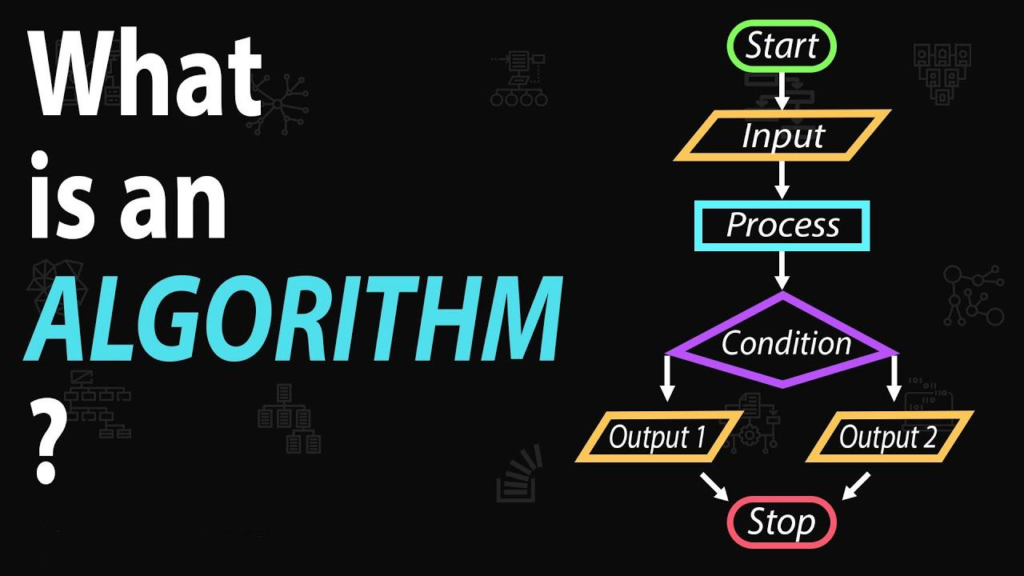
An algorithm is a finite sequence of instructions designed to solve a specific problem.
Examples include:
- Sorting numbers
- Searching for data
- Finding shortest paths
- Compressing files
- Encrypting information
Python Makes DSA Easier 🐍
Python provides built-in structures like:
list()
tuple()
dict()
set()
These allow developers to focus on understanding concepts before implementing complex structures manually.
Understanding the Core Data Structures Step by Step 🪜


Lists
Lists store ordered collections.
numbers = [10,20,30]
Advantages:
🚀 Dynamic size
✅ Easy indexing
✅ Fast append operations
Disadvantages:
❌ Slow insertion at beginning
Tuples
Immutable collections.
point = (10,20)
Advantages:
- Faster than lists
- Memory efficient
- Safe from modification
Sets
Store unique values.
colors = {"Red","Blue","Green"}
Perfect for:
- Removing duplicates
- Membership testing
Dictionaries
Python’s hash tables.
student = {
"name":"Emma",
"Grade":92
}
Fast lookups make dictionaries one of Python’s most powerful tools.
Stacks 📚
Last In First Out (LIFO)
Like stacking books.
Book3
Book2
Book1
Operations:
- Push
- Pop
- Peek
Applications:
- Undo functionality
- Browser history
- Function calls
Queues 🚍
First In First Out (FIFO)
Like waiting in line.
Alice
Bob
Charlie
Applications:
- Printer jobs
- CPU scheduling
- Customer service systems
Trees 🌳
Hierarchical structures.
Examples:
- File systems
- XML
- HTML DOM
- Decision Trees
Graphs 🌐
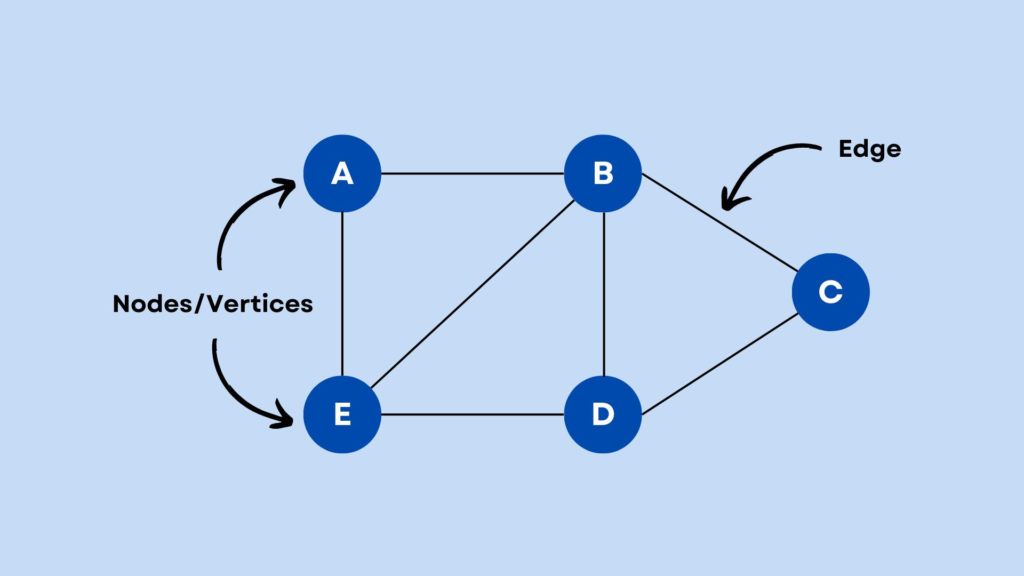
Represent relationships.
Examples:
- Google Maps
- Facebook Friends
- Airline Routes
- Computer Networks
How Algorithms Work Step by Step ⚙️
Consider finding the number 88.
Linear Search
Look through every item.
12
54
88 ✔
100
Worst-case performance:
O(n)
Binary Search
Requires sorted data.
10 20 30 40 50 60 70 80 90
Check the middle first.
Discard half.
Repeat.
Performance:
O(log n)
Much faster.
Bubble Sort
Compare neighboring values.
Swap if needed.
Repeat until sorted.
Simple but inefficient.
Merge Sort
Divide
↓
Sort
↓
Merge
Performance:
O(n log n)
Excellent for large datasets.
Quick Sort
Choose pivot
↓
Partition
↓
Recursively sort
One of the fastest practical sorting algorithms.
Comparison Table 📊
| Structure | Ordered | Mutable | Fast Lookup | Typical Use |
|---|---|---|---|---|
| List | ✅ | ✅ | Medium | General storage |
| Tuple | ✅ | ❌ | Medium | Fixed records |
| Set | ❌ | ✅ | Very Fast | Unique elements |
| Dictionary | ❌ | ✅ | Extremely Fast | Key-value storage |
| Stack | Yes | Yes | Fast | Undo operations |
| Queue | Yes | Yes | Fast | Scheduling |
| Tree | Yes | Yes | Fast | Hierarchies |
| Graph | Flexible | Yes | Variable | Networks |
Visual Overview of Major Structures 🖼️


Simple Tree Diagram
          A
        /   \
       B     C
      / \
     D   E
Simple Graph
A ----- B
|       |
|       |
C ----- D
Stack
Top
---
9
5
2
---
Bottom
Queue
Front

A -> B -> C -> D

Rear
Time Complexity Explained ⏱️
One of the most important concepts in DSA is Big O Notation, which describes how an algorithm’s runtime grows as the input size increases.
| Complexity | Performance | Example |
|---|---|---|
| O(1) | Excellent 🚀 | Dictionary lookup |
| O(log n) | Very Fast | Binary Search |
| O(n) | Good | Linear Search |
| O(n log n) | Efficient | Merge Sort |
| O(n²) | Slow | Bubble Sort |
| O(2ⁿ) | Extremely Slow | Brute-force recursion |
Choosing a better algorithm often has a much greater impact than upgrading hardware.
Python Examples 💻
Example 1
Reverse a list.
numbers=[1,2,3,4]

numbers.reverse()

print(numbers)
Output
4
3
2
1
Example 2
Dictionary lookup.
grades={
"Alice":95,
"Bob":88
}

print(grades["Alice"])
Example 3
Stack.
stack=[]

stack.append(10)

stack.append(20)

stack.pop()
Example 4
Queue.
from collections import deque

queue=deque()

queue.append(1)

queue.append(2)

queue.popleft()
Real-World Applications 🌍
DSA powers countless technologies:
- 🔍 Search engines index billions of web pages using trees and graphs.
- 🛒 E-commerce platforms manage inventory with hash tables and databases.
- 🚗 Navigation apps compute the shortest routes using graph algorithms.
- 🎬 Streaming services recommend content through graph analysis and machine learning.
- 🏥 Healthcare systems organize patient records with efficient data structures.
- 💰 Financial institutions process transactions using optimized queues and trees.
- 🤖 Artificial intelligence models rely on efficient algorithms for data processing.
- ☁️ Cloud platforms manage distributed systems using advanced scheduling algorithms.
Common Mistakes ❌
Many learners encounter similar issues:
- ❌ Memorizing code without understanding concepts.
- ❌ Ignoring time and space complexity.
- 🚀 Using lists when dictionaries provide faster lookups.
- ❌ Selecting inefficient sorting algorithms for large datasets.
- ❌ Forgetting that recursion has memory costs.
- 🚀 Overengineering simple problems with overly complex structures.
Challenges and Practical Solutions 🛠️
| Challenge | Solution |
|---|---|
| Choosing the right structure | Analyze data access patterns before coding. |
| Slow performance | Measure complexity and optimize bottlenecks. |
| Large datasets | Prefer algorithms with O(n log n) or better when possible. |
| Memory constraints | Use compact structures such as tuples where appropriate. |
| Difficult debugging | Break algorithms into smaller functions and test incrementally. |
Case Study 📈
Optimizing an Online Book Store
An online engineering bookstore initially stored all book information in a single list. Every search required scanning the entire collection, causing noticeable delays as the catalog grew.
Initial approach:
- Data stored in a list.
- Search performed with linear search.
- Time complexity: O(n).
Improved approach:
- Store books in a dictionary keyed by ISBN.
- Retrieve records directly.
- Average lookup complexity: O(1).
Results:
| Metric | Before | After |
|---|---|---|
| Search speed | Slow | Instant |
| Scalability | Limited | Excellent |
| User experience | Poor | Great |
| Server workload | High | Reduced |
This simple design change significantly improved responsiveness without requiring more powerful hardware.
Essential Tips ⭐
- 🚀 Master Python lists before learning linked lists.
- 📚 Practice one data structure at a time.
- 🎯 Focus on understanding why an algorithm works, not just how.
- 📈 Analyze time and space complexity for every solution.
- 🧩 Solve coding challenges consistently to reinforce concepts.
- 🛠️ Build small projects that combine multiple structures.
- 📖 Read well-written code from experienced developers.
- 🔄 Review and refactor your own implementations regularly.
Frequently Asked Questions ❓
1. Why are data structures important?
They organize data efficiently, enabling faster storage, retrieval, and processing while improving software performance.
2. Is Python suitable for learning algorithms?
Yes. Python’s readable syntax allows learners to concentrate on algorithmic thinking rather than language complexity.
3. Which data structure should beginners learn first?
Start with lists, dictionaries, sets, and tuples before progressing to stacks, queues, trees, and graphs.
4. What is Big O notation?
Big O notation measures how an algorithm’s execution time or memory usage grows as the input size increases.
5. Should I memorize algorithms?
No. Aim to understand the underlying ideas and be able to implement or adapt them when needed.
6. Are algorithms useful outside software engineering?
Absolutely. They are essential in finance, healthcare, logistics, scientific computing, artificial intelligence, cybersecurity, and many other fields.
7. Which sorting algorithm is best?
There is no universal best choice. Efficient general-purpose algorithms such as Merge Sort, Quick Sort, and Python’s built-in Timsort are preferred for most practical applications.
Conclusion 🎯
Data Structures and Algorithms are fundamental to modern software engineering. Rather than viewing them as abstract academic topics, think of them as practical tools that help you organize information and solve problems efficiently.
Python provides an excellent environment for mastering these concepts because its clear syntax lets you focus on logic and design. By understanding core structures like lists, dictionaries, stacks, queues, trees, and graphs—and by learning efficient algorithms for searching and sorting—you’ll be equipped to build scalable, high-performance applications across domains ranging from web development and cloud computing to artificial intelligence and scientific research.
Whether you’re preparing for technical interviews, enhancing your engineering skills, or developing production software, investing time in DSA is one of the most valuable steps you can take. Practice consistently, analyze algorithm efficiency, and remember: the smartest solution is often not the one with the most code, but the one with the best design. 🚀