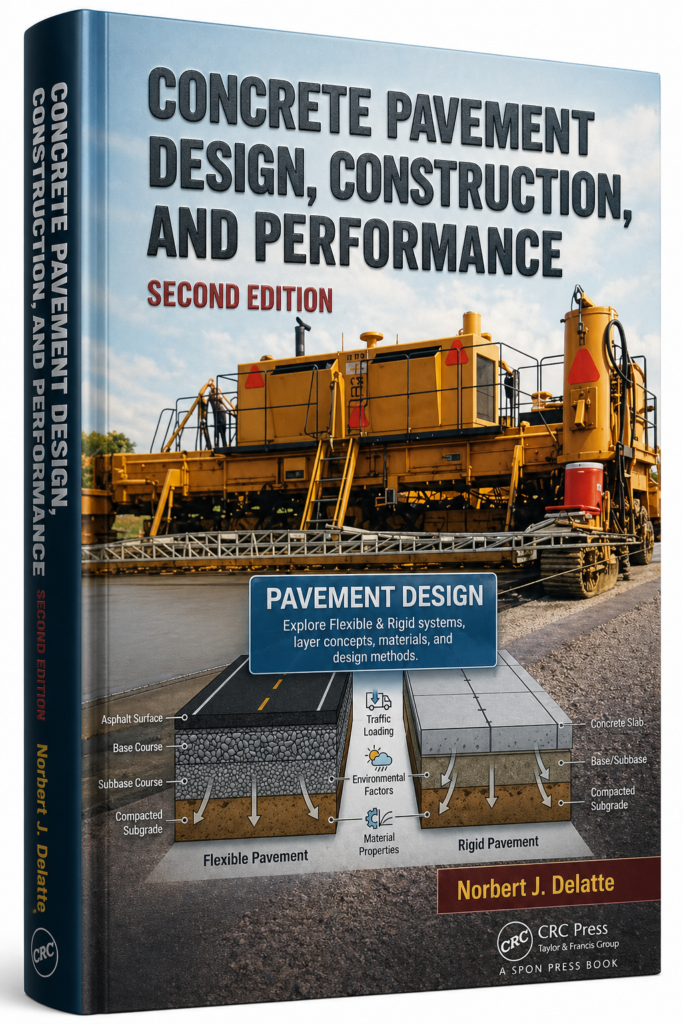
Concrete Pavement Design Construction And Performance 2nd Edition: Complete Engineering Guide for Durable Roads, Highways, and Airfields 🏗️🛣️
Introduction
Concrete pavements are among the most important elements of modern transportation infrastructure. Every day, millions of vehicles travel across highways, city streets, airport runways, industrial yards, ports, and parking facilities built with concrete pavement systems. These pavements are expected to carry heavy loads, resist environmental changes, remain safe for users, and perform economically over long service lives.
The topic Concrete Pavement Design Construction And Performance 2nd Edition is widely recognized as a foundational engineering subject because it combines structural mechanics, material science, geotechnical engineering, transportation planning, quality control, sustainability, and lifecycle economics.
Unlike flexible pavements made mainly from asphalt, concrete pavements behave as rigid slabs. Their high stiffness allows wheel loads to spread over wider areas, reducing stress on underlying soils. This often leads to longer service life and lower maintenance frequency when properly designed and constructed.
For engineering students, this subject provides an understanding of how theory becomes infrastructure. For professionals, it offers practical tools to improve durability, reduce failures, optimize budgets, and increase pavement performance.
This article explains the full subject in beginner-friendly language while also offering advanced technical depth. It covers:
- Background theory
- Structural design principles
- Construction processes
- Performance factors
- Comparison with asphalt pavements
- Case studies
- Common mistakes
- Challenges and solutions
- Real-world applications
- FAQs
Whether you are a civil engineering student, site engineer, consultant, contractor, highway designer, or infrastructure manager, this guide will help you understand concrete pavement systems from concept to long-term service. 🚧
Background Theory
Evolution of Pavement Engineering
Road building has existed for thousands of years. Ancient civilizations used stone roads to support trade and military movement. However, modern pavement engineering developed rapidly during the industrial age when traffic volumes and axle loads increased.
Concrete pavements became popular in the early 20th century because they offered:
- Better load-carrying capacity
- Lower rutting risk
- Good durability
- Lower fuel resistance damage
- Long service life
As trucks became heavier and highways longer, engineers needed scientific design methods instead of trial-and-error construction.
Why Concrete Works So Well
Concrete is a composite material made from:
- Cement
- Water
- Fine aggregate (sand)
- Coarse aggregate (gravel/crushed stone)
- Admixtures (optional)
When cement reacts with water, hydration occurs, creating hardened paste that binds aggregates into a strong mass.
Concrete pavements benefit from:
- High compressive strength 💪
- High stiffness (modulus of elasticity)
- Good abrasion resistance
- Long durability
- Light-colored surface improving visibility 🌙
- Lower deformation under load
Rigid Pavement Behavior
Concrete pavements are called rigid pavements because the slab distributes load through bending action.
When a wheel load acts on the slab:
- The slab bends slightly.
- Internal tensile and compressive stresses develop.
- The load spreads over a broad area.
- Subgrade stress reduces compared with flexible pavement.
This structural behavior is central to design calculations.
Main Pavement Types
Concrete pavement systems include:
- Jointed Plain Concrete Pavement (JPCP)
- Jointed Reinforced Concrete Pavement (JRCP)
- Continuously Reinforced Concrete Pavement (CRCP)
- Prestressed Concrete Pavement
- Roller Compacted Concrete Pavement (RCC)
Each type serves different traffic and performance needs.
Technical Definition
Concrete pavement design, construction, and performance can be technically defined as:
The engineering process of selecting slab dimensions, materials, joints, reinforcement, drainage, support layers, and construction methods to provide a safe, durable, economical pavement capable of carrying projected traffic loads under environmental conditions throughout its design life.
This definition includes three connected pillars:
Design
Determining thickness, joints, dowels, tie bars, support layers, and load capacity.
Construction
Transforming design drawings into a real pavement using correct materials, equipment, workmanship, curing, and quality control.
Performance
How the pavement behaves over time regarding:
- Cracking
- Faulting
- Roughness
- Skid resistance
- Deflection
- Durability
- Maintenance needs
Step-by-step Explanation
Pavement Design Workflow
Step 1: Traffic Analysis 🚛
Engineers estimate future traffic loads using:
- Average Daily Traffic (ADT)
- Growth rate
- Lane distribution
- Heavy truck percentage
- Equivalent Single Axle Loads (ESALs)
Traffic loading strongly influences slab thickness.
Step 2: Subgrade Investigation 🌍
The soil below pavement must be studied through:
- California Bearing Ratio (CBR)
- Plate load tests
- Resilient modulus
- Moisture content
- Swell/shrink potential
Weak soils may require stabilization.
Step 3: Material Selection
Concrete mix design considers:
- Compressive strength
- Flexural strength (modulus of rupture)
- Workability
- Durability
- Freeze-thaw resistance
- Air entrainment
Step 4: Thickness Design
Slab thickness depends on:
- Traffic loading
- Support condition
- Reliability level
- Concrete strength
- Drainage quality
- Design life
Typical highway slabs range from 200 mm to 350 mm or more.
Step 5: Joint Design
Concrete shrinks and expands. Joints control cracking.
Types:
- Contraction joints
- Expansion joints
- Construction joints
- Longitudinal joints
Step 6: Load Transfer Devices
To reduce differential movement:
- Dowels transfer wheel loads across transverse joints
- Tie bars hold adjacent lanes together
Step 7: Drainage Design 💧
Poor drainage shortens pavement life.
Design may include:
- Cross slope
- Edge drains
- Permeable base layers
- Ditches and outlets
Step 8: Construction Planning
Includes:
- Batching plant setup
- Equipment selection
- Traffic management
- Workforce planning
- Weather strategy
Step 9: Quality Control
Testing includes:
- Slump
- Air content
- Temperature
- Strength cylinders/beams
- Thickness checks
- Surface smoothness
Step 10: Maintenance Strategy
Even durable pavements need:
- Joint resealing
- Diamond grinding
- Partial-depth repair
- Full-depth repair
- Slab replacement
Structural Concepts in Concrete Pavement
Wheel Load Stress
Loads near slab edges and corners create higher stress than center loading.
Warping Stress 🌡️
Temperature gradients cause slab curling:
- Top warmer than bottom → downward curl
- Top cooler than bottom → upward curl
Frictional Resistance
Movement between slab and base creates restraint stresses.
Fatigue
Repeated loads may initiate cracks over many cycles.
Comparison
Concrete Pavement vs Asphalt Pavement
| Feature | Concrete Pavement | Asphalt Pavement |
|---|---|---|
| Structural Type | Rigid | Flexible |
| Initial Cost | Higher | Lower |
| Maintenance Frequency | Lower | Higher |
| Rutting Resistance | Excellent | Moderate |
| Construction Speed | Slower curing | Faster opening |
| Surface Color | Light | Dark |
| Fuel Resistance | Excellent | Lower |
| Service Life | 20–40+ years | 10–20 years |
| Noise | Can be higher | Often quieter |
| Recycling | Good | Excellent |
When Concrete Is Better ✅
- Heavy truck routes
- Bus lanes
- Industrial yards
- Airports
- Long-life highways
- Hot climates causing asphalt rutting
When Asphalt Is Better ✅
- Rapid rehabilitation
- Lower first cost projects
- Cold overlays
- Temporary or staged roads
Diagrams & Tables
Typical Concrete Pavement Layer System
↓
———————- Concrete Slab
———————- Base/Subbase
~~~~~~~~~~~~~~~~~~~~~~ Compacted Subgrade
Jointed Pavement Layout
Joint Joint Joint
Typical Material Properties
| Property | Typical Range |
|---|---|
| Compressive Strength | 30–50 MPa |
| Flexural Strength | 4–6 MPa |
| Elastic Modulus | 25–40 GPa |
| Unit Weight | 2300–2450 kg/m³ |
| Poisson Ratio | 0.15–0.20 |
Distress Types
| Distress | Cause |
|---|---|
| Cracking | Overstress, shrinkage, fatigue |
| Faulting | Poor load transfer |
| Scaling | Freeze-thaw or poor finishing |
| Pumping | Water + fines ejection |
| Spalling | Joint deterioration |
Construction Process
Site Preparation
Clearing and Grading
The road alignment is prepared by removing vegetation, debris, and weak materials.
Subgrade Compaction
Proper density is required to avoid settlement.
Moisture Control
Too dry or too wet soils reduce support quality.
Base Course Placement
Granular or stabilized base improves:
- Uniform support
- Drainage
- Construction platform quality
Concrete Production
Batching Accuracy
Materials must be proportioned correctly.
Mixing Time
Insufficient mixing causes nonuniform concrete.
Transportation
Transit mixers or paving trains move concrete quickly.
Placement and Paving 🚜
Slipform pavers are common for highways.
They perform:
- Spreading
- Consolidation
- Leveling
- Surface shaping
Finishing
Surface texture may be produced using:
- Tining
- Broom finish
- Burlap drag
- Grinding
Curing 🌤️
Essential for hydration and durability.
Methods:
- Curing compounds
- Wet burlap
- Plastic sheets
Joint Sawing
Contraction joints are saw-cut at the correct time to induce controlled cracking.
Examples
Example 1: Urban Roadway
Traffic is moderate with buses and cars.
Recommended system:
- JPCP
- 220 mm slab
- Doweled joints
- Good drainage
Benefits:
- Low rutting
- Long maintenance intervals
Example 2: Container Yard
Heavy slow-moving loads and turning trucks.
Recommended:
- Thick concrete slab
- Reinforced pavement
- Strong stabilized base
Benefits:
- High load capacity
- Resistance to fuel spills
Example 3: Airport Apron ✈️
Aircraft wheel loads are very high.
Recommended:
- High-strength concrete
- Thick slab
- Precision jointing
- Tight tolerances
Real World Application
Highways and Motorways
Concrete pavements are widely used in major freight corridors because of truck durability demands.
Airports
Runways, taxiways, and aprons often use concrete for high wheel pressure resistance.
Ports and Logistics Areas 🚢
Containers and heavy handling equipment create extreme loads.
Bus Rapid Transit Lanes
Bus stops experience repeated braking and acceleration, which damages asphalt faster.
Industrial Plants
Concrete resists fuel, oils, and static heavy loads.
Parking Structures
Rigid slabs provide strength and long life.
Common Mistakes ❌
Design Mistakes
Underestimating Traffic
Future truck growth can exceed predictions.
Ignoring Drainage
Water is one of the biggest pavement enemies.
Poor Joint Spacing
Large slab panels crack randomly.
Weak Subgrade Assumptions
Uneven support creates stress concentration.
Construction Mistakes
Late Saw Cutting
Leads to uncontrolled cracks.
Excess Water in Mix
Reduces strength and durability.
Poor Curing
Causes shrinkage cracking and weak surface.
Inadequate Vibration
Creates honeycombing and voids.
Maintenance Mistakes
Ignoring Early Distress
Small joint issues become major repairs later.
Challenges & Solutions
Challenge 1: Cracking
Causes
- Thermal stress
- Shrinkage
- Overloading
- Poor joint design
Solutions
- Correct spacing
- Proper curing
- Adequate thickness
- Improved mix design
Challenge 2: Faulting
Difference in slab elevation across joints.
Solutions
- Dowels
- Good drainage
- Strong support layers
Challenge 3: Pumping 💦
Water and fines eject through joints under traffic.
Solutions
- Seal joints
- Improve drainage
- Stabilized base layers
Challenge 4: Surface Polishing
Loss of skid resistance.
Solutions
- Diamond grinding
- Texture restoration
Challenge 5: Climate Effects 🌨️☀️
Freeze-thaw, heat, moisture changes.
Solutions
- Air entrainment
- Durable aggregates
- Expansion planning
Performance Evaluation
Key Indicators
Roughness
Measured by International Roughness Index (IRI).
Cracking Percentage
Surface crack extent.
Load Transfer Efficiency
Joint performance indicator.
Deflection
Measured using Falling Weight Deflectometer (FWD).
Friction
Safety-related skid resistance value.
Long-Term Performance Factors
- Quality materials
- Strong support
- Good drainage
- Proper joints
- Preventive maintenance
- Controlled traffic loading
Case Study
Highway Freight Corridor Rehabilitation
Project Background
A major freight route suffered rutting and frequent asphalt repairs every 4–6 years. Truck volumes increased sharply.
Engineering Decision
The authority selected concrete pavement reconstruction.
Design Features
- 280 mm JPCP slab
- Cement-treated base
- Doweled joints
- Edge drains
- Optimized shoulder support
Construction Strategy
Traffic was maintained lane by lane. Night paving reduced congestion.
Performance After 10 Years 📈
- Minimal rutting
- Lower annual maintenance cost
- Improved ride quality
- Better heavy truck reliability
Lessons Learned
Although initial cost was higher, lifecycle cost was lower than repeated asphalt overlays.
Sustainability and Environmental Benefits 🌱
Long Life = Less Reconstruction
Longer service life reduces material consumption over time.
Reflective Surface
Lighter concrete surfaces can reduce lighting demand in some areas.
Fuel Savings
Some studies suggest stiff pavements may reduce rolling resistance for heavy vehicles.
Recycled Materials
Concrete can use:
- Recycled aggregates
- Supplementary cementitious materials
- Industrial by-products
Reduced Maintenance Closures
Fewer lane closures lower traffic congestion emissions.
Advanced Engineering Concepts
Mechanistic-Empirical Design
Modern pavement design uses models that combine:
- Mechanical stress calculations
- Real traffic loading
- Climate data
- Historical performance data
This improves accuracy compared with purely empirical methods.
Finite Element Analysis
Engineers simulate slab behavior under loads, temperature gradients, and support conditions.
Smart Pavements 📡
Emerging systems may include:
- Embedded sensors
- Temperature monitoring
- Load monitoring
- Predictive maintenance analytics
Tips for Engineers 👷
For Students
- Master stress and strain fundamentals
- Learn material properties
- Practice pavement thickness problems
- Understand joint purpose
For Site Engineers
- Watch water addition carefully
- Verify subgrade density
- Monitor curing daily
- Check saw-cut timing
For Designers
- Use realistic traffic growth
- Prioritize drainage
- Consider climate region
- Design for lifecycle cost, not only first cost
For Managers
- Track pavement condition annually
- Repair small defects early
- Maintain drainage systems
- Keep construction records
FAQs
1. Why is concrete pavement called rigid pavement?
Because concrete slabs have high stiffness and distribute loads through slab bending over a wide area.
2. What is the usual lifespan of concrete pavement?
Well-designed concrete pavements often last 20 to 40 years or more with maintenance.
3. Why are joints needed in concrete roads?
Concrete expands, contracts, and shrinks. Joints control cracking and allow movement safely.
4. Is concrete pavement more expensive?
Initial cost is usually higher than asphalt, but lifecycle cost may be lower due to longer durability.
5. What causes cracks in concrete pavement?
Overloading, shrinkage, thermal movement, weak support, poor curing, or poor joint spacing.
6. What is dowel bar function?
Dowels transfer wheel loads across joints while allowing horizontal slab movement.
7. Can damaged concrete pavement be repaired?
Yes. Methods include sealing, grinding, partial-depth repair, full-depth repair, and slab replacement.
8. Which is better for airports: concrete or asphalt?
Many airports prefer concrete in heavy-load zones due to durability and resistance to fuel spills.
Practical Checklist Before Construction ✅
Engineering Review
- Traffic forecast approved
- Soil investigation complete
- Thickness verified
- Drainage finalized
- Joint layout approved
Site Readiness
- Equipment calibrated
- Crew trained
- Weather checked
- Material supply secured
During Construction
- Slump tested
- Air content checked
- Thickness monitored
- Surface smoothness measured
- Curing applied immediately
After Construction
- Strength achieved before opening
- Joints sealed if required
- Final inspection completed
Future Trends in Concrete Pavement
Low-Carbon Concrete
Reducing cement emissions through blended binders.
Faster Construction
Rapid-set concrete for overnight highway repairs.
Automated Paving Robots 🤖
Improved precision and productivity.
Data-Driven Maintenance
AI models predicting distress before visible damage.
Noise Reduction Textures
Safer and quieter surfaces.
Conclusion
Concrete pavement design, construction, and performance is one of the most valuable fields in civil and transportation engineering. It transforms raw materials such as cement, aggregates, and water into infrastructure that supports economies, mobility, logistics, and public safety.
The success of a concrete pavement does not depend on slab thickness alone. It requires integration of:
- Accurate traffic forecasting
- Reliable geotechnical data
- Strong material design
- Proper joints and load transfer
- Effective drainage
- Skilled construction
- Continuous maintenance
When these factors are combined, concrete pavements can deliver decades of service with excellent structural performance and reduced lifecycle costs.
For students, mastering this subject builds a strong engineering foundation. For professionals, it offers tools to design smarter, build better, and manage infrastructure more efficiently.
In a world demanding sustainable, durable, and resilient transportation systems, concrete pavement engineering remains a critical solution for highways, airports, ports, industrial facilities, and cities worldwide. 🛣️🌍