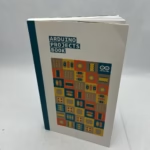
🚀 Arduino Cookbook 3rd Edition: Recipes to Begin, Expand, and Enhance Your Projects 🔧📘
🌍 Introduction
In the rapidly evolving world of embedded systems and electronics prototyping, Arduino has become a global standard for innovation, education, and rapid product development. Engineers, students, makers, and professionals across the USA, UK, Canada, Australia, and Europe rely on Arduino for everything from classroom experiments to industrial automation prototypes.
One of the most respected resources in this ecosystem is the book Arduino Cookbook. The third edition expands significantly on earlier versions, offering updated recipes aligned with modern Arduino boards, IoT systems, wireless communication modules, and real-world engineering practices.
This article provides a complete engineering breakdown of the concepts, structure, applications, and practical implementations inspired by the book. It is written for:
🎓 Engineering students
👨💻 Embedded system developers
🏭 Industrial automation professionals
🤖 Robotics designers
🧠 IoT innovators
Whether you are just starting with microcontrollers or designing scalable embedded solutions, this guide will serve both beginners and advanced engineers.
📚 Background Theory
🔬 Microcontroller Fundamentals
At the heart of every Arduino board lies a microcontroller — a compact integrated circuit designed to govern a specific operation in an embedded system.
A microcontroller typically contains:
CPU (Central Processing Unit)
RAM (Volatile Memory)
Flash Memory (Program Storage)
I/O Ports
Timers and Counters
Communication Interfaces (UART, SPI, I2C)
Unlike general-purpose computers, microcontrollers:
Execute one main program continuously
Operate in real-time
Interact directly with hardware
⚡ Embedded Systems Architecture
An embedded system consists of:
Hardware Layer
Firmware Layer
Application Logic
Arduino simplifies this stack by offering:
Pre-built hardware boards
Bootloader firmware
Simplified C++-based programming environment
🔄 Digital vs Analog Systems
Arduino interacts with both digital and analog signals.
Digital Signals
Binary: 0 (LOW) or 1 (HIGH)
Used for buttons, relays, LEDs
Analog Signals
Continuous voltage values
Read via ADC (Analog-to-Digital Converter)
🧠 Control Systems Basics
Arduino projects often involve:
Feedback systems
Sensors and actuators
PWM (Pulse Width Modulation)
PID controllers
These principles are used in robotics, automotive systems, HVAC systems, and industrial automation.
🏗 Technical Definition
📖 What Is Arduino Cookbook 3rd Edition?
Arduino Cookbook is a structured technical reference guide composed of engineering “recipes.”
A recipe in this context includes:
Problem Statement
Hardware Requirements
Wiring Instructions
Code Implementation
Technical Explanation
Variations and Extensions
It acts as:
A troubleshooting manual
A rapid prototyping guide
A professional reference
⚙ Step-by-Step Explanation of an Arduino Engineering Workflow
🧩 Step 1: Define the Engineering Problem
Example:
Measure room temperature
Control a motor
Send sensor data to the cloud
🔌 Step 2: Select Hardware Components
| Component | Purpose |
|---|---|
| Arduino Board | Control Unit |
| Sensor | Input Data |
| Actuator | Output Action |
| Power Supply | Energy Source |
🔗 Step 3: Circuit Wiring
Follow:
Voltage compatibility
Current limits
Pull-up / Pull-down resistors
Protection components
💻 Step 4: Program Development
Structure:
// Initialization
}
void loop() {
// Continuous Execution
}
Key programming principles:
Non-blocking code
Interrupt handling
Memory optimization
🧪 Step 5: Testing and Debugging
Use:
Serial Monitor
Oscilloscope
Multimeter
Logic Analyzer
📈 Step 6: Optimization
Improve:
Power consumption
Execution speed
Noise immunity
EMI resistance
⚖ Comparison: Arduino Cookbook vs Traditional Engineering Textbooks
| Feature | Arduino Cookbook | Traditional Textbook |
|---|---|---|
| Learning Style | Practical Recipes | Theoretical Chapters |
| Code Examples | Ready-to-Use | Limited |
| Troubleshooting | Included | Rare |
| Industrial Focus | Moderate | High |
📊 Diagrams & Tables
🔄 Basic Arduino System Block Diagram
↓
[Communication]
📌 Common Communication Protocols
| Protocol | Speed | Application |
|---|---|---|
| UART | Medium | Serial communication |
| I2C | Medium | Sensors |
| SPI | High | Displays & SD Cards |
| CAN | Very High | Automotive |
🧮 Detailed Examples
🌡 Example 1: Temperature Monitoring System
Components:
Arduino Board
Temperature Sensor (e.g., LM35)
LCD Display
Engineering Concepts:
ADC resolution
Voltage scaling
Signal filtering
🤖 Example 2: Motor Speed Control with PWM
Concepts covered:
Duty cycle
MOSFET switching
Back EMF protection
🌐 Example 3: IoT Sensor Node
Includes:
WiFi module
Cloud data transmission
JSON formatting
HTTP requests
🏢 Real World Applications in Modern Projects
🏭 Industrial Automation
Conveyor belt control
Safety monitoring
Process optimization
🚗 Automotive Prototyping
CAN Bus diagnostics
Sensor data logging
ECU simulation
🏠 Smart Homes
Motion detection
Energy monitoring
Smart lighting
🌍 Environmental Monitoring
Air quality sensors
Water level measurement
Agricultural automation
❌ Common Mistakes
🔥 1. Incorrect Voltage Levels
Applying 5V to 3.3V modules can permanently damage components.
⚡ 2. Ignoring Current Limits
Exceeding I/O pin current rating can destroy the microcontroller.
🧠 3. Blocking Code
Using delay() excessively prevents multitasking.
🔋 4. Poor Power Design
Noise and brownouts cause system instability.
🛠 Challenges & Solutions
Challenge: Noise in Analog Readings
Solution:
Shielded cables
Capacitors
Averaging algorithms
Challenge: Memory Limitations
Solution:
PROGMEM storage
Efficient data types
Code modularization
Challenge: Real-Time Performance
Solution:
Interrupt-driven programming
RTOS integration
🏗 Case Study: Smart Greenhouse Automation System
📍 Project Overview
Location: Europe
Purpose: Automated plant growth monitoring
🛠 System Components
Soil moisture sensors
Temperature sensors
Relay-controlled irrigation
Cloud dashboard
🔄 Engineering Process
Sensor calibration
Data acquisition
Decision logic
Remote monitoring
📈 Results
35% water savings
Improved crop yield
Reduced labor cost
🎯 Tips for Engineers
🧠 Think in Systems
Always consider:
Power
Communication
Mechanical integration
🧪 Prototype Before Production
Arduino is excellent for proof-of-concept before moving to:
Custom PCBs
Industrial controllers
📚 Study Datasheets
Engineering excellence comes from understanding:
Electrical characteristics
Timing diagrams
Absolute maximum ratings
🧩 Modularize Code
Create reusable libraries for scalable projects.
❓ FAQs
1️⃣ Is Arduino suitable for professional engineering projects?
Yes. It is widely used for prototyping and low-volume production.
2️⃣ Can Arduino handle industrial environments?
With proper shielding, industrial power supplies, and enclosures — yes.
3️⃣ What programming language does Arduino use?
C++ with hardware abstraction libraries.
4️⃣ Is Arduino secure for IoT systems?
Security depends on implementation — encryption and authentication must be added.
5️⃣ How does Arduino compare to Raspberry Pi?
Arduino:
Real-time control
Microcontroller-based
Raspberry Pi:
Full Linux computer
6️⃣ Can I use Arduino in automotive systems?
Yes, especially in diagnostics and testing applications.
7️⃣ Is Arduino suitable for beginners?
Absolutely. It is one of the best entry platforms in embedded engineering.
🏁 Conclusion
The Arduino Cookbook is far more than a beginner manual. It is an engineering reference packed with practical implementations that bridge theory and application.
For students in the USA, UK, Canada, Australia, and Europe, it serves as:
A hands-on learning companion
A professional troubleshooting resource
A rapid prototyping accelerator
For professionals, it offers:
Scalable embedded system strategies
Communication protocol implementation
Real-world hardware interfacing techniques
In a world driven by IoT, automation, robotics, and smart systems, mastering Arduino through structured engineering recipes is not just educational — it is strategic.
If used properly, the principles in this guide can transform simple ideas into scalable engineering solutions that power modern industries.