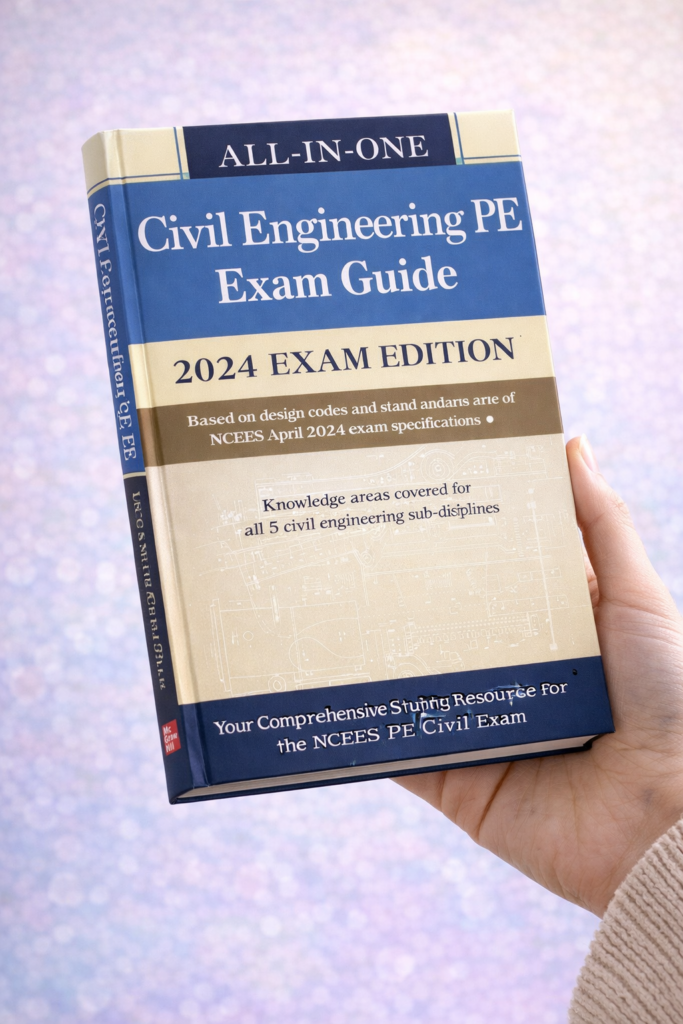
Civil Engineering PE All-in-One Exam Guide 2024 Exam Edition
Introduction
Preparing for the Civil Engineering PE (Professional Engineer) Exam is a critical milestone for engineers seeking licensure and professional recognition. Whether you are a fresh graduate, experienced practitioner, or international engineer, the PE exam represents a deep dive into your technical knowledge and problem-solving abilities. This 2024 All-in-One Exam Guide has been crafted to support engineers at all levels — from beginners familiarizing themselves with concepts to seasoned professionals refreshing best practices.
In this comprehensive guide, we will explore the foundational theory, key technical definitions, step-by-step methodologies, detailed worked examples, real-world applications, common pitfalls, strategies for success, and frequently asked questions. This guide is designed to be your go-to resource during preparation and revision.
Background Theory
Understanding the background theory behind the Civil PE exam is essential. The PE exam tests applied knowledge across multiple domains such as:
Structural Engineering
Geotechnical Engineering
Transportation Engineering
Water Resources & Environmental Engineering
Construction Engineering
The exam assesses your ability to apply engineering principles to practical problems, not just memorize formulas. Let’s delve into the theoretical underpinnings that support these practical tasks.
Fundamental Concepts Covered
Statics and Dynamics
Forces, moments, equilibrium
Moments of inertia
Kinematics of particles and rigid bodies
Strength of Materials
Stress-strain relationships
Bending moments and shear forces
Torsion and axial loading
Fluid Mechanics
Continuity, momentum, and energy equations
Laminar vs. turbulent flow
Open channel flow
Soil Mechanics
Soil classification
Shear strength
Consolidation and settlement
Hydrology & Hydraulics
Precipitation, runoff
Flood frequency analysis
Design of storm drainage systems
Continuous exposure to these topics builds the foundation for solving exam questions effectively.
Technical Definition
Before we move into analysis and examples, it’s important to define several technical terms that commonly appear in the Civil PE exam.
Professional Engineer (PE)
A licensed engineer who has met the education, experience, and exam requirements established by the state licensing board. A PE license grants legal authority to sign and seal engineering documents.
NCEES
National Council of Examiners for Engineering and Surveying — the organization responsible for administering the PE exam.
Breadth vs. Depth
Breadth: Covers general topics across all civil engineering disciplines (morning session).
Depth: Focused subject area of your choice — e.g., Structural, Geotechnical, Transportation (afternoon session).
Reference Standards
Exam items often require knowledge of standards and codes such as:
AISC (Steel Construction)
ACI (Concrete Design)
AASHTO (Highway Specifications)
ASCE Manuals
Step-by-Step Explanation
Preparing for the Civil PE exam requires a methodical approach. Here is a step-by-step framework that you can follow:
1. Evaluate Eligibility and Registration
Ensure you meet your state board’s requirements (education + experience).
Register with NCEES for the 2024 exam window.
2. Select Your Depth Module
Choose one area of specialization, such as:
Construction
Geotechnical
Structural
Transportation
Water Resources & Environmental
Each depth has a tailored focus chart in the NCEES exam specifications.
3. Gather Reference Materials
Collect essential materials:
NCEES Civil PE Reference Handbook (official)
Discipline-specific codes (AISC, ACI, etc.)
Review manuals (practice questions and solutions)
4. Create a Study Plan
Allocate your time based on:
Strengths and weaknesses
Breadth vs. depth topics
Practice exam availability
A typical plan might be:
3 months general review
1 month depth focus
Last 2–3 weeks intensive problem practice
5. Practice Problem Solving
Work on:
Timed practice exams
Topic-specific question sets
Review incorrect solutions thoroughly
6. Take Practice Exams Under Simulated Conditions
Build stamina for the 8-hour test:
Morning: 4 hours — breadth
Afternoon: 4 hours — depth
Review where you lost time or made errors.
7. Final Review & Consolidation
Close gaps in:
Fundamental theory
Codes and standards
Strategy adjustments
Refine your calculator skills (e.g., TI-36X Pro).
Detailed Examples
Let’s work through some typical Civil PE exam problems.
Example 1: Structural — Bending Stress
Problem:
A simply supported beam with a uniform load of 5 kips/ft over a 20 ft span is constructed from steel. What is the maximum bending moment and the section modulus required if allowable stress is 22 ksi?
Solution:
Step 1 — Maximum Moment for Uniform Load:
Maximum moment,
M=8wL2=85×(20)2=85×400=250ft\cdotpkips=3000in\cdotpkips
Step 2 — Required Section Modulus:
Allowable stress formula,
S=σM=223000=136.36in3
Result:
Minimum section modulus S=136.36 in3S = \mathbf{136.36 \, in^3}
Example 2: Water Resources — Manning’s Equation
Problem:
A trapezoidal channel has bottom width 10 ft, side slopes 2:1, and carries 50 ft³/s of water with a Manning’s n = 0.015. Compute the normal depth.
Solution:
Trial and iteration using Manning’s formula:
… (process of trial area and hydraulic radius) …
Result:
Normal depth ≈ 3.9 ft
Real-World Application in Modern Projects
Preparing for the Civil PE exam is not just academic — it mirrors real engineering decisions in modern infrastructure projects. Here are relevant examples:
1. Bridge Design (Structural)
Engineers calculate loads, moments, section modulus, and fatigue life. The methods learned in the PE exam directly apply to real bridge design checks and reinforcement decisions.
2. Highway Drainage (Hydraulics)
Manning’s equation, continuity principles, and flood control criteria are used in designing storm drains, culverts, and retention basins.
3. Foundations (Geotechnical)
Understanding soil bearing capacity and settlement ensures safe support for buildings and heavy equipment.
4. Water Treatment (Water Resources)
Civil engineers design sedimentation tanks, filters, and analysis of flow distribution using principles identical to exam scenarios.
Common Mistakes
Many examinees fall into avoidable traps:
1. Ignoring the Reference Handbook
The PE exam is open-book. Familiarity with how information is organized saves time.
2. Poor Time Management
Students often spend too long on initial problems and rush later ones.
3. Not Practicing Calculator Skills
Simple arithmetic errors due to unfamiliarity with calculators cost valuable points.
4. Skipping Practice Exams
Limited practice reduces exposure to question formats and strategic pacing.
Challenges & Solutions
Challenge: Scope of Material
Solution:
Use topic checklists and focus on high-frequency exam areas first.
Challenge: Test Anxiety
Solution:
Simulate exam conditions weekly. Take breaks strategically to build endurance.
Challenge: Balancing Work/Study
Solution:
Create weekly goals — short but consistent study bursts (e.g., 90 minutes/day).
Challenge: Incomplete Understanding of Standards
Solution:
Dedicate separate study sessions to reference standards (ACI, AISC, etc.).
Case Study: Successful PE Preparation
Background
Jane — a transportation engineer with 4 years’ experience — decided to take the 2024 Civil PE exam. She struggled most with hydraulics and structural depth topics.
Approach
Followed a 6-month study plan.
Used a mix of review books, practice exams, and flashcards.
Joined a study group for discipline-specific discussions.
Key Actions
3 full-length practice exams
Weekly focus sessions on weak topics
Memorized common formulas and code references
Outcome
Jane passed the exam on her first attempt with solid scores in both breadth and the transportation depth section.
Lessons Learned
Start early.
Practice more than you think you need.
Understand how to use reference codes quickly.
Tips for Engineers
Whether you are preparing for the first time or attempting a re-take, the following tips will elevate your preparation:
📌 Understand the Exam Format
Know the structure — 40 questions in the morning (breadth) and 40 in the afternoon (depth) — each with 4 choices.
🕒 Practice Time Blocking
Set timers when practicing: allocate more time for unfamiliar topics.
🧠 Focus on Concepts, Not Memorization
Engineering is about application. Understanding beats rote memorization.
🔎 Use the Official Reference Handbook
Become an expert in navigating the handbook — it’s allowed and essential.
📊 Focus on High-Yield Topics
Some topics appear more frequently. Prioritize them in your study plan.
FAQs
1. What is the Civil PE exam format?
The exam consists of 80 questions — 40 breadth (AM) across core civil topics and 40 depth (PM) in a chosen specialty. The exam is closed-book except for the official reference handbook.
2. How long does it take to prepare?
Most candidates spend 4–6 months of part-time study. Time depends on experience, background, and familiarity with exam topics.
3. Can I use reference books during the exam?
Only the NCEES Civil Reference Handbook is permitted. Other books are not allowed in the testing center.
4. What calculator is allowed?
Approved scientific calculators such as the TI-36X Pro (verify current NCEES list). Graphing calculators with text storage may be restricted.
5. Is the PE exam hard?
It’s challenging but passable with systematic study and practice. Many candidates fail on their first attempt due to preparation gaps.
6. What is the best study resource?
A combination of the NCEES Handbook, discipline-specific manuals, and practice problems from reputable prep providers.
7. Do engineering ethics appear in the exam?
Yes, ethics and professional practice questions may appear, especially in foundation and breadth sections.
8. What score do I need to pass?
The NCEES scoring system is scaled and subject-specific. There is no published pass mark, but consistent practice and correct application of fundamentals improves scores.
Conclusion
The Civil Engineering PE All-in-One Exam Guide — 2024 Exam Edition is your strategic roadmap to success. From building a solid theoretical foundation to mastering real-world problem solving, this guide equips students and professionals with the tools they need to prepare effectively.
Remember that passing the PE exam is not just about hard work — it’s about smart work. Prioritize structured study, understand the exam format, practice under timed conditions, and lean on real continuous learning.
Good luck on your journey toward licensure — engineer your success! 🚀