Civil Engineering PE All-in-One Exam Guide: Breadth and Depth 4th Edition
Introduction
The Civil Engineering Professional Engineer (PE) Exam is one of the most important milestones in a civil engineer’s career. Passing the PE exam is not just about earning a license; it represents professional credibility, higher responsibility, better career opportunities, and legal authority to sign and seal engineering documents.
However, the PE exam is also known for being broad, deep, technical, and demanding. Candidates must demonstrate both general civil engineering knowledge (Breadth) and specialized expertise (Depth) in a chosen discipline such as Structural, Geotechnical, Transportation, Water Resources, or Construction.
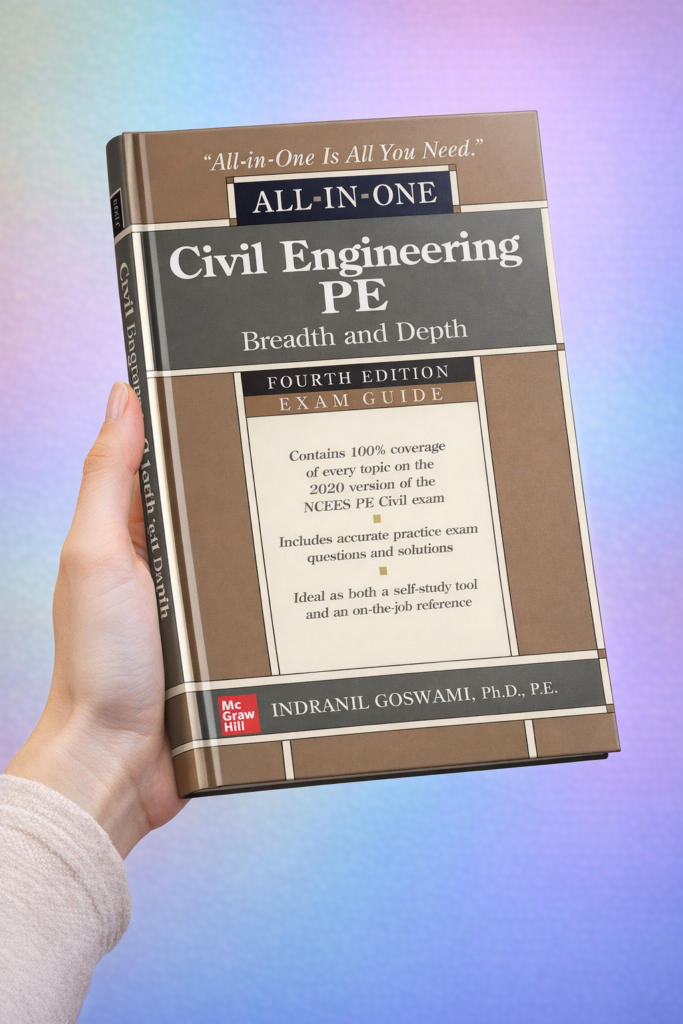
This article serves as a Civil Engineering PE All-in-One Exam Guide, designed for:
Beginner engineers who are new to the PE exam structure
Advanced engineers seeking a systematic, exam-focused review
Students and professionals aiming to understand how theory connects to practice
We will cover theory, definitions, step-by-step strategies, real-world applications, common mistakes, challenges, case studies, and expert tips—making this a complete learning resource.
Background Theory
What Is the PE Exam?
The PE (Professional Engineer) exam is administered by NCEES (National Council of Examiners for Engineering and Surveying). For civil engineers, it is divided into two main components:
PE Civil Breadth
PE Civil Depth (discipline-specific)
The exam is designed to test minimum competency for practicing engineers—not academic perfection, but practical engineering judgment.
Breadth vs Depth: Core Philosophy
Breadth evaluates your understanding of all major civil engineering areas
Depth evaluates your advanced knowledge in one specialization
This structure ensures that licensed engineers:
Understand interdisciplinary coordination
Can specialize safely and competently
Apply engineering judgment across projects
Major Civil Engineering Disciplines Covered
Breadth Topics Include:
Mathematics
Engineering Economics
Ethics
Structural Engineering
Geotechnical Engineering
Transportation Engineering
Water Resources & Environmental Engineering
Construction Engineering
Depth Disciplines (Choose One):
Structural
Geotechnical
Transportation
Water Resources & Environmental
Construction
Technical Definition
Civil Engineering PE Exam (Technical Definition)
The Civil Engineering PE Exam is a professional licensure examination that evaluates an engineer’s ability to apply engineering principles, standards, and judgment to real-world civil infrastructure problems under realistic constraints.
Breadth Section – Technical Scope
The Breadth section tests:
Fundamental equations
Conceptual understanding
Quick problem-solving ability
Cross-disciplinary awareness
Example topics:
Bending stress calculations
Soil classification
Open channel flow
Traffic flow theory
Cost estimation and scheduling
Depth Section – Technical Scope
The Depth section focuses on:
Advanced calculations
Design codes and standards
Detailed engineering scenarios
Professional-level decision making
Example:
Structural depth → ACI, AISC, ASCE codes
Geotechnical depth → Bearing capacity, slope stability
Transportation depth → Signal timing, pavement design
Step-by-Step Explanation: How to Prepare for the PE Exam
Step 1: Understand the Exam Specifications
Download the official NCEES PE Civil Exam Specifications and identify:
Topic weights
Reference standards
Depth-specific requirements
This document is your roadmap.
Step 2: Master Breadth Fundamentals First
Breadth questions are often:
Short
Formula-driven
Time-sensitive
Focus on:
Core equations
Unit conversions
Conceptual clarity
Recommended approach:
Create a formula notebook
Practice quick problem recognition
Learn when to skip and return
Step 3: Choose the Right Depth Discipline
Choose based on:
Your work experience
Your strongest technical area
Availability of study materials
Depth requires confidence and repetition.
Step 4: Build a Reference Strategy
The PE exam is open-book (CBT format with provided references). Success depends on:
Knowing where information is
Navigating codes efficiently
Avoiding unnecessary searching
Step 5: Practice Under Exam Conditions
Simulate:
Time pressure
Mental fatigue
Mixed difficulty questions
Practice builds engineering intuition, not just memory.
Detailed Examples
Example 1: Breadth – Structural Engineering
Problem:
A simply supported beam carries a uniformly distributed load. Find the maximum bending moment.
Solution Concept:
For a simply supported beam with uniform load:
Mmax=wL2/8
Engineering Insight:
This formula appears repeatedly in Breadth questions and should be instantly recognizable.
Example 2: Breadth – Geotechnical Engineering
Problem:
Classify soil using the Unified Soil Classification System (USCS).
Steps:
Determine % passing No. 200 sieve
Identify liquid limit and plasticity index
Use plasticity chart
Result:
Correct soil classification ensures proper foundation design decisions.
Example 3: Depth – Transportation Engineering
Problem:
Calculate signal cycle length using Webster’s Method.
Formula:
C=1.5L+5/1−Y
Where:
= total lost time
= sum of critical flow ratios
Professional Relevance:
This directly affects traffic efficiency and safety.
Real-World Application in Modern Projects
Infrastructure Design
PE-level knowledge is applied in:
Highway expansion projects
Bridge rehabilitation
Urban drainage systems
Water treatment facilities
Risk and Safety Management
Licensed engineers:
Approve load ratings
Evaluate failure modes
Ensure public safety
Sustainable Engineering
Modern projects demand:
Environmental impact analysis
Resource optimization
Climate-resilient design
PE engineers apply theory to meet sustainability goals.
Project Management and Leadership
PE engineers often:
Lead multidisciplinary teams
Review contractor submittals
Resolve technical disputes
Breadth knowledge is critical here.
Common Mistakes
1. Ignoring Breadth Topics
Many candidates over-focus on Depth and neglect Breadth, which can cause easy point losses.
2. Memorizing Without Understanding
The PE exam tests application, not rote memory.
3. Poor Time Management
Spending too long on one problem is a major exam failure cause.
4. Weak Code Navigation Skills
Knowing where information is matters more than memorizing it.
5. Choosing the Wrong Depth
Selecting a depth outside your experience significantly increases risk.
Challenges & Solutions
Challenge 1: Vast Syllabus
Solution:
Create a prioritized study plan based on exam weight.
Challenge 2: Complex Standards
Solution:
Practice real problems using actual codes and references.
Challenge 3: Exam Anxiety
Solution:
Mock exams + time simulations reduce stress.
Challenge 4: Balancing Work and Study
Solution:
Short daily sessions (1–2 hours) are more effective than long, irregular study.
Case Study
Case Study: Structural PE Candidate
Background:
A civil engineer with 5 years of bridge design experience.
Approach:
Focused Breadth review (6 weeks)
Structural Depth practice (10 weeks)
Weekly mock exams
Outcome:
Passed on the first attempt.
Key Success Factors:
Depth aligned with work experience
Strong familiarity with AASHTO and ACI codes
Time management mastery
Tips for Engineers
Study concepts, not just formulas
Practice with real engineering units
Learn elimination techniques for multiple-choice questions
Keep a mistake log and review it weekly
Focus on accuracy before speed
Treat the exam like a professional responsibility, not a school test
FAQs
Q1: Is the PE Civil exam harder than the FE exam?
Answer: Yes. The PE exam focuses on professional-level application, while the FE tests academic fundamentals.
Q2: How long should I prepare for the PE exam?
Answer: Most candidates prepare for 3–6 months, depending on experience.
Q3: Is Breadth more important than Depth?
Answer: Both are equally important; neglecting either can lead to failure.
Q4: Can I pass the PE exam without work experience?
Answer: Practical experience significantly improves your chances, especially for Depth.
Q5: Are calculators important for the exam?
Answer: Yes. Learn your approved calculator’s functions thoroughly.
Q6: Is the PE exam more theory or practice-based?
Answer: It strongly emphasizes practical engineering judgment.
Q7: What is the biggest reason candidates fail?
Answer: Poor preparation strategy and weak time management.
Conclusion
The Civil Engineering PE All-in-One Exam is not just an academic test—it is a professional benchmark. Success requires a balanced mastery of Breadth fundamentals and Depth specialization, combined with strategic preparation, real-world thinking, and disciplined practice.
By understanding theory, applying concepts through examples, avoiding common mistakes, and aligning preparation with real engineering work, both students and professionals can confidently approach the PE exam.
Passing the PE exam is not the end—it is the beginning of professional leadership in civil engineering.