Civil Engineering PE Practice Exams: Breadth and Depth 2nd Edition — The Ultimate Guide
Introduction
The Principles and Practice of Engineering (PE) Civil Exam is one of the most important milestones in a civil engineer’s professional career. Passing this exam grants the Professional Engineer (PE) license, which unlocks higher career opportunities, legal authority to sign and seal engineering documents, and increased professional credibility.
However, the PE Civil exam is widely known for its difficulty—not because the problems are unsolvable, but because it requires both wide-ranging knowledge (Breadth) and deep specialization (Depth). This dual structure often overwhelms candidates, especially those returning to academic-style exams after years in professional practice.
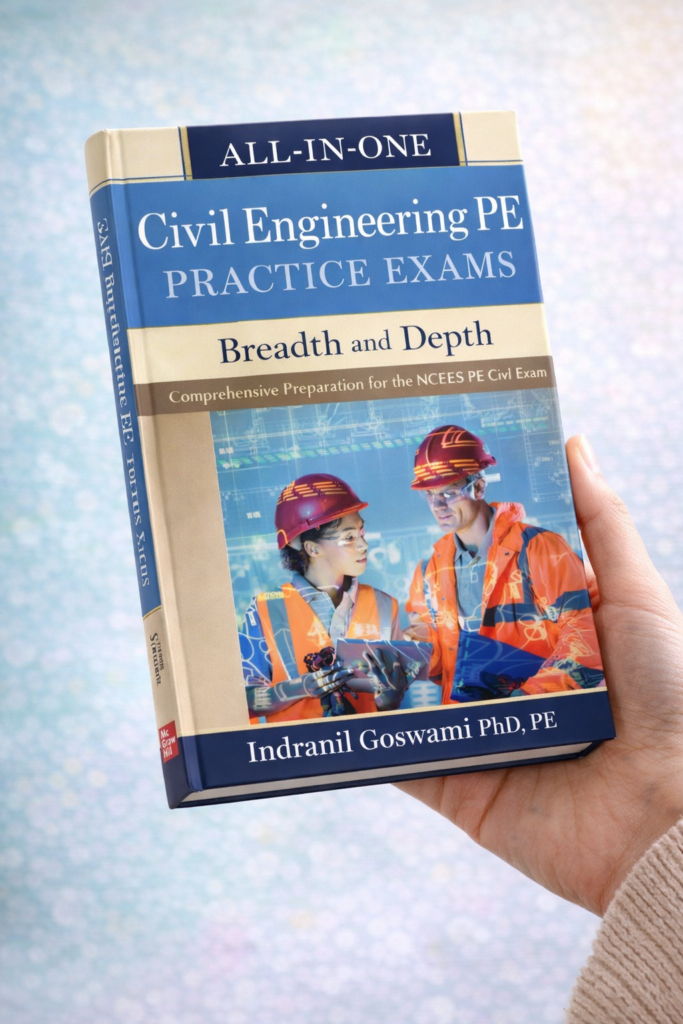
This is where Civil Engineering PE Practice Exams become critical. Practice exams simulate the real testing environment, reinforce conceptual understanding, improve time management, and expose knowledge gaps before the actual exam day.
In this comprehensive article, we will explore Civil Engineering PE Practice Exams: Breadth and Depth, starting from theory and definitions, moving through step-by-step preparation strategies, real-world applications, common mistakes, challenges, and ending with a detailed case study and expert tips.
This guide is designed for both beginners and advanced engineers, whether you are a recent graduate or a seasoned professional aiming to secure your PE license.
Background Theory
What Is the PE Civil Exam?
The PE Civil Exam is administered by NCEES (National Council of Examiners for Engineering and Surveying). It is a computer-based test (CBT) offered year-round at approved testing centers.
The exam is divided into two major parts:
-
Breadth (Morning Session)
-
Depth (Afternoon Session)
Each part evaluates different skill sets and knowledge levels.
Breadth vs. Depth: The Core Concept
Breadth Section
-
Covers all major civil engineering disciplines
-
Tests fundamental principles
-
Emphasizes problem-solving speed and conceptual clarity
Depth Section
-
Focuses on one chosen specialization
-
Requires in-depth technical knowledge
-
Reflects real-world engineering decision-making
Why Practice Exams Matter (Learning Theory Perspective)
From a learning science standpoint, practice exams leverage:
-
Active Recall – retrieving information strengthens memory
-
Spaced Repetition – repeated exposure improves retention
-
Contextual Learning – solving problems in exam-like conditions improves transfer of knowledge
Studies consistently show that students who use realistic practice exams perform significantly better than those who rely on passive reading alone.
Technical Definition
Civil Engineering PE Practice Exam
A Civil Engineering PE Practice Exam is a structured, timed set of engineering problems designed to replicate:
-
The format of the real PE Civil exam
-
The difficulty level
-
The breadth and depth distribution
-
The reference handbook usage
Technical Characteristics
-
Computer-based format
-
Multiple-choice questions
-
NCEES Reference Handbook-based
-
Timed environment (average ~6 minutes per problem)
Breadth Practice Exam Definition
A Breadth Practice Exam evaluates general civil engineering knowledge across all disciplines, regardless of the candidate’s depth choice.
Depth Practice Exam Definition
A Depth Practice Exam evaluates advanced, discipline-specific knowledge in one of the following areas:
-
Structural Engineering
-
Geotechnical Engineering
-
Transportation Engineering
-
Water Resources & Environmental Engineering
-
Construction Engineering
Step-by-Step Explanation: How to Use PE Practice Exams Effectively
Step 1: Understand the Exam Specifications
Before solving a single problem:
-
Review NCEES exam specifications
-
Identify topic weight percentages
-
Understand allowed references
This prevents over-studying low-weight topics and under-preparing critical ones.
Step 2: Start with Diagnostic Practice Exams
Take a full-length practice exam early in your preparation.
Purpose:
-
Identify weak areas
-
Establish a baseline score
-
Adjust your study plan
Do not worry about your score—this is purely diagnostic.
Step 3: Topic-Based Practice
Break practice exams into topic-based sets:
-
Structural analysis problems
-
Hydraulics calculations
-
Soil mechanics questions
This approach builds confidence and technical depth gradually.
Step 4: Timed Full-Length Practice Exams
Once fundamentals are strong:
-
Take full-length, timed exams
-
Simulate real exam conditions
-
Use only approved references
This step trains mental endurance and time management.
Step 5: Post-Exam Analysis
The most important learning happens after the exam:
-
Analyze incorrect answers
-
Identify conceptual vs. calculation errors
-
Create an error log
This transforms mistakes into long-term strengths.
Detailed Examples
Example 1: Breadth – Structural Engineering
Problem:
A simply supported beam with a uniformly distributed load requires maximum bending moment calculation.
Solution Outline:
-
Identify beam type and loading
-
Apply bending moment formula
Mmax=8wL/2
-
Verify units and sign convention
-
Select correct answer from options
Exam Skill Tested:
-
Structural fundamentals
-
Formula recall
-
Speed and accuracy
Example 2: Breadth – Hydraulics
Problem:
Determine flow velocity in a pipe using the continuity equation.
Q=A×V
This tests:
-
Fluid mechanics basics
-
Unit conversions
-
Conceptual understanding
Example 3: Depth – Geotechnical Engineering
Problem:
Calculate ultimate bearing capacity using Terzaghi’s equation.
qu=cNc+γDfNq+0.5γBNγ
This problem requires:
-
Soil parameter interpretation
-
Proper factor selection
-
Engineering judgment
Real-World Applications in Modern Projects
Why Breadth Knowledge Matters in Practice
In real projects, engineers must:
-
Coordinate with multiple disciplines
-
Understand cross-disciplinary impacts
-
Communicate technical decisions clearly
Breadth exam preparation enhances interdisciplinary awareness.
Why Depth Knowledge Is Critical
Depth knowledge directly applies to:
-
Structural design calculations
-
Foundation design decisions
-
Transportation system optimization
-
Water system modeling
PE practice exams mirror these professional responsibilities.
Modern Engineering Tools and PE Knowledge
Many modern tools (ETABS, Civil 3D, HEC-RAS) are built upon principles tested in PE exams. Practice exams strengthen the theoretical foundation behind software outputs.
Common Mistakes
1. Memorizing Without Understanding
Relying solely on formula memorization leads to failure when problems are slightly modified.
2. Ignoring Breadth After Choosing Depth
Many candidates focus only on depth and underestimate breadth, resulting in low overall scores.
3. Poor Time Management
Spending too long on one problem can cost multiple easy points later.
4. Not Using the Reference Handbook Efficiently
Knowing where formulas are located is as important as knowing the formula itself.
Challenges & Solutions
Challenge 1: Returning to Exams After Years of Work
Solution:
Start with fundamentals and gradually increase difficulty.
Challenge 2: Managing Full-Time Work and Study
Solution:
-
Create a realistic weekly study plan
-
Use practice exams as progress checkpoints
Challenge 3: Depth Topic Complexity
Solution:
Focus on high-frequency problem types from practice exams instead of rare edge cases.
Case Study: Successful PE Exam Preparation
Candidate Profile
-
6 years of experience
-
Transportation Engineering depth
-
Failed first attempt
Initial Mistakes
-
No full-length practice exams
-
Weak breadth preparation
-
Poor time management
Revised Strategy
-
Took 5 full practice exams
-
Analyzed every mistake
-
Practiced under timed conditions
Result
-
Passed on second attempt
-
Reported improved confidence and efficiency
-
Applied exam knowledge directly in professional projects
Tips for Engineers
-
Treat practice exams as training, not tests
-
Focus on understanding assumptions
-
Build a personal formula index
-
Practice unit conversions daily
-
Simulate exam-day conditions at least twice
-
Review engineering ethics concepts
-
Stay consistent rather than cramming
FAQs
1. How many practice exams should I take?
Ideally, 4–6 full-length practice exams, plus multiple topic-based quizzes.
2. Are older practice exams still useful?
Yes, fundamentals rarely change, though always check updated specifications.
3. Should I focus more on breadth or depth?
Balance is key—breadth builds your score, depth secures it.
4. Can I pass without practice exams?
Possible, but statistically unlikely. Practice exams significantly improve pass rates.
5. How close are practice exams to the real exam?
High-quality practice exams closely mimic difficulty, format, and timing.
6. Is speed more important than accuracy?
Accuracy first, speed second—but both are essential.
7. How early should I start practice exams?
After covering core topics, usually 6–8 weeks before exam day.
Conclusion
Civil Engineering PE Practice Exams: Breadth and Depth are not optional—they are essential tools for success. They bridge the gap between academic knowledge and professional application, improve confidence, and sharpen problem-solving skills under pressure.
For beginners, practice exams clarify expectations and build structure. For advanced engineers, they refine expertise and identify blind spots developed over years of routine work.
By mastering both breadth and depth through strategic practice, civil engineers position themselves not just to pass the PE exam, but to excel as licensed professionals shaping modern infrastructure.
Your PE journey is not just about passing an exam—it is about proving your readiness to take responsibility for the safety, efficiency, and sustainability of the world we build.
✔️read more👉 Seismic Design Of Steel Structures