Construction Program Management: A Complete Guide to Planning, Scheduling, Cost, Risk & Project Delivery
Introduction
Construction projects are rarely difficult because of one technical task. The real challenge is coordinating hundreds or thousands of interconnected activities involving designers, contractors, consultants, suppliers, authorities, workers, equipment, budgets, and clients. 🏗️
This is where construction program management becomes essential.
Construction program management provides a structured approach for controlling multiple projects, work packages, schedules, resources, costs, risks, and stakeholders while keeping the overall development aligned with strategic objectives.
A construction program may include a single large infrastructure development or a collection of related projects such as roads, bridges, buildings, utilities, rail systems, hospitals, airports, or industrial facilities.


Why Construction Program Management Matters
A well-managed construction program helps organizations answer important questions:
- What needs to be completed?
- When should each project start and finish?
- Which activities are critical?
- How much will the program cost?
- Which resources are required?
- What risks could delay delivery?
- Which contractors are responsible for each package?
- How will changes be controlled?
- Are individual projects supporting the overall program objective?
The goal is not simply to finish construction. The goal is to deliver the right outcomes, at the right time, within acceptable cost, quality, safety, and risk parameters. 🎯
Construction Management vs Program Management
Construction management usually focuses on managing a particular construction project or site.
Program management operates at a broader level.
For example, a construction manager may manage the construction of one hospital. A program manager could coordinate the complete healthcare development program involving:
- Multiple hospitals
- Medical infrastructure
- Roads and parking
- Utility networks
- Procurement packages
- Technology systems
- Landscaping
- Commissioning
The program manager therefore needs a wider view of the entire system.
Background Theory
Construction program management is based on principles from project management, construction management, systems engineering, cost management, scheduling, risk management, procurement, quality management, and organizational leadership.
The Program Management Perspective
A construction program can be viewed as a network of interconnected projects.
For example:
Master Program → Individual Projects → Work Packages → Activities → Resources → Deliverables
A delay in one project can create consequences elsewhere.
A late utility package may prevent road construction. A delayed structural design may affect procurement. A procurement delay may stop installation. A delayed installation may postpone commissioning.
This means program managers must understand dependencies rather than isolated activities.
The Triple Constraint and Beyond
Traditional project management often considers:
- Scope
- Time
- Cost
Construction programs must go further by incorporating:
- Quality
- Safety
- Sustainability
- Risk
- Resources
- Procurement
- Stakeholder expectations
- Regulatory compliance
- Operational readiness
Modern program management therefore treats construction as a dynamic interconnected system rather than a simple sequence of tasks.
Definition
Construction program management is the coordinated planning, governance, monitoring, and control of multiple related construction projects and activities to achieve defined strategic objectives.
Main Components
A construction program typically includes several management disciplines.
Scope Management
Defines what the program must deliver and establishes boundaries around what is outside the agreed scope.
Schedule Management
Coordinates individual project schedules into an integrated program schedule.
Cost Management
Tracks budgets, commitments, forecasts, variations, and final expected costs.
Resource Management
Coordinates labor, equipment, materials, specialist contractors, facilities, and technical resources.
Risk Management
Identifies potential threats and opportunities and establishes appropriate responses.
Quality Management
Ensures that design and construction outputs meet required standards and specifications.
Procurement Management
Coordinates suppliers, contractors, consultants, purchase orders, and delivery schedules.
Stakeholder Management
Maintains communication between owners, contractors, government agencies, communities, consultants, and other interested parties.
Step-by-Step Construction Program Management
Managing a construction program requires a structured workflow. The exact process varies according to project size and contract strategy, but the following sequence provides a strong foundation.


Step 1: Establish Program Objectives
The first step is understanding why the program exists.
Objectives should be specific and measurable.
Examples include:
- Delivering a new transportation network
- Expanding industrial capacity
- Developing a university campus
- Constructing multiple residential buildings
- Modernizing public infrastructure
The program team should identify the required business, operational, social, and technical outcomes.
Step 2: Define the Program Scope
The team then determines what projects and work packages belong to the program.
A major infrastructure program could contain:
- Civil works
- Structural works
- Electrical systems
- Mechanical systems
- Utilities
- Roads
- Landscaping
- Communications
- Testing and commissioning
A clear scope prevents uncontrolled expansion later.
Step 3: Develop the Program Structure
The program is divided into manageable components.
A typical structure may look like:
Program → Project → Contract → Work Package → Activity
This hierarchy makes responsibility and reporting easier.
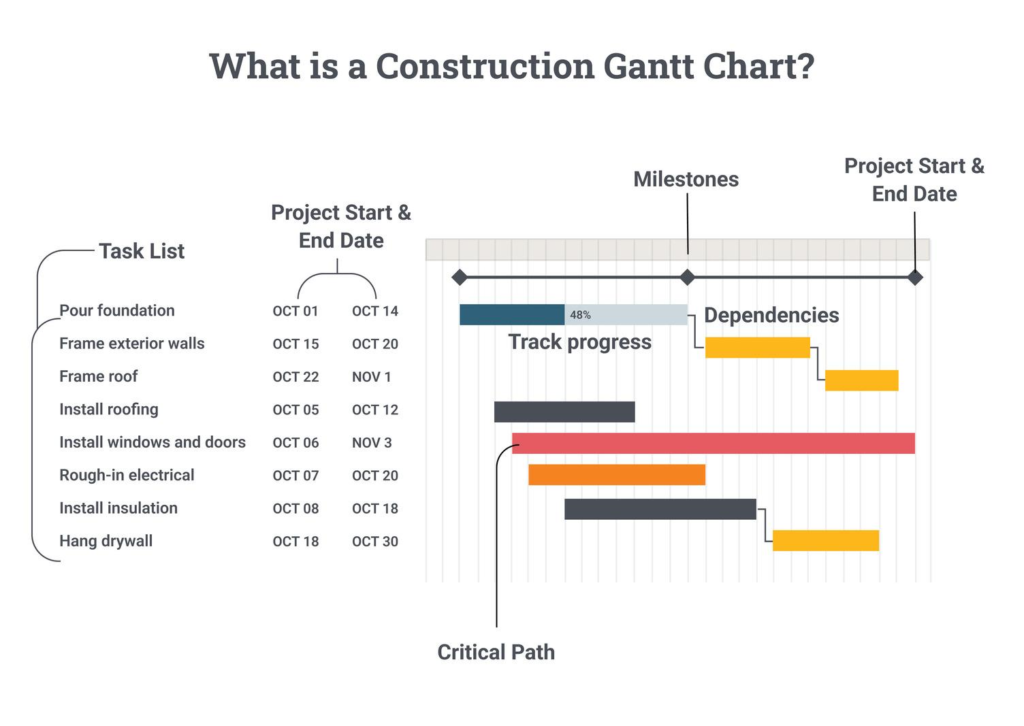
Step 4: Develop the Integrated Schedule
Individual project schedules should be connected.
The program schedule identifies:
- Major milestones
- Project interfaces
- Procurement dates
- Design deadlines
- Construction periods
- Testing activities
- Commissioning
- Handover
Critical dependencies should receive special attention. ⏱️
Step 5: Establish the Cost Baseline
The program team establishes approved budgets for different projects and packages.
Cost control should distinguish between:
- Original budget
- Approved changes
- Actual expenditure
- Committed expenditure
- Forecast expenditure
- Remaining budget
This allows management to identify financial problems before they become serious.
Step 6: Identify Risks
Risk workshops can identify threats such as:
- Material shortages
- Design changes
- Labor shortages
- Regulatory delays
- Weather conditions
- Ground conditions
- Contractor performance
- Supply-chain disruption
- Inflation
- Interface conflicts
Each significant risk should have an owner and response strategy.
Step 7: Coordinate Procurement
Long-lead items require early attention.
Examples include:
- Transformers
- Elevators
- Generators
- Steel structures
- Mechanical equipment
- Specialized control systems
- Switchgear
Procurement schedules must be synchronized with construction requirements.
Step 8: Monitor Performance
Program managers compare actual progress with approved baselines.
Typical indicators include:
- Schedule performance
- Cost performance
- Safety performance
- Quality performance
- Procurement progress
- Risk exposure
- Change volume
- Productivity
Step 9: Manage Change
Construction programs experience continuous change.
Changes should be evaluated for their effect on:
Scope → Cost → Schedule → Resources → Risk → Quality
A seemingly small design modification can have consequences across multiple projects.
Step 10: Complete Handover and Closeout
Program completion is more than finishing physical construction.
The team must coordinate:
- Testing
- Commissioning
- Defect correction
- Documentation
- Training
- Asset information
- Regulatory approvals
- Operational readiness
- Final accounts
Only then can the program transition successfully into operation.
Comparison
Understanding the difference between project, program, and portfolio management is important.
| Management Level | Primary Focus | Typical Example |
|---|---|---|
| Project Management | One defined project | Construction of one hospital |
| Program Management | Related projects and their interfaces | Healthcare campus development |
| Portfolio Management | Strategic collection of investments | National infrastructure investment portfolio |
Program Management vs Traditional Project Management
Program management emphasizes relationships between projects.
Project management asks:
“How do we successfully deliver this project?”
Program management asks:
“How do these projects work together to achieve the overall objective?”
That distinction becomes extremely important on major developments.
Diagrams & Tables
A simplified construction program structure can be visualized as:
                    CONSTRUCTION PROGRAM
                             │
        ┌────────────────────┼────────────────────┐
        │                    │                    │
     PROJECT A            PROJECT B            PROJECT C
        │                    │                    │
   ┌────┼────┐          ┌────┼────┐          ┌────┼────┐
 Design Civil MEP       Design Civil MEP      Design Civil MEP
        │                    │                    │
   Work Packages        Work Packages        Work Packages
        │                    │                    │
    Activities           Activities           Activities
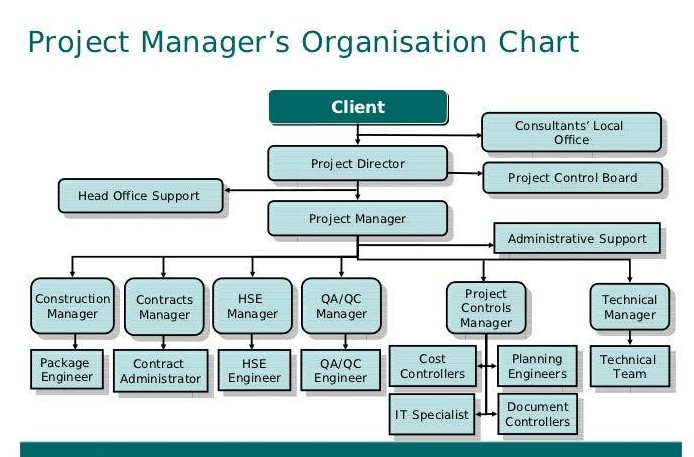
The important point is that these projects are not independent. Their interfaces must be actively managed.



Key Program Control Areas
| Control Area | Main Question |
|---|---|
| Scope | Are we delivering what was approved? |
| Time | Are milestones being achieved? |
| Cost | Is expenditure within the approved forecast? |
| Quality | Does the work meet requirements? |
| Safety | Are workers and the public protected? |
| Risk | What could prevent successful delivery? |
| Procurement | Will required materials arrive on time? |
| Resources | Are people and equipment available? |
| Interfaces | Are projects coordinated effectively? |
Examples Without Equations and Mathematics
Consider a large university campus construction program.
The program contains:
- Three academic buildings
- A research laboratory
- Student housing
- Roads
- Utility infrastructure
- A central energy plant
The laboratory requires specialized mechanical equipment. That equipment depends on final engineering drawings.
If the drawings are delayed, procurement cannot proceed.
If procurement is delayed, installation is delayed.
If installation is delayed, testing is delayed.
If testing is delayed, the laboratory cannot open.
The program manager therefore monitors the entire chain rather than looking only at the construction site.
Another Example: Airport Expansion
An airport expansion program may involve:
- Terminal construction
- Runway improvements
- Baggage systems
- Electrical infrastructure
- Security systems
- Roads
- Parking facilities
The terminal could be physically complete while the airport still cannot operate because the baggage system or security infrastructure is unfinished.
This demonstrates why program-level integration is critical.
Real-World Application
Construction program management is used across many sectors.
Infrastructure
Large transportation programs often include roads, bridges, tunnels, rail systems, stations, utilities, and supporting infrastructure.
Commercial Development
Large property developments can contain offices, retail areas, hotels, parking facilities, and public spaces.
Energy Projects
Energy programs may involve generation facilities, substations, transmission infrastructure, control systems, and supporting civil works.
Healthcare
Hospital programs require coordination between buildings, medical systems, utilities, technology, equipment, and operational teams.
Industrial Construction
Manufacturing programs often involve complex process equipment, buildings, utilities, automation, logistics, and commissioning.
Public-Sector Construction
Government programs require additional attention to procurement regulations, transparency, public accountability, environmental requirements, and community stakeholders.
Common Mistakes
Treating Every Project as Independent
Projects within a program often share resources, interfaces, suppliers, and dependencies.
Ignoring these relationships creates avoidable delays.
Using Poor Quality Schedule Data
A sophisticated scheduling system cannot compensate for inaccurate progress information.
The quality of decisions depends on the quality of the data. 📊
Ignoring Procurement
Construction teams sometimes focus heavily on site activities while overlooking long-lead procurement.
This can create major schedule problems.
Weak Change Control
Uncontrolled changes can gradually transform the approved program.
Every significant change should be assessed before implementation.
Focusing Only on Cost
A project can appear financially successful while experiencing unacceptable schedule, quality, or safety problems.
Effective program management requires a balanced performance view.
Poor Communication
Technical information can become fragmented among designers, contractors, consultants, and management.
Clear reporting structures are therefore essential.
Challenges & Solutions
| Challenge | Practical Solution |
|---|---|
| Schedule delays | Integrated master scheduling and early-warning indicators |
| Cost growth | Continuous forecasting and change control |
| Supply-chain disruption | Procurement planning and alternative suppliers |
| Design conflicts | Strong design coordination and interface management |
| Contractor underperformance | Clear KPIs and regular performance reviews |
| Resource shortages | Program-level resource planning |
| Stakeholder conflict | Structured communication and escalation processes |
| Poor data | Standardized reporting and centralized information |
| Quality problems | Inspection, testing, and corrective-action systems |
| Safety incidents | Proactive safety management and site leadership |
Managing Interfaces
One of the most difficult challenges is the interface between organizations.
For example, a civil contractor may complete a plant room while an electrical contractor still needs access.
Neither contractor may technically be responsible for the overall interface.
The program manager must therefore establish clear interface responsibilities.
Case Study
Imagine a hypothetical European metropolitan rail expansion program.
The program includes:
- New railway stations
- Track infrastructure
- Signaling
- Power systems
- Passenger facilities
- Road modifications
- Underground utilities
During construction, the signaling contractor reports that equipment installation cannot begin because electrical rooms are not ready.
The electrical contractor responds that installation was delayed because room layouts changed.
The design consultant explains that the layout changed because of updated operational requirements.
A project-level response might focus on fixing the electrical room.
A program-level response investigates the entire chain:
Operational requirement → Design → Approval → Procurement → Civil works → Electrical installation → Signaling → Testing
The program team can then identify the underlying interface problem and establish stronger design-freeze and approval procedures.
This example illustrates an important principle:
Program management should manage causes and interfaces, not only visible symptoms.
Essential Tips
Build a Reliable Baseline
Establish realistic scope, schedule, cost, and resource baselines before serious execution begins.
Use Milestones
Major milestones make complex programs easier to communicate and monitor.
Monitor Trends
Do not wait until a project is officially late.
Watch for declining productivity, increasing variation, procurement delays, and unresolved technical issues.
Maintain an Interface Register
Document important relationships between projects, contractors, consultants, and systems.
Prioritize Long-Lead Items
Identify critical equipment and materials early.
Create Clear Escalation Paths
Teams should know when and how problems are escalated.
Integrate Risk and Schedule Management
A major risk should be reflected in the program schedule when appropriate.
Use Visual Reporting
Dashboards, milestone charts, risk matrices, progress curves, and status indicators can make complex information easier to understand. 📈
Protect Data Quality
Accurate information is the foundation of effective program control.
Think Beyond Construction
Successful programs ultimately deliver usable assets and operational outcomes, not simply completed buildings.
FAQs
What is construction program management?
Construction program management is the coordinated management of multiple related construction projects, resources, schedules, costs, risks, stakeholders, and interfaces to achieve broader strategic objectives.
What is the difference between construction project management and program management?
Project management concentrates on delivering an individual project. Program management coordinates multiple related projects and focuses on their interactions and overall outcomes.
Why is scheduling important in construction program management?
Scheduling identifies dependencies, milestones, resource requirements, procurement deadlines, and potential delays. An integrated schedule helps management understand how one project’s delay could affect other projects.
What software is commonly used for construction program management?
Organizations may use scheduling, cost-control, document-management, BIM, enterprise resource planning, and project collaboration platforms. The best technology depends on program size, contract structure, reporting requirements, and organizational maturity.
How does program management control construction costs?
Cost control involves establishing budgets, monitoring commitments and actual expenditure, forecasting final costs, evaluating changes, and identifying emerging cost risks.
What are the biggest risks in construction programs?
Common risks include design changes, procurement problems, contractor performance, labor shortages, unforeseen site conditions, regulatory issues, inflation, stakeholder conflicts, safety events, and schedule delays.
Is BIM useful for construction program management?
Yes. Building Information Modeling can improve design coordination, visualization, clash detection, asset information management, and communication between project participants. At program level, BIM can also help coordinate information across multiple projects.
What skills does a construction program manager need?
A strong program manager needs technical understanding, leadership, communication, scheduling, cost management, risk management, negotiation, procurement knowledge, stakeholder management, decision-making, and the ability to understand complex project interfaces.
Conclusion
Construction program management provides the organizational framework required to control complex construction initiatives involving multiple projects, organizations, contracts, systems, and stakeholders. 🏗️🌍
The discipline goes far beyond simply tracking construction progress. Effective program management connects scope, schedule, cost, procurement, resources, quality, safety, risk, design, and stakeholder requirements into one coordinated management system.
For beginners, the most important concept is simple: construction programs succeed when related projects are managed as an interconnected system rather than as isolated activities.
For experienced professionals, the challenge is deeper: maintaining reliable information, anticipating interfaces, controlling change, managing uncertainty, and converting strategic objectives into measurable construction outcomes.
As construction projects become larger, more digital, more sustainable, and increasingly integrated with complex infrastructure systems, the importance of skilled program management will continue to grow.
Ultimately, successful construction program management is about creating clarity from complexity—turning numerous projects, teams, contracts, schedules, and technical requirements into one coordinated path toward successful delivery. 🚧📊🏆