Construction Cost Management 2nd Edition: Principles, Methods, Tools, and Real-World Applications
Introduction
Construction cost management is one of the most important disciplines in modern construction engineering. A technically excellent project can still fail if its costs are poorly estimated, uncontrolled, or inadequately monitored. 🏗️💰
From residential buildings and commercial developments to bridges, hospitals, infrastructure, and industrial facilities, every construction project operates within financial constraints. Cost management provides the framework for planning where money will be spent, monitoring actual expenditure, identifying deviations, and taking corrective action before financial problems become critical.
For students, engineers, quantity surveyors, project managers, contractors, consultants, and clients, understanding construction cost management is essential for making informed decisions throughout the project life-cycle.

A successful cost-management system does not simply attempt to make a project cheaper. Instead, it aims to achieve the required scope, quality, schedule, safety, and performance within an approved financial framework.
In simple terms:
Good cost management = planned spending + accurate measurement + continuous monitoring + informed decisions. 📊
Background Theory
Construction projects are affected by hundreds of financial variables. Material prices can change, labor availability can fluctuate, design requirements can evolve, and unexpected site conditions can create additional work.
Historically, construction cost control was often heavily dependent on paper-based quantity measurements, manual records, and periodic financial reports. Modern projects increasingly combine these traditional techniques with digital estimating software, Building Information Modeling (BIM), cloud-based collaboration, automated reporting, and data analytics.
The Construction Cost life-cycle
Cost management begins long before workers arrive on site.
A typical life-cycle includes:
- Concept development
- Preliminary cost estimating
- Feasibility analysis
- Budget development
- Detailed estimating
- Tendering and procurement
- Contract award
- Construction cost control
- Change management
- Forecasting
- Final account and closeout
Each stage provides information needed by the next.
Why Early Cost Planning Matters
Decisions made during conceptual design can have a major effect on the final project cost.
For example, selecting:
- A structural system
- Building geometry
- Foundation type
- Façade system
- Mechanical services
- Finishing standards
- Construction method
can influence both initial construction cost and long-term operating expenses.
Therefore, cost management should not be treated as an accounting activity performed after construction begins. It should be integrated into design, procurement, engineering, scheduling, and project management.
Definition
Construction cost management is the systematic process of estimating, planning, allocating, monitoring, controlling, forecasting, and reporting the financial resources required to successfully deliver a construction project.
Its primary objective is to maintain financial control while ensuring that the project achieves its contractual and technical requirements.
Main Components
Construction cost management generally includes:
- Cost estimating
- Budget preparation
- Cost planning
- Quantity measurement
- Procurement analysis
- Tender evaluation
- Cost coding
- Commitment tracking
- Change-order management
- Progress valuation
- Cost forecasting
- Cash-flow management
- Risk allowances
- Financial reporting
- Final cost reconciliation
Cost Management vs Cost Cutting
These terms are not identical.
Cost management focuses on controlling expenditure while protecting project objectives.
Cost cutting generally focuses on reducing expenditure, sometimes without considering the consequences.
For example, replacing a high-quality waterproofing system with a cheaper alternative may reduce the immediate construction cost but create expensive maintenance or failure problems later.
A professional cost manager therefore asks:
“What provides the best overall value for the project?”
rather than simply:
“What is the cheapest option?”
Step-by-Step Construction Cost Management Process
A reliable cost-management process should be established before major financial commitments are made.


Step 1: Define the Project Scope
The first step is to understand exactly what the project is expected to deliver.
The scope should identify:
- Building or infrastructure type
- Required facilities
- Performance requirements
- Quality standards
- Construction boundaries
- Completion requirements
- Client expectations
An unclear scope creates uncertainty throughout the cost-management process.
Step 2: Develop an Initial Estimate
An early estimate provides an approximate indication of project affordability.
At this stage, detailed quantities may not exist, so estimators may rely on:
- Historical projects
- Cost databases
- Floor-area information
- Construction type
- Location
- Market conditions
- Preliminary design information
The estimate should clearly state its assumptions and limitations.
Step 3: Establish the Project Budget
Once the project becomes better defined, the preliminary estimate develops into a structured budget.
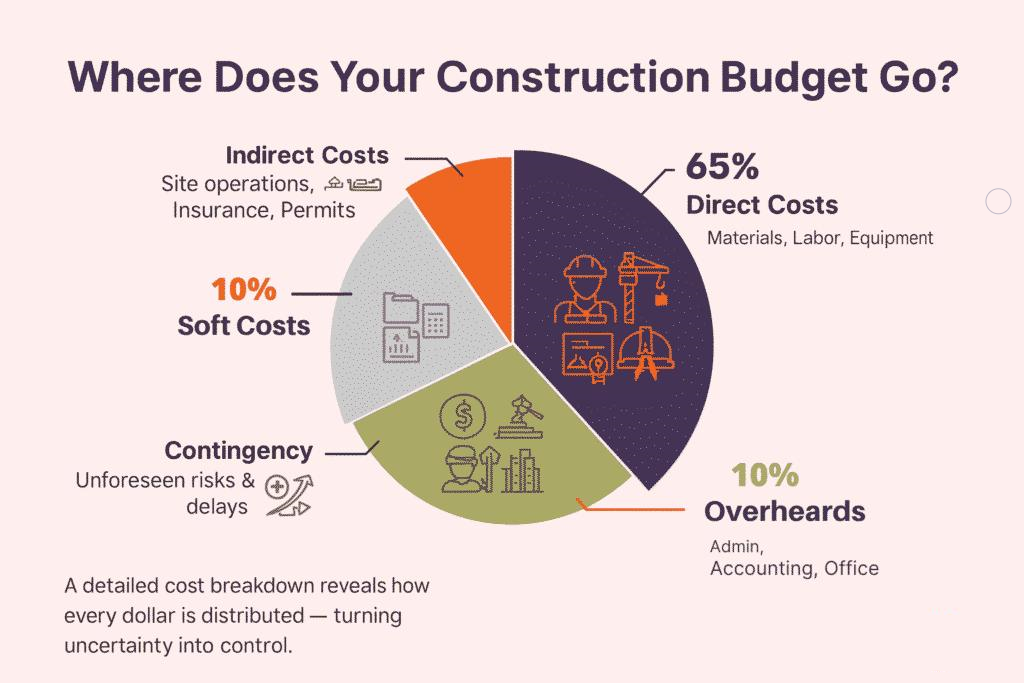
The budget can be divided into categories such as:
| Cost Category | Typical Examples |
|---|---|
| Site works | Excavation, earthworks, temporary works |
| Structure | Concrete, steel, reinforcement |
| Architecture | Walls, doors, windows, finishes |
| MEP | Mechanical, electrical, plumbing systems |
| External works | Roads, landscaping, drainage |
| Labor | Direct construction labor |
| Equipment | Cranes, excavators, temporary equipment |
| Professional services | Design, supervision, consultancy |
| Contingency | Allowance for identified uncertainty |
Step 4: Create a Cost Breakdown Structure
A Cost Breakdown Structure (CBS) organizes project costs into manageable packages.
For example:
Project → Building → Floor → Work Package → Activity → Cost Item
This makes it easier to determine where money is being spent.
Step 5: Measure Quantities
Detailed quantities are developed from drawings, specifications, BIM models, schedules, and other project documentation.
Quantity measurement may include:
- Concrete
- Reinforcement
- Structural steel
- Masonry
- Plaster
- Flooring
- Paint
- Pipes
- Cables
- Equipment
Accurate quantity information forms the foundation of a reliable estimate.
Step 6: Obtain Supplier and Contractor Pricing
Current market information should be collected from suitable suppliers and subcontractors.
Pricing can be influenced by:
- Location
- Material availability
- Transportation
- Currency fluctuations
- Labor market conditions
- Supplier capacity
- Project size
- Procurement strategy
Step 7: Develop the Procurement Strategy
The project team decides how construction work and materials will be purchased.
Possible approaches include:
- Competitive tendering
- Negotiated procurement
- Design-build procurement
- Traditional procurement
- Framework agreements
- Specialist subcontracting
The procurement method can significantly affect cost certainty and risk allocation.
Step 8: Establish Cost Baselines
A cost baseline provides a reference against which actual project performance can be compared.
The baseline should be linked to:
- Approved scope
- Work packages
- Schedule
- Budget
- Contract commitments
Step 9: Monitor Actual Costs
During construction, financial information should be collected continuously.
Typical information includes:
- Actual invoices
- Labor costs
- Material purchases
- Equipment costs
- Subcontractor payments
- Approved variations
- Pending changes
- Accrued costs
Step 10: Compare Planned and Actual Performance
The project team compares actual spending with the approved budget.
If expenditure is higher than expected, the team investigates the reason.
Possible causes include:
- Quantity increases
- Material price increases
- Design changes
- Productivity problems
- Delays
- Rework
- Poor procurement
- Unforeseen site conditions
Step 11: Forecast the Final Cost
A project should not rely solely on historical expenditure.
The team should continually ask:
“Based on current performance, what is the project likely to cost when completed?”
Forecasting allows management to identify potential overruns before they become unavoidable.
Step 12: Close and Reconcile the Project
At completion, the project team reviews:
- Final quantities
- Approved variations
- Claims
- Subcontractor accounts
- Retention
- Outstanding commitments
- Final payments
The final cost is then compared with the original budget and approved changes.
Comparison
Different cost-management approaches are appropriate at different project stages.


| Approach | Main Purpose | Best Application |
|---|---|---|
| Preliminary estimating | Establish early affordability | Concept stage |
| Detailed estimating | Develop accurate project pricing | Design stage |
| Cost planning | Allocate budget across design elements | Design development |
| Cost control | Monitor spending | Construction |
| Cost forecasting | Predict final expenditure | Construction |
| Value engineering | Improve value without sacrificing requirements | Design and procurement |
| Life-cycle costing | Evaluate long-term financial performance | Major assets |
| BIM-based costing | Connect quantities, models, and costs | Digitally managed projects |
Traditional vs Digital Cost Management
| Feature | Traditional Approach | Digital Approach |
|---|---|---|
| Quantity measurement | Manual or spreadsheet-based | BIM and digital measurement |
| Reporting | Periodic | Potentially real-time |
| Data integration | Limited | Highly integrated |
| Change tracking | Manual records | Automated workflows |
| Collaboration | Documents and meetings | Cloud platforms |
| Forecasting | Spreadsheet models | Integrated analytics |
| Visualization | Tables | Dashboards and models |
Neither approach eliminates the need for professional judgment. Digital tools improve information handling, but engineers and cost professionals still need to interpret the information correctly.
Diagrams and Tables
A simplified construction cost-management structure can be represented as:
PROJECT SCOPE
      ↓
COST ESTIMATE
      ↓
PROJECT BUDGET
      ↓
COST BREAKDOWN STRUCTURE
      ↓
PROCUREMENT & CONTRACTS
      ↓
CONSTRUCTION
      ↓
ACTUAL COST TRACKING
      ↓
VARIATION & CHANGE CONTROL
      ↓
COST FORECAST
      ↓
FINAL ACCOUNT




Important Cost-Control Information
| Information | Why It Matters |
|---|---|
| Approved budget | Establishes financial target |
| Actual cost | Shows expenditure to date |
| Commitments | Shows future contractual obligations |
| Variations | Tracks changes to approved scope |
| Forecast final cost | Indicates potential financial outcome |
| Cash flow | Supports funding and payment planning |
| Contingency | Provides controlled allowance for uncertainty |
Examples
Example 1: Commercial Office Building
A developer plans a multi-story office building.
During design, the team discovers that the proposed façade system is considerably more expensive than alternatives.
Instead of waiting until tendering, the cost manager compares several façade options with the architect and engineering team.
The final selection satisfies the appearance, thermal performance, durability, and planning requirements while improving budget performance.
This demonstrates the importance of early cost planning.
Example 2: Residential Development
A residential contractor notices that flooring costs are increasing because of supplier price changes.
The project team investigates alternative suppliers and evaluates equivalent products.
Rather than immediately reducing quality, the team negotiates purchasing quantities and adjusts procurement timing.
The project therefore protects both budget and quality.
Example 3: Infrastructure Project
During road construction, unexpected ground conditions require additional excavation and stabilization.
The cost manager records the change, verifies the quantities, reviews contractual responsibilities, and updates the project forecast.
This creates a transparent financial record rather than allowing the additional work to become an uncontrolled cost.
Real-World Applications
Construction cost management is used across almost every area of the built environment.
Building Construction
Cost management supports:
- Residential buildings
- Offices
- Hotels
- Hospitals
- Schools
- Universities
- Shopping centers
- Industrial buildings
Civil Engineering
Infrastructure projects require particularly strong cost management because they can involve large quantities, complex contracts, and long construction periods.
Applications include:
- Highways
- Railways
- Bridges
- Tunnels
- Airports
- Dams
- Water-treatment facilities
- Utilities
Sustainable Construction 🌱
Cost management is increasingly connected with sustainability.
A project team may compare:
- Conventional materials vs recycled materials
- Standard systems vs energy-efficient systems
- Low-cost equipment vs high-efficiency equipment
- Short-term construction cost vs long-term operating cost
This encourages whole-life value rather than focusing exclusively on initial expenditure.
BIM and 5D Cost Management
Building Information Modeling can connect physical building components with quantities and cost information.
This approach is often referred to as 5D BIM, where cost information is associated with the 3D model and project information.
A design modification can therefore potentially trigger updates to quantities and cost information, depending on the software and workflow used.
Common Mistakes
Poor Scope Definition
An incomplete scope produces unreliable estimates.
Solution: Establish clear requirements before developing detailed budgets.
Using Outdated Prices
Historical prices may no longer represent current market conditions.
Solution: Combine historical information with current supplier quotations and market intelligence.
Ignoring Indirect Costs
Some teams focus only on visible construction materials and labor.
However, projects can also involve:
- Site management
- Temporary facilities
- Insurance
- Permits
- Transportation
- Professional fees
- Financing
- Testing
- Security
Solution: Build a comprehensive cost structure.
Weak Change Management
Small changes can accumulate into substantial financial impacts.
Solution: Record, assess, approve, and track every significant change.
Treating the Budget as Fixed Forever
A project may evolve as design and site information develops.
Solution: Maintain a controlled baseline while documenting approved changes separately.
Poor Communication
Cost information is useless if decision-makers do not receive it in time.
Solution: Establish regular financial reporting and clear responsibility for cost information.
Challenges and Solutions
| Challenge | Potential Solution |
|---|---|
| Material price volatility | Early procurement and market monitoring |
| Labor shortages | Workforce planning and productivity monitoring |
| Design changes | Formal change-control procedures |
| Inaccurate quantities | Independent quantity verification |
| Construction delays | Integrated schedule and cost monitoring |
| Poor supplier information | Multiple quotations and market benchmarking |
| Unforeseen site conditions | Risk identification and appropriate contingency |
| Data fragmentation | Integrated digital project platforms |
| Weak forecasting | Regular cost-to-complete reviews |
Managing Cost Uncertainty
No estimate is perfectly certain.
The professional objective is not to eliminate uncertainty but to identify, quantify, monitor, and manage it.
A useful risk register can classify risks according to:
- Probability
- Potential financial impact
- Responsible party
- Mitigation action
- Current status
Case Study
Large Mixed-Use Development
Consider a hypothetical mixed-use development containing residential units, retail space, parking, mechanical systems, landscaping, and public areas.
At the beginning, the developer establishes a preliminary budget based on the conceptual design.
As design progresses, detailed cost planning identifies three major concerns:
- The structural design is becoming more expensive than anticipated.
- Mechanical systems exceed the original allowance.
- Imported finishing materials create procurement uncertainty.
The cost-management team works with architects, structural engineers, MEP engineers, and procurement specialists.
Structural Optimization
The engineering team evaluates alternative structural arrangements that satisfy performance requirements while reducing unnecessary complexity.
MEP Review
The mechanical and electrical systems are reviewed for efficiency, maintainability, and procurement availability.
Procurement Strategy
For materials exposed to significant market volatility, the team investigates alternative suppliers and evaluates early purchasing.
Construction Monitoring
Once construction begins, monthly cost reports compare:
- Original budget
- Approved changes
- Actual expenditure
- Contract commitments
- Forecast remaining expenditure
- Forecast final cost
Several design changes occur during construction, but each is evaluated through the project’s change-control process.
The result is not simply a lower construction price. Instead, the project achieves greater cost predictability and better financial decision-making.
This illustrates an important principle:
Cost management is a continuous management process, not a one-time estimate.
Essential Tips
For Students 🎓
- Learn quantity measurement fundamentals.
- Understand construction drawings.
- Study construction contracts.
- Practice reading bills of quantities.
- Learn spreadsheet-based cost analysis.
- Understand project scheduling.
- Explore BIM and 5D workflows.
- Study risk management.
For Engineers 🏗️
Always connect technical decisions with their financial consequences.
A design decision can influence:
Materials → Labor → Equipment → Schedule → Risk → Final Cost
For Quantity Surveyors
Maintain accurate records and verify quantities before approving financial information.
Good documentation protects both the client and contractor.
For Project Managers
Do not wait for a final financial report to discover an overrun.
Use regular indicators to identify emerging problems.
For Contractors
Track commitments as carefully as actual expenditure.
A project may appear financially healthy today while significant supplier and subcontractor obligations are still approaching.
For Professionals Using Digital Tools 💻
Use digital systems to improve:
- Data accuracy
- Collaboration
- Reporting
- Change tracking
- Forecasting
- Visualization
But always validate automated outputs.
Technology can process information quickly; professional judgment determines what the information means.
FAQs
What is construction cost management?
Construction cost management is the process of estimating, budgeting, monitoring, controlling, forecasting, and reporting the financial resources required to complete a construction project.
Why is construction cost management important?
It helps prevent uncontrolled spending, improves financial visibility, supports better decisions, and increases the probability that a project will be completed within its approved financial framework.
Who is responsible for construction cost management?
Responsibilities vary by project. Quantity surveyors, cost managers, project managers, contractors, commercial managers, estimators, engineers, consultants, and clients may all participate.
What is the difference between cost estimating and cost control?
Cost estimating predicts what a project is expected to cost. Cost control monitors actual and committed expenditure during the project and identifies deviations from the approved plan.
How does BIM help construction cost management?
BIM can connect building components with quantities and cost information. This can improve quantity extraction, change analysis, coordination, and cost visualization when the model and cost data are properly structured.
What causes construction cost overruns?
Common causes include design changes, inaccurate estimates, material-price changes, labor problems, delays, poor productivity, unforeseen site conditions, rework, procurement problems, and inadequate change control.
What is value engineering?
Value engineering is a structured approach to improving the value of a project by examining functions, performance, quality, and cost. It is not simply choosing the cheapest available option.
Can cost management eliminate project cost overruns?
No. Construction contains uncertainty and risks that cannot always be eliminated. Effective cost management aims to identify risks early, control avoidable costs, and provide reliable forecasts so that management can respond quickly.
Conclusion
Construction cost management is a fundamental part of successful engineering and project delivery. 🏗️📊
It begins with understanding the project scope and continues through estimating, budgeting, procurement, construction, monitoring, forecasting, change control, and final account reconciliation.
The strongest cost-management systems combine technical knowledge, financial discipline, accurate data, communication, risk management, and professional judgment.
For modern construction professionals, the field is also becoming increasingly digital. BIM, cloud platforms, automated reporting, digital quantity measurement, and data analytics are changing how project teams understand and control costs.
However, technology does not replace engineering expertise. A sophisticated software platform cannot compensate for an incomplete scope, inaccurate quantities, poor procurement decisions, or weak communication.
The fundamental principle remains simple:
Plan the cost → understand the risk → track the spending → control the changes → forecast the outcome → deliver the value. 🚀
When these principles are applied consistently, construction cost management becomes much more than a financial control function. It becomes a strategic engineering tool that helps clients, contractors, consultants, and project teams make better decisions and deliver successful projects.