Mathematics for Machine Learning: The Complete Beginner-to-Advanced Guide to Linear Algebra, Calculus, Probability, and Optimization
Introduction 🤖📊🧠
Machine Learning (ML) has transformed industries ranging from healthcare and finance to robotics and autonomous vehicles. While many beginners focus primarily on learning Python libraries such as TensorFlow, PyTorch, or Scikit-learn, experienced engineers understand that mathematics is the true foundation behind every machine learning algorithm.
Every prediction made by an AI system depends on mathematical principles. Whether a model is classifying images, predicting stock prices, recommending movies, or detecting fraud, it relies on concepts from:
- 📐 Linear Algebra
- 📈 Calculus
- 🎲 Probability
- 📊 Statistics
- ⚡ Optimization
- 📉 Numerical Methods
Without understanding these topics, engineers often treat machine learning as a “black box.” Learning the mathematics behind ML allows you to:
✅ Build better models
✅ Debug training problems
📈 Improve model accuracy
✅ Understand research papers
✅ Design new algorithms
This guide explains the mathematical foundations of machine learning in an intuitive, engineering-focused manner suitable for both beginners and professionals.


Background Theory 📚
Machine learning is essentially a mathematical optimization problem.
Instead of manually programming rules, engineers provide data, and algorithms discover mathematical relationships automatically.
The entire ML workflow can be summarized as:
Input Data → Mathematical Model → Prediction → Error Calculation → Parameter Update → Better Prediction
Nearly every ML algorithm repeatedly performs these four mathematical operations:
- Matrix multiplication
- Differentiation
- Probability estimation
- Optimization
These operations appear everywhere—from simple Linear Regression to advanced Deep Neural Networks.
Definition 📖
Mathematics for Machine Learning refers to the collection of mathematical disciplines used to develop, train, evaluate, and improve machine learning algorithms.
The primary mathematical branches include:
| Mathematics Branch | Purpose |
|---|---|
| Linear Algebra | Represents data efficiently |
| Calculus | Learns parameters through optimization |
| Probability | Handles uncertainty |
| Statistics | Learns patterns from data |
| Optimization | Finds the best model |
| Numerical Methods | Solves large-scale computations |
Together, these subjects enable computers to learn from experience rather than explicit programming.
Core Mathematical Foundations 🧮
Linear Algebra


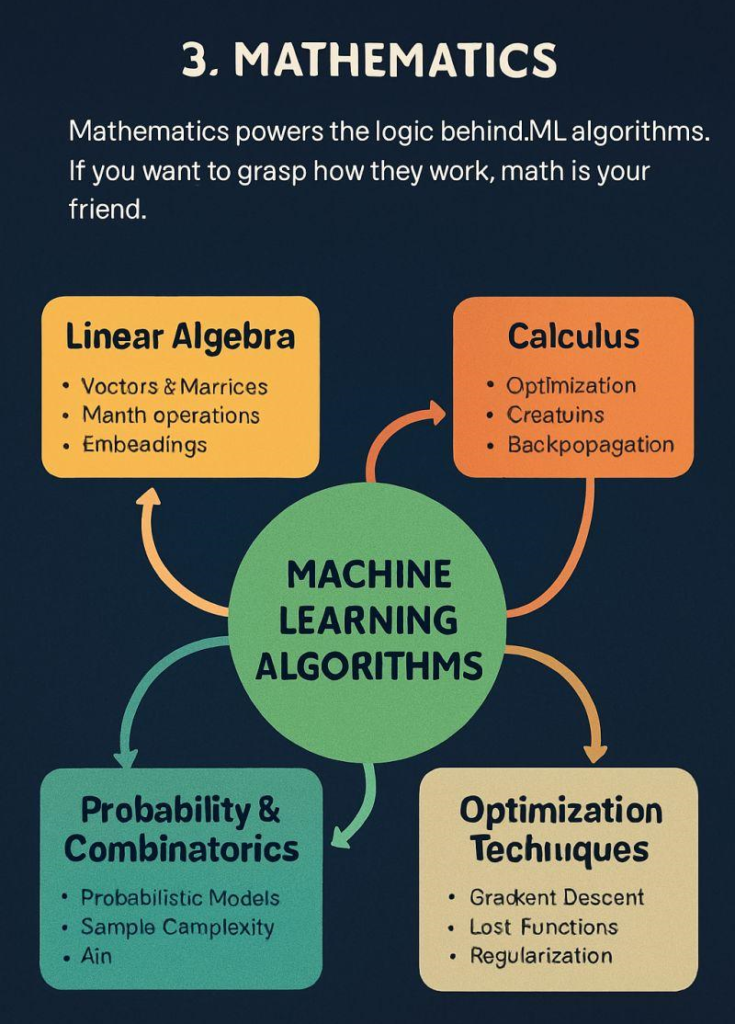
Linear algebra is arguably the most important mathematical topic in machine learning.
Almost every dataset is stored as matrices.
Example:
Student scores
| Student | Math | Physics | Programming |
|---|---|---|---|
| A | 90 | 82 | 95 |
| B | 75 | 80 | 77 |
| C | 88 | 91 | 90 |
This table becomes a matrix.
Important concepts include:
- Vectors
- Matrices
- Matrix multiplication
- Eigenvalues
- Eigenvectors
- Singular Value Decomposition (SVD)
- Rank
- Basis
- Orthogonality
Applications:
- Recommendation systems
- Image processing
- Principal Component Analysis (PCA)
- Neural networks
Calculus
Calculus teaches models how to learn.
The primary concepts include:
- Functions
- Limits
- Derivatives
- Partial derivatives
- Chain Rule
- Gradient
- Hessian Matrix
During training:
Prediction → Compute Error → Compute Gradient → Update Parameters
Gradient Descent is impossible without calculus.
Probability
Probability measures uncertainty.
Examples:
- Spam filtering
- Weather prediction
- Medical diagnosis
- Credit risk
Key concepts:
- Random variables
- Bayes theorem
- Conditional probability
- Gaussian distribution
- Likelihood
Statistics
Statistics helps computers understand datasets.
Important topics:
- Mean
- Median
- Mode
- Variance
- Standard deviation
- Correlation
- Covariance
- Hypothesis testing
Statistics is heavily used in:
- Data cleaning
- Feature engineering
- Model evaluation
Optimization
Optimization minimizes prediction errors.
Popular optimization algorithms:
- Gradient Descent
- Stochastic Gradient Descent (SGD)
- Mini-Batch Gradient Descent
- Adam Optimizer
- RMSProp
- AdaGrad
Step-by-Step Learning Roadmap 🚀


Step 1 – Learn Basic Algebra
Understand:
- Variables
- Equations
- Functions
- Graphs
Step 2 – Study Linear Algebra
Master:
- Vectors
- Matrices
- Matrix multiplication
- Dot product
Step 3 – Learn Calculus
Focus on:
- Derivatives
- Partial derivatives
- Chain rule
Step 4 – Study Probability
Learn:
- Events
- Distributions
- Bayes theorem
Step 5 – Learn Statistics
Study:
- Mean
- Variance
- Confidence intervals
Step 6 – Numerical Optimization
Practice:
- Gradient descent
- Learning rates
- Loss functions
Step 7 – Apply Mathematics Using Python
Popular libraries include:
- NumPy
- SciPy
- Pandas
- Scikit-learn
- TensorFlow
- PyTorch
Comparison of Mathematical Topics
| Topic | Difficulty | Importance | Used In |
|---|---|---|---|
| Algebra | ⭐ | ⭐⭐⭐⭐ | Every model |
| Linear Algebra | ⭐⭐⭐ | ⭐⭐⭐⭐⭐ | Neural Networks |
| Calculus | ⭐⭐⭐⭐ | ⭐⭐⭐⭐⭐ | Deep Learning |
| Probability | ⭐⭐⭐ | ⭐⭐⭐⭐ | Classification |
| Statistics | ⭐⭐⭐ | ⭐⭐⭐⭐ | Data Analysis |
| Optimization | ⭐⭐⭐⭐ | ⭐⭐⭐⭐⭐ | Model Training |
Visual Relationship Between Topics


| ML Component | Main Mathematics |
|---|---|
| Data Representation | Linear Algebra |
| Feature Scaling | Statistics |
| Neural Networks | Calculus |
| Loss Functions | Optimization |
| Classification | Probability |
| PCA | Eigenvectors |
| Regression | Matrix Algebra |
| Reinforcement Learning | Probability + Optimization |
Examples 💡
Example 1 — Linear Regression
Predict house prices.
Mathematics used:
- Matrix multiplication
- Least Squares
- Calculus
- Optimization
Example 2 — Image Recognition
Recognize handwritten digits.
Uses:
- Convolution
- Matrix operations
- Gradient Descent
- Probability
Example 3 — Recommendation Systems
Netflix recommendations.
Uses:
- Matrix Factorization
- Eigenvalues
- Optimization
Example 4 — Chatbots
Large Language Models rely on:
- Linear Algebra
- Attention matrices
- Probability distributions
- Gradient optimization
Real-World Applications 🌍
Mathematics powers nearly every AI-powered technology.
Healthcare 🏥
- Cancer detection
- MRI analysis
- Drug discovery
- Medical imaging
Finance 💰
- Fraud detection
- Credit scoring
- Portfolio optimization
- Stock prediction
Robotics 🤖
- Motion planning
- Computer vision
- Navigation
- Object detection
Manufacturing 🏭
- Predictive maintenance
- Quality inspection
- Industrial automation
Transportation 🚗
- Self-driving vehicles
- Traffic prediction
- Route optimization
Agriculture 🌱
- Crop monitoring
- Disease detection
- Smart irrigation
Common Mistakes ❌
Many learners encounter avoidable pitfalls:
- ❌ Memorizing formulas without understanding concepts.
- ❌ Ignoring linear algebra while jumping into deep learning.
- 📈 Skipping probability and statistics.
- ❌ Focusing only on coding libraries.
- ❌ Not practicing mathematical proofs or derivations.
- 📈 Avoiding real datasets.
- ❌ Expecting immediate mastery without consistent practice.
Challenges & Solutions 🛠️
| Challenge | Solution |
|---|---|
| Mathematics feels overwhelming | Break topics into small lessons and practice daily. |
| Difficulty understanding matrices | Use visual examples and interactive notebooks. |
| Calculus concepts are abstract | Relate derivatives to optimization and model learning. |
| Probability is confusing | Solve many real-world examples with datasets. |
| Forgetting formulas | Derive them instead of memorizing. |
| Applying theory to code | Implement algorithms from scratch before using libraries. |
Case Study 📚
Building a House Price Prediction Model
An engineering team wanted to predict house prices using historical data.
Problem
Estimate the selling price based on features such as:
- Area
- Number of bedrooms
- Age of the house
- Distance from city center
Mathematical Workflow
- Collect and clean data using statistics.
- Represent data as matrices with linear algebra.
- Normalize features.
- Define a loss function.
- Compute gradients using calculus.
- Optimize parameters with Gradient Descent.
- Evaluate performance using statistical metrics such as RMSE and R².
Outcome
The team achieved accurate predictions, reduced manual appraisal time, and improved decision-making for buyers and sellers.
Essential Tips ⭐
- 📚 Build a strong algebra foundation before studying advanced topics.
- 🧠 Understand concepts instead of memorizing equations.
- 💻 Practice mathematics using Python and NumPy.
- 📈 Visualize vectors, matrices, and functions whenever possible.
- 🔍 Read research papers to see mathematics applied in modern AI.
- 📝 Solve exercises regularly to reinforce learning.
- 🚀 Implement algorithms from scratch before relying on ML frameworks.
- 🤝 Combine theory with real-world engineering projects.
Frequently Asked Questions (FAQs) ❓
1. Do I need advanced mathematics before learning Machine Learning?
No. A solid understanding of algebra, basic calculus, and introductory probability is enough to begin. You can deepen your mathematical knowledge as you progress.
2. Which mathematics topic is the most important?
Linear Algebra is often considered the most fundamental because data, model parameters, and neural network computations are represented using vectors and matrices.
3. Is calculus required for Deep Learning?
Yes. Training neural networks relies on derivatives, gradients, and the chain rule to update model parameters efficiently.
4. Why is probability important in AI?
Probability helps models quantify uncertainty, estimate likelihoods, and make informed predictions in uncertain environments.
5. Can I learn Machine Learning by only using Python libraries?
You can build simple applications, but understanding the mathematics enables you to troubleshoot models, improve performance, and innovate beyond existing tools.
6. How long does it take to learn the required mathematics?
With consistent study, many learners gain a practical foundation in three to six months. Mastery develops over continued practice and project work.
7. Which programming language is best for practicing ML mathematics?
Python is the most widely used due to its rich ecosystem, including NumPy, SciPy, Pandas, Scikit-learn, TensorFlow, and PyTorch.
Conclusion 🎯
Mathematics is the language that powers machine learning. Every prediction, recommendation, classification, and optimization performed by modern AI systems is rooted in mathematical concepts such as linear algebra, calculus, probability, statistics, and optimization. Rather than viewing these subjects as obstacles, learners should embrace them as tools that unlock a deeper understanding of intelligent systems.
For beginners, mastering the basics provides confidence and clarity when working with machine learning frameworks. For experienced engineers and researchers, strong mathematical intuition enables the design of more efficient algorithms, the interpretation of cutting-edge research, and the ability to solve complex real-world problems.
By combining mathematical knowledge with practical programming in Python, continuous experimentation, and hands-on projects, students and professionals can build reliable, explainable, and high-performing AI solutions that are ready for today’s engineering challenges and tomorrow’s innovations. 🚀