Structural Analysis 10th Edition in SI Units: The Ultimate Engineering Guide for Students and Professionals 📘🏗️
Introduction 📖
Structural analysis is one of the most important subjects in civil and structural engineering. Every bridge, skyscraper, residential building, industrial facility, stadium, and offshore platform begins with a detailed structural analysis before construction starts.
Structural Analysis 10th Edition in SI Units is one of the most respected textbooks for understanding how structures behave under different loading conditions. It provides students and practicing engineers with systematic procedures for calculating internal forces, reactions, deflections, and stability while using the International System of Units (SI).
Whether you’re preparing for university exams, working on professional engineering projects, or refreshing your engineering fundamentals, this guide explains the major concepts in an easy-to-understand yet technically accurate manner.
✨ In this article, you’ll discover:
- 📐 Fundamental structural analysis concepts
- 🏗️ Types of structural systems
- ⚖️ Methods used for analysis
- 📊 Practical engineering examples
- 🚧 Common mistakes engineers should avoid
- 🌍 Real-world engineering applications
- 💡 Professional tips for better structural design


Background Theory 🏛️
Structural analysis is based on the principles of:
- Newton’s Laws of Motion
- Static Equilibrium
- Mechanics of Materials
- Elasticity Theory
- Compatibility Conditions
- Energy Methods
The objective is to determine how external loads are transmitted throughout a structure and how every structural member responds.
Every structure experiences:
- Dead Loads
- Live Loads
- Wind Loads
- Snow Loads
- Earthquake Loads
- Thermal Loads
- Dynamic Loads
The engineer must ensure that every member safely resists these forces without excessive deformation or collapse.
Definition 📚
Structural Analysis is the engineering process of determining the reactions, internal forces, stresses, strains, and deflections within structural members subjected to various external loads.
The analysis allows engineers to verify that structures satisfy:
- ✅ Strength requirements
- ✅ Stability requirements
- 🏗️ Serviceability requirements
- ✅ Safety regulations
- ✅ Building code provisions
Without proper structural analysis, safe structural design is impossible.
Fundamental Structural Concepts 🔬
Equilibrium
Every structure must satisfy equilibrium equations.
- ΣFx = 0
- ΣFy = 0
- ΣM = 0
These equations form the foundation of all structural analysis techniques.
Compatibility
Compatibility ensures that connected structural members deform together without creating impossible geometries.
Examples include:
- Continuous beams
- Rigid frames
- Trusses
- Multi-story buildings
Material Behavior
Most introductory structural analysis assumes:
- Linear elasticity
- Small deformations
- Homogeneous materials
- Isotropic behavior
Advanced analysis considers:
- Plastic deformation
- Nonlinear behavior
- Cracking
- Creep
- Fatigue
Step-by-Step Structural Analysis Process 🛠️


Step 1 — Understand the Structure
Determine:
- Geometry
- Supports
- Connections
- Material properties
Step 2 — Identify Loads
Typical loads include:
- Dead load
- Live load
- Wind
- Seismic
- Temperature
- Equipment loads
Step 3 — Draw the Free Body Diagram
The free body diagram (FBD) isolates the structure while showing:
- External forces
- Moments
- Support reactions
A correct FBD is often the most important step.
Step 4 — Calculate Support Reactions
Apply equilibrium equations to determine unknown reactions.
Step 5 — Determine Internal Forces
Calculate:
- Axial force
- Shear force
- Bending moment
- Torsion
Step 6 — Draw Internal Force Diagrams
Prepare:
- Shear Force Diagram (SFD)
- Bending Moment Diagram (BMD)
- Axial Force Diagram
Step 7 — Compute Deflections
Use methods such as:
- Double Integration
- Moment Area
- Virtual Work
- Conjugate Beam
- Energy Methods
Step 8 — Verify Safety
Compare calculated stresses against allowable design limits.
Structural Analysis Methods 📐
| Method | Best Used For | Difficulty | Accuracy |
|---|---|---|---|
| Method of Joints | Trusses | Easy | High |
| Method of Sections | Trusses | Easy | High |
| Slope Deflection | Continuous Beams | Medium | High |
| Moment Distribution | Frames | Medium | High |
| Matrix Stiffness | Large Structures | Advanced | Very High |
| Finite Element Method | Complex Structures | Advanced | Excellent |
Comparison ⚖️
| Feature | Classical Analysis | Matrix Analysis | Finite Element Analysis |
|---|---|---|---|
| Manual Calculations | Excellent | Moderate | Limited |
| Computer Use | Low | High | Very High |
| Accuracy | Good | Excellent | Outstanding |
| Complex Geometry | Poor | Good | Excellent |
| Industry Use | Moderate | High | Very High |
Diagrams & Engineering Illustrations 📊
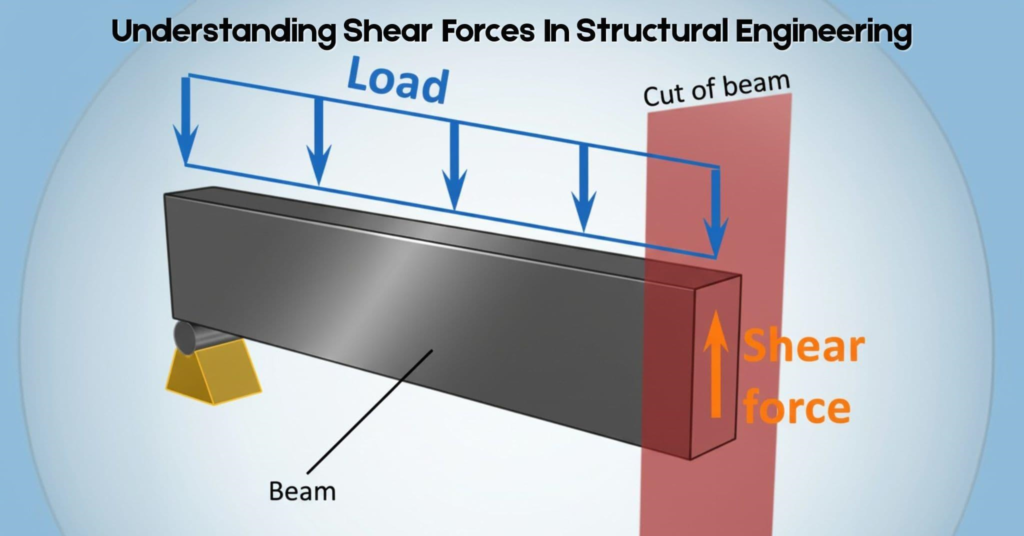
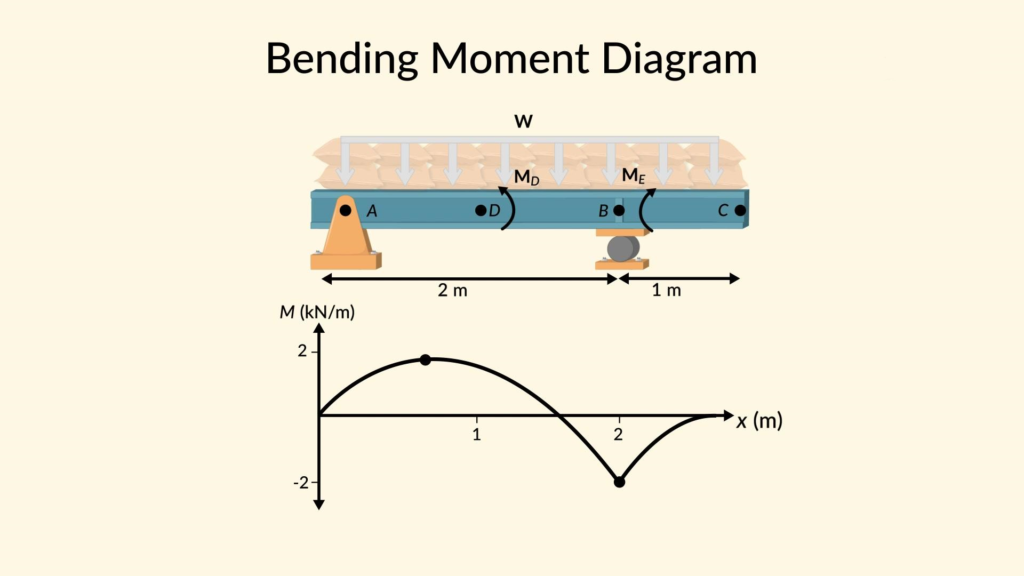


Typical Structural Analysis Workflow
| Stage | Output |
|---|---|
| Geometry | Structural Model |
| Loading | Load Diagram |
| Supports | Boundary Conditions |
| Analysis | Internal Forces |
| Deflections | Serviceability Check |
| Design | Member Sizes |
Internal Force Relationships
| Quantity | Symbol | Units (SI) |
|---|---|---|
| Force | F | N |
| Moment | M | kN·m |
| Stress | σ | MPa |
| Strain | ε | Dimensionless |
| Deflection | δ | mm |
| Rotation | θ | radians |
Examples ✏️
Example 1 – Simply Supported Beam
A simply supported beam carries a uniformly distributed load.
Determine:
- Support reactions
- Maximum shear
- Maximum bending moment
Typical outcome:
- Equal reactions at supports
- Maximum moment occurs at midspan
- Zero moment at supports
Example 2 – Roof Truss
A steel roof truss supports snow loading.
The engineer determines:
- Member tension
- Compression members
- Critical buckling members
Example 3 – Multi-Story Building
A reinforced concrete frame is subjected to:
- Dead load
- Live load
- Wind load
Software performs matrix analysis to determine:
- Story drift
- Beam moments
- Column forces
Real-World Applications 🌍
Structural analysis is essential across numerous engineering disciplines.
Building Construction 🏢
- Residential buildings
- Hospitals
- Schools
- Airports
- Shopping centers
Bridge Engineering 🌉
Analysis ensures bridges safely carry:
- Vehicles
- Pedestrians
- Wind loads
- Earthquakes
Industrial Engineering ⚙️
Used for:
- Factories
- Warehouses
- Pipe racks
- Crane structures
Offshore Engineering 🌊
Platforms resist:
- Waves
- Wind
- Corrosion
- Fatigue
Transportation Infrastructure 🚄
Applications include:
- Railway bridges
- Metro stations
- Elevated highways
- Airport terminals
Common Mistakes ❌
Even experienced engineers occasionally make errors.
Incorrect Load Assumptions
Missing wind or seismic loads can produce unsafe designs.
Poor Boundary Conditions
Incorrect support modeling changes internal forces dramatically.
Ignoring Deflection
A structure may be strong enough but fail serviceability requirements.
Unit Conversion Errors
Confusing:
- N
- kN
- MPa
- GPa
is one of the most common engineering mistakes.
Incomplete Load Combinations
Design codes require multiple load combinations.
Ignoring one critical combination may lead to unsafe results.
Challenges & Solutions 🚀
| Challenge | Solution |
|---|---|
| Complex Geometry | Finite Element Analysis |
| Large Structures | Matrix Methods |
| Dynamic Loading | Time-History Analysis |
| Material Nonlinearity | Nonlinear Analysis |
| Soil-Structure Interaction | Integrated Geotechnical Modeling |
Case Study 🏗️
Steel Office Building
A consulting engineering firm designed a 12-story office building.
Initial calculations underestimated wind drift.
After performing a refined matrix stiffness analysis:
- Additional bracing was introduced.
- Beam stiffness increased.
- Story drift reduced significantly.
- Occupant comfort improved.
- Building code requirements were satisfied.
The revised design slightly increased steel weight but substantially enhanced structural performance and long-term safety.
Essential Tips 💡
Learn Statics Thoroughly
Structural analysis builds directly upon equilibrium principles.
Master Free Body Diagrams
A correct diagram prevents many calculation mistakes.
Practice Manual Calculations
Even when using software, manual verification remains essential.
Understand Software Limitations
Programs provide numerical results—not engineering judgment.
Follow Design Codes
Always comply with applicable standards such as:
- Eurocodes
- AISC
- ACI
- ASCE
- CSA
- Australian Standards
Check Units Constantly
Consistent SI units eliminate many avoidable errors.
Validate Computer Results
Compare software output with approximate hand calculations whenever possible.
Frequently Asked Questions ❓
1. Is Structural Analysis 10th Edition suitable for beginners?
Yes. It starts with fundamental concepts before progressing to advanced analytical methods.
2. Why are SI Units important?
SI units provide international consistency, reduce conversion errors, and are widely adopted in engineering practice and education.
3. What software is commonly used for structural analysis?
Popular tools include SAP2000, ETABS, STAAD.Pro, Robot Structural Analysis, and ANSYS, depending on project complexity.
4. Is manual calculation still important?
Absolutely. Manual calculations help engineers understand structural behavior and verify software results.
5. What is the difference between structural analysis and structural design?
Structural analysis determines forces, moments, and deflections. Structural design uses those results to size members and ensure compliance with design codes.
6. Why is deflection important?
Excessive deflection can affect serviceability, occupant comfort, finishes, and long-term structural performance even when strength requirements are met.
7. Which analysis method is most widely used today?
Matrix stiffness methods and finite element analysis dominate modern engineering because they efficiently handle complex structures with high accuracy.
Conclusion 🎯
Structural Analysis 10th Edition in SI Units remains an invaluable resource for civil and structural engineering education and professional practice. By combining fundamental mechanics with modern analytical techniques, it equips engineers to evaluate beams, trusses, frames, and complex structures subjected to a wide range of loading conditions.
From understanding equilibrium and compatibility to applying matrix methods and finite element analysis, mastering structural analysis enables engineers to create structures that are safe, economical, durable, and code-compliant. Whether you’re a student preparing for examinations or a practicing engineer designing real-world infrastructure, a solid grasp of these principles forms the backbone of successful structural engineering. Continuous practice, careful verification of results, and adherence to international standards will help you develop the confidence and expertise needed to solve increasingly challenging structural problems. 🏗️📐🌍