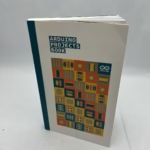
The Giant Book of Electronics Projects: The Ultimate Engineering Guide for Students, Makers, and Professionals ⚡📘🔧
Introduction 🚀
Electronics engineering has transformed modern civilization in ways that were once unimaginable. From smartphones and medical devices to industrial automation and artificial intelligence systems, electronics are deeply integrated into daily life. One of the most exciting ways to learn electronics is through practical experimentation and project-based learning. This is exactly where The Giant Book of Electronics Projects becomes incredibly valuable.
For engineering students, hobbyists, researchers, and professional engineers, project-oriented learning provides a direct path toward understanding complex electronic systems. Instead of memorizing formulas alone, readers build real circuits, analyze outputs, troubleshoot errors, and understand how theoretical concepts behave in real-world conditions.
📡 Electronics projects encourage:
- Hands-on engineering skills
- Circuit design understanding
- Analytical thinking
- Problem-solving abilities
- Innovation and creativity
- Embedded systems experience
- Hardware troubleshooting skills
- Practical application of theory
The importance of project-based electronics education has increased dramatically due to the growth of:
- Internet of Things (IoT)
- Robotics 🤖
- Renewable energy systems ☀️
- Smart homes 🏠
- Automotive electronics 🚗
- Wearable technology ⌚
- Industrial automation 🏭
- Artificial intelligence hardware
The Giant Book of Electronics Projects acts as a bridge between theory and implementation. It contains hundreds of practical projects that range from beginner-level LED circuits to advanced microcontroller and sensor-based systems.
This article explores the engineering foundations, technical concepts, practical applications, learning methods, common mistakes, and advanced engineering insights related to electronics project development.
Background Theory ⚙️
Understanding electronics projects requires a strong foundation in electrical and electronic engineering principles. Before building circuits, engineers must understand the behavior of electricity, components, and signals.
Fundamentals of Electricity ⚡
Electricity is the movement of electrons through a conductor. Electronic systems depend on voltage, current, resistance, and power.
Voltage
Voltage is the electrical pressure that pushes electrons through a circuit.
Unit: Volt (V)
Examples:
- 1.5V battery
- 5V USB supply
- 12V automotive systems
- 220V AC household systems
Current
Current is the flow rate of electric charge.
Unit: Ampere (A)
Two types:
- Direct Current (DC)
- Alternating Current (AC)
Resistance
Resistance opposes the flow of current.
Unit: Ohm (Ω)
Resistors protect circuits and control current flow.
Power
Electrical power measures energy consumption.
Unit: Watt (W)
The power equation is central to electronics engineering:
genui{“math_block_widget_always_prefetch_v2”:{“content”:”P = VI”}}
Where:
- P = Power
- V = Voltage
- I = Current
Ohm’s Law 🔍
One of the most important concepts in electronics is Ohm’s Law.
genui{“math_block_widget_always_prefetch_v2”:{“content”:”V = IR”}}
This equation explains the relationship between voltage, current, and resistance.
Applications include:
- LED current calculations
- Sensor interfacing
- Power supply design
- Circuit troubleshooting
- Amplifier design
Electronic Components 🧩
Electronics projects involve multiple hardware components.
Passive Components
Passive components do not amplify signals.
Examples:
- Resistors
- Capacitors
- Inductors
Active Components
Active components control or amplify signals.
Examples:
- Transistors
- Integrated circuits (ICs)
- MOSFETs
- Operational amplifiers
⚡ Analog vs Digital Electronics 💡
Analog Electronics
Analog circuits process continuously varying signals.
Examples:
- Audio amplifiers
- Radio receivers
- Sensor conditioning circuits
Digital Electronics
Digital systems use binary values:
- 0 (LOW)
- 1 (HIGH)
Examples:
- Microcontrollers
- Computers
- Logic gates
- Arduino systems
Semiconductor Theory 🧪
Semiconductors are the foundation of modern electronics.
Common semiconductor materials:
- Silicon
- Germanium
- Gallium arsenide
Semiconductors enable:
- Transistors
- Diodes
- Solar cells
- Integrated circuits
Technical Definition 📘
The Giant Book of Electronics Projects can be technically defined as a comprehensive engineering resource containing structured practical electronic systems designed for educational, experimental, and professional implementation.
The projects included typically combine:
- Circuit theory
- Component selection
- PCB concepts
- Power management
- Signal processing
- Embedded programming
- Troubleshooting techniques
- Real-world engineering practices
The primary purpose of such a project collection is to help learners:
- Understand electronics practically
- Build functioning systems
- Develop engineering intuition
- Learn debugging methods
- Improve hardware design skills
- Explore innovation opportunities
Electronics project books often include:
| Category | Description | Difficulty |
|---|---|---|
| Basic LED Projects | Beginner circuits | Easy |
| Audio Systems | Amplifiers and sound circuits | Medium |
| Sensor Projects | Environmental sensing | Medium |
| Robotics | Automation and motion control | Advanced |
| RF Systems | Wireless communication | Advanced |
| IoT Projects | Internet-connected systems | Advanced |
| Power Electronics | Energy conversion systems | Advanced |
Step-by-step Explanation 🛠️
Building electronics projects requires systematic engineering methodology.
Step 1: Understand the Circuit Diagram 📑
A schematic diagram represents the electrical connections between components.
Engineers must identify:
- Power supply
- Ground connections
- Signal paths
- Component values
- Input and output sections
Typical symbols include:
| Symbol | Component |
|---|---|
| Zigzag line | Resistor |
| Parallel plates | Capacitor |
| Triangle | Amplifier |
| Arrow diode | LED |
| Coil | Inductor |
Step 2: Gather Components 📦
Before building a project, engineers collect all required materials.
Examples:
- Breadboard
- Jumper wires
- ICs
- Resistors
- Sensors
- LEDs
- Power supply
- Soldering tools
Step 3: Prototype on Breadboard 🔌
Breadboards allow temporary circuit assembly without soldering.
Advantages:
- Easy modifications
- Fast testing
- Low risk
- Beginner friendly
However, breadboards may introduce:
- Noise
- Loose connections
- Signal instability
Step 4: Test Power Supply ⚠️
Incorrect voltage is one of the most common causes of circuit failure.
Always verify:
- Voltage polarity
- Current capability
- Stable output
- Short circuits
Step 5: Assemble the Circuit 🔧
Engineers connect components according to the schematic.
Important practices:
- Keep wires organized
- Use correct resistor values
- Avoid reversed polarity
- Double-check pin numbers
Step 6: Program the Controller 💻
Advanced projects often use:
- Arduino
- Raspberry Pi
- ESP32
- STM32
- PIC microcontrollers
Programming languages may include:
- C
- C++
- Python
- Embedded assembly
Step 7: Debug and Troubleshoot 🧠
Troubleshooting is a critical engineering skill.
Common debugging tools:
- Multimeter
- Oscilloscope
- Logic analyzer
- Signal generator
Step 8: Optimize Performance 🚀
Professional engineers improve:
- Efficiency
- Power consumption
- Signal quality
- Heat management
- Reliability
Comparison Between Beginner and Advanced Electronics Projects ⚖️
| Feature | Beginner Projects | Advanced Projects |
|---|---|---|
| Complexity | Low | High |
| Components | Basic | Specialized |
| Programming | Minimal | Extensive |
| Power Requirements | Low | Moderate to High |
| Cost | Affordable | Expensive |
| Troubleshooting | Easy | Complex |
| PCB Design | Optional | Essential |
| Applications | Educational | Industrial |
Beginner Project Examples 🌟
- LED blinkers
- Simple alarms
- Light-sensitive circuits
- Basic timers
- Temperature indicators
Advanced Project Examples 🚀
- Autonomous robots
- Smart energy systems
- Wireless communication modules
- AI-powered embedded systems
- Industrial automation controllers
Diagrams and Engineering Tables 📊
Basic Electronics System Diagram
Power Supply → Input Sensors → Controller → Output Device
Example: LED Circuit Diagram
Battery (+) ── Resistor ── LED ── Battery (-)
Common Resistor Color Codes 🎨
| Color | Value |
|---|---|
| Black | 0 |
| Brown | 1 |
| Red | 2 |
| Orange | 3 |
| Yellow | 4 |
| Green | 5 |
| Blue | 6 |
| Violet | 7 |
| Gray | 8 |
| White | 9 |
Common Sensor Types 📡
| Sensor | Purpose |
|---|---|
| Temperature Sensor | Heat measurement |
| Ultrasonic Sensor | Distance detection |
| PIR Sensor | Motion detection |
| Gas Sensor | Air quality monitoring |
| Light Sensor | Brightness measurement |
Examples of Popular Electronics Projects 🔥
LED Blinking Circuit 💡
This is usually the first electronics project for beginners.
Concepts learned:
- Timing
- Current limiting
- Circuit assembly
- Basic troubleshooting
Applications:
- Indicators
- Decorations
- Alert systems
Automatic Street Light System 🌃
Uses light sensors to switch lights ON or OFF automatically.
Engineering concepts:
- Sensor interfacing
- Transistor switching
- Energy efficiency
Temperature Monitoring System 🌡️
This project measures environmental temperature.
Possible components:
- LM35 sensor
- Arduino board
- LCD display
Applications:
- Weather stations
- Industrial monitoring
- HVAC systems
Smart Home Automation 🏠
Modern electronics projects often involve IoT systems.
Features:
- Remote control
- Wi-Fi communication
- Mobile apps
- Sensor automation
Robotics Projects 🤖
Robotics combines:
- Electronics
- Programming
- Mechanics
- Artificial intelligence
Robotics projects teach:
- Motor control
- Sensor fusion
- Embedded systems
- Autonomous navigation
Real World Applications 🌍
Electronics projects are not just educational experiments. Many technologies used globally started as small engineering prototypes.
Healthcare Systems 🏥
Electronics projects contribute to:
- ECG monitors
- Patient monitoring systems
- Portable medical devices
- Smart prosthetics
- Wearable health sensors
Industrial Automation 🏭
Factories rely heavily on electronic systems.
Applications include:
- PLC systems
- Robotics
- Conveyor automation
- Predictive maintenance
- Smart manufacturing
Automotive Electronics 🚗
Modern vehicles contain hundreds of electronic modules.
Examples:
- ABS braking systems
- Airbag controllers
- Engine management systems
- Autonomous driving sensors
- Infotainment systems
Renewable Energy ⚡☀️
Electronics are essential in sustainable energy systems.
Applications:
- Solar charge controllers
- Wind turbine systems
- Battery management systems
- Smart grids
- Energy monitoring devices
Aerospace Engineering ✈️
Aircraft and spacecraft use advanced electronics for:
- Navigation
- Communication
- Flight control
- Telemetry
- Radar systems
Common Mistakes in Electronics Projects ❌
Even experienced engineers make mistakes during project development.
Incorrect Polarity
Connecting power backward can destroy components.
Affected components:
- Electrolytic capacitors
- LEDs
- ICs
- Diodes
Wrong Resistor Values
Using incorrect resistor values may:
- Burn LEDs
- Cause unstable signals
- Damage transistors
Poor Soldering 🔥
Bad solder joints create unreliable circuits.
Signs of poor soldering:
- Dull solder joints
- Loose connections
- Intermittent operation
Ignoring Heat Dissipation 🌡️
Power electronics generate heat.
Without cooling:
- Components overheat
- Efficiency drops
- Failure rates increase
Weak Grounding
Improper grounding causes:
- Noise
- Signal distortion
- System instability
No Circuit Protection ⚠️
Professional designs include:
- Fuses
- Voltage regulators
- Current protection
- Reverse polarity protection
Challenges and Solutions 🧩
Electronics engineering projects often involve technical challenges.
Challenge: Signal Noise 📶
Noise affects analog and digital systems.
Solutions
- Shielded cables
- Decoupling capacitors
- Proper PCB layout
- Ground planes
Challenge: Power Instability ⚡
Unstable voltage damages systems.
Solutions
- Voltage regulators
- Capacitor filtering
- Stable power supplies
- Power conditioning circuits
Challenge: Component Availability 📦
Some parts become unavailable.
Solutions
- Use equivalent components
- Redesign circuits
- Source globally
- Maintain inventory databases
Challenge: Debugging Complexity 🧠
Large projects are difficult to troubleshoot.
Solutions
- Modular design
- Incremental testing
- Simulation software
- Documentation
Challenge: PCB Design Errors
Poor PCB design causes system failure.
Solutions
- Design rule checking
- Thermal analysis
- Proper trace sizing
- EMC testing
Case Study: Smart Greenhouse Monitoring System 🌱
A university engineering team developed a smart greenhouse monitoring project inspired by concepts commonly found in electronics project books.
Project Goals 🎯
The team wanted to:
- Monitor temperature
- Control irrigation
- Track humidity
- Reduce water waste
- Enable remote monitoring
Hardware Used 🔧
| Component | Purpose |
|---|---|
| Arduino Mega | Main controller |
| DHT22 Sensor | Temperature and humidity |
| Soil Moisture Sensor | Water level detection |
| Relay Module | Pump control |
| Wi-Fi Module | Internet communication |
| LCD Display | Local monitoring |
Engineering Process ⚙️
Planning Phase
Engineers created:
- Block diagrams
- Power calculations
- Sensor placement layouts
Development Phase
The team built prototypes using breadboards before PCB fabrication.
Testing Phase
Tests included:
- Temperature accuracy
- Pump reliability
- Wireless stability
- Long-term operation
Results 📈
The system achieved:
- 30% reduction in water usage
- Improved crop consistency
- Remote smartphone monitoring
- Automatic irrigation scheduling
Lessons Learned 📚
The engineering team discovered:
- Sensor calibration is critical
- Noise filtering improves reliability
- Modular programming simplifies debugging
- Power management affects stability
Tips for Engineers 👨💻👩💻
Start Simple
Beginners should first understand:
- LEDs
- Resistors
- Basic sensors
- Simple microcontrollers
Learn Circuit Simulation 💻
Simulation software helps reduce mistakes.
Popular tools:
- Proteus
- Multisim
- LTspice
- KiCad
- EasyEDA
Read Datasheets Carefully 📄
Datasheets contain critical information:
- Voltage limits
- Current ratings
- Pin configurations
- Timing diagrams
Keep a Project Notebook 📘
Professional engineers document:
- Schematics
- Test results
- Problems
- Solutions
- Version updates
Focus on Safety ⚠️
Electrical safety is essential.
Always:
- Disconnect power before changes
- Use insulated tools
- Avoid overloaded circuits
- Wear eye protection
Practice Troubleshooting 🛠️
Strong debugging skills separate excellent engineers from average ones.
Build Portfolio Projects 🌟
Students should create projects that demonstrate:
- Creativity
- Technical depth
- Practical skills
- Problem-solving ability
Portfolio projects improve:
- Internship opportunities
- Engineering careers
- Research applications
- Startup innovation
FAQs ❓
What is The Giant Book of Electronics Projects?
It is a comprehensive collection of practical electronics projects designed to teach engineering concepts through hands-on experimentation.
Is the book suitable for beginners?
Yes. Most electronics project books start with simple circuits before moving to advanced systems.
What tools are required for electronics projects?
Basic tools include:
- Multimeter
- Breadboard
- Soldering iron
- Power supply
- Wire cutters
Are electronics projects useful for engineering careers?
Absolutely. Practical project experience improves:
- Technical understanding
- Interview performance
- Engineering confidence
- Problem-solving skills
What programming languages are commonly used?
Popular choices include:
- C
- C++
- Python
- Embedded C
Can electronics projects help in robotics?
Yes. Robotics heavily depends on:
- Sensors
- Motor drivers
- Embedded systems
- Communication circuits
What is the biggest challenge for beginners?
Troubleshooting and understanding circuit diagrams are often the biggest initial challenges.
How can engineers improve faster?
The best method is consistent practice through:
- Building projects
- Reading datasheets
- Experimenting
- Debugging
- Studying real systems
Conclusion 🎯
The Giant Book of Electronics Projects represents far more than a simple collection of circuits. It is a gateway into the world of engineering innovation, practical experimentation, and technological creativity.
Electronics projects provide one of the most effective methods for learning engineering because they combine theory with hands-on implementation. Through building and testing circuits, students and professionals gain deep technical understanding that cannot be achieved through theory alone.
Modern engineering industries increasingly value practical experience. Engineers who can design, prototype, debug, and optimize electronic systems are highly sought after in fields such as:
- Robotics 🤖
- Renewable energy ☀️
- Artificial intelligence 🧠
- Aerospace ✈️
- Automotive engineering 🚗
- Industrial automation 🏭
- Healthcare technology 🏥
The future of electronics engineering is extremely exciting. Emerging technologies such as quantum computing, edge AI, smart sensors, and autonomous systems will continue to create opportunities for engineers with strong practical electronics knowledge.
Whether you are a beginner experimenting with LEDs or an advanced engineer designing embedded systems, electronics projects remain one of the best ways to strengthen technical expertise and develop real-world engineering skills.
Every great innovation starts with experimentation, curiosity, and the courage to build something new. ⚡🔬🚀