The Art of Statistics: Learning from Data — A Practical Guide for Engineers, Students, and Professionals
Introduction
Statistics is far more than a collection of formulas, charts, and probability rules. In engineering, statistics is a way of thinking about uncertainty. It helps us transform raw observations into useful evidence, recognize patterns hidden inside noisy measurements, and make decisions when the available information is incomplete.
Imagine an engineer monitoring thousands of measurements from a manufacturing process. Some readings will naturally vary. A few may be unusually high or low. The important question is not simply “What number did we measure?” but rather:
“What does the entire collection of measurements tell us?” 📊
This is where statistical thinking becomes powerful.

For students, statistics provides a foundation for experimental work, research, data science, quality control, and machine learning. For professionals, it supports decisions involving reliability, manufacturing, construction, energy systems, software performance, environmental monitoring, and many other engineering disciplines.
The central idea is simple: data contains information, but statistics helps us extract that information responsibly.
Background Theory
Why Engineers Need Statistics
Engineering systems rarely behave in exactly the same way every time.
A sensor may produce slightly different readings. A manufactured component may have small dimensional variations. A bridge may experience different traffic loads. A software application may respond differently depending on workload.
This variation does not necessarily indicate failure.
Statistics gives engineers tools for separating:
- Normal variation
- Unusual observations
- Measurement errors
- Meaningful trends
- Relationships between variables
- Random fluctuations
- Genuine process changes
Population and Sample
A population represents the complete group or system that we want to understand.
A sample is a smaller collection of observations selected from that population.
For example, a manufacturer may produce one million bearings during a year. Testing every bearing may be expensive or impossible. Instead, engineers can inspect a representative sample and use statistical reasoning to understand the broader production process.
The quality of the conclusion depends heavily on how that sample was collected.
Variation Is Information
Variation is one of the most important concepts in statistics.
Suppose five machines produce components with slightly different dimensions. Looking only at the average could make the machines appear identical. However, examining the spread of their measurements might reveal that one machine is much less stable.
Therefore, engineers should ask two questions:
Where is the data centered?
and
How much does the data vary?
Both are essential.
Definition
What Is Statistics?
Statistics is the discipline of collecting, organizing, analyzing, interpreting, and communicating data to support informed conclusions and decisions.
In engineering practice, statistics can be viewed as a workflow:
Observation → Data → Analysis → Evidence → Decision → Improvement
Descriptive Statistics
Descriptive statistics summarizes information that has already been collected.
Common tools include:
- Mean
- Median
- Mode
- Range
- Variance
- Standard deviation
- Percentiles
- Frequency distributions
- Histograms
- Box plots
These methods answer questions such as:
What does our dataset look like?
Inferential Statistics
Inferential statistics goes one step further.
Instead of describing only the observed sample, engineers use the sample to make carefully qualified statements about a larger population.
Examples include:
- Estimating population characteristics
- Testing hypotheses
- Constructing confidence intervals
- Evaluating relationships
- Comparing groups
- Predicting outcomes
Probability and Uncertainty
Probability provides a framework for discussing uncertainty.
An engineer might ask:
- How likely is a component to fail?
- How frequently does a defect occur?
- What is the probability that a measurement exceeds a specification?
- How reliable is a system under a particular operating condition?
Statistics and probability therefore work together to support engineering decisions.
Step-by-Step Statistical Thinking
Step 1: Define the Engineering Question
Never begin with a statistical method simply because it is available.
Start with the engineering problem.
For example:
“Why has the average production time increased?”
is more useful than:
“Which statistical test should I use?”
The question determines what data is needed and how it should be analyzed.
Step 2: Identify the Variables
Determine what needs to be measured.
A manufacturing investigation might involve:
- Temperature
- Pressure
- Production speed
- Material properties
- Defect rate
- Machine identification
- Production time
Clearly defining variables prevents confusion later.
Step 3: Collect Reliable Data
Good statistical analysis cannot rescue fundamentally bad data.
During collection, consider:
- Measurement accuracy
- Sensor calibration
- Sampling frequency
- Missing observations
- Recording errors
- Environmental conditions
- Selection bias
Step 4: Clean and Organize the Dataset
Before analysis, inspect the dataset.
Look for:
- Missing values
- Duplicate records
- Impossible values
- Incorrect units
- Typographical errors
- Suspicious measurements
- Changes in measurement procedures
Data preparation is often one of the most time-consuming parts of real-world statistics.
Step 5: Visualize the Data
Visualization can reveal patterns that numerical summaries hide.
Useful charts include:
- Histograms
- Scatter plots
- Line charts
- Box plots
- Bar charts
- Control charts
A well-designed visualization can sometimes reveal a problem within seconds.
Step 6: Summarize the Data
Use appropriate descriptive statistics.
The mean can describe a typical value, while the median may better represent a dataset containing extreme observations.
Measures of spread explain how consistent the observations are.
Step 7: Investigate Relationships
Engineers frequently need to determine whether variables are associated.
For example:
Does increasing temperature correspond to increased failure rates?
A scatter plot may provide an initial answer.
Correlation can quantify the strength of an association, while regression can help model relationships and make predictions.
Step 8: Interpret the Results
Statistical output is not automatically an engineering conclusion.
An engineer must consider:
- Practical significance
- Measurement uncertainty
- Domain knowledge
- Sample quality
- Operating conditions
- Potential alternative explanations
Step 9: Communicate the Findings
A statistical analysis is valuable only if decision-makers can understand it.
A good engineering report should explain:
What happened?
Why does it matter?
How confident are we?
What should we do next?
Comparison
Descriptive vs Inferential Statistics
| Feature | Descriptive Statistics | Inferential Statistics |
|---|---|---|
| Main purpose | Summarize observed data | Draw conclusions beyond observed data |
| Typical tools | Mean, median, charts | Tests, intervals, models |
| Focus | What happened? | What can we reasonably conclude? |
| Example | Summarizing factory defects | Estimating defect behavior across production |
| Risk | Oversimplification | Overgeneralization |
Mean vs Median
| Feature | Mean | Median |
|---|---|---|
| Calculation | Uses all observations | Identifies the middle position |
| Sensitivity to extreme values | Higher | Lower |
| Useful for | Relatively balanced data | Skewed data |
| Engineering use | Average production measurements | Typical repair times or costs |
Correlation vs Causation
One of the most important distinctions in statistics is:
Association does not automatically mean causation.
Two variables can move together because of:
- A third variable
- Coincidence
- Selection effects
- Environmental conditions
- An underlying common cause
This distinction protects engineers from drawing unsupported conclusions.
Diagrams and Statistical Tables
The Statistical Analysis Pipeline


A useful conceptual diagram is:
Engineering Problem
↓
Data Collection
↓
Data Cleaning
↓
Exploratory Analysis
↓
Statistical Modeling
↓
Interpretation
↓
Engineering Decision
Each stage matters.
Skipping data cleaning can produce misleading results. Skipping visualization can hide important patterns. Skipping interpretation can turn technically correct calculations into poor engineering decisions.
Choosing a Statistical Tool
| Engineering Question | Useful Approach |
|---|---|
| What does the dataset look like? | Descriptive statistics |
| How is the data distributed? | Histogram/distribution analysis |
| Are two variables associated? | Correlation/scatter plot |
| Can one variable predict another? | Regression |
| Are groups different? | Comparative statistical methods |
| Is a process stable? | Control charts |
| How uncertain is an estimate? | Confidence intervals |
| How frequently does failure occur? | Reliability/statistical analysis |
Reading a Histogram
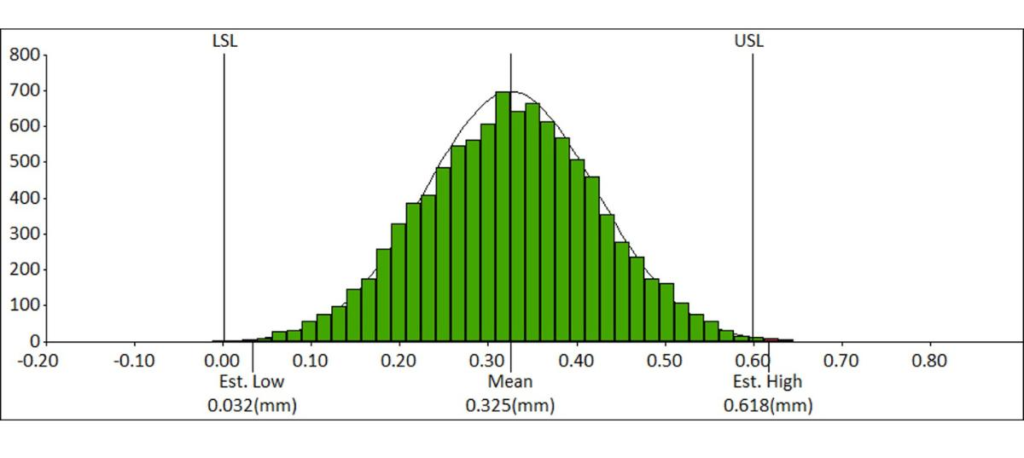


A histogram groups observations into intervals.
It can help identify:
- Concentration of measurements
- Skewness
- Multiple groups
- Unusual observations
- Approximate distribution shape
- Process changes
However, the appearance of a histogram depends on how observations are grouped. Engineers should avoid interpreting every visual feature as meaningful without further investigation.
Examples
Example 1: Manufacturing
A factory notices that a percentage of components fail final inspection.
An engineer collects measurements from several production shifts.
The analysis reveals that defects are concentrated during one shift. Further investigation shows that the machine calibration procedure differs between shifts.
Statistics did not directly “solve” the problem. Instead, it helped identify where engineers should investigate.
Example 2: Software Performance
A development team measures application response times.
The average appears acceptable, but a distribution chart reveals occasional extremely slow responses.
The team investigates these unusual events and discovers that they occur when database activity becomes unusually high.
The lesson is important:
An average can hide important behavior in the extremes.
Example 3: Structural Engineering
Engineers monitor vibration in a structure over several months.
Most measurements remain within a stable range. However, the data gradually changes during a particular period.
Rather than immediately assuming structural failure, engineers compare the measurements with temperature, traffic, environmental conditions, and sensor performance.
Statistical analysis becomes part of a broader engineering investigation.
Example 4: Energy Systems
An energy engineer studies electricity consumption across several buildings.
The analysis shows that two buildings with similar occupancy have significantly different consumption patterns.
This encourages further investigation into:
- HVAC systems
- Building insulation
- Equipment efficiency
- Operating schedules
- Control systems
The statistical analysis identifies an opportunity for engineering improvement.
Real-World Applications
Manufacturing and Quality Control
Statistics is fundamental to modern manufacturing.
Engineers use it for:
- Process monitoring
- Defect analysis
- Quality assurance
- Supplier evaluation
- Process optimization
- Experimental design
- Predictive maintenance
Civil and Structural Engineering
Statistical methods help engineers analyze:
- Material properties
- Structural loads
- Environmental conditions
- Construction quality
- Soil characteristics
- Failure probabilities
- Long-term monitoring data
Mechanical Engineering
Applications include:
- Reliability engineering
- Machine performance
- Fatigue testing
- Tolerance analysis
- Maintenance planning
- Experimental testing
Electrical Engineering
Statistics supports:
- Signal analysis
- Communication systems
- Reliability
- Power demand forecasting
- Sensor analysis
- Fault detection
Data Science and Machine Learning
Modern machine learning depends heavily on statistical concepts.
Statistics helps professionals understand:
- Data distributions
- Sampling
- Model uncertainty
- Feature relationships
- Overfitting
- Model evaluation
- Prediction errors
In this sense, statistics is one of the conceptual foundations beneath modern data-driven engineering.
Common Mistakes
Mistake 1: Trusting the Average Too Much
An average is useful, but it does not describe every observation.
Always examine variability and distribution.
Mistake 2: Ignoring Data Quality
Incorrect measurements can produce highly convincing but completely misleading results.
Mistake 3: Treating Correlation as Causation
A relationship between two variables does not prove that one caused the other.
Mistake 4: Removing Outliers Automatically
An unusual observation may be:
- A measurement error
- A genuine rare event
- Evidence of a new process condition
- An indication of equipment failure
It should be investigated before removal.
Mistake 5: Using Too Many Charts
More visualization is not always better.
Choose charts that directly answer the engineering question.
Mistake 6: Confusing Statistical and Practical Significance
A result can be statistically detectable but practically unimportant.
Engineers should always ask:
Does this difference matter in the real system?
Challenges & Solutions
Challenge: Small Samples
Small datasets may contain substantial uncertainty.
Solution: Improve sampling where possible and clearly communicate uncertainty.
Challenge: Biased Data
If the sample does not represent the target population, conclusions can become unreliable.
Solution: Develop a sampling strategy before collecting data.
Challenge: Missing Data
Missing observations may not be random.
Solution: Determine why data is missing before deciding how to handle it.
Challenge: Measurement Error
A sensor can introduce systematic or random errors.
Solution: Calibrate instruments, document measurement procedures, and understand sensor limitations.
Challenge: Complex Systems
Engineering systems often contain many interacting variables.
Solution: Combine statistical analysis with engineering knowledge, controlled experiments, and appropriate modeling.
Case Study
Improving a Hypothetical Production Process
Consider a fictional manufacturing facility producing precision mechanical components.
Management notices that the defect rate has increased.
Instead of immediately replacing machinery, the engineering team follows a structured statistical investigation.
Phase 1: Data Collection
The team gathers production records covering:
- Production dates
- Machine identification
- Operators
- Environmental conditions
- Component measurements
- Inspection results
Phase 2: Exploration
Visualizations reveal that most machines operate consistently, but one machine produces noticeably greater variation.
Phase 3: Investigation
Engineers compare the machine’s operating conditions with those of other machines.
They discover that the problematic machine experiences temperature fluctuations that other machines do not.
Phase 4: Engineering Action
The team improves temperature control and introduces additional monitoring.
Phase 5: Verification
New production data is collected.
The statistical analysis shows that measurement variation has decreased and the defect pattern has improved.
The important lesson is not the particular machine or manufacturing process.
It is the method of thinking:
Measure → Compare → Investigate → Improve → Verify
Statistics provides evidence throughout the process.
Essential Tips
Build Statistical Thinking Before Learning Advanced Formulas
You do not need advanced mathematics to begin thinking statistically.
Start by asking:
- What am I measuring?
- Where did the data come from?
- Is it representative?
- How much does it vary?
- What patterns exist?
- What could explain those patterns?
- How certain is the conclusion?
Always Visualize Data
A simple chart can expose:
- Trends
- Clusters
- Outliers
- Process changes
- Relationships
Understand Your Domain
A statistician who does not understand the engineering system may misinterpret technically correct results.
Engineering knowledge and statistical knowledge should work together.
Report Uncertainty Honestly
Good engineering communication does not pretend that every result is perfectly certain.
Use language such as:
- “The evidence suggests…”
- “The observed data indicates…”
- “The result is consistent with…”
- “Further testing is recommended…”
This is more scientifically responsible than claiming certainty without sufficient evidence.
Learn Tools, but Don’t Become Dependent on Them
Software such as Python, R, MATLAB, Excel, and specialized statistical packages can perform sophisticated analyses.
However:
Software can calculate a result; it cannot automatically determine whether the question was appropriate.
The engineer remains responsible for interpretation.
FAQs
What is the main purpose of statistics in engineering?
Statistics helps engineers understand variation, analyze measurements, identify patterns, evaluate uncertainty, compare alternatives, and make evidence-based decisions.
Do engineers need advanced mathematics to learn statistics?
Not initially. Beginners can develop strong statistical intuition through data visualization, averages, distributions, sampling, and interpretation. More advanced engineering applications may require probability, calculus, linear algebra, or mathematical statistics.
Why is variation important?
Variation shows how consistently a system behaves. Two processes can have the same average while having dramatically different levels of stability.
What is the difference between data and information?
Data consists of observations or measurements. Information emerges when those observations are organized, analyzed, and interpreted in context.
Can statistics prove that one variable causes another?
Statistical analysis can provide strong evidence for relationships, especially when supported by well-designed experiments. However, observational association alone does not automatically establish causation.
Why are outliers important?
Outliers may represent errors, rare events, unusual operating conditions, or genuine system behavior. Investigating them can reveal important engineering information.
Is statistics useful for machine learning?
Absolutely. Statistical thinking supports data preparation, sampling, uncertainty analysis, model evaluation, prediction, and interpretation.
What is the most important statistical skill for an engineer?
Perhaps the most valuable skill is asking the right question before analyzing the data. A sophisticated analysis of irrelevant or biased data can still produce a useless conclusion.
Conclusion
The art of statistics is ultimately the art of learning from evidence.
For engineers, statistics transforms collections of measurements into a structured understanding of real systems. It helps reveal variation, identify unusual behavior, compare alternatives, evaluate uncertainty, and support better decisions.
The journey can begin with something as simple as a table of measurements and a basic chart. From there, engineers can progress toward probability, statistical inference, regression, experimental design, reliability analysis, quality control, and machine learning.
The most important lesson is not to memorize statistical formulas.
It is to develop the habit of thinking critically about data:
Where did it come from?
What does it actually show?
What does it not show?
How reliable is the evidence?
What engineering decision should follow?
📊 Data gives us observations.
🔎 Statistics helps us discover patterns.
🧠 Engineering judgment gives those patterns meaning.
🚀 Together, they turn uncertainty into informed action.
That is the real art of statistics: not merely calculating numbers, but learning what the numbers can responsibly tell us about the world.