🔌 Switching Power Supply Design 3rd Edition – Complete Guide for Engineers
Introduction ⚡
Switching power supplies (SMPS) are the backbone of modern electronic devices, from laptops and smartphones to industrial machinery and renewable energy systems. Unlike traditional linear power supplies, SMPS offers high efficiency, compact size, and precise voltage regulation.
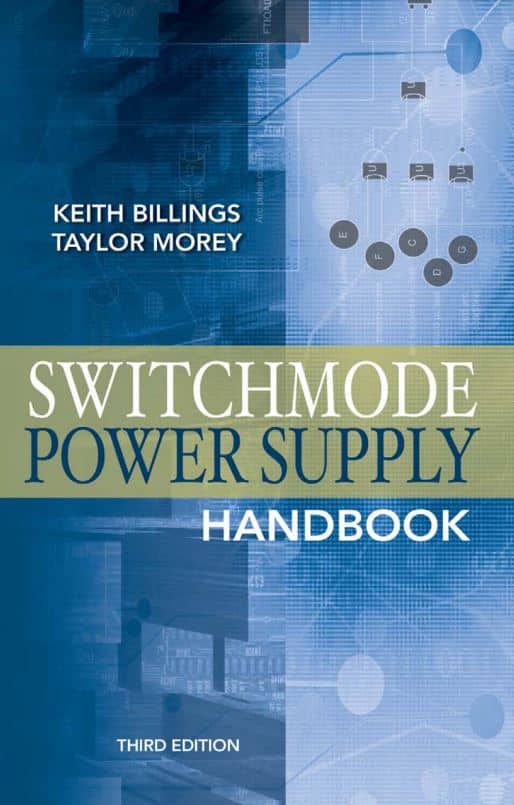
Whether you’re a student diving into power electronics or a professional engineer looking to refresh your knowledge, the 3rd edition of Switching Power Supply Design provides comprehensive guidance on theory, design techniques, and practical applications. This article explores the book’s concepts, explains the technical foundations, and shares real-world examples and tips for engineers.
Background Theory 📚
Before diving into design, it’s crucial to understand the core principles behind switching power supplies:
What is a Switching Power Supply? ⚙️
A switching power supply converts electrical power efficiently using electronic switches like MOSFETs or IGBTs, along with energy storage components such as inductors and capacitors. Unlike linear regulators, which dissipate excess voltage as heat, switching supplies “chop” input voltage at high frequencies to regulate output.
Key Advantages:
-
High efficiency (80–95% typical)
-
Smaller size and lighter weight
-
Wide input voltage range
-
Better thermal management
Key Components:
-
Semiconductor switches (MOSFETs, IGBTs)
-
Transformers and inductors
-
Diodes and rectifiers
-
Capacitors
-
Feedback/control circuits
Technical Definition 🛠️
A Switching Power Supply (SMPS) is an electronic circuit that converts DC or AC electrical power to a regulated DC voltage using high-frequency switching techniques and energy storage elements.
Mathematical Foundation:
The ideal output voltage of a buck converter, a common SMPS topology, is defined as:
Vout=D⋅Vin
Where:
-
Vout = Output voltage
-
D = Duty cycle (0 to 1)
-
Vin = Input voltage
For boost and buck-boost converters, the formulas vary, but all rely on the same principle: controlled switching and energy storage.
Step-by-Step Explanation 📝
Designing an SMPS involves several critical steps:
1️⃣ Define Specifications
-
Input voltage range
-
Output voltage and current
-
Ripple and noise requirements
-
Efficiency goals
2️⃣ Select Topology
Common topologies include:
-
Buck Converter (Step-down)
-
Boost Converter (Step-up)
-
Buck-Boost Converter
-
Flyback, Forward, Push-Pull (for isolated supplies)
3️⃣ Choose Switching Devices
-
MOSFETs for high-speed switching
-
IGBTs for high-power applications
4️⃣ Design the Magnetic Components
-
Transformer turns ratio for isolated designs
-
Inductor value for ripple current control
5️⃣ Implement Feedback & Control
-
Voltage-mode or current-mode control
-
Compensation network for stability
6️⃣ Simulate the Circuit
-
Use SPICE or LTSpice for transient and steady-state analysis
7️⃣ Prototype & Test
-
Check thermal performance
-
Measure efficiency and load regulation
Comparison ⚖️
| Feature | Linear Regulator | Switching Power Supply (SMPS) |
|---|---|---|
| Efficiency | 30–60% | 80–95% |
| Size & Weight | Large & Heavy | Compact & Lightweight |
| Heat Dissipation | High | Low |
| Input Voltage Range | Narrow | Wide |
| Complexity | Simple | Complex |
💡 Insight: While SMPS is more complex, it offers significant advantages in energy efficiency and size, making it ideal for modern electronics.
Detailed Examples 🖥️
Example 1: Buck Converter Design
Given:
-
Input: 24V
-
Output: 12V
-
Load: 2A
Step 1: Duty Cycle
D=VinVout=2412=0.5
Step 2: Choose Inductor
L=ΔIL⋅fsVout⋅(1−D)
Assume ripple current and switching frequency fs=100kHzf_s = 100kHz
L=0.4⋅100,00012⋅(1−0.5)=150μH
Example 2: Flyback Converter for Isolation
-
Input: 120V AC
-
Output: 5V DC, 2A
-
Transformer: 24:1 turns ratio
-
Peak switch current: calculated based on load and turns ratio
These examples illustrate practical design calculations that engineers use every day.
Real-World Applications in Modern Projects 🌍
Switching power supplies are everywhere:
-
Consumer Electronics: Smartphones, laptops, gaming consoles
-
Data Centers: High-efficiency server power supplies
-
Industrial Automation: PLCs, motor drives, robotics
-
Renewable Energy Systems: Solar inverters, wind turbines
-
Electric Vehicles (EVs): Battery chargers and DC-DC converters
💡 Modern designs often integrate power factor correction (PFC) and digital control for higher efficiency and smart monitoring.
Common Mistakes ❌
-
Ignoring EMI & Noise: Poor layout can cause high-frequency noise.
-
Incorrect Component Ratings: Using undervalued capacitors or inductors leads to failure.
-
Insufficient Heat Management: SMPS generate heat even with high efficiency.
-
Skipping Simulation: Prototype failures increase without proper simulation.
Challenges & Solutions 🔧
| Challenge | Solution |
|---|---|
| High-frequency switching losses | Use low-Rds(on) MOSFETs and soft switching |
| Voltage spikes due to parasitic inductance | Add snubber circuits or clamp diodes |
| Thermal management | Add heatsinks or use advanced cooling techniques |
| Loop instability | Proper compensation network design |
Case Study 🏗️
Project: 500W LED Driver for Street Lighting
Challenge: Maintain stable output voltage under variable AC mains (85–265V).
Solution:
-
Topology: Flyback with secondary regulation
-
Switching frequency: 65kHz
-
Feedback: Optocoupler with voltage-mode control
-
Results: 92% efficiency, minimal EMI, and stable performance under load
💡 Engineers learned the importance of feedback loop design and thermal simulation for real-world reliability.
Tips for Engineers 💡
-
Use modular design for easy upgrades.
-
Always simulate before prototyping.
-
Include EMI filters for compliance.
-
Track component derating to extend lifespan.
-
Document every calculation and design choice.
FAQs ❓
Q1: What is the main advantage of SMPS over linear regulators?
A1: Higher efficiency, smaller size, and lower heat dissipation.
Q2: Can SMPS be used for battery charging?
A2: Yes, with proper voltage/current regulation and protections.
Q3: Why is high-frequency operation preferred in SMPS?
A3: Higher frequency reduces transformer/inductor size and improves efficiency.
Q4: What are common SMPS topologies?
A4: Buck, Boost, Buck-Boost, Flyback, Forward, Push-Pull.
Q5: How do engineers minimize EMI in SMPS?
A5: Proper layout, snubber circuits, shielding, and filtering.
Q6: Is SMPS suitable for high-power industrial applications?
A6: Yes, with IGBTs and robust cooling methods.
Q7: What’s the role of feedback in SMPS?
A7: To maintain stable output voltage under load variations.
Q8: Are SMPS designs covered in Switching Power Supply Design 3rd Edition beginner-friendly?
A8: Yes, the book includes step-by-step explanations, formulas, and examples suitable for all skill levels.
Conclusion ✅
Switching power supply design is a critical skill for modern engineers and electronics enthusiasts. The 3rd Edition of Switching Power Supply Design provides in-depth theory, practical techniques, and real-world examples that cater to beginners and professionals alike.
Mastering SMPS allows engineers to build efficient, compact, and reliable power systems for consumer electronics, industrial applications, renewable energy, and beyond. By avoiding common mistakes, addressing challenges, and applying practical tips, you can design high-performance power supplies that meet today’s engineering demands.
⚡ Remember: The future of electronics runs on efficient, smart, and reliable power — and that starts with mastering switching power supply design.