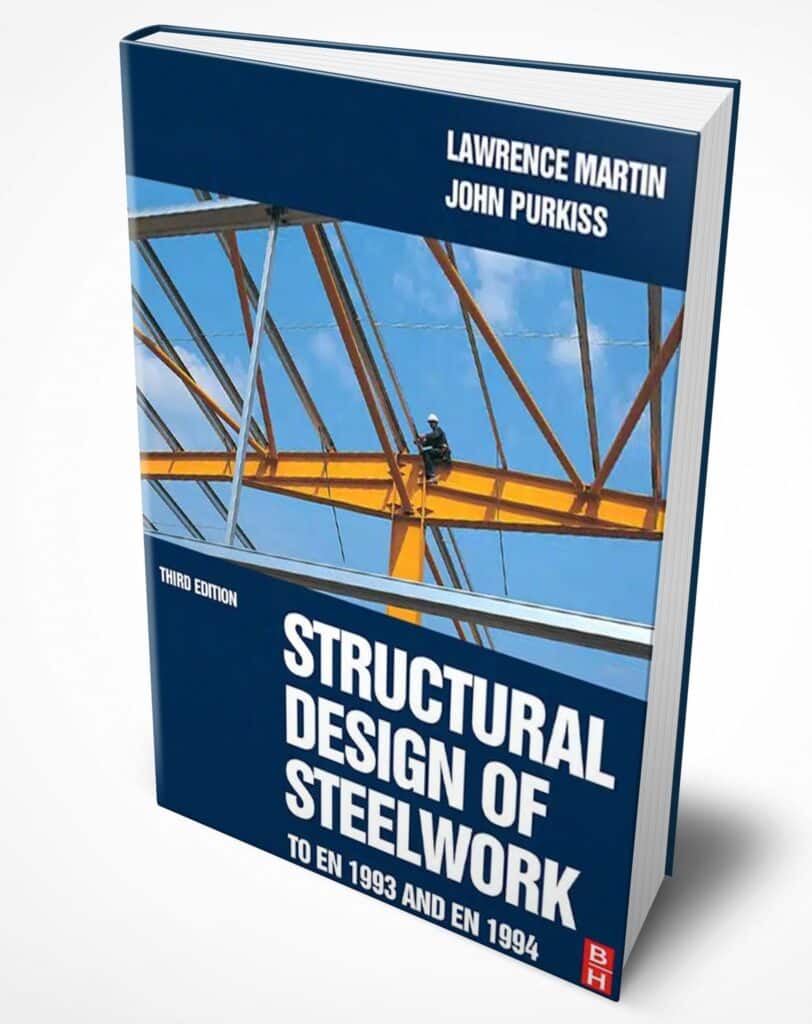
🛠️ Structural Design of Steelwork to EN 1993 and EN 1994 3rd Edition: A Comprehensive Engineering Guide for Students & Professionals
📘 Introduction
Steel structures are the backbone of modern infrastructure—from bridges towering over rivers to high‑rise buildings shaping city skylines. The Structural Design of Steelwork 3rd Edition is a cornerstone text that helps engineers, engineering students, and design professionals understand steel design principles based on the latest standards and practices.
This article explores the theory, step‑by‑step methods, practical examples, and advanced insights from the book. Whether you’re preparing for exams, improving your design efficiency, or seeking a deeper understanding of steelwork behavior—this guide has you covered.
📚 Background Theory
🧠 What Is Steel Structural Design?
Structural design defines how and why a steel framework should be built to safely carry loads. It combines physics, materials science, and engineering theory to determine:
- What shape, size, and grade of steel are used.
- How loads (dead, live, wind, earthquake) affect stability.
- How connections are designed for strength and durability.
The 3rd edition builds on previous volumes by incorporating updated design codes (e.g., Eurocode 3, AISC/ANSI standards) and modern analytical techniques.
📏 Technical Definition

🔹 Structural Steelwork
In engineering terms, structural steelwork refers to steel components assembled to support loads in buildings, bridges, towers, and other structures.
🔎 Steelwork design ensures that members like beams, columns, braces, and connections satisfy strength, serviceability, and safety criteria under various load conditions.
📘 Key Design Standards Covered
✔ Eurocode 3
✔ AISC 360‑16
📌 BS 5950 (older UK standard)
✔ National annexes (USA, UK, Canada, Australia, Europe)
The text interprets and applies these standards with clear examples and design charts.
🪜 Step‑by‑Step Explanation
The heart of steel design is a repeatable, methodical process. Below is a simplified step‑by‑step breakdown.
💡 Step 1: Define Load Cases
Identify loads acting on the structure:
| Load Type | Description |
|---|---|
| Dead Load (DL) | Permanent structural weight |
| Live Load (LL) | Occupancy, movable weight |
| Wind Load (WL) | Environmental lateral force |
| Seismic Load (EQ) | Earthquake forces |
| Thermal Load (TL) | Temperature‑induced stress |
👉 Use load combinations prescribed by design codes.
💡 Step 2: Select Suitable Steel Grade
Steel grades (e.g., S235, S275, S355) indicate yield and tensile strengths.
| Grade | Yield Strength (MPa) | Tensile Strength (MPa) |
|---|---|---|
| S235 | 235 | 360–510 |
| S275 | 275 | 410–560 |
| S355 | 355 | 490–630 |
💡 Step 3: Determine Member Sizes
Choose section types based on loads:
📌 Beams: I‑sections minimize bending stress
🔹 Columns: Box/circular sections resist buckling
🔹 Braces: Angle or tubular members for stability
Analysis tools (hand‑calc or software) compute required section modulus and area.
💡 Step 4: Analyze Internal Forces
Structural analysis determines bending moments, shear forces, axial loads, and deflections:
- Use moment distribution or matrix methods.
- Software like SAP2000, STAAD.Pro, RFEM accelerates design.
💡 Step 5: Check Design Criteria
For each member, verify:
- Strength Limit State
- Bending capacity
- Shear capacity
- Axial capacity
- Serviceability Limit State
- Deflection limits
- Vibration criteria
- Stability / Buckling
- Use slenderness ratios
💡 Step 6: Design Connections
Connections are often the critical points of a structure.
Types:
- Bolted: Simple erection, easy inspection
- Welded: Rigid, clean aesthetics
- Combined: Offer hybrid performance
Design checks include bolt shear, weld strength, and eccentric connections.
⚖️ Comparison
🆚 Eurocode vs AISC
| Feature | Eurocode 3 | AISC 360 |
|---|---|---|
| Basis | Limit state design (LRFD equivalent) | ASD/LRFD options |
| Units | Metric (kN, mm) | Imperial (lb, in) |
| Sections | Wide range, including hot‑rolled | Extensive AISC shapes |
| Analogies | More prescriptive stability equations | More empirical connection guidance |
Both aim for safe, economical design but come from different engineering traditions.
📊 Diagrams & Tables (Textual Forms)
🔹 Example: Load–Moment Diagram (Text)
Horizontal Axis: Beam Length (m)▲
M | _________
o | / \
m | / \
e |____________/ \______
n
t
📋 Typical Steel Section Property Table
| Section | Area (cm²) | Ix (cm⁴) | Iy (cm⁴) | Weight (kg/m) |
|---|---|---|---|---|
| IPE 200 | 26.1 | 1980 | 160 | 20.5 |
| HEA 300 | 77.9 | 9300 | 2940 | 61.0 |
| RHS 150x150x6 | 15.5 | 202 | 202 | 12.1 |
🧪 Examples
📌 Example 1: Simple Beam Design
Given:
- Span: 8 m
- Load: 15 kN/m uniformly distributed
- Steel: S275
Solution Outline:
- Compute total moment:
Mmax=wL2/8=15×82/8=120kN⋅m - Select suitable section:
Target section modulus Z=Mmax/fy/γM - Check deflection and shear
- Finalize section
📌 Example 2: Column Buckling
Given:
- Height: 4 m
- Axial load: 400 kN
- Steel: S355
Steps:
- Calculate slenderness ratio
- Determine critical buckling load
- Choose compact section
🏗️ Real World Application
🌉 Bridges
Steel trusses and girder bridges take advantage of steel’s high strength‑to‑weight ratio. Designers must balance fatigue performance and dynamic loading (e.g., vehicles, wind).
🏢 Skyscrapers
Steel frames provide flexibility and speed of erection, critical in urban environments. Seismic design and fireproofing are vital.
🛠️ Industrial Structures
Factories and warehouses often use steel portal frames for large column‑free spaces.
⚠️ Common Mistakes
❌ Ignoring Lateral‑Torsional Buckling
Beginners often size beams without checking twist/buckling capacity.
❌ Overlooking Connection Design
Members may be adequate, but weak connections cause failure.
❌ Mixing Code Requirements
Using Eurocode formulas with AISC tables leads to errors.
🧩 Challenges & Solutions
🧱 Challenge: Limited Budget Constraints
Solution: Optimize sections using iterative analysis and steel grades.
🌪️ Challenge: Wind & Seismic Loads
Solution: Perform dynamic analysis and implement bracing systems.
🔧 Challenge: Complex Connections
Solution: Use finite element modeling of connections to ensure reliability.
📊 Case Study
🏙️ The Grand Steel Pavilion (Hypothetical)
Background:
An exhibition pavilion designed with long‑span steel arches.
Challenges:
- Achieving minimal deflection under live load
- Ensuring symmetry in load distribution
- Weather resistance (wind gusts)
Approach:
📌 Parametric modeling to refine geometry
✔ Braced frame systems to improve stability
✔ High‑strength bolts for ease of construction
Outcome:
Efficient lightweight structure with excellent safety performance.
💡 Tips for Engineers
🛠️ For Students
📌 Master equilibrium and strength basics
✔ Practice design hand calculations
✔ Learn popular design software
👷♀️ For Professionals
📌 Stay updated with code amendments
✔ Document assumptions clearly
✔ Use quality assurance for fabrication
❓ Frequently Asked Questions (FAQs)
❓ 1. What makes the 3rd edition unique?
The 3rd edition integrates updated codes, practical design examples, and modern analysis techniques for various international standards.
❓ 2. Is this text suitable for beginners?
Yes! It starts with fundamentals and gradually introduces advanced topics with clear examples.
❓ 3. How do Eurocode and AISC differ in application?
Eurocode is more prescriptive for stability, while AISC offers detailed connection procedures.
❓ 4. Why is steel preferred in modern construction?
Steel’s high strength, ductility, and speed of assembly make it ideal for large spans and tall buildings.
❓ 5. What software is commonly used in steel design?
Common tools include SAP2000, STAAD.Pro, ETABS, and RFEM.
❓ 6. How do I choose between bolts and welds?
Bolts are easier to inspect; welds are stronger but need skilled labor.
❓ 7. What are serviceability checks?
Serviceability checks include deflection limits, vibration tolerances, and long‑term performance under daily loads.
❓ 8. How often should steel structures be inspected?
Regularly—especially after extreme events like earthquakes or high winds.
🧠 Conclusion
The Structural Design of Steelwork 3rd Edition remains a foundational resource for engineers and students worldwide. Its balanced presentation of theory, code practice, examples, and real‑world design procedures equips readers from beginner to expert levels.
By understanding load paths, selecting appropriate steel grades, designing safe members and connections, and applying modern standards, engineers can create efficient, safe, and economical steel structures.