Structural Analysis: The Analytical Method – A Complete Beginner-to-Professional Guide for Safe and Efficient Structural Design
Introduction 🏗️📐
Every bridge, skyscraper, stadium, industrial plant, and residential building must safely support thousands—or even millions—of pounds of load throughout its lifetime. Structural failures can lead to catastrophic consequences, making structural analysis one of the most important disciplines in civil and structural engineering.
Among the many techniques engineers use, The Analytical Method remains one of the most fundamental approaches. Before advanced computer software became common, engineers relied on mathematical equations and engineering principles to predict how structures would behave under various loading conditions. Even today, understanding analytical methods is essential because engineering software is built upon these same mathematical foundations.
Whether you’re a university student learning structural engineering for the first time or an experienced engineer reviewing fundamental concepts, mastering analytical methods provides the confidence needed to design safe, economical, and reliable structures.
Throughout this guide, you’ll explore the theory, calculations, comparisons, diagrams, examples, practical applications, challenges, and professional engineering practices associated with structural analytical methods.


Background Theory 📚
Structural analysis is the science of determining how structures respond to external forces.
The objective is to calculate:
- 📌 Internal forces
- 📌 Support reactions
- 🏗️ Shear forces
- 📌 Bending moments
- 📌 Axial forces
- 🏗️ Deflections
- 📌 Rotations
- 📌 Stresses
These calculations ensure that every structural component remains within safe design limits.
The analytical method is based primarily on:
- Newton’s Laws of Motion
- Static Equilibrium
- Material Mechanics
- Compatibility Conditions
- Structural Geometry
Together these principles allow engineers to mathematically predict structural behavior before construction begins.
Definition 📖
Structural Analysis: The Analytical Method is a mathematical procedure used to determine the response of structural members and complete structures under applied loads by solving equilibrium equations, compatibility relationships, and material constitutive laws.
Unlike approximate graphical methods, analytical methods provide precise numerical solutions.
Fundamental Principles ⚙️
Equilibrium
Every stable structure satisfies three equilibrium equations.
For two-dimensional structures:
- 🏗️ Sum of Horizontal Forces = 0
- Sum of Vertical Forces = 0
- Sum of Moments = 0
Without equilibrium, collapse occurs.
Compatibility
Compatibility ensures that connected members deform together without separating or overlapping.
For example:
If two beams are rigidly connected, both must rotate together at the connection.
Material Behavior
Most structural analysis assumes linear elasticity.
This means:
- Stress is proportional to strain.
- Hooke’s Law applies.
- Material returns to its original shape after unloading.
Boundary Conditions
Supports define how structures behave.
Common supports include:
- 🔹 Fixed Support
- 🔹 Roller Support
- 🏗️ Pin Support
- 🔹 Guided Support
Each restrains different degrees of freedom.
Step-by-Step Analytical Method 🔍



Step 1 — Identify the Structure
Determine whether it is:
- Beam
- Frame
- Truss
- Arch
- Cable
- Plate
- Shell
Each follows different analytical procedures.
Step 2 — Determine Loads
Possible loads include:
- Dead Load
- Live Load
- Wind Load
- Snow Load
- Earthquake Load
- Impact Load
- Thermal Load
Load combinations follow national design standards.
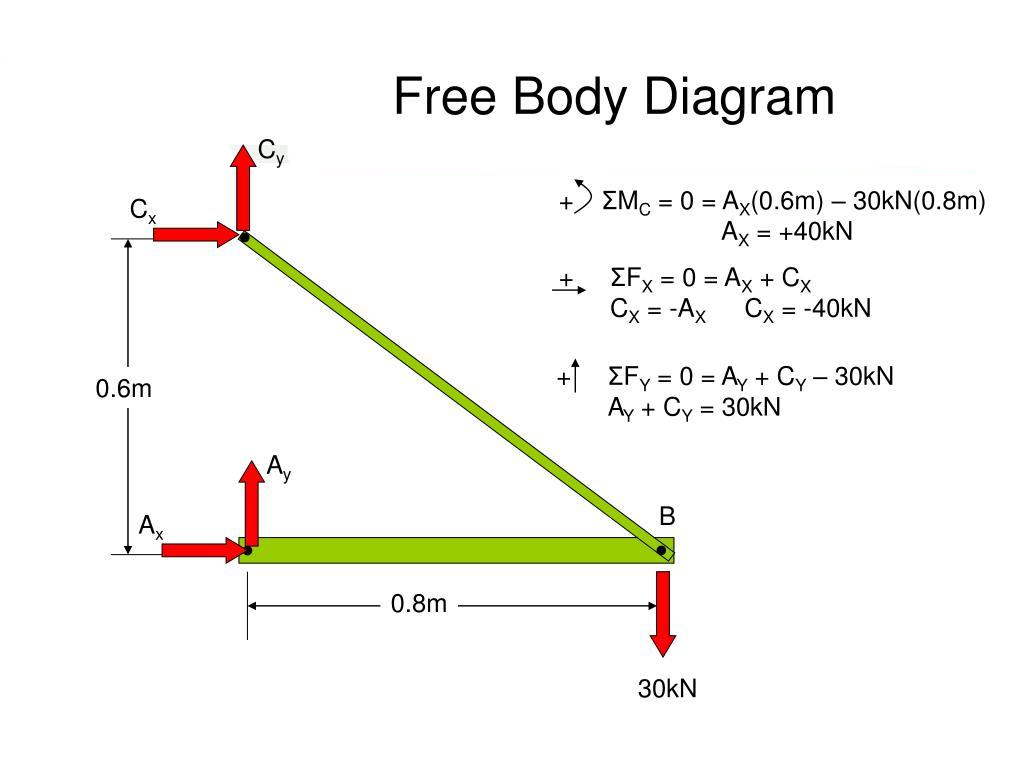
Step 3 — Draw the Free Body Diagram
Include:
- External Loads
- Reactions
- Dimensions
- Supports
A clear free-body diagram is the foundation of accurate analysis.
Step 4 — Calculate Support Reactions
Use equilibrium equations.
Example:
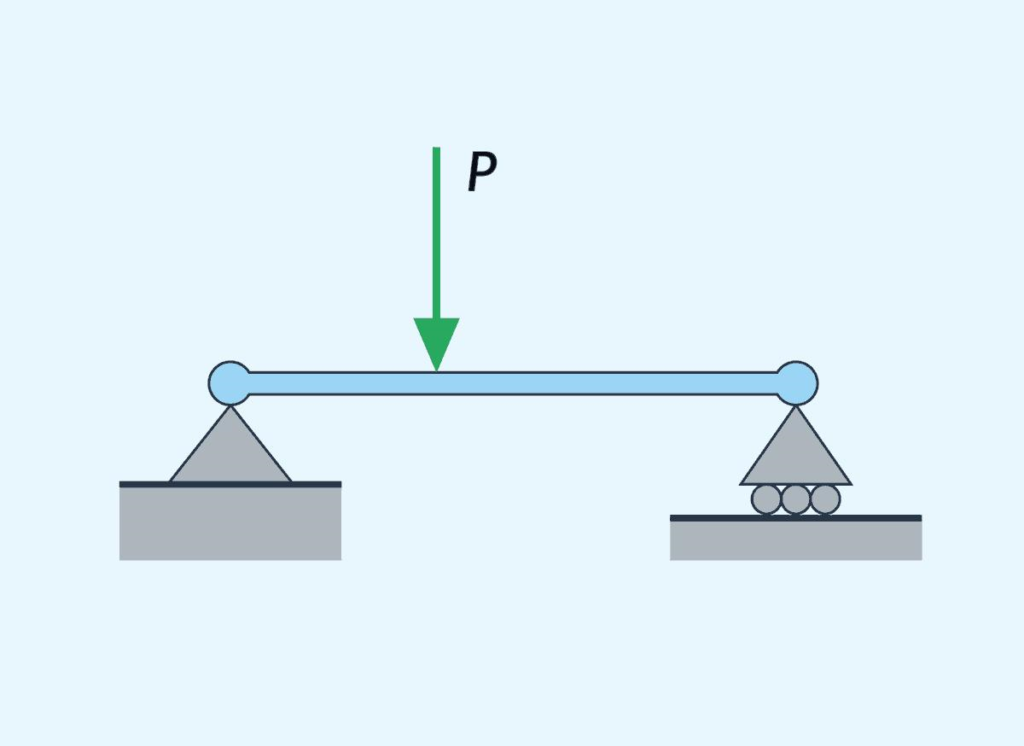
For a simply supported beam:
- Vertical reactions
- Horizontal reactions
- Support moments (if fixed)
Step 5 — Calculate Internal Forces
Determine:
- Shear Force
- Bending Moment
- Axial Force
- Torsion
These values change along the member length.
Step 6 — Draw Structural Diagrams
Create:
- Shear Force Diagram (SFD)
- Bending Moment Diagram (BMD)
- Axial Force Diagram
- Deflection Curve
These graphical tools reveal critical locations.
Step 7 — Check Safety
Verify:
- Maximum stress
- Allowable stress
- Deflection limits
- Stability
- Serviceability
Comparison 📊
| Feature | Analytical Method | Numerical Method | Experimental Method |
|---|---|---|---|
| Accuracy | Very High | Very High | High |
| Cost | Low | Medium | High |
| Equipment | None | Computer | Laboratory |
| Learning Difficulty | Moderate | High | High |
| Suitable for Complex Structures | Limited | Excellent | Excellent |
| Design Verification | Excellent | Excellent | Good |
Structural Diagrams & Tables 📈


Common Internal Forces
| Force | Symbol | Effect |
|---|---|---|
| Axial Force | N | Tension/Compression |
| Shear Force | V | Sliding |
| Bending Moment | M | Bending |
| Torque | T | Twisting |
Common Structural Supports
| Support | Horizontal | Vertical | Moment |
|---|---|---|---|
| Roller | ❌ | ✅ | ❌ |
| Pin | ✅ | ✅ | ❌ |
| Fixed | ✅ | ✅ | ✅ |
Typical Structural Members
| Member | Main Force |
|---|---|
| Beam | Bending |
| Column | Compression |
| Tie Rod | Tension |
| Truss Member | Axial Force |
| Shaft | Torsion |
Examples 🧮
Example 1
A simply supported beam has:
- Length = 8 m
- Point Load = 20 kN at the center
Because the load is centered:
Reaction at Left Support = 10 kN
Reaction at Right Support = 10 kN
Maximum bending moment:
[
M=\frac{PL}{4}
]
= 20 × 8 ÷ 4
= 40 kN·m
Example 2
A steel column carries:
500 kN axial compression.
Cross-sectional area:
5000 mm²
Stress:
σ = 500000 / 5000
= 100 MPa
Compare this with allowable stress to determine safety.
Real-World Applications 🌍🏢
Analytical structural analysis is used in nearly every engineering project.
Applications include:
🏗 High-rise buildings
🌉 Highway bridges
🏟 Sports stadiums
✈ Airport terminals
🚇 Underground tunnels
⚡ Transmission towers
🏭 Industrial facilities
🚢 Offshore platforms
🚄 Railway bridges
🌊 Dams
Even modern skyscrapers analyzed using sophisticated finite element software begin with analytical verification.
Common Mistakes ❌
Many beginners make avoidable errors.
Incorrect Load Directions
Always verify force orientation.
Missing Reaction Forces
Every support produces reactions.
Unit Conversion Errors
Never mix:
- mm and m
- N and kN
- MPa and Pa
Ignoring Sign Convention
Maintain consistent positive and negative directions.
Poor Free Body Diagrams
Missing dimensions often produce incorrect calculations.
Skipping Deflection Checks
Strength alone is insufficient.
Large deflections may cause serviceability problems.
Challenges & Solutions 🚧
| Challenge | Solution |
|---|---|
| Indeterminate structures | Use compatibility equations |
| Multiple load combinations | Analyze each separately |
| Large structures | Divide into smaller components |
| Human calculation errors | Verify each step |
| Complex geometry | Simplify where possible |
| Dynamic loads | Perform dynamic analysis |
Case Study 🏙️
Steel Office Building
A six-story steel office building experienced excessive floor vibration during occupancy.
Problem
Although strength requirements were satisfied, occupants felt uncomfortable vibrations.
Investigation
Engineers performed a detailed analytical structural analysis.
They discovered:
- Beam stiffness was insufficient.
- Floor natural frequency matched walking frequencies.
Solution
Additional steel beams were installed.
Beam depth increased.
Floor stiffness improved.
Result
✅ Reduced vibration
✅ Increased occupant comfort
🏗️ No major structural modifications required
This case demonstrates that structural analysis extends beyond preventing collapse—it also ensures comfort and long-term performance.
Essential Tips 💡
✔ Draw accurate free-body diagrams before calculating.
✔ Keep units consistent throughout calculations.
🏗️ Verify equilibrium after solving.
✔ Double-check support conditions.
✔ Learn manual calculations before relying on software.
🏗️ Understand assumptions behind analytical equations.
✔ Compare analytical solutions with software whenever possible.
✔ Practice solving beam and truss problems regularly.
🏗️ Review engineering design codes frequently.
✔ Develop strong mathematical fundamentals.
Frequently Asked Questions ❓
What is structural analysis?
Structural analysis determines how structures respond to applied loads and environmental effects.
Why is the analytical method important?
It provides the theoretical foundation for all structural engineering calculations and software.
Is analytical analysis still used today?
Yes. Engineers routinely verify software results using analytical calculations.
What is the difference between analysis and design?
Analysis determines structural behavior.
Design selects member sizes and materials capable of safely resisting calculated forces.
Which structures can be analyzed analytically?
Beams, frames, trusses, arches, columns, and many statically determinate structures.
What software uses analytical principles?
Programs such as SAP2000, ETABS, STAAD.Pro, ANSYS, and Robot Structural Analysis implement the same engineering principles through numerical computation.
What mathematical subjects are most important?
Students should understand:
- Statics
- Calculus
- Linear Algebra
- Mechanics of Materials
- Differential Equations
Conclusion 🎯
Structural Analysis: The Analytical Method remains one of the most valuable engineering disciplines because it provides the mathematical framework for understanding how structures behave under load. While modern engineering software has dramatically accelerated the design process, every reliable digital solution is ultimately grounded in the same principles of equilibrium, compatibility, and material behavior developed through analytical methods.
By mastering free-body diagrams, support reactions, internal force calculations, shear and bending diagrams, and structural verification, engineers gain the ability to assess safety, optimize designs, and troubleshoot structural problems with confidence. Whether designing a residential beam, a long-span bridge, or a high-rise building, a strong understanding of analytical structural analysis enables engineers to produce solutions that are not only safe and code-compliant but also economical, durable, and efficient. Combining solid analytical skills with modern computational tools is the hallmark of a well-rounded structural engineer prepared to meet the challenges of today’s infrastructure projects.