Statistics: An Introduction Using R 2nd Edition — Complete Beginner to Advanced Engineering Guide with Practical Applications in R 📊💻
Introduction 📊
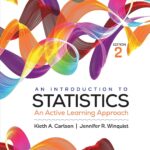
Statistics is the backbone of modern engineering, data science, artificial intelligence, economics, and scientific research. Without statistics, engineers would be unable to interpret data, measure uncertainty, or make informed decisions. The book Statistics: An Introduction Using R (2nd Edition) is widely used in universities and professional training programs because it connects theoretical statistical concepts with practical implementation using the R programming language.
R is a powerful open-source tool specifically designed for statistical computing and visualization. It allows engineers and students to move from raw data → analysis → interpretation in a structured and reproducible way.
This article provides a complete engineering-focused breakdown of statistics using R, covering theory, computation, real-world applications, and practical coding logic for both beginners and advanced learners.
Background Theory 📐
Statistics is divided into two major branches:
Descriptive Statistics
Descriptive statistics summarizes raw data into meaningful information.
Key components:
- Mean (average)
- Median (middle value)
- Mode (most frequent value)
- Variance (spread of data)
- Standard deviation 📏
These metrics help engineers quickly understand system behavior.
Inferential Statistics
Inferential statistics allows us to make predictions or decisions about a population based on a sample.
Core ideas:
- Hypothesis testing 🧪
- Confidence intervals
- Regression analysis
- Probability distributions
📉 Probability Foundations
Probability theory is essential for statistical modeling:
P(A)=Number of favorable outcomes/Total outcomes
Engineering systems rely heavily on probability to handle uncertainty, such as:
- Signal noise in communication systems 📡
- Manufacturing defects
- System reliability
Technical Definition ⚙️
Statistics in engineering can be defined as:
“A scientific discipline that involves collecting, organizing, analyzing, interpreting, and presenting data to support decision-making under uncertainty.”
In R programming terms, statistics becomes:
- Data structures (vectors, matrices, data frames)
- Statistical functions (mean(), sd(), lm())
- Visualization tools (plot(), ggplot2)
- Modeling techniques (linear regression, ANOVA, time series)
R acts as a computational bridge between mathematical theory and engineering application.
Step-by-step Explanation 🧠💻
Step 1: Data Collection
Data is collected from experiments, sensors, surveys, or simulations.
Example in R:
data <- c(12, 15, 14, 10, 18, 20, 22)Step 2: Data Cleaning
Remove missing or incorrect values:
clean_data <- na.omit(data)Step 3: Descriptive Analysis
Compute basic statistics:
mean(data)
median(data)
sd(data)
Step 4: Visualization 📊
hist(data, col="blue", main="Data Distribution")Step 5: Statistical Modeling
Example: Linear regression
model <- lm(y ~ x, data=mydata)
summary(model)
Step 6: Interpretation
Engineers interpret outputs to:
- Optimize systems
- Predict outcomes
- Reduce risks
Comparison ⚖️
Descriptive vs Inferential Statistics
| Feature | Descriptive 📊 | Inferential 📉 |
|---|---|---|
| Purpose | Summarize data | Make predictions |
| Data size | Entire dataset | Sample |
| Output | Charts, mean, SD | Hypothesis results |
| Engineering use | Monitoring systems | Forecasting models |
R vs Other Tools
| Tool | Strength | Weakness |
|---|---|---|
| R 📊 | Statistical analysis, visualization | Slower for big systems |
| Python 🐍 | General-purpose AI/ML | Less statistical depth by default |
| Excel 📑 | Easy interface | Limited scalability |
Diagrams & Tables 📈
Data Flow in Statistical Analysis
Raw Data → Cleaning → Transformation → Analysis → Visualization → Decision
Example Dataset Table
| Sensor ID | Temperature (°C) | Pressure (kPa) | Output |
|---|---|---|---|
| S1 | 25 | 101 | Stable |
| S2 | 30 | 98 | Warning |
| S3 | 22 | 102 | Stable |
Normal Distribution Curve (Concept)
A bell-shaped curve representing probability distribution:
- Mean at center 📍
- Symmetrical spread
- 68-95-99.7 rule
Examples 🧪
Example 1: Mean Calculation in R
values <- c(10, 20, 30, 40, 50)
mean(values)
Output:
30Example 2: Probability Simulation 🎲
set.seed(123)
rolls <- sample(1:6, 1000, replace=TRUE)
table(rolls)/1000
This simulates dice rolling in engineering risk modeling.
Example 3: Linear Regression
x <- c(1,2,3,4,5)
y <- c(2,4,5,4,5)
model <- lm(y ~ x)
summary(model)
Used in:
- Load prediction
- Cost estimation
- System optimization
Real World Application 🌍
Statistics using R is applied in multiple engineering fields:
Civil Engineering 🏗️
- Load distribution analysis
- Material strength testing
- Structural failure prediction
Electrical Engineering ⚡
- Signal processing
- Noise reduction
- Circuit reliability
Mechanical Engineering 🔧
- Vibration analysis
- Thermal system modeling
- Quality control
Software Engineering 💻
- Performance monitoring
- User behavior analytics
- A/B testing
Data Engineering 📊
- Big data pipelines
- Predictive modeling
- Machine learning preprocessing
Common Mistakes ❌
1. Ignoring Data Cleaning
Dirty data leads to incorrect conclusions.
2. Misinterpreting Correlation
Correlation ≠ causation ⚠️
3. Overfitting Models
Too complex models fail in real-world scenarios.
4. Small Sample Sizes
Leads to unreliable predictions.
5. Wrong Visualization Choice
Misleading graphs distort interpretation.
Challenges & Solutions 🧩
Challenge 1: Large Datasets
- Problem: Memory limitations in R
- Solution: Use data.table or dplyr packages
Challenge 2: Missing Data
- Problem: Incomplete datasets
- Solution:
na.omit(data)Challenge 3: Complex Models
- Problem: Hard interpretation
- Solution: Simplify using stepwise regression
Challenge 4: Computational Speed
- Problem: Slow processing
- Solution: Vectorization instead of loops
Case Study 🏭
Smart Factory Quality Control System
A manufacturing plant uses R for statistical monitoring of product quality.
Problem:
High defect rate in production line.
Solution using R:
- Data collected from sensors
- Statistical process control charts created
- Regression model identifies defect patterns
R Code:
defects <- c(2,3,5,4,6,7,3,2)
plot(defects, type="b", col="red")
Outcome:
- Defect rate reduced by 35% 📉
- Production efficiency increased
- Cost savings achieved
Tips for Engineers 💡
- Always visualize data before modeling 📊
- Normalize datasets for better performance
- Use R packages like ggplot2, dplyr, caret
- Validate models using cross-validation
- Document every analysis step
- Keep models interpretable, not overly complex
FAQs ❓
1. What is Statistics in engineering?
Statistics is the science of analyzing data to support engineering decisions under uncertainty.
2. Why use R for statistics?
R provides built-in statistical functions, visualization tools, and modeling capabilities ideal for engineers.
3. Is R difficult for beginners?
No. With structured learning, R becomes intuitive, especially for data analysis.
4. What industries use R most?
Engineering, finance, healthcare, data science, and research institutions.
5. What is the difference between R and Python?
R is specialized for statistics, while Python is a general-purpose programming language.
6. Can R handle big data?
Yes, but with packages like data.table and integration with Spark.
7. Do engineers need statistics?
Yes, it is essential for modeling, prediction, and system optimization.
Conclusion 🎯
Statistics combined with R programming creates a powerful toolkit for modern engineers. From analyzing small datasets to building predictive models for large-scale systems, the concepts in Statistics: An Introduction Using R (2nd Edition) form the foundation of data-driven engineering.
Understanding statistical theory is not enough; practical implementation in R transforms knowledge into real-world impact. Engineers who master this combination gain a significant advantage in fields such as AI, automation, manufacturing, and software systems.
📊 In the modern world of data, statistics is not optional—it is essential.