Statistical Inference for Data Science: A Practical Guide to Making Reliable Decisions from Data
Introduction
Data science is not only about collecting data, creating dashboards, or training machine-learning models. A major part of professional data science is answering a deeper question:
“What can we reasonably conclude about a much larger population from the data we actually observed?” 📊🔍
This is where statistical inference becomes essential.
Imagine an online company wants to understand customer satisfaction across millions of users. It is usually impossible to ask every customer for an opinion. Instead, analysts collect a representative sample and use statistical methods to estimate broader customer behavior.
Statistical inference provides the framework for making those conclusions while explicitly considering uncertainty, variability, sampling, and evidence.


For beginners, statistical inference may initially seem abstract because it combines probability, statistics, and decision-making. For experienced professionals, however, it is one of the foundations of trustworthy analytical work.
The central idea is simple:
Use observed data to learn something meaningful about a larger or unknown situation.


Whether you work in artificial intelligence, engineering, finance, healthcare, marketing, software development, or scientific research, statistical inference helps transform raw observations into defensible conclusions.
Background Theory
Population and Sample
Statistical inference begins with two important concepts: the population and the sample.
A population represents the complete group that interests us. It could be:
- All customers of a company
- All manufactured components from a production line
- All transactions processed by a financial platform
- All students at a university
- All devices connected to a network
A sample is a smaller portion of that population that we actually observe.
The challenge is that the sample will rarely be perfectly identical to the population. Different samples can produce different results.
This natural variation is called sampling variability.
Parameters and Statistics
A parameter describes a characteristic of a population.
A statistic describes a characteristic calculated from a sample.
For example, an engineering company may want to know the average lifetime of every component it produces. The true population average is a parameter. Testing a smaller group of components gives a sample average, which is a statistic.
The statistic becomes evidence about the unknown parameter.
Probability and Uncertainty
Inference relies heavily on probability because data contains uncertainty.
Even a carefully selected sample can produce an estimate that differs from the true population value. Probability allows data scientists to quantify how much uncertainty may exist.
This is one reason statistical inference is different from simply reporting descriptive statistics.
Descriptive statistics answer:
“What happened in this dataset?”
Statistical inference asks:
“What can this dataset tell us about something beyond this dataset?”
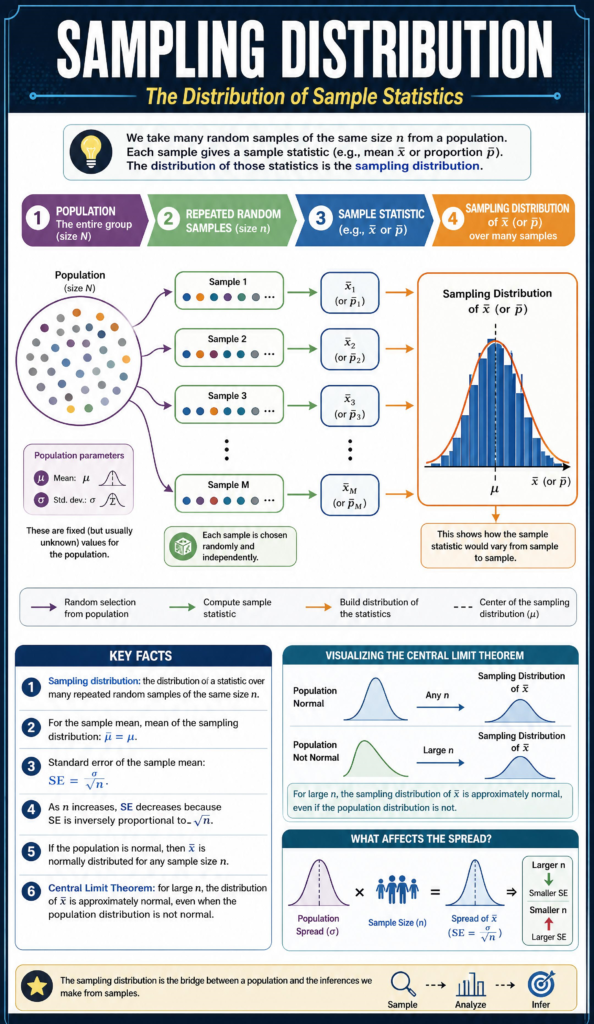
Sampling Distributions
A particularly important concept is the sampling distribution.
Imagine repeatedly taking samples of the same size from a population and calculating the same statistic each time. The collection of those statistics forms a sampling distribution.
This concept helps data scientists understand how much an estimate might naturally change from sample to sample.
As sample size increases, estimates often become more stable, assuming the sampling process is appropriate.
Definition
Statistical inference is the process of using sample data, probability, and statistical methods to estimate population characteristics, evaluate hypotheses, quantify uncertainty, and support decisions about a broader population or process.
In data science, statistical inference commonly includes:
- Parameter estimation
- Confidence intervals
- Hypothesis testing
- Sampling distributions
- Statistical significance
- Effect size
- Uncertainty quantification
- Regression inference
- Bayesian inference
- Resampling methods
- Experimental analysis
The objective is not simply to produce a number.
The objective is to determine how much confidence we should place in that number and what conclusions the evidence actually supports. 🎯
Step-by-Step Explanation
Step 1: Define the Question
Start with a specific analytical question.
For example:
“Has the new website design improved customer conversion?”
A vague question produces vague analysis. A well-defined question identifies the population, variables, comparison, and desired outcome.
Step 2: Identify the Population
Determine exactly what group you want to understand.
For a website experiment, the population might be all eligible visitors during a particular period.
Step 3: Collect an Appropriate Sample
The quality of inference depends heavily on how data is collected.
A biased sample can produce a misleading conclusion even when sophisticated statistical methods are used afterward.
Consider whether the sample represents important groups, time periods, geographic areas, and user behaviors.
Step 4: Explore the Data
Before performing inference, inspect the dataset.
Look for:
- Missing observations
- Outliers
- Duplicate records
- Unexpected categories
- Measurement problems
- Strong skewness
- Data-entry errors
Exploratory analysis should come before formal inference.
Step 5: Select an Inference Method
Different questions require different methods.
For example:
- Estimating an average → estimation techniques
- Comparing groups → comparative inference
- Testing a claim → hypothesis testing
- Estimating uncertainty → confidence intervals
- Complex uncertainty → bootstrap or Bayesian methods
- Relationships between variables → regression inference
Step 6: Quantify Uncertainty
A single estimate can create false confidence.
Instead of saying:
“The average customer spends $X.”
a data scientist should consider the uncertainty surrounding that estimate.
Confidence intervals, prediction intervals, standard errors, bootstrap distributions, and Bayesian credible intervals can provide additional information.
Step 7: Interpret the Evidence
Statistical output is not automatically a business conclusion.
Ask:
- Is the effect meaningful?
- Is it practically important?
- Could sampling variation explain the result?
- Are assumptions reasonable?
- Is the dataset representative?
- Are there alternative explanations?
Step 8: Communicate the Result
Finally, explain the result in language appropriate for the audience.
An executive may need a concise business interpretation, while an engineering team may require detailed assumptions and diagnostics.


Comparison
Descriptive Statistics vs Statistical Inference
| Feature | Descriptive Statistics | Statistical Inference |
|---|---|---|
| Main purpose | Summarize observed data | Draw conclusions beyond observed data |
| Main focus | What happened? | What can we conclude? |
| Typical tools | Mean, median, charts, distributions | Confidence intervals, tests, estimation |
| Uncertainty | Usually limited | Central concept |
| Population conclusions | Not necessarily | Yes, when assumptions are appropriate |
| Example | Average order value in a dataset | Estimated average order value for all customers |
Frequentist vs Bayesian Inference
| Feature | Frequentist | Bayesian |
|---|---|---|
| Main idea | Analyze evidence through repeated-sampling concepts | Combine prior information with observed evidence |
| Uncertainty | Often expressed through confidence intervals | Often expressed through credible intervals |
| Prior information | Not normally part of the standard framework | Explicitly incorporated |
| Common applications | Experiments, classical statistics | Decision systems, forecasting, complex models |
| Interpretation | Based on sampling behavior | Based on probability distributions for unknown quantities |
Neither approach is universally “better.” The appropriate choice depends on the problem, assumptions, available information, and decision context.
Diagrams & Tables
The Inference Pipeline
        REAL-WORLD POPULATION
                 ↓
          Select a Sample
                 ↓
          Collect the Data
                 ↓
        Explore & Clean Data
                 ↓
       Choose Statistical Model
                 ↓
      Estimate / Test / Compare
                 ↓
        Quantify Uncertainty
                 ↓
       Interpret the Evidence
                 ↓
          MAKE A DECISION
Core Components of Statistical Inference


| Component | Main Question |
|---|---|
| Sampling | How should observations be selected? |
| Estimation | What is the likely population value? |
| Confidence interval | How uncertain is the estimate? |
| Hypothesis testing | Is the evidence inconsistent with a specified assumption? |
| Effect size | How substantial is the observed difference? |
| Resampling | What happens when we repeatedly reorganize or resample the observed data? |
| Bayesian inference | How should existing knowledge and new evidence be combined? |




Examples
Example 1: E-Commerce Conversion
An online retailer changes its checkout interface.
The data science team compares customers who experienced the new interface with customers who experienced the previous version.
The observed conversion rate is higher with the new design.
Inference helps determine whether the difference is likely to represent a genuine improvement or could reasonably have appeared because of sampling variability.
Example 2: Manufacturing Quality
A factory produces thousands of mechanical components every day.
Engineers cannot inspect every component using an expensive destructive test. They select a sample and measure performance.
Statistical inference allows them to estimate the broader production quality while accounting for uncertainty.
Example 3: Customer Support
A software company receives thousands of support tickets.
Analysts select a sample and investigate resolution times.
Instead of merely reporting the average resolution time in the sample, they can estimate the likely range for the broader customer-support population.
Example 4: Machine Learning
Suppose a data scientist develops a new classification model.
The new model performs better on a test dataset.
That observation alone does not guarantee that the model will consistently outperform the existing system.
Inference and statistical testing can help evaluate whether the observed performance difference is sufficiently convincing.
Real-World Applications
Engineering
Engineers use inference for:
- Reliability analysis
- Quality control
- Failure prediction
- Experimental design
- Sensor analysis
- Material testing
- Manufacturing optimization
Statistical inference is particularly valuable when testing every physical component is expensive or impossible.
Finance
Financial analysts use inference to study:
- Investment performance
- Risk
- Customer behavior
- Credit decisions
- Market relationships
- Portfolio characteristics
Because financial data is highly variable, uncertainty must be treated carefully.
Healthcare
Researchers can use statistical inference to evaluate treatments, compare groups, study risk factors, and analyze clinical observations.
The consequences of incorrect inference can be significant, making study design and assumptions especially important.
Marketing
Marketing teams use inference to analyze:
- Campaign performance
- Customer segmentation
- Conversion rates
- A/B testing
- Pricing experiments
- Customer retention
Artificial Intelligence
Modern AI systems also benefit from statistical inference.
It can support:
- Model evaluation
- Uncertainty estimation
- Experiment analysis
- Feature analysis
- A/B testing
- Probabilistic prediction
- Model comparison
Common Mistakes
Confusing Correlation with Causation
Two variables can move together without one causing the other.
A statistical relationship should not automatically be interpreted as a causal relationship.
Ignoring Sampling Bias
A very large biased sample can still produce a poor conclusion.
Representativeness matters.
Treating Statistical Significance as Practical Importance
A result can be statistically convincing while having little real-world value.
For example, a very large dataset can make a tiny difference appear statistically significant.
Misinterpreting Confidence Intervals
A confidence interval should not be interpreted as a guarantee that a particular unknown value has a fixed probability of being inside the interval after the calculation.
Its interpretation depends on the statistical framework and repeated-sampling procedure used to construct it.
Ignoring Multiple Comparisons
Testing many hypotheses increases the chance of obtaining apparently interesting results simply by chance.
Data scientists should account for multiple testing when appropriate.
Overlooking Model Assumptions
Statistical methods often rely on assumptions involving independence, distributions, variance, sampling mechanisms, or model structure.
Violating important assumptions can undermine inference.
Challenges & Solutions
| Challenge | Practical Solution |
|---|---|
| Small sample | Collect more representative observations when possible |
| Sampling bias | Improve the sampling strategy |
| Missing data | Investigate why values are missing before choosing an imputation method |
| Outliers | Examine their origin and influence rather than automatically deleting them |
| Non-independent observations | Use methods designed for clustered or repeated observations |
| Multiple testing | Apply appropriate correction or control procedures |
| Model uncertainty | Compare reasonable models and conduct sensitivity analysis |
| Misinterpretation | Communicate assumptions and uncertainty clearly |
Case Study
Evaluating a New Industrial Sensor
Consider an engineering company developing a new temperature sensor for industrial equipment.
The company wants to know whether the new sensor provides measurements that are sufficiently reliable compared with the existing sensor.
Testing every sensor under every operating condition would be expensive and time-consuming.
Instead, engineers create a carefully designed sample covering different operating temperatures, equipment conditions, and production batches.
The data science team then:
- Defines the target population.
- Establishes the performance criteria.
- Selects representative test conditions.
- Collects measurements.
- Checks data quality.
- Compares the new and existing sensors.
- Estimates uncertainty.
- Investigates unusual observations.
- Performs sensitivity analysis.
- Communicates whether the evidence supports deployment.
The important point is that the team does not base the decision solely on the average observed performance.
They also consider uncertainty, variation, sample selection, measurement conditions, and practical engineering requirements.
This is the real value of statistical inference: it transforms limited observations into a structured decision-making process.
Essential Tips
For Beginners
🔹 Learn the difference between population, sample, parameter, and statistic.
🔹 Understand probability before memorizing statistical tests.
🔹 Visualize your data before performing formal inference.
🔹 Learn confidence intervals conceptually rather than treating them as formulas.
🔹 Always ask how the sample was collected.
For Advanced Data Scientists
🚀 Focus on assumptions, not just statistical software output.
🚀 Report effect sizes alongside significance measures.
🚀 Use resampling methods when they provide a more appropriate representation of uncertainty.
🚀 Consider Bayesian approaches when prior information is genuinely useful.
🚀 Perform sensitivity analysis for important decisions.
🚀 Distinguish predictive performance from causal inference.
🚀 Treat statistical inference as part of the entire data-generation process, not merely the final analysis step.
For Engineering Students and Professionals
⚙️ Connect statistical conclusions to physical processes.
⚙️ Ask whether a statistically detectable difference matters to engineering performance.
⚙️ Document measurement procedures and sampling conditions.
⚙️ Never hide uncertainty when making safety-critical or expensive decisions.
FAQs
What is statistical inference in data science?
Statistical inference is the process of using sample data to estimate population characteristics, evaluate claims, quantify uncertainty, and support decisions.
Why is statistical inference important?
Because data scientists usually work with limited observations. Inference provides a disciplined way to generalize from those observations while recognizing uncertainty.
What is the difference between descriptive and inferential statistics?
Descriptive statistics summarize the data that has been observed. Inferential statistics use observed data to make conclusions about a broader population or process.
What is a confidence interval?
A confidence interval is an interval-estimation technique designed to communicate uncertainty around an estimated population quantity.
What is hypothesis testing?
Hypothesis testing is a structured method for evaluating whether observed evidence is sufficiently inconsistent with a specified statistical hypothesis.
Is statistical significance the same as practical importance?
No. Statistical significance concerns evidence under a statistical framework, while practical importance asks whether the size of an effect actually matters in the real world.
Can statistical inference be used with machine learning?
Yes. It can be used for model comparison, experiments, feature analysis, uncertainty estimation, A/B testing, and many other machine-learning tasks.
Does a large dataset guarantee reliable inference?
No. Large datasets reduce some forms of random uncertainty, but they do not automatically eliminate sampling bias, measurement errors, confounding, or poor study design.
Conclusion
Statistical inference is one of the most important bridges between data and decision-making. 📈🧠
Descriptive analysis tells us what we observed. Statistical inference goes further by asking what those observations allow us to conclude about a broader population or process.
The discipline combines sampling, probability, estimation, hypothesis testing, uncertainty analysis, and careful interpretation.
For beginners, the most important concepts are the relationships between population, sample, statistic, parameter, variability, and uncertainty.
For advanced data scientists, the challenge is deeper: understanding assumptions, recognizing bias, choosing appropriate models, interpreting effect sizes, and communicating uncertainty honestly.
In engineering and professional data science, the strongest analysis is not necessarily the one with the most sophisticated algorithm. It is the one that provides a conclusion that is statistically defensible, practically meaningful, transparent about uncertainty, and useful for making better decisions. ⚙️📊
Ultimately, statistical inference teaches a powerful principle:
Good data science is not just about finding patterns—it is about understanding how much those patterns deserve to be trusted.