Standard Specifications for Road, Bridge, and Municipal Construction 2023 Edition: Complete Engineering Guide
Introduction
Roads, bridges, drainage systems, utility corridors, sidewalks, and other public infrastructure require much more than good engineering drawings. Successful construction depends on consistent technical requirements, quality control, material standards, measurement procedures, safety requirements, and contract administration.
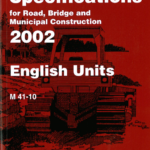
The 2023 Standard Specifications for Road, Bridge, and Municipal Construction provide a structured framework for many of these requirements. The Washington State Department of Transportation (WSDOT) identifies the Standard Specifications as M 41-10, with the specifications organized into divisions covering areas such as general requirements, earthwork, aggregates and bases, pavements, structures, drainage, miscellaneous construction, and materials.
It is important to understand that specifications are not simply a collection of construction rules. They form part of the technical language connecting the owner, engineer, contractor, subcontractors, inspectors, suppliers, and testing laboratories.


For students, the specifications provide an excellent introduction to how engineering theory becomes physical infrastructure. For professionals, they provide a practical reference for preparing bids, controlling construction quality, inspecting work, evaluating materials, and closing projects.
Engineering principle: A drawing shows what should be built; specifications help define how the work is to be performed and accepted. 🏗️
The 2023 edition should also be distinguished from later editions. WSDOT currently lists separate 2023, 2024, 2025, and 2026 editions, so engineers should always verify which edition is contractually applicable to a particular project.
Background Theory
Construction specifications are based on the principle of standardization.
Without standardized requirements, two contractors could interpret the same design differently. One might use a particular aggregate source, another could select a different material, and inspection criteria could vary from project to project.
Standard specifications reduce this uncertainty by establishing common requirements.
Why Standard Specifications Matter
A major infrastructure project normally involves several technical disciplines:
- Civil engineering
- Structural engineering
- Geotechnical engineering
- Transportation engineering
- Hydraulics and drainage
- Materials engineering
- Surveying
- Construction management
- Environmental engineering
- Utility coordination
A road project, for example, may contain earthwork, aggregate base, asphalt pavement, concrete structures, stormwater facilities, signs, electrical systems, and utility work.
Standard specifications create a common technical framework for these activities.
The Construction Quality Concept
A useful way to understand specifications is through the sequence:
Design → Materials → Construction → Inspection → Testing → Acceptance → Documentation
Each stage influences the next.
Poor material selection can cause construction problems. Poor construction practices can produce unacceptable results even when excellent materials are used. Likewise, good construction can be difficult to prove without proper inspection and documentation.
Definition
The Standard Specifications for Road, Bridge, and Municipal Construction can be understood as a standardized technical document establishing requirements for performing and accepting infrastructure construction work.
The 2023 WSDOT specification system includes major divisions addressing:
| Division | General subject |
|---|---|
| Division 1 | General Requirements |
| Division 2 | Temporary Features |
| Division 3 | Earthwork |
| Division 4 | Aggregates and Bases |
| Division 5 | Surface Treatments and Pavements |
| Division 6 | Structures |
| Division 7 | Drainage, Storm Sewers, Sanitary Sewers, Water Mains and Conduits |
| Division 8 | Miscellaneous Construction |
| Division 9 | Materials |
WSDOT’s published specification structure confirms these divisions and identifies Division 6 as the principal location for bridge and structural requirements.
Specifications vs. Construction Drawings
Drawings and specifications work together.
Drawings commonly communicate:
- Geometry
- Dimensions
- Alignment
- Profiles
- Details
- Locations
- Reinforcement arrangements
- Typical sections
Specifications generally communicate:
- Work requirements
- Materials
- Execution procedures
- Quality requirements
- Testing
- Measurement
- Payment
- Contractor responsibilities
Therefore, an engineer should not treat drawings and specifications as independent documents.
Step-by-Step Explanation: How to Use the Specifications


Step 1: Identify the Contract Requirements
Begin with the contract documents.
Determine:
- Applicable specification edition
- Project special provisions
- Standard plans
- Contract drawings
- Supplemental specifications
- Owner requirements
- Applicable regulations
This is critical because a project may modify or supplement standard requirements.
Step 2: Locate the Correct Division
Identify the type of work being performed.
For example:
A road excavation project → Earthwork
A crushed aggregate base → Aggregates and Bases
An asphalt pavement operation → Surface Treatments and Pavements
A bridge component → Structures
A stormwater pipe → Drainage and Storm Sewers
This division-based structure makes large specifications easier to navigate.
Step 3: Review Material Requirements
Materials are central to construction quality.
Engineers and inspectors may need to verify:
- Material source
- Material classification
- Physical properties
- Manufacturing requirements
- Certification
- Testing
- Storage
- Handling
- Delivery conditions
Material requirements are particularly important because an apparently acceptable material may still fail when subjected to traffic, water, freeze-thaw cycles, chemical exposure, or structural loads.
Step 4: Review Construction Requirements
After understanding the material, determine how it must be incorporated into the project.
For example, roadwork can involve:
Site preparation → excavation → grading → subgrade preparation → aggregate placement → compaction → pavement construction → finishing → inspection
Every stage can influence final performance.
Step 5: Establish Quality Control
Quality control should not be treated as an activity performed only at the end.
Instead, inspection should occur throughout construction.
Typical controls may involve:
- Survey checks
- Visual inspections
- Material testing
- Compaction verification
- Concrete testing
- Pavement inspection
- Drainage inspection
- Dimensional verification
- Documentation
Step 6: Document the Work
Construction documentation may include:
- Daily reports
- Test results
- Inspection records
- Material certifications
- Delivery tickets
- Survey records
- Photographs
- Nonconformance reports
- Change documentation
- As-built information
Good documentation protects both the owner and contractor.
Step 7: Verify Acceptance
The final question is simple:
Does the completed work satisfy the contract requirements?
Acceptance should be based on objective evidence rather than appearance alone.
Comparison: Standard Specifications and Other Project Documents
| Document | Primary purpose | Typical user |
|---|---|---|
| Standard Specifications | Establish technical construction requirements | Engineer, contractor, inspector |
| Project Drawings | Communicate design geometry and details | Designer, contractor |
| Special Provisions | Modify or supplement standard requirements | Owner, engineer |
| Standard Plans | Provide repeatable construction details | Designer, contractor |
| Method Statement | Explain proposed construction approach | Contractor |
| Inspection Report | Record observed construction conditions | Inspector |
| Test Report | Demonstrate material or work properties | Laboratory/engineer |
| As-Built Drawings | Record constructed conditions | Owner/engineer |
The important concept is that these documents work as a system.
2023 Edition vs. Later Editions
The WSDOT website lists separate annual editions, including 2023 through 2026. Consequently, engineers should not automatically substitute a newer edition for a contractually specified 2023 edition.
A municipality may also formally adopt the specifications. For example, some Washington municipalities incorporate the Standard Specifications into their local requirements while allowing specific amendments.
Diagrams and Tables: Understanding the Specification Structure
A simplified relationship can be visualized as:


PROJECT
⬇️
Contract Documents
⬇️
Drawings + Standard Specifications + Special Provisions
⬇️
Construction Activities
⬇️
Inspection + Testing
⬇️
Acceptance
⬇️
Completion + Documentation
Major Construction Areas
| Construction area | Examples of engineering activities |
|---|---|
| Earthwork | Excavation, embankment, grading |
| Aggregate | Base, subbase, crushed materials |
| Pavement | Asphalt, surface treatments, concrete pavement |
| Structures | Bridges, retaining structures, structural concrete |
| Drainage | Storm sewers, culverts, drainage structures |
| Utilities | Water mains, conduits, sanitary systems |
| Miscellaneous | Traffic control, restoration, site features |
| Materials | Material quality and acceptance requirements |
This organization allows engineers to move from a broad project requirement toward a specific technical section.
Examples
Example 1: Roadway Reconstruction
Suppose an existing urban road must be reconstructed.
The project may require:
- Removal of unsuitable pavement.
- Excavation to the required grade.
- Preparation of the subgrade.
- Placement of aggregate material.
- Compaction and inspection.
- Installation of drainage.
- Pavement construction.
- Roadway finishing.
- Final inspection.
The specifications help define the acceptable materials, construction procedures, testing, and acceptance requirements.
Example 2: Bridge Construction
A bridge project introduces additional complexity.
The engineer must coordinate:
- Excavation
- Foundations
- Reinforcing steel
- Concrete
- Structural components
- Bearings
- Deck construction
- Drainage
- Expansion systems
- Finishing operations
WSDOT specifically identifies Division 6 as the section containing standard specifications for bridges and structures.
Example 3: Municipal Stormwater Project
A municipality may construct a new stormwater drainage system.
The work could include:
- Trenching
- Pipe installation
- Manholes
- Catch basins
- Bedding
- Backfilling
- Compaction
- Surface restoration
The drainage-related requirements are addressed within the specification framework associated with Division 7.
Real-World Applications
Standard specifications have applications far beyond classroom exercises.
Transportation Infrastructure 🚗
Highway construction requires consistent approaches to:
- Pavement
- Earthwork
- Drainage
- Traffic control
- Shoulders
- Roadside improvements
Bridge Infrastructure 🌉
Bridge construction depends heavily on quality control because structural defects can have serious consequences.
Specifications help establish requirements for materials, construction operations, inspection, and acceptance.
Municipal Infrastructure 🏙️
Cities and towns use technical specifications for:
- Streets
- Sidewalks
- Water systems
- Sewer systems
- Stormwater systems
- Utility conduits
- Public facilities
Construction Management
Project managers can use specifications to develop:
- Work packages
- Inspection plans
- Procurement requirements
- Quality-control procedures
- Construction schedules
- Submittal registers
Common Mistakes
Ignoring the Applicable Edition
One of the most common mistakes is using the wrong specification edition.
A 2026 document is not automatically interchangeable with a 2023 contract requirement.
Reading Only the Drawings
Drawings rarely contain every requirement necessary for construction.
The contractor and engineer should review drawings together with specifications and special provisions.
Treating Standard Specifications as Optional Guidance
When incorporated into the contract, specifications can become contractual requirements rather than general advice.
Poor Material Documentation
Even compliant materials can create project-management problems when certifications and test documentation are missing.
Inadequate Inspection
Waiting until the end of construction to discover defects is inefficient and expensive.
Ignoring Project-Specific Requirements
Special provisions can modify standard requirements.
Always check the complete contract package.
Challenges & Solutions
| Challenge | Practical solution |
|---|---|
| Large specification documents | Use divisions and section numbers to navigate |
| Conflicting information | Establish the contract document hierarchy |
| Material uncertainty | Require approved sources and appropriate testing |
| Construction defects | Increase inspection at critical stages |
| Documentation gaps | Maintain daily records and organized test reports |
| Specification changes | Track revisions formally |
| Contractor misunderstanding | Hold preconstruction meetings |
| Quality problems | Use corrective-action procedures |
Managing Conflicts
When drawings and specifications appear inconsistent, do not simply select whichever requirement is easier to follow.
The project team should review:
- Contract language
- Special provisions
- Drawings
- Standard specifications
- Applicable regulations
- Engineer instructions
The conflict should be formally resolved and documented.
Case Study: Urban Road and Drainage Reconstruction
Consider a hypothetical municipal project involving reconstruction of an urban roadway.
The existing road has deteriorated pavement, inadequate drainage, and damaged pedestrian facilities.
Project Phase 1: Investigation
Engineers review:
- Existing pavement
- Soil conditions
- Drainage
- Utilities
- Traffic requirements
- Existing right-of-way
Project Phase 2: Design
The design team develops:
- Roadway alignment
- Pavement structure
- Drainage layout
- Utility coordination
- Sidewalk improvements
- Construction details
Project Phase 3: Construction
The contractor begins with traffic control and site preparation.
Excavation is then performed, followed by subgrade preparation and aggregate placement.
Inspection verifies that each stage is progressing according to the contract requirements.
Project Phase 4: Drainage Installation
Drainage structures and pipes are installed before final pavement operations.
The inspection team checks alignment, connections, bedding, backfill, and restoration.
Project Phase 5: Pavement
The roadway receives its specified pavement system.
Quality control focuses on material delivery, placement operations, surface condition, and required testing.
Project Phase 6: Final Acceptance
The project team reviews:
- Completed construction
- Test records
- Deficiencies
- Documentation
- Final measurements
- As-built information
The result is not simply a new road. It is a documented infrastructure asset that can be operated and maintained by the municipality.
Essential Tips for Students and Professionals
Tip 1: Learn the Structure First
Do not try to memorize an entire specification.
Understand the division and section organization.
Tip 2: Connect Specifications to Drawings
When reading a specification section, locate the corresponding drawing detail.
This develops practical engineering judgment.
Tip 3: Understand the “Why”
Do not memorize requirements without understanding their engineering purpose.
For example, compaction requirements exist because uncontrolled soil density can influence settlement, strength, drainage, and pavement performance.
Tip 4: Pay Attention to Materials
Materials determine much of the long-term behavior of infrastructure.
Learn how engineers evaluate:
- Aggregates
- Asphalt
- Concrete
- Structural steel
- Reinforcement
- Pipe materials
- Fill materials
Tip 5: Keep Inspection Records Organized
A strong documentation system makes it easier to prove compliance.
Tip 6: Check Current Contract Requirements
WSDOT publishes annual editions, so always confirm the edition applicable to your project.
Tip 7: Use Specifications With Engineering Judgment
A specification cannot replace engineering judgment.
Site conditions, design requirements, safety considerations, environmental constraints, and project-specific requirements must also be considered.
FAQs
What is the 2023 Standard Specifications for Road, Bridge, and Municipal Construction?
It is a standardized construction specification framework used for defining requirements associated with transportation, structural, drainage, utility, and municipal construction work. WSDOT identifies its Standard Specifications as M 41-10.
Who uses these specifications?
They can be used by owners, engineers, contractors, subcontractors, inspectors, materials laboratories, project managers, and other construction professionals.
What are the main divisions?
The major divisions include general requirements, temporary features, earthwork, aggregates and bases, pavements, structures, drainage and utility systems, miscellaneous construction, and materials.
Where are bridge requirements located?
Bridge and structural requirements are primarily associated with Division 6 – Structures in the WSDOT specification organization.
Are standard specifications the same as drawings?
No. Drawings primarily communicate the physical design and geometry, while specifications establish detailed requirements governing materials, construction, quality, measurement, and related contractual matters.
Can a newer edition replace the 2023 edition?
Not automatically. The applicable edition depends on the project contract and governing requirements. WSDOT publishes multiple annual editions, so the project documents should be checked before using a different edition.
Are specifications important for municipal projects?
Yes. Municipalities can adopt standard specifications into local requirements, sometimes with amendments or project-specific modifications.
Are the specifications useful for engineering students?
Absolutely. Students can use them to understand how theoretical concepts such as soil mechanics, pavement engineering, structural engineering, materials science, drainage, and construction management are translated into field requirements.
Conclusion
The 2023 Standard Specifications for Road, Bridge, and Municipal Construction represent an important bridge between engineering design and real-world construction. Their value comes from creating consistent expectations for materials, workmanship, inspection, testing, documentation, measurement, and acceptance.
For beginners, the best approach is to first understand the overall structure rather than attempting to memorize individual clauses. For experienced engineers, the key is to integrate the specifications with drawings, special provisions, project conditions, quality-control procedures, and sound engineering judgment.
The 2023 framework is organized into logical construction divisions, ranging from general requirements and earthwork to pavements, structures, drainage, miscellaneous work, and materials.
Most importantly, specifications should be viewed as part of a larger engineering system:
Design 📐 → Materials 🧱 → Construction 🏗️ → Inspection 🔍 → Testing 🧪 → Acceptance ✅ → Infrastructure Performance 🚧
When this process is managed correctly, standard specifications help transform engineering plans into infrastructure that is safer, more reliable, maintainable, and consistent.
For professionals working on a specific project, the contract documents remain the controlling source of requirements. The 2023 edition should therefore be consulted in its official project context rather than treated as a universal substitute for local laws, regulations, amendments, special provisions, or later contract-specific requirements. WSDOT currently maintains separate editions and revision history for the specifications.