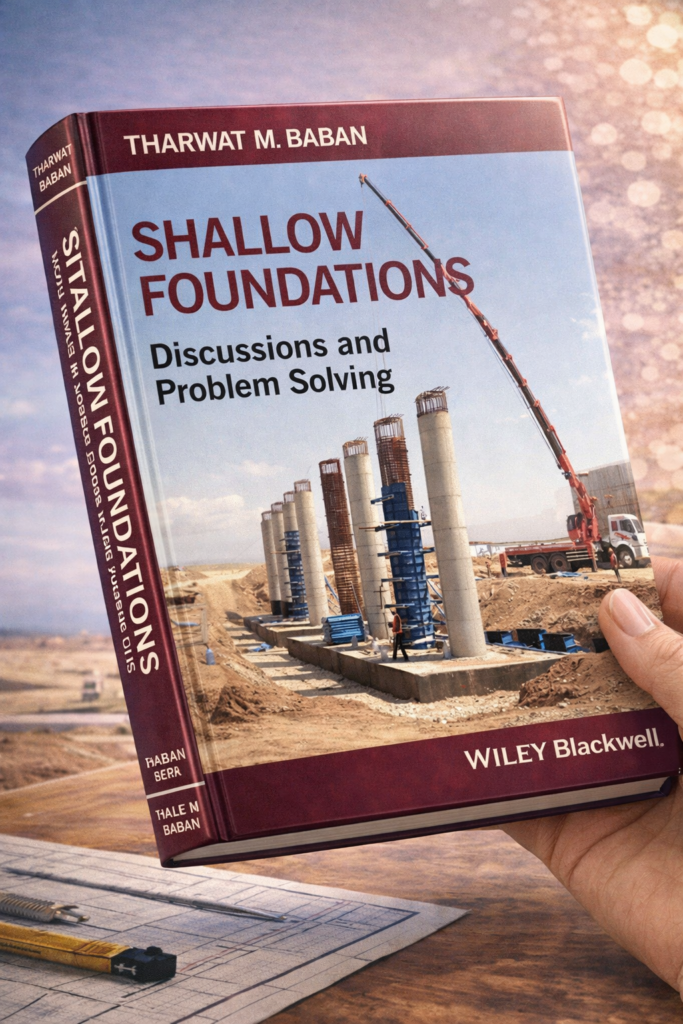
🏗️ Shallow Foundations: Discussions and Problem Solving Strategies, Design Principles
🌍 Introduction to Shallow Foundations Discussions and Problem-Solving
Shallow foundations are a core element in modern construction, playing a vital role in supporting structures while maintaining cost efficiency and constructability. Unlike deep foundations that extend significantly below ground level, shallow foundations transfer structural loads to soil layers located close to the surface.
This characteristic makes shallow foundations ideal for buildings subjected to light to moderate loads and constructed on relatively stable soil conditions.
A solid understanding of shallow foundation behavior is essential for civil engineers, architects, and construction professionals. Inadequate design, poor soil assessment, or improper execution can result in structural failures, uneven settlement, or long-term serviceability problems.
This article provides an in-depth discussion of shallow foundations, covering definitions, design principles, common challenges, and real-world problem-solving strategies to ensure long-term performance and structural safety.
🧱 What Are Shallow Foundations?
📌 Definition and Engineering Importance
Shallow foundations are structural components designed to support buildings, bridges, and infrastructure by distributing loads over a relatively wide area near the ground surface. They are used when the near-surface soil possesses adequate bearing capacity to safely resist applied loads without excessive settlement.
From an engineering perspective, shallow foundations:
Reduce construction costs
Simplify construction procedures
Provide efficient load transfer for low- to medium-rise structures
🏠 Types of Shallow Foundations
🟦 Spread Footings (Isolated Footings)
Spread footings, also known as isolated footings, are used to support individual columns or piers. Their primary function is to spread concentrated structural loads over a larger soil area, thereby reducing contact pressure on the soil.
🔹 Common applications:
Residential buildings
Small to medium-sized commercial structures
🔹 Key advantages:
Simple design and construction
Cost-effective solution for strong soils
🟨 Strip Footings (Continuous Footings)
Strip footings, or continuous footings, are long and narrow foundations designed to support load-bearing walls or a series of closely spaced columns.
🔹 Common applications:
Residential housing
Commercial buildings with load-bearing masonry walls
🔹 Key advantages:
Uniform load distribution along walls
Reduced differential settlement along structural lines
🟥 Mat or Raft Foundations
Mat foundations, also referred to as raft foundations, extend across a large portion—or the entirety—of a building footprint. They support multiple columns and walls simultaneously.
🔹 Ideal for:
Weak or variable soil conditions
Areas prone to differential settlement
🔹 Engineering benefits:
Even load distribution
Reduced total settlement
Improved structural stability
🧠 Design Principles for Shallow Foundations
Designing an efficient shallow foundation system requires careful consideration of soil behavior, structural demands, and environmental conditions.
🧪 Understanding Soil-Bearing Capacity
Soil-bearing capacity represents the maximum pressure the soil can safely support without failure or excessive settlement. Engineers rely on geotechnical investigations, including:
Borehole drilling
Standard Penetration Tests (SPT)
Laboratory soil testing
These assessments ensure that the foundation design aligns with the soil’s mechanical properties.
⚖️ Load Distribution Mechanisms
A properly designed shallow foundation ensures uniform load distribution, minimizing stress concentrations that could lead to settlement or cracking. Engineers use:
Analytical methods
Numerical modeling
Finite element software
to optimize load transfer and foundation geometry.
📉 Settlement Considerations
Settlement occurs as soil compresses under applied structural loads. While some settlement is inevitable, excessive or uneven settlement can result in:
Cracks in walls and slabs
Misalignment of structural elements
Long-term serviceability issues
Design adjustments and soil improvement techniques are commonly applied to control settlement behavior.
🌦️ Factors Influencing Design Choices
Several factors directly affect shallow foundation design decisions:
Soil Type:
Clay soils may expand or shrink, while sandy soils compact differently under load.Groundwater Level:
High water tables reduce effective stress and may require drainage or waterproofing solutions.Structural Load:
Heavier loads demand larger foundation areas or alternative foundation systems.Environmental Conditions:
Seasonal temperature changes, seismic activity, and frost action can significantly influence foundation performance.
⚠️ Common Challenges in Shallow Foundations
Despite their simplicity, shallow foundations face several practical challenges that must be addressed proactively.
📐 Uneven Settlement
Uneven or differential settlement occurs when different portions of a foundation settle at varying rates. This problem often arises due to:
Non-uniform soil conditions
Inconsistent load distribution
Consequences include structural cracking, tilting, and in extreme cases, partial collapse.
🌊 Soil Erosion and Stability Issues
Water infiltration, poor drainage, and surface runoff can lead to soil erosion beneath or around shallow foundations. Loss of supporting soil compromises stability and increases failure risk.
🪨 Poor Soil-Bearing Capacity
Weak soils may not be able to resist applied loads, resulting in excessive settlement or shear failure. In such cases, engineers must enhance soil strength or reconsider foundation type selection.
🌍 Environmental Impacts
Environmental factors such as:
Flooding
Earthquakes
Frost heave
can severely affect shallow foundation performance. For example, frost heave can cause foundations to lift and shift, leading to structural damage in cold regions.
🛠️ Problem-Solving Strategies for Shallow Foundations
Engineers employ a range of techniques to mitigate shallow foundation problems and restore structural stability.
🧱 Soil Improvement Techniques
Enhancing soil properties is often the first line of defense against foundation failure.
✔️ Compaction:
Densifying soil to reduce voids and increase load-bearing capacity.
✔️ Soil Stabilization:
Mixing cement, lime, or chemical stabilizers to improve soil strength and durability.
📊 Addressing Settlement Issues
To manage and control settlement, engineers utilize:
Differential Settlement Monitoring:
Sensors, leveling surveys, and instrumentation to track movement over time.Retrofitting Solutions:
Techniques such as underpinning, grouting, or soil injection to restore load-bearing capacity.
🏗️ Foundation Modifications
When existing foundations underperform, structural modifications may be required:
Reinforcement Techniques:
Using reinforced concrete or steel elements to enhance foundation strength.Expanding Foundation Area:
Increasing the footing size to distribute loads more evenly and reduce soil pressure.
📚 Case Studies in Shallow Foundation Problem-Solving
🏢 Case Study 1: Differential Settlement Resolution
A commercial building experienced differential settlement caused by varying soil conditions across the site. Engineers implemented underpinning techniques, successfully stabilizing the foundation and preventing further damage.
🧪 Case Study 2: Innovative Solutions in Weak Soil Areas
In a region characterized by low soil strength, engineers adopted a raft foundation combined with deep soil mixing. This hybrid solution significantly reduced settlement while maintaining economic feasibility.
✅ Best Practices for Shallow Foundation Design
🔍 Comprehensive Site Investigation
Detailed geotechnical studies are essential for understanding subsurface conditions and selecting the most appropriate foundation type.
🔄 Regular Monitoring and Maintenance
Routine inspections help detect early signs of:
Settlement
Soil erosion
Structural distress
allowing timely intervention.
💻 Use of Advanced Engineering Tools
Modern design and analysis software such as:
STAAD Pro
Plaxis
enhance accuracy, efficiency, and overall foundation reliability.
❓ FAQs About Shallow Foundations Discussions and Problem-Solving
❓ What is the main advantage of shallow foundations?
✅ Shallow foundations are economical, easy to construct, and highly effective in stable soil conditions.
❓ How can uneven settlement be addressed?
✅ Through soil stabilization, foundation reinforcement, and continuous monitoring systems.
❓ When should shallow foundations be avoided?
✅ In weak or unstable soils, high groundwater conditions, or for structures with heavy loads.
❓ What tools are used in shallow foundation design?
✅ Software such as STAAD Pro, Plaxis, and traditional analytical methods are widely used.
🧾 Conclusion
Shallow foundations remain one of the most efficient and widely used foundation systems in construction engineering. Their effectiveness depends heavily on proper soil analysis, thoughtful design, and proactive problem-solving.
By identifying potential challenges early and applying modern engineering techniques, professionals can significantly enhance the durability, safety, and performance of shallow foundation systems. This guide provides a comprehensive framework for understanding shallow foundations and addressing their practical challenges with confidence and precision.