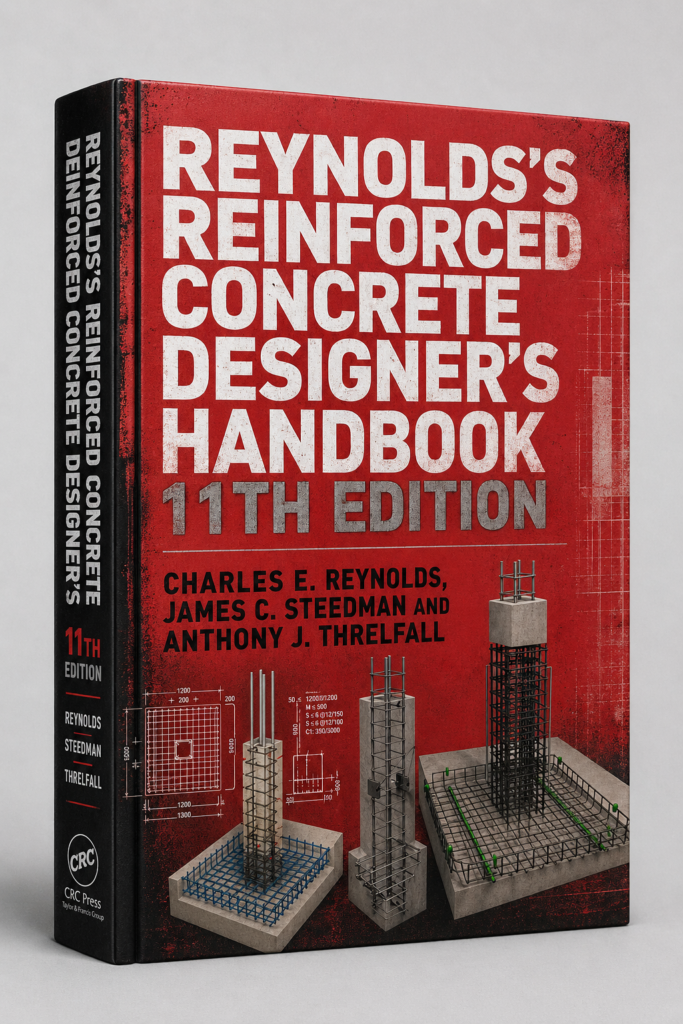
Reynold’s Reinforced Concrete Designer’s Handbook 11 Edition: Complete Engineering Guide for Students, Structural Designers & Civil Professionals 🏗️📘
Introduction
Reinforced concrete remains one of the most important construction materials in the modern world. From skyscrapers in New York 🏙️ to bridges in London 🌉, tunnels in Europe 🚇, and residential towers in Canada 🇨🇦, reinforced concrete is everywhere. To design these structures safely and efficiently, engineers need trusted references that combine theory with practical calculations.
One of the most respected resources in structural engineering is Reynolds’s Reinforced Concrete Designer’s Handbook 11th Edition. This handbook has long been recognized as a professional guide for engineers who design beams, slabs, columns, foundations, retaining walls, bridges, and containment structures. It includes practical procedures, design tables, worked examples, diagrams, and guidance aligned with British Standards and Eurocodes.
Whether you are:
- A civil engineering student 🎓
- A graduate structural engineer 👷
- A site engineer 🏗️
- A consulting designer 📐
- A senior project manager 📊
…this handbook can improve your understanding of reinforced concrete design.
This article gives you a 100% original deep guide to the book, its engineering value, theory, applications, and how to use it effectively in real practice.
Background Theory
What is Reinforced Concrete?
Concrete is excellent in compression but weak in tension. Steel reinforcement bars (rebar) are added to resist tensile stresses.
This combination creates:
- High compressive strength
- Good tensile resistance
- Fire resistance 🔥
- Durability
- Economic construction
- Versatile shapes
Why Reinforcement is Needed
Consider a simply supported beam:
- Top fibers under compression
- Bottom fibers under tension
Concrete handles the top zone well, but cracks form in the bottom tension zone. Steel bars are placed there to carry tension forces.
Historical Importance
Reinforced concrete revolutionized engineering in the 20th century. It allowed:
- Longer spans
- Taller buildings
- Safer bridges
- Underground infrastructure
- Water-retaining tanks
The Reynolds handbook became popular because it transformed complex code rules into usable engineering methods.
Technical Definition
What is Reynolds’s Reinforced Concrete Designer’s Handbook?
It is a professional structural design reference book authored by Charles E. Reynolds, with later editions involving James C. Steedman and Anthony J. Threlfall. The 11th edition was revised to reflect newer standards including Eurocodes and updated British Standards.
Main Purpose of the Handbook
The handbook helps engineers:
- Analyze reinforced concrete structures
- Size structural members
- Select reinforcement
- Check serviceability
- Detail bars and anchorage
- Design according to recognized standards
- Solve practical engineering problems quickly
Scope Covered
The book includes guidance for:
- Buildings
- Bridges
- Retaining walls
- Foundations
- Containment structures
- Slabs
- Beams
- Columns
- Shear walls
Step-by-step Explanation
How Engineers Use the Handbook in Practice
Step 1: Define Structural System
Determine whether the element is:
- Beam
- Slab
- Column
- Footing
- Wall
- Frame
Step 2: Identify Loads
Calculate:
- Dead load
- Live load
- Wind load
- Snow load
- Seismic load (where applicable)
Step 3: Perform Structural Analysis
Find:
- Bending moments
- Shear forces
- Axial loads
- Deflections
Step 4: Choose Material Grades
Example:
| Material | Typical Grade |
|---|---|
| Concrete | C25/30, C30/37 |
| Steel | 500 MPa |
Step 5: Design Cross Section
Use handbook equations/tables for:
- Flexure design
- Shear design
- Torsion
- Compression members
Step 6: Check Serviceability
Ensure:
- Acceptable deflection
- Crack control
- Durability cover requirements
Step 7: Detailing
Prepare reinforcement drawings:
- Bar diameter
- Spacing
- Hooks
- Lap splices
- Anchorage lengths
Comparison
Reynolds Handbook vs Other Concrete Design References
| Feature | Reynolds Handbook | University Textbooks | Code Documents |
|---|---|---|---|
| Practical Design Tables | Excellent ⭐ | Limited | Minimal |
| Worked Examples | Strong | Good | Rare |
| Code Explanation | Good | Moderate | Technical only |
| Quick Office Use | Excellent | Fair | Poor |
| Academic Learning | Good | Excellent | Moderate |
| Real Project Use | Excellent | Moderate | Essential |
Why Engineers Still Like Reynolds
Many practicing engineers appreciate references that explain calculations clearly and give usable examples instead of only legal code language.
Diagrams & Tables
Basic RC Beam Stress Diagram
┌──────────────────┐
│██████████████████│
│ │
│ Neutral Axis │
│———————————-│
│ │
│ Steel Rebar │ ← Tension Zone
└──────────────────┘
Typical Beam Reinforcement Table
| Beam Span | Approx Depth | Main Bars |
|---|---|---|
| 4 m | 300 mm | 2T16 |
| 6 m | 450 mm | 3T20 |
| 8 m | 600 mm | 4T25 |
Illustrative only. Final design must be calculated.
Examples
Example 1: Simply Supported Beam
Given:
- Span = 6 m
- UDL = 20 kN/m
Maximum moment:
M=wL2/8
M=20×62/8=90 kN⋅m
Then use handbook charts/tables to determine:
- Beam dimensions
- Steel area
- Shear links
Example 2: Column Design
Given:
- Axial load = 1200 kN
- Concrete grade C30
Engineer uses interaction charts to choose:
- 400 × 400 mm column
- 8T20 bars
- Ties at required spacing
Example 3: Slab Design
For residential slab:
- Span = 4.5 m
- Live load = 2 kN/m²
Use span/depth ratios and reinforcement tables.
Real World Application
Where This Handbook Helps Most
Building Design
Used for:
- Apartment towers
- Offices
- Schools
- Hospitals 🏥
Infrastructure
Used in:
- Bridges
- Culverts
- Tunnels
- Parking structures
Water Structures
Useful for:
- Tanks
- Reservoirs
- Treatment plants 💧
Retaining Structures
Supports design of:
- Basement walls
- Retaining walls
- Earth pressure systems
Consultancy Offices
Many structural offices rely on handbooks for preliminary sizing before software verification.
Common Mistakes
Errors Engineers Make When Using RC Handbooks
1. Blindly Copying Old Values
Always verify current code updates.
2. Ignoring Load Combinations
Dead + live + wind combinations matter greatly.
3. Poor Detailing
Good calculations fail with bad detailing.
4. Neglecting Deflection
Strong beams may still sag excessively.
5. Wrong Cover Thickness
Durability depends on cover depth.
6. Unit Conversion Errors
Mixing mm, m, MPa, kN causes expensive mistakes ⚠️
Challenges & Solutions
Challenge 1: Transition from British Standards to Eurocodes
Solution:
Use handbook concepts, then verify with latest local codes.
Challenge 2: Manual Calculations Take Time
Solution:
Use spreadsheets + handbook logic.
Challenge 3: Complex Structures
Solution:
Use FEM software, then use handbook for member checks.
Challenge 4: Beginners Feel Overwhelmed
Solution:
Start with beams and slabs first.
Case Study
Mid-Rise Residential Building in Europe
Project Data
- 8 floors
- Reinforced concrete frame
- Flat slab system
- Basement retaining wall
How Reynolds Handbook Helps
Preliminary Design
Engineer quickly estimates:
- Column sizes
- Slab thickness
- Beam dimensions
Detailed Checks
Uses handbook methods for:
- Punching shear
- Deflection control
- Crack width limits
- Wall pressure design
Result
- Faster concept stage
- Efficient reinforcement quantities
- Reliable manual checks against software results
Tips for Engineers
Smart Ways to Use the Handbook
For Students 🎓
- Rework examples manually
- Understand force flow
- Sketch stress diagrams
For Junior Engineers 👷
- Use it beside design software
- Verify outputs independently
- Learn detailing rules
For Senior Engineers 📐
- Use for concept sizing
- Review junior calculations
- Optimize reinforcement economically
For All Professionals
Keep these tools together:
- Handbook
- Current code
- Calculator
- Spreadsheet
- Structural software
FAQs
1. Is the 11th edition still useful today?
Yes. The engineering principles remain highly valuable, especially for manual understanding and preliminary design.
2. Is it good for beginners?
Yes, if used with guidance. Start with beams, slabs, and basic reinforced concrete theory.
3. Does it replace design codes?
No. Codes are mandatory. The handbook is a practical companion.
4. Is it better than software?
Software is faster, but the handbook helps engineers understand why results occur.
5. Which countries benefit most?
USA, UK, Canada, Australia, and Europe all benefit from reinforced concrete principles, though local codes differ.
6. Can students use it for exams?
Yes, especially for conceptual understanding and worked examples.
7. Is it only for buildings?
No. It also covers bridges, retaining walls, containment structures, and foundations.
8. Should engineers still learn hand calculations?
Absolutely. Manual skill builds judgment and catches software errors.
Conclusion
Reynolds’s Reinforced Concrete Designer’s Handbook 11th Edition remains one of the most respected practical references in structural engineering. It bridges the gap between theory and real-world design by helping engineers calculate, size, detail, and understand reinforced concrete structures.
Its value comes from three strengths:
✅ Practical calculations
✅ Real engineering examples
🏗️ Reliable design logic
🏗️ For students, it builds strong fundamentals.
For professionals, it improves speed and confidence.
For senior engineers, it remains a trusted review tool.
Even in the era of advanced software, engineers who understand reinforced concrete manually are the ones who design safer, smarter, and more economical structures. 🏗️📘✨