Regression Analysis by Example 5th Edition: A Complete Practical Guide for Data Analysts
Introduction 📊
Regression analysis is one of the most useful techniques in modern data analytics. It helps analysts understand relationships between variables, identify important factors, make predictions, and transform raw datasets into actionable business insights.
Imagine a retailer wants to understand why some products generate higher sales than others. A data analyst might examine advertising expenditure, product price, customer ratings, seasonality, and website traffic. Regression analysis can help determine which factors are associated with sales and how strongly they contribute to the observed outcome.
Similarly, an engineering company may want to estimate equipment performance from operating conditions, while a financial analyst may investigate how economic indicators relate to investment returns.


The important point is that regression is not simply a prediction technique. It is also a framework for understanding relationships within data.
In this practical guide, we will explore regression analysis from the fundamentals through real-world applications, examples, challenges, and professional best practices. The discussion is designed for both beginners learning regression for the first time and experienced analysts looking to improve their modeling workflow.
Background Theory 🧠
Why Regression Analysis Matters
Modern organizations generate enormous quantities of data. However, collecting data is only the beginning. Analysts must determine what the data means and how different variables interact.
Regression provides a structured way to investigate these relationships.
For example, consider a dataset containing information about houses:
- Property size
- Number of bedrooms
- Property age
- Location
- Parking availability
- Sale price
An analyst could investigate whether larger properties tend to have higher prices. More importantly, regression can help determine whether size remains an important predictor after considering other characteristics.
The Basic Idea
At its simplest, regression attempts to describe how an outcome changes when one or more explanatory variables change.
The outcome is often called the dependent variable, while the factors used to explain or predict it are called independent variables, predictors, or features.
A regression model can therefore answer questions such as:
🔹 Which variables are associated with the outcome?
🔹 Which variables appear most influential?
🔹 How accurately can the outcome be predicted?
🔹 How well does the model explain observed variation?
🔹 What happens to predictions when input conditions change?
Regression and Correlation Are Not the Same
Correlation measures the strength and direction of association between variables.
Regression goes further by creating a model that describes an outcome using one or more predictors.
This distinction is particularly important for professional analysts because a strong association does not automatically prove causation.
Definition 📘
What Is Regression Analysis?
Regression analysis is a statistical modeling technique used to examine the relationship between a dependent variable and one or more independent variables.
The objective may be prediction, explanation, forecasting, or identification of important relationships.
Common regression approaches include:
| Method | Typical Purpose |
|---|---|
| Simple Linear Regression | Study one predictor and one continuous outcome |
| Multiple Linear Regression | Analyze several predictors simultaneously |
| Polynomial Regression | Model curved relationships |
| Logistic Regression | Model categorical outcomes |
| Ridge Regression | Reduce sensitivity to correlated predictors |
| Lasso Regression | Perform prediction and variable selection |
| Elastic Net | Combine ridge and lasso characteristics |
| Robust Regression | Reduce the influence of extreme observations |
Dependent Variable
The dependent variable represents what the analyst wants to explain or predict.
Examples include:
- Revenue
- Energy consumption
- Delivery time
- Product demand
- Temperature
- Equipment output
Independent Variables
Independent variables represent information that may help explain the dependent variable.
Examples include:
- Advertising spending
- Product price
- Machine temperature
- Customer age
- Production volume
- Traffic volume
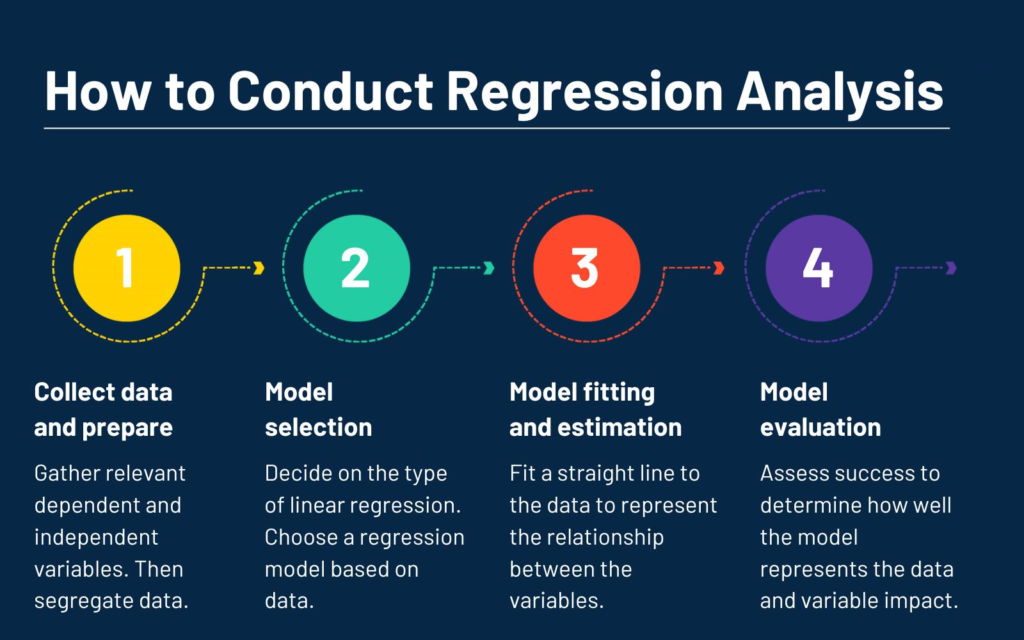
Step-by-Step Regression Workflow 🔎
Step 1: Define the Analytical Question
Start with the business or engineering problem—not the statistical method.
Instead of saying:
“I need to run regression.”
Ask:
“What factors are associated with equipment failure?”
or:
“Can historical customer information help predict sales?”
A well-defined question determines the appropriate dataset and modeling strategy.
Step 2: Collect the Data
Gather relevant observations from reliable sources.
A dataset might contain thousands of rows representing customers, machines, products, transactions, buildings, or experimental observations.
Before modeling, verify:
- Data completeness
- Variable definitions
- Measurement consistency
- Time periods
- Units
- Duplicate records
- Missing values
Step 3: Explore the Dataset
Exploratory data analysis should happen before regression.
Examine:
- Distributions
- Outliers
- Relationships
- Missing observations
- Unusual categories
- Potential data-entry errors
genui{“learning_viz”:{“type_id”:”LEAST_SQUARE_REGRESSION”}}
A scatterplot is particularly useful for understanding whether a relationship appears approximately linear.
Step 4: Prepare the Variables
Data preparation may involve:
- Handling missing values
- Transforming skewed variables
- Encoding categorical variables
- Removing obvious data errors
- Standardizing variables when appropriate
- Creating meaningful features
Feature engineering can significantly improve a regression model.
Step 5: Build a Baseline Model
Start with a relatively simple model.
For example, a sales analyst could begin with product price and advertising expenditure before introducing dozens of additional variables.
This creates a baseline against which more complicated models can be compared.
Step 6: Examine Model Performance
Several measures can help evaluate regression performance.
Common metrics include:
R² — indicates how much variation in the outcome is explained by the model.
Adjusted R² — accounts for model complexity and can be more informative when multiple predictors are used.
MAE — measures average absolute prediction error.
RMSE — gives greater weight to larger prediction errors.
Residual analysis — investigates differences between observed and predicted values.
Step 7: Validate the Model
A model should not simply be evaluated on the same observations used to train it.
A common workflow divides data into:
- Training data
- Validation data
- Test data
Cross-validation can provide a more reliable estimate of how the model performs on unseen observations.
Step 8: Interpret the Results
The final step is translating statistical output into meaningful conclusions.
A technically correct model is not particularly useful if stakeholders cannot understand what it means.


Comparison: Major Regression Approaches ⚖️
Simple vs Multiple Regression
| Characteristic | Simple Regression | Multiple Regression |
|---|---|---|
| Predictors | One | Two or more |
| Complexity | Low | Higher |
| Interpretation | Easier | More detailed |
| Typical Use | Basic relationships | Real-world analysis |
| Data Requirements | Relatively small | Usually larger |
| Risk of Multicollinearity | Low | Higher |
Simple regression is excellent for learning the fundamental concept, while multiple regression is often more representative of practical analytics.
Linear vs Logistic Regression
Linear regression generally addresses continuous outcomes such as revenue, temperature, or energy consumption.
Logistic regression is commonly used when the outcome represents categories such as:
- Customer churn: Yes/No
- Fraud: Fraudulent/Not fraudulent
- Failure: Failed/Successful
- Purchase: Purchased/Not purchased
Traditional Regression vs Machine Learning Regression
Traditional statistical regression often emphasizes:
- Interpretation
- Statistical inference
- Relationships
- Confidence intervals
- Hypothesis testing
Machine-learning regression often emphasizes:
- Predictive performance
- Generalization
- Cross-validation
- Feature engineering
- Model optimization
In practice, these approaches overlap considerably.
Diagrams and Practical Model Structure 📈
A regression analysis can be visualized as a pipeline:
Raw Data → Cleaning → Exploration → Feature Preparation → Model Training → Validation → Interpretation → Decision
Another useful conceptual diagram is:
Predictors → Regression Model → Predicted Outcome → Residual Analysis → Model Evaluation


Understanding Residuals
A residual represents the difference between an observed value and the value predicted by the model.
Residual analysis is extremely important because a model can have a seemingly impressive overall performance while still violating important assumptions.
Analysts should look for:
- Patterns
- Clusters
- Increasing spread
- Extreme residuals
- Systematic deviations
Random-looking residuals are generally more encouraging than obvious patterns.
Practical Examples 💡
Example 1: House Price Analysis
Suppose a property company has historical information about thousands of homes.
The analyst wants to understand which characteristics are associated with sale prices.
Potential predictors include:
- Floor area
- Number of rooms
- Property age
- Location
- Parking
- Renovation status
A regression model could identify whether property size remains important after accounting for other characteristics.
The company could then use the model to support pricing analysis.
Example 2: Energy Consumption
An engineering team monitors a commercial building.
The dataset includes:
- Outdoor temperature
- Building occupancy
- Operating hours
- HVAC settings
- Historical energy consumption
Regression could help identify which operating conditions are associated with increased energy use.
This information could support energy-efficiency initiatives.
Example 3: Software Delivery Time
A technology company tracks software projects.
Variables might include:
- Number of developers
- Project size
- Number of requirements
- Previous project experience
- Number of revisions
Regression could help estimate expected project duration and identify factors associated with longer development cycles.
Real-World Applications 🌍
Engineering
Regression is widely useful in engineering analytics.
Applications include:
- Predictive maintenance
- Equipment performance
- Energy modeling
- Manufacturing quality
- Reliability analysis
- Process optimization
- Structural monitoring
Engineers can use historical measurements to identify patterns and support operational decisions.
Finance
Financial analysts may use regression to study relationships involving:
- Asset returns
- Interest rates
- Economic indicators
- Corporate characteristics
- Market variables
However, financial data often contains noise, changing relationships, and time-dependent behavior, so model validation is particularly important.
Marketing
Marketing teams can investigate relationships between:
- Advertising expenditure
- Website traffic
- Customer acquisition
- Sales
- Conversion activity
Regression can help evaluate whether additional spending is associated with measurable changes in business outcomes.
Healthcare and Life Sciences
Regression methods can help researchers analyze relationships between outcomes and factors such as:
- Patient characteristics
- Treatment variables
- Environmental conditions
- Laboratory measurements
Professional applications require careful attention to study design, confounding factors, and ethical considerations.
Data Analytics
For data analysts, regression can serve as a bridge between descriptive analytics and predictive analytics.
Instead of simply asking:
“What happened?”
the analyst can investigate:
“Which factors are associated with what happened?”
and:
“What might happen under similar conditions?”
Common Mistakes ⚠️
Using Regression Without a Clear Question
A model should answer a meaningful analytical question.
Running multiple models simply because a dataset contains many variables can produce misleading conclusions.
Confusing Correlation With Causation
Regression can reveal associations, but observational regression alone does not establish that one variable caused another.
For example, two variables may move together because a third variable influences both.
Ignoring Outliers
Extreme observations can strongly influence regression results.
Always investigate unusual records rather than automatically deleting them.
Ignoring Multicollinearity
Multiple predictors may contain overlapping information.
For example, a company’s annual revenue and monthly revenue may be highly related.
Strong predictor relationships can make individual coefficients difficult to interpret.
Overfitting
A highly complicated model may perform extremely well on historical data but poorly on new observations.
This is one reason validation is essential.
Ignoring Residual Patterns
Residual plots can reveal problems that summary metrics hide.
A good analyst does not rely exclusively on R².
Challenges and Solutions 🛠️
| Challenge | Possible Solution |
|---|---|
| Missing data | Investigate the cause and use an appropriate treatment |
| Outliers | Investigate their origin and assess their influence |
| Multicollinearity | Remove redundant variables or use regularization |
| Nonlinear relationships | Transform variables or use nonlinear models |
| Overfitting | Simplify the model and use cross-validation |
| Poor data quality | Improve collection and validation procedures |
| Changing relationships | Evaluate the model across different time periods |
| Difficult interpretation | Use visualizations and domain knowledge |
Data Quality Challenge
A sophisticated algorithm cannot compensate for fundamentally unreliable data.
If sensor readings are incorrect or customer records contain systematic errors, regression results may look precise while being practically useless.
Model Stability Challenge
A model developed from one period may not perform similarly in another period.
Economic conditions, customer behavior, technology, and operational processes can change.
Therefore, regression models should be monitored after deployment.
Case Study: Predicting Retail Sales 🛒
Imagine a retailer operating across several European and North American markets.
The company wants to understand factors associated with weekly sales.
Available Data
The analytics team collects:
- Weekly sales
- Product prices
- Promotional activity
- Website visits
- Advertising expenditure
- Inventory availability
- Seasonal indicators
Initial Analysis
The team begins with exploratory analysis.
They discover that sales are generally higher during promotional periods, but some products show unusually weak performance despite heavy advertising.
The analysts investigate inventory levels and discover an important issue: several products were frequently unavailable.
Model Development
The team creates a regression model using relevant predictors.
Instead of focusing only on overall model performance, analysts inspect individual variables and residual patterns.
They also separate historical observations into training and testing groups.
Findings
The model indicates that promotional activity and website traffic are strongly associated with sales, while inventory availability is also an important operational factor.
However, the analysts avoid claiming that advertising alone causes increased sales because the data is observational.
Business Decision
The company uses the findings to:
- Improve inventory planning
- Coordinate advertising with stock availability
- Identify underperforming promotions
- Improve sales forecasting
- Prioritize additional data collection
This illustrates an important principle:
Regression analysis becomes valuable when statistical findings are connected to practical decisions.
Essential Tips for Data Analysts 🚀
Start Simple
Build a simple baseline before creating a sophisticated model.
Complexity should solve a real problem rather than exist for its own sake.
Visualize Before Modeling
Scatterplots, distributions, residual plots, and correlation views can reveal problems before the model is built.
Understand the Business Context
Statistical output should never be interpreted without understanding how the underlying process works.
A domain expert may recognize an important factor that is missing from the dataset.
Validate Everything
Always ask:
Does this model work on observations it has not seen before?
That question is more important than achieving an impressive training score.
Watch for Data Leakage
Data leakage occurs when information unavailable at prediction time accidentally enters the model.
This can produce unrealistic performance.
Document the Workflow
Record:
- Dataset versions
- Feature definitions
- Cleaning decisions
- Modeling choices
- Validation methodology
- Performance metrics
- Interpretation
Good documentation improves reproducibility.
Communicate Uncertainty
Professional analysts should avoid presenting predictions as guaranteed outcomes.
Every prediction has uncertainty.
Combine Statistics With Visualization
A regression table may be technically correct, but a clear chart can make the relationship much easier to understand.
FAQs ❓
What is regression analysis used for?
Regression analysis is used to examine relationships between variables, explain variation in an outcome, and make predictions from available data.
Is regression only useful for data scientists?
No. Regression is widely used by engineers, economists, financial analysts, researchers, marketers, business analysts, and other professionals working with quantitative data.
What is the difference between simple and multiple regression?
Simple regression uses one predictor, while multiple regression uses several predictors to analyze an outcome.
Does regression prove causation?
No. Regression can identify statistical associations, but causation generally requires stronger evidence, such as experimental design or carefully justified causal methods.
What does R² tell an analyst?
R² describes the proportion of observed variation in the dependent variable that is explained by the fitted regression model under the model’s assumptions. It should not be interpreted as a universal measure of model quality.
Why are residuals important?
Residuals help analysts identify systematic errors, unusual observations, changing variance, and other potential model problems.
Can regression be used for forecasting?
Yes. Regression can support forecasting when predictors are available reliably for the future and the relationship remains sufficiently stable.
What software can analysts use for regression?
Popular options include Python, R, Excel, SQL-based analytics environments, MATLAB, and specialized statistical software. The best choice depends on the size of the dataset, analytical requirements, and organizational workflow.
Conclusion 🎯
Regression analysis is one of the most practical foundations of modern data analytics. Its value comes not simply from producing a prediction, but from helping analysts understand how variables are related and how those relationships can support better decisions.
A successful regression workflow begins with a clear question and reliable data. It continues through exploratory analysis, careful variable preparation, model development, validation, residual analysis, and interpretation.
For beginners, the most important lesson is to understand the logic behind the model rather than memorize statistical commands. For experienced analysts, the challenge is often more subtle: avoiding overfitting, identifying hidden data problems, validating assumptions, and communicating uncertainty responsibly.
Whether you are analyzing engineering measurements, business performance, financial data, customer behavior, or scientific observations, regression provides a powerful framework for turning data into evidence.
The strongest analysts therefore treat regression as a complete analytical process—not simply a button they press to generate a model. 📊🔍🚀