Metalearning 2nd Edition: Applications to Automated Machine Learning and Data Mining – The Complete Beginner-to-Professional Guide 🤖📊
Introduction 🚀
Machine learning has transformed industries by allowing computers to recognize patterns, make predictions, and automate decision-making. However, one major challenge remains: selecting the best algorithm and optimizing it for a specific dataset often requires extensive expertise and countless experiments.
This is where Metalearning comes into play.
The book Metalearning 2nd Edition: Applications to Automated Machine Learning and Data Mining explores how machine learning systems can learn from previous learning experiences to make future machine learning tasks faster, smarter, and more efficient.
Instead of treating every new dataset as a completely new problem, metalearning enables AI systems to ask:
“Have I solved something similar before?” 🤔
If the answer is yes, the system can reuse previous knowledge, recommend algorithms, estimate performance, and even automate the entire machine learning pipeline.
This article explains the concepts from beginner to advanced level while providing practical engineering insights suitable for students, researchers, engineers, and data scientists.


Background Theory 📚
Machine learning traditionally follows a repetitive workflow:
- Data collection
- Data cleaning
- Feature engineering
- Model selection
- Hyperparameter tuning
- Model evaluation
- Deployment
Each new project repeats nearly the same cycle.
Metalearning attempts to reduce this repetitive effort by learning from previous machine learning projects.
Instead of only learning from data, it learns from past learning experiences.
Think of it as:
- Human learning → Learning mathematics
- Machine Learning → Learning from data
- Metalearning → Learning how to learn
This higher level of intelligence makes modern AutoML systems possible.
Definition 📖
Metalearning is a branch of artificial intelligence that studies how machine learning algorithms can improve their own learning process by using experience gained from solving previous problems.
Its objectives include:
- Faster learning
- Better model selection
- Automated hyperparameter optimization
- Reduced computational cost
- Improved prediction accuracy
- Automatic feature engineering
It acts as the “memory” of machine learning.
Step-by-Step Explanation ⚙️
Step 1️⃣ Collect Historical Machine Learning Tasks
Past datasets are stored together with:
- Dataset characteristics
- Algorithms used
- Hyperparameters
- Performance metrics
- Training time
Example:
Dataset A:
- 5,000 samples
- 40 features
- Classification
Best algorithm:
Random Forest
Accuracy:
96%
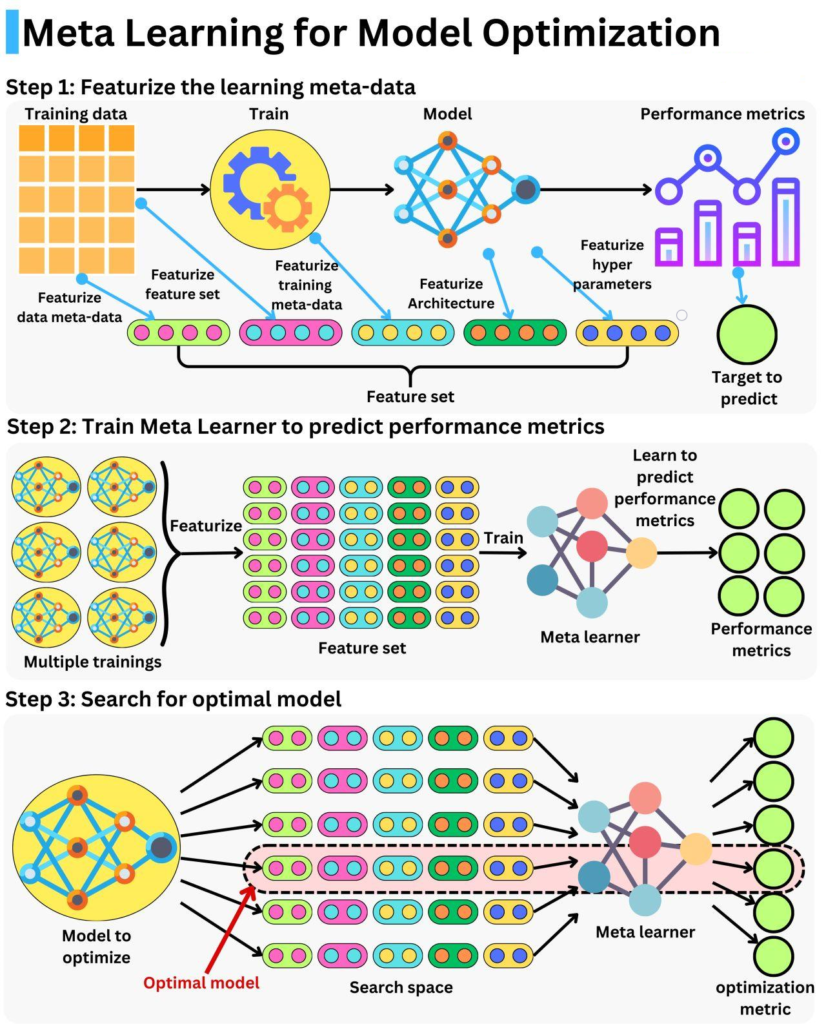
Step 2️⃣ Extract Meta-Features 🔍
Rather than using raw data, the system computes descriptive characteristics called meta-features.
Examples include:
- Number of samples
- Number of attributes
- Percentage of missing values
- Feature correlation
- Data skewness
- Class imbalance
These describe the dataset.
Step 3️⃣ Compare Similar Datasets 📊
The new dataset is compared against historical datasets.
If similarities exist, previous successful algorithms become recommended candidates.
Step 4️⃣ Recommend Algorithms 🤖
Instead of testing hundreds of models, the system predicts which ones are likely to perform well.
Possible recommendations:
- XGBoost
- Random Forest
- LightGBM
- SVM
- Neural Networks
Step 5️⃣ Hyperparameter Optimization ⚡
Metalearning also predicts good parameter values.
Instead of random guessing, previous experiments guide optimization.
Step 6️⃣ Continuous Learning 🔄
Every completed experiment becomes additional experience.
The system continually becomes smarter.



Comparison ⚖️
| Feature | Traditional ML | Metalearning |
|---|---|---|
| Starts from scratch | ✅ | ❌ |
| Uses previous experience | ❌ | ✅ |
| Automatic algorithm recommendation | ❌ | ✅ |
| AutoML support | Limited | Excellent |
| Training efficiency | Moderate | High |
| Human intervention | High | Low |
| Hyperparameter optimization | Manual | Automated |
| Scalability | Moderate | Excellent |
Architecture of a Metalearning System 🏗️
Historical Datasets
         │
         ▼
 Meta-Feature Extraction
         │
         ▼
 Meta Database
         │
         ▼
 Similar Dataset Search
         │
         ▼
 Algorithm Recommendation
         │
         ▼
 Hyperparameter Suggestion
         │
         ▼
 Best Machine Learning Model
Common Meta-Features Table 📋
| Category | Examples |
|---|---|
| General | Number of rows |
| Statistical | Mean, Variance |
| Information Theory | Entropy |
| Correlation | Pearson coefficient |
| Landmarking | Simple classifier performance |
| Model-based | Decision tree depth |
| Complexity | Feature redundancy |
Types of Metalearning 🔬
Instance-Based Metalearning
Learns similarities between datasets.
Model-Based Metalearning
Uses previous models to predict future performance.
Optimization-Based Metalearning
Improves hyperparameter optimization.
Neural Metalearning
Uses deep learning for rapid adaptation.
Reinforcement Metalearning
Learns optimal learning strategies through rewards.
Examples 💡
Example 1
Medical Diagnosis
Dataset:
Cancer prediction
Metalearning recommends:
- XGBoost
- LightGBM
instead of testing 25 algorithms.
Training time decreases significantly.
Example 2
Fraud Detection
Historical banking datasets indicate:
Random Forest performs best.
New fraud datasets immediately begin with Random Forest instead of starting blindly.
Example 3
Image Classification
Previous CNN architectures guide selection of:
- ResNet
- EfficientNet
- Vision Transformer
saving weeks of experimentation.
Real-World Applications 🌍
Metalearning is widely used across industries.
Healthcare 🏥
- Disease diagnosis
- Medical imaging
- Drug discovery
- Personalized medicine
Finance 💰
- Credit scoring
- Fraud detection
- Risk assessment
- Stock prediction
Manufacturing 🏭
- Predictive maintenance
- Quality inspection
- Robotics
- Smart factories
Cybersecurity 🔐
- Malware detection
- Intrusion detection
- Threat intelligence
Autonomous Vehicles 🚗
- Sensor fusion
- Object recognition
- Driving policy optimization
Climate Science 🌎
- Weather forecasting
- Flood prediction
- Environmental monitoring
Common Mistakes ❌
Assuming More Data Always Means Better
Quality matters more than quantity.
Ignoring Dataset Characteristics
Meta-features are essential.
Using Too Few Historical Experiments
A limited experience database reduces recommendation quality.
Overfitting Meta Models
The recommendation engine itself can overfit.
Poor Feature Engineering
Garbage in produces garbage out.
Ignoring Computational Cost
Fast algorithms may be preferable despite slightly lower accuracy.
Challenges & Solutions 🛠️
| Challenge | Solution |
|---|---|
| Sparse historical data | Build larger repositories |
| Cold-start problem | Use benchmark datasets |
| Expensive experiments | Transfer learning |
| High dimensionality | Feature selection |
| Large search space | Bayesian optimization |
| Model bias | Diverse datasets |
Case Study 🏆
AutoML for Industrial Predictive Maintenance
An engineering company monitored:
- Motors
- Pumps
- Compressors
Historical maintenance datasets were stored over five years.
Traditional workflow:
- 40 algorithms tested
- Manual tuning
- Three weeks per project
After introducing metalearning:
- Recommended only five candidate algorithms
- Automatic parameter tuning
- Completed within two days
Results:
| Metric | Before | After |
|---|---|---|
| Training Time | 3 weeks | 2 days |
| Accuracy | 91% | 95% |
| Engineering Effort | High | Low |
| Deployment Speed | Slow | Fast |
The company reduced maintenance costs while improving prediction accuracy.
Essential Tips ⭐
✔ Build a large metadata repository.
✔ Record every experiment.
🚀 Use benchmark datasets.
✔ Focus on meaningful meta-features.
✔ Combine Bayesian Optimization with metalearning.
🚀 Continuously update historical knowledge.
✔ Evaluate recommendations regularly.
✔ Consider computational efficiency.
🚀 Avoid overfitting.
✔ Learn AutoML frameworks alongside metalearning.
Popular AutoML Platforms 🚀
| Platform | Features |
|---|---|
| Auto-sklearn | Metalearning-based model selection |
| H2O AutoML | Automatic model training |
| TPOT | Genetic programming |
| AutoGluon | Fast automated ML |
| FLAML | Lightweight optimization |
| Google Vertex AI | Enterprise AutoML |
| Azure AutoML | Cloud-based automation |
Benefits of Metalearning 🌟
- Faster experimentation
- Lower computational cost
- Better algorithm recommendations
- Improved prediction accuracy
- Reduced engineering effort
- Easier model deployment
- Continuous improvement
- Strong foundation for AutoML
FAQs ❓
What is metalearning?
Metalearning is the process of learning from previous machine learning experiences to improve future learning tasks.
Is metalearning the same as machine learning?
No. Machine learning learns from data, while metalearning learns how machine learning itself should be performed.
Why is metalearning important?
It significantly reduces the time required to select algorithms and optimize machine learning pipelines.
Can beginners learn metalearning?
Yes. A solid understanding of machine learning basics makes it much easier to understand metalearning concepts.
What industries use metalearning?
Healthcare, finance, manufacturing, cybersecurity, robotics, autonomous driving, marketing, and scientific research all benefit from metalearning.
Does metalearning replace data scientists?
No. It automates repetitive tasks, allowing data scientists to focus on solving business problems and interpreting results.
Is metalearning part of AutoML?
Yes. Many modern AutoML systems rely heavily on metalearning for algorithm recommendation and hyperparameter optimization.
Conclusion 🎯
Metalearning 2nd Edition: Applications to Automated Machine Learning and Data Mining provides a comprehensive exploration of one of the most influential technologies behind modern artificial intelligence. By enabling systems to learn from previous learning experiences, metalearning dramatically reduces the effort required to build high-performing machine learning models.
For engineering students, researchers, and professionals, understanding metalearning is increasingly valuable as organizations adopt AutoML platforms to accelerate development, improve model quality, and reduce operational costs. Mastering concepts such as meta-features, algorithm recommendation, transfer of learning experience, and automated optimization equips practitioners with the skills needed to build scalable, efficient, and intelligent AI solutions for real-world engineering challenges.