Introduction
Civil engineering is one of the oldest and most impactful engineering disciplines, shaping the physical world around us—from roads and bridges to skyscrapers, dams, and water systems. Yet, mastering civil engineering is not just about reading textbooks or memorizing formulas; it is about understanding concepts, applying logic, and continuously testing knowledge.
One of the most effective learning strategies for both students and professionals is question-based learning. This approach is embodied in the concept behind “Mastering Civil Engineering – The Big Quiz Book: 1500 Q&A”, which focuses on reinforcing theory through structured questions and answers across core civil engineering domains.
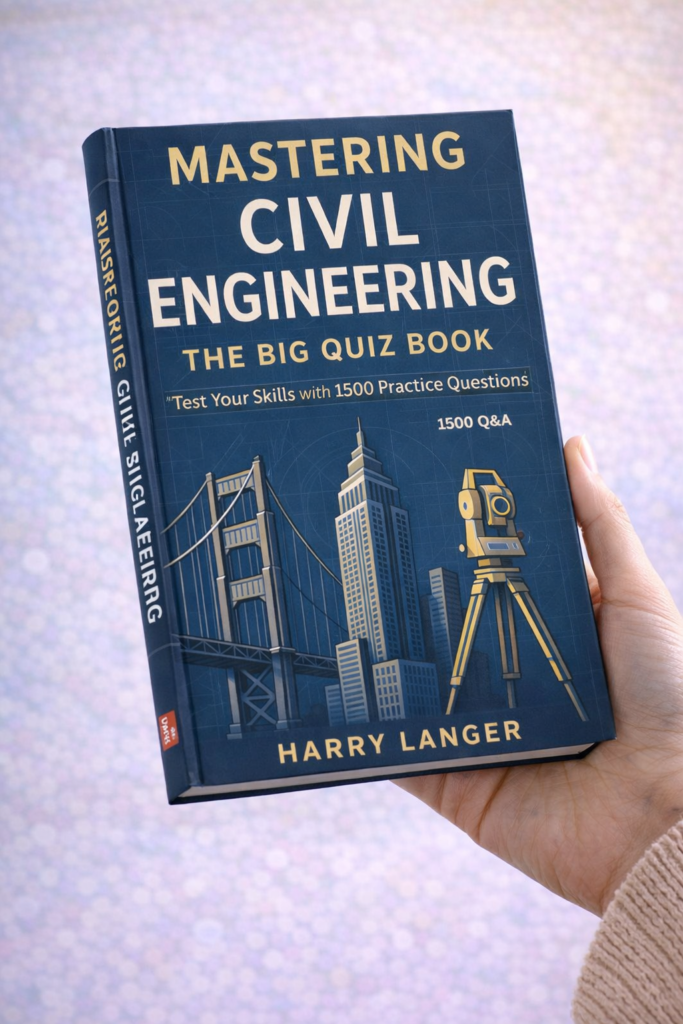
This article is a comprehensive engineering guide inspired by that philosophy. It explains the theoretical background, technical definitions, step-by-step learning strategies, real-world applications, and challenges in civil engineering—serving both beginners building foundations and advanced engineers sharpening their expertise.
Background Theory
Civil engineering integrates physics, mathematics, material science, geology, and management principles to design safe, efficient, and sustainable infrastructure.
Core Branches of Civil Engineering
Civil engineering is traditionally divided into several main domains:
-
Structural Engineering – Analysis and design of load-bearing structures
-
Geotechnical Engineering – Soil mechanics and foundation engineering
-
Transportation Engineering – Roads, railways, traffic systems
-
Environmental Engineering – Water, wastewater, pollution control
-
Construction Engineering & Management – Planning, scheduling, cost control
-
Hydraulics & Water Resources Engineering – Flow of water, dams, canals
Each branch requires a deep understanding of theory and the ability to apply it under real constraints such as safety, cost, time, and environmental impact.
Why Quiz-Based Learning Works
From a cognitive engineering education perspective:
-
Questions activate active recall
-
Repetition strengthens long-term memory
-
Problem-solving improves engineering judgment
-
Scenario-based questions simulate real-world decision-making
This makes Q&A-based mastery an excellent complement to traditional learning.
Technical Definition
What Does “Mastering Civil Engineering” Mean?
Mastering civil engineering can be technically defined as:
The ability to analyze, design, execute, and evaluate civil infrastructure systems using scientific principles, engineering judgment, codes, and ethical responsibility.
Key Competencies Involved
-
Mathematical modeling and analysis
-
Application of engineering codes (ACI, AASHTO, Eurocode, IS codes)
-
Use of software tools (ETABS, SAFE, STAAD, AutoCAD, Civil 3D)
-
Risk assessment and safety evaluation
-
Sustainable and economic design
A quiz-based system with 1500+ questions typically targets these competencies across increasing levels of difficulty.
Step-by-Step Explanation: How to Use Quiz-Based Mastery Effectively
Step 1: Build Conceptual Foundations
Before solving questions, engineers must understand:
-
Basic mechanics (forces, moments, equilibrium)
-
Material behavior (stress–strain relationships)
-
Engineering mathematics (calculus, matrices, statistics)
Tip: Questions at this stage should be conceptual, not numerical.
Step 2: Apply Core Formulas and Laws
Examples include:
-
Bending stress:
σ=My/I
-
Darcy’s Law (fluid flow in soil):
Q=kiA
-
Factor of Safety (FOS):
FOS=Resisting Force/Driving Force
Quiz questions reinforce when and why to use these formulas—not just how.
Step 3: Solve Numerical Problems
This stage involves:
-
Unit conversions
-
Load combinations
-
Boundary conditions
-
Engineering assumptions
Mistakes here often reveal weak theoretical understanding.
Step 4: Analyze Design-Based Questions
Design questions integrate:
-
Codes and standards
-
Safety margins
-
Practical constraints
Example:
“Design a simply supported RCC beam under given loading as per IS 456.”
Step 5: Interpret Real-World Scenarios
Advanced quiz questions may involve:
-
Failure case analysis
-
Value engineering decisions
-
Construction sequencing problems
This step bridges theory and practice.
Detailed Examples
Example 1: Structural Engineering Question
Question:
Why is under-reinforced concrete beam design preferred?
Answer Explanation:
In under-reinforced beams, steel yields before concrete crushes, providing:
-
Ductile failure
-
Visible warning signs
-
Higher safety
This reflects engineering ethics and safety principles.
Example 2: Geotechnical Engineering Question
Question:
What happens if foundation soil has low bearing capacity?
Answer Explanation:
Possible solutions include:
-
Increasing foundation area
-
Soil stabilization
-
Deep foundations (piles)
A quiz helps engineers recall both problems and remedies.
Example 3: Environmental Engineering Question
Question:
Why is BOD important in wastewater design?
Answer Explanation:
BOD measures organic pollution and determines:
-
Treatment process type
-
Aeration requirements
-
Environmental compliance
Real-World Applications in Modern Projects
Smart Infrastructure Projects
Quiz-based knowledge supports engineers working on:
-
Smart highways with sensors
-
Intelligent traffic systems
-
Digital twins of bridges
High-Rise and Mega Structures
Designing tall buildings requires:
-
Lateral load analysis
-
Wind and seismic considerations
-
Performance-based design
Engineers trained through extensive problem-solving perform better under such complexity.
Sustainable and Green Projects
Modern civil engineering focuses on:
-
Low-carbon concrete
-
Rainwater harvesting
-
Energy-efficient construction
Scenario-based questions improve sustainable decision-making.
Common Mistakes
1. Memorizing Without Understanding
Engineers often memorize formulas without knowing assumptions, leading to misuse.
2. Ignoring Units and Dimensions
Dimensional inconsistency is one of the most common numerical errors.
3. Overlooking Soil–Structure Interaction
Assuming fixed supports without soil analysis leads to unsafe designs.
4. Misinterpreting Code Provisions
Codes are guidelines, not shortcuts. Misreading them causes design errors.
Challenges & Solutions
Challenge 1: Vast Syllabus
Solution:
Divide content into modules and use topic-wise quizzes.
Challenge 2: Bridging Theory and Practice
Solution:
Include case-based and design-oriented questions.
Challenge 3: Keeping Knowledge Updated
Solution:
Add questions based on recent code revisions and technologies.
Challenge 4: Exam vs Real-World Gap
Solution:
Use applied problem-solving instead of rote questions.
Case Study
Case Study: RCC Building Design Optimization
Project Overview:
A mid-rise residential RCC building in a seismic zone.
Problem Identified
-
Excessive material cost
-
Conservative member sizes
Quiz-Based Intervention
The engineering team used structured Q&A sessions covering:
-
Load combinations
-
Ductility detailing
-
Seismic code provisions
Outcome
-
12% reduction in concrete volume
-
Improved seismic performance
-
Faster design approvals
This demonstrates how systematic questioning improves engineering outcomes.
Tips for Engineers
For Students
-
Practice daily, even 10–15 questions
-
Focus on explanation, not just answers
-
Link every question to theory
For Professionals
-
Use quizzes for design reviews
-
Train junior engineers using Q&A sessions
-
Convert project issues into learning questions
General Tips
-
Maintain an error log
-
Revisit wrong answers regularly
-
Apply concepts to real projects
FAQs
Q1: Is quiz-based learning suitable for advanced engineers?
Yes. Advanced scenario and design-based questions enhance judgment and decision-making.
Q2: Can quizzes replace textbooks?
No. Quizzes reinforce learning but should complement textbooks and codes.
Q3: Which civil engineering subjects benefit most from Q&A learning?
Structural analysis, geotechnical engineering, and environmental engineering benefit greatly.
Q4: How many questions should an engineer practice daily?
10–30 quality questions with explanations are more effective than high volume.
Q5: Are quiz books useful for competitive exams?
Yes, especially for concept clarity and revision.
Q6: Do quizzes help in real project execution?
Absolutely. They improve problem recognition and solution selection.
Q7: Should answers include calculations or concepts only?
Both. Conceptual clarity and numerical accuracy are equally important.
Conclusion
Mastering civil engineering is a continuous journey, not a one-time achievement. Inspired by the philosophy behind “The Big Quiz Book: 1500 Q&A”, this article has shown that question-driven learning is one of the most powerful tools for developing strong engineering fundamentals and advanced professional judgment.
By combining theory, technical definitions, step-by-step problem-solving, real-world applications, and reflective analysis, civil engineers can build confidence, competence, and creativity.
Whether you are a student preparing for exams or a professional designing critical infrastructure, remember:
Great civil engineers are not defined by what they memorize—but by the questions they can answer, analyze, and apply in the real world.