Learn Python 3 the Hard Way: A Very Simple Introduction to the Terrifyingly Beautiful World of Computers and Code — Complete Engineering Guide for Beginners and Professionals 🐍💻
Introduction 🚀
Python has become one of the world’s most influential programming languages. Whether you dream of designing intelligent robots, analyzing millions of engineering measurements, automating industrial systems, developing AI applications, or creating powerful software, Python offers one of the easiest entry points into computer programming.
The book “Learn Python 3 the Hard Way: A Very Simple Introduction to the Terrifyingly Beautiful World of Computers and Code” is famous because it teaches programming through continuous practice rather than passive reading. Instead of memorizing syntax, readers build real programming skills by typing code, fixing mistakes, and learning from experience.
For engineering students and professionals across the United States, Canada, the United Kingdom, Australia, and Europe, Python has become a must-have technical skill. Universities teach it, research laboratories rely on it, and industries from aerospace to biomedical engineering use it every day.

This comprehensive guide explores the concepts presented in the book while expanding them into modern engineering applications.
Background Theory 📚
Programming is fundamentally the process of giving precise instructions to a computer.
Unlike humans, computers cannot guess intentions. Every operation must be written with absolute clarity.
Python follows three important engineering principles:
- Simplicity
- Readability
- Productivity
Python was designed so programmers spend more time solving engineering problems and less time worrying about complicated syntax.
Modern Python is used in:
- Artificial Intelligence 🤖
- Machine Learning
- Scientific Computing
- Data Analysis
- Robotics
- Automation
- Cybersecurity
- Web Development
- Embedded Systems
- Cloud Computing
- Digital Signal Processing
Its versatility explains why Python appears in almost every engineering discipline today.
Definition 📖
Python is a high-level, interpreted, object-oriented programming language designed to produce clear, readable, and maintainable code.
Unlike low-level programming languages, Python allows developers to express complex ideas using fewer lines of code.
Major characteristics include:
- Open Source
- Cross Platform
- Easy to Learn
- Massive Community
- Thousands of Libraries
- Excellent Documentation
- Rapid Development
Understanding the Learning Philosophy 💡
Learning by Typing
One of the book’s core ideas is that programming cannot be learned simply by watching videos.
Instead:
✔ Type every line.
🐍 Make mistakes.
✔ Debug errors.
✔ Repeat.
This process strengthens long-term programming skills.
The Importance of Failure ⚙️
Programming errors are expected.
Professional software engineers spend a significant amount of their time fixing bugs.
Each bug teaches:
- Logic
- Debugging
- Reading documentation
- Patience
The book intentionally encourages making mistakes because debugging builds real expertise.
Step-by-Step Explanation 🛠️
Step 1 — Install Python
Download and install the latest Python version for your operating system.
Verify installation using:
python --version
Step 2 — Create Your First Program
print("Hello Engineering World!")
Output:
Hello Engineering World!
Simple—but it demonstrates communication between programmer and computer.
Step 3 — Variables
temperature = 25
pressure = 101.3
Variables store information.
Think of them as labeled containers.
Step 4 — Mathematical Operations
force = 20
distance = 5

work = force * distance

print(work)
Engineering calculations become easy.
Step 5 — Decision Making
temperature = 90

if temperature > 80:
    print("Cooling Required")
Conditional statements allow intelligent decision making.
Step 6 — Loops
for i in range(5):
    print(i)
Loops eliminate repetitive work.
Step 7 — Functions
def area(length, width):
    return length * width
Functions organize reusable code.
Step 8 — Modules
import math

print(math.sqrt(144))
Modules extend Python with powerful capabilities.
Step 9 — File Handling
with open("results.txt","w") as file:
    file.write("Engineering Complete")
Python can read and write files efficiently.
Step 10 — Build Real Projects
The final goal is creating complete applications rather than isolated code snippets.


Python Learning Progression 📈
| Stage | Skill | Difficulty |
|---|---|---|
| Installation | Beginner | ⭐ |
| Variables | Beginner | ⭐ |
| Conditions | Beginner | ⭐⭐ |
| Loops | Beginner | ⭐⭐ |
| Functions | Intermediate | ⭐⭐⭐ |
| Objects | Intermediate | ⭐⭐⭐⭐ |
| Modules | Intermediate | ⭐⭐⭐ |
| File Processing | Intermediate | ⭐⭐⭐ |
| APIs | Advanced | ⭐⭐⭐⭐ |
| Automation Projects | Advanced | ⭐⭐⭐⭐⭐ |
Comparison ⚖️
| Feature | Python | C++ | Java |
|---|---|---|---|
| Easy to Learn | ⭐⭐⭐⭐⭐ | ⭐⭐ | ⭐⭐⭐ |
| Speed | ⭐⭐⭐ | ⭐⭐⭐⭐⭐ | ⭐⭐⭐⭐ |
| Readability | ⭐⭐⭐⭐⭐ | ⭐⭐ | ⭐⭐⭐ |
| AI Development | ⭐⭐⭐⭐⭐ | ⭐⭐ | ⭐⭐ |
| Scientific Computing | ⭐⭐⭐⭐⭐ | ⭐⭐⭐ | ⭐⭐⭐ |
| Robotics | ⭐⭐⭐⭐ | ⭐⭐⭐⭐⭐ | ⭐⭐⭐ |
| Web Development | ⭐⭐⭐⭐⭐ | ⭐ | ⭐⭐⭐⭐ |
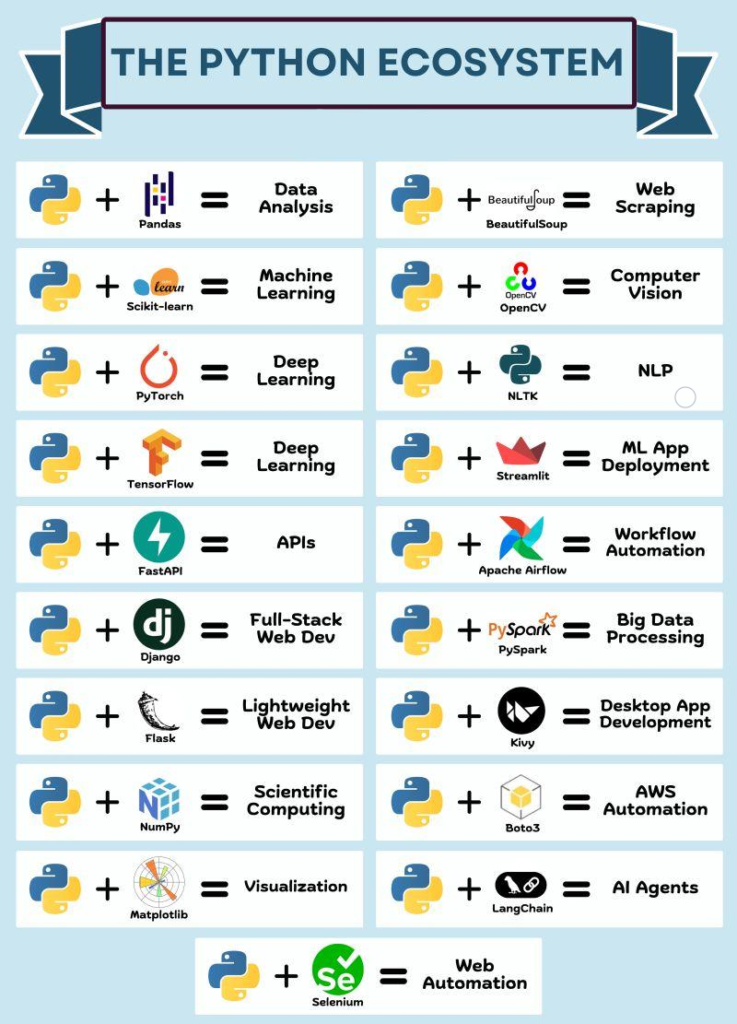
Python Ecosystem Overview 🌍


Core Programming Concepts Table 📊
| Concept | Purpose |
|---|---|
| Variables | Store information |
| Lists | Store collections |
| Dictionaries | Key-value storage |
| Loops | Repeat operations |
| Functions | Reusable code |
| Classes | Model real objects |
| Exceptions | Handle errors |
| Modules | Reuse existing tools |
Examples 💻
Example 1 — Area Calculation
length = 10
width = 4

print(length * width)
Example 2 — Temperature Converter
celsius = 35

fahrenheit = (celsius * 9/5) + 32

print(fahrenheit)
Example 3 — Engineering Calculator
voltage = 230
current = 5

power = voltage * current

print(power)
Example 4 — Unit Conversion
meters = 100

feet = meters * 3.28084

print(feet)
Example 5 — Average Sensor Reading
values = [21,23,22,20,24]

average = sum(values)/len(values)

print(average)
Real-World Applications 🌎
Python powers countless engineering solutions.
Artificial Intelligence 🤖
- Neural Networks
- Computer Vision
- Speech Recognition
Mechanical Engineering ⚙️
- CAD automation
- Finite Element Analysis
- Stress calculations
Civil Engineering 🏗️
- Structural analysis
- Traffic simulation
- GIS processing
Electrical Engineering ⚡
- Signal processing
- Embedded systems
- PCB automation
Robotics 🤖
Python controls:
- Robot arms
- Autonomous vehicles
- Industrial automation
- Drones
Data Science 📊
Engineers analyze:
- Millions of sensor readings
- Manufacturing quality
- Equipment performance
- Predictive maintenance
Scientific Research 🔬
Python dominates modern research because of libraries like:
- NumPy
- SciPy
- Pandas
- Matplotlib
Common Mistakes ❌
Copying Without Understanding
Always type the code yourself.
Ignoring Error Messages
Read every error carefully.
They usually identify the exact problem.
Skipping Exercises
Programming improves only through repetition.
Poor Variable Names
Avoid:
a=10
b=20
Prefer:
temperature=10
pressure=20
Not Practicing Daily
Even 30 minutes each day produces excellent long-term progress.
Challenges & Solutions 🔧
| Challenge | Solution |
|---|---|
| Syntax Errors | Read carefully |
| Indentation Problems | Use consistent spaces |
| Debugging | Test one section at a time |
| Large Programs | Break into functions |
| Low Confidence | Build many small projects |
| Complex Libraries | Learn fundamentals first |
Case Study 🏭
Python in Predictive Maintenance
A manufacturing company wanted to reduce unexpected machine failures.
Engineers installed vibration sensors on production equipment.
Python collected thousands of measurements every minute.
Using machine learning algorithms, the software detected unusual vibration patterns before mechanical failures occurred.
Results included:
- 🔹 35% reduction in maintenance costs
- 🔹 42% less downtime
- 🐍 Higher production efficiency
- 🔹 Improved worker safety
- 🔹 Better equipment lifespan
This demonstrates how basic Python skills can evolve into advanced industrial solutions.
Essential Tips ⭐
Practice Every Day
Consistency beats intensity.
Read Documentation
Professional developers rely heavily on official documentation.
Build Small Projects
Ideas include:
- Calculator
- Quiz Game
- Expense Tracker
- Unit Converter
- Weather App
Learn Debugging
Finding mistakes is as valuable as writing code.
Join Programming Communities
Learning with others accelerates progress.
Never Fear Errors
Every experienced programmer still encounters bugs daily.
Focus on Logic First
Programming is about solving problems—not memorizing commands.
Frequently Asked Questions ❓
Is Python difficult to learn?
No. Python is widely considered one of the easiest programming languages for beginners because of its clean syntax and readable structure.
Is this book suitable for complete beginners?
Yes. It starts with fundamental concepts and gradually introduces more advanced programming techniques through hands-on exercises.
Why is it called “the Hard Way”?
The title emphasizes disciplined practice. Instead of relying on shortcuts, readers type code manually, repeat exercises, and learn through debugging, which builds lasting skills.
Can Python be used in engineering?
Absolutely. Engineers use Python for simulation, automation, numerical analysis, robotics, data processing, optimization, and machine learning.
Is Python used professionally?
Yes. It is used by startups, research institutions, and many of the world’s largest technology companies for production software, scientific computing, and AI applications.
How long does it take to become proficient?
With regular practice, beginners can become comfortable with the fundamentals in a few months. Professional-level expertise develops through continuous project work and experience.
Should I learn Python before AI?
Yes. A solid understanding of Python fundamentals makes learning machine learning and artificial intelligence much easier.
Conclusion 🎯
Learn Python 3 the Hard Way: A Very Simple Introduction to the Terrifyingly Beautiful World of Computers and Code remains a valuable resource because it emphasizes an enduring truth: programming is learned through deliberate practice. By typing code, embracing mistakes, and solving progressively challenging problems, readers develop the confidence and problem-solving mindset that engineers rely on every day.
Python’s combination of readability, versatility, and a rich ecosystem of libraries has made it indispensable across engineering disciplines—from robotics and automation to scientific research, data analytics, and artificial intelligence. Whether you are a student beginning your programming journey or a professional expanding your technical toolkit, mastering Python opens the door to designing smarter systems, automating complex tasks, and building innovative solutions that address real-world engineering challenges.
The key is simple: practice consistently, understand the logic behind your code, and keep building projects. Every program you write strengthens the foundation for more advanced software development and engineering innovation.