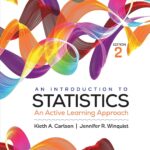
Introduction to Statistics and Data Analysis 4th Edition 📊⚙️
Introduction 🚀
Statistics and data analysis are among the most powerful tools in modern engineering, science, business, healthcare, manufacturing, and technology. From designing aircraft engines to improving smartphone applications, engineers and researchers rely on statistical methods to understand data, make predictions, improve quality, and solve complex problems.
The book Introduction to Statistics and Data Analysis 4th Edition is widely recognized as a beginner-friendly and practical resource for students and professionals who want to understand statistical concepts in a clear and application-oriented way. It introduces the foundations of statistics while also connecting theory to real-world engineering and scientific problems.
In today’s digital era 🌍💻, almost every engineering field generates large amounts of data. Civil engineers analyze structural performance data, electrical engineers examine signal measurements, mechanical engineers monitor machine efficiency, and software engineers evaluate user behavior and system performance.
Without statistics, raw data is just a collection of numbers.
With statistics, data becomes knowledge.
This article explores the core concepts, methods, applications, and engineering relevance of statistics and data analysis. It is designed for:
- Engineering students 🎓
- Researchers 🔬
- Data analysts 📈
- Industrial professionals 🏭
- Scientists 🧪
- Technology specialists 💡
Whether you are a beginner learning statistics for the first time or an advanced engineer looking to strengthen your analytical thinking, this guide provides a complete overview.
Background Theory 📚
Statistics developed from the need to collect, organize, and interpret information. Historically, governments used statistical methods to record populations, taxes, agriculture, and military data.
Over time, statistics evolved into a scientific discipline used in mathematics, economics, engineering, medicine, and computer science.
Early Development of Statistics
The origins of statistics date back centuries. Ancient civilizations collected numerical information related to trade, population, and agriculture.
In the 17th and 18th centuries, mathematicians such as:
- Blaise Pascal
- Pierre de Fermat
- Carl Friedrich Gauss
- Thomas Bayes
helped establish probability theory and statistical reasoning.
These mathematical foundations later became essential in engineering analysis and scientific experimentation.
Statistics in Engineering ⚙️
Engineering systems are never completely perfect because real-world processes contain uncertainty.
Examples include:
- Material strength variation
- Electrical signal noise
- Manufacturing defects
- Environmental changes
- Sensor inaccuracies
- Human operational errors
Statistics helps engineers:
- Measure uncertainty
- Predict system behavior
- Improve reliability
- Optimize processes
- Reduce production costs
- Enhance product quality
Evolution of Data Analysis 💻
Modern computing transformed statistics into data analysis and data science.
Today, engineers use:
- Machine learning
- Artificial intelligence
- Predictive analytics
- Big data systems
- Statistical software
- Cloud computing
Advanced data analysis now supports industries such as:
| Industry | Use of Statistics |
|---|---|
| Aerospace | Flight reliability analysis |
| Automotive | Quality control |
| Healthcare | Medical diagnosis |
| Manufacturing | Process optimization |
| Telecommunications | Signal processing |
| Energy | Power system forecasting |
| Software Engineering | User behavior analysis |
| Construction | Structural safety analysis |
Technical Definition 🧠
Statistics is the science of collecting, organizing, analyzing, interpreting, and presenting data.
Data analysis is the process of examining data to extract meaningful information, patterns, trends, and conclusions.
Types of Statistics
Statistics is generally divided into two major categories.
Descriptive Statistics 📋
Descriptive statistics summarize and organize data.
Common descriptive tools include:
- Mean
- Median
- Mode
- Standard deviation
- Variance
- Charts
- Histograms
- Tables
Example:
An engineer measures temperatures from a machine every hour and calculates the average operating temperature.
Inferential Statistics 🔍
Inferential statistics uses sample data to make predictions or conclusions about a larger population.
Common methods include:
- Hypothesis testing
- Confidence intervals
- Regression analysis
- Probability distributions
Example:
Testing whether a new manufacturing process reduces defect rates.
Important Statistical Terms 📖
Population
The complete set of items or observations.
Example:
All manufactured bolts produced in one month.
Sample
A subset selected from the population.
Example:
200 bolts tested for quality inspection.
Variable
A measurable characteristic.
Examples:
- Voltage
- Temperature
- Pressure
- Weight
- Speed
Parameter
A numerical value describing a population.
Statistic
A numerical value describing a sample.
Step-by-Step Explanation 🔧📊
Understanding statistics becomes easier when broken into systematic steps.
Step 1: Define the Problem 🎯
Every statistical analysis starts with a question.
Examples:
- Does the new material improve durability?
- Which design reduces fuel consumption?
- Is the production process stable?
A clear objective ensures meaningful analysis.
Step 2: Collect Data 📥
Data can be collected from:
- Experiments
- Sensors
- Surveys
- Simulations
- Databases
- Industrial equipment
Types of Data
Quantitative Data
Numerical values.
Examples:
- Temperature = 75°C
- Voltage = 220V
- Speed = 80 km/h
Qualitative Data
Categorical information.
Examples:
- Good/Bad
- Pass/Fail
- Male/Female
Step 3: Organize the Data 🗂️
Data organization improves readability.
Methods include:
- Tables
- Graphs
- Histograms
- Frequency distributions
Example Frequency Table
| Score Range | Frequency |
|---|---|
| 0–10 | 2 |
| 11–20 | 5 |
| 21–30 | 9 |
| 31–40 | 7 |
Step 4: Calculate Descriptive Statistics 🧮
Mean
The arithmetic average.
Formula:
Mean = Sum of observations / Number of observations
Example:
Data: 4, 6, 8
Mean = (4 + 6 + 8) / 3 = 6
Median
The middle value in sorted data.
Mode
The most frequent value.
Range
Difference between maximum and minimum values.
Standard Deviation 📏
Measures data spread.
Low standard deviation means data points are close to the average.
High standard deviation means greater variation.
Step 5: Visualize the Data 📈
Visualization improves understanding.
Common engineering graphs include:
- Scatter plots
- Bar charts
- Histograms
- Pie charts
- Control charts
Example Diagram
Temperature Distribution Histogram

|
|          ███
|       ███████
|    ███████████
| ███████████████
|____________________
   20 30 40 50 60
Step 6: Apply Probability Theory 🎲
Probability measures the likelihood of events.
Formula:
Probability = Favorable outcomes / Total outcomes
Example:
Probability of getting heads on a coin toss:
P(Heads) = 1/2
Step 7: Conduct Inferential Analysis 🔍
Engineers use inferential statistics to make decisions.
Hypothesis Testing
Used to evaluate claims.
Example:
- Null Hypothesis: New engine design does not improve efficiency.
- Alternative Hypothesis: New engine design improves efficiency.
Step 8: Interpret Results 📊
The final step involves drawing conclusions.
Questions include:
- 🚀 Is the process reliable?
- Is the design acceptable?
- Is the change statistically significant?
Comparison ⚖️
Understanding differences between statistical methods is essential.
Descriptive vs Inferential Statistics
| Feature | Descriptive Statistics | Inferential Statistics |
|---|---|---|
| Purpose | Summarize data | Predict or infer |
| Data Scope | Existing data | Population estimation |
| Tools | Mean, graphs | Hypothesis tests |
| Complexity | Lower | Higher |
| Example | Average temperature | Predict future temperature |
Qualitative vs Quantitative Data
| Feature | Qualitative | Quantitative |
|---|---|---|
| Type | Categorical | Numerical |
| Example | Color | Weight |
| Analysis | Frequency | Mathematical calculations |
| Charts | Pie charts | Histograms |
Population vs Sample
| Feature | Population | Sample |
|---|---|---|
| Definition | Entire group | Part of group |
| Size | Large | Smaller |
| Cost | Expensive | Affordable |
| Time | Longer | Faster |
Manual Analysis vs Software Analysis 💻
| Feature | Manual | Software |
|---|---|---|
| Speed | Slow | Fast |
| Accuracy | Human error possible | High accuracy |
| Data Size | Small datasets | Large datasets |
| Examples | Calculator | MATLAB, Python, Excel |
Diagrams & Tables 📐📋
Normal Distribution Curve
The normal distribution is one of the most important concepts in statistics.
                    /
                 /      \
              /            \
           /                  \
________/______________________\________
Characteristics:
- Bell-shaped curve
- Symmetrical distribution
- Mean = Median = Mode
Process Control Diagram
Upper Limit ----------------------
                *
          *           *
     *
           *      *
Center Line ----------------------

Lower Limit ----------------------
Used in manufacturing quality control.
Engineering Data Analysis Workflow
Data Collection
       ↓
Data Cleaning
       ↓
Data Analysis
       ↓
Visualization
       ↓
Decision Making
Common Probability Distributions
| Distribution | Application |
|---|---|
| Normal | Measurement errors |
| Binomial | Pass/fail testing |
| Poisson | Failure analysis |
| Uniform | Random simulations |
| Exponential | Reliability engineering |
Examples 🧪
Example 1: Mechanical Engineering
A mechanical engineer measures the diameter of 10 shafts.
Measurements:
20.1, 20.0, 19.9, 20.2, 20.1, 20.0, 19.8, 20.1, 20.0, 20.2
Analysis
- Mean diameter ≈ 20.04 mm
- Small variation indicates good manufacturing consistency.
Example 2: Electrical Engineering ⚡
An engineer records voltage readings:
220V, 221V, 219V, 220V, 222V
Observation
Voltage variation is minimal.
This suggests stable system performance.
Example 3: Civil Engineering 🏗️
Concrete compressive strength tests:
| Sample | Strength (MPa) |
|---|---|
| A | 32 |
| B | 35 |
| C | 34 |
| D | 33 |
Average strength:
34 MPa
The concrete meets design requirements.
Example 4: Software Engineering 💻
Website loading times:
| User | Time (sec) |
|---|---|
| 1 | 1.2 |
| 2 | 1.5 |
| 3 | 1.3 |
| 4 | 1.7 |
Analysis helps optimize server performance.
Example 5: Manufacturing Industry 🏭
Defective products per day:
| Day | Defects |
|---|---|
| Monday | 5 |
| Tuesday | 3 |
| Wednesday | 4 |
| Thursday | 6 |
| Friday | 2 |
Statistical monitoring helps reduce defects.
Real World Application 🌎
Statistics and data analysis are used in nearly every engineering and industrial sector.
Manufacturing Engineering 🏭
Manufacturers use statistical process control to:
- Improve quality
- Reduce waste
- Increase efficiency
- Predict equipment failures
Aerospace Engineering ✈️
Aircraft systems generate enormous amounts of data.
Statistics supports:
- Flight safety
- Engine reliability
- Fuel efficiency
- Navigation systems
Automotive Industry 🚗
Car manufacturers analyze:
- Crash test data
- Fuel consumption
- Sensor performance
- Production quality
Artificial Intelligence 🤖
Machine learning heavily depends on statistical principles.
Applications include:
- Image recognition
- Speech processing
- Recommendation systems
- Autonomous vehicles
Healthcare Engineering 🏥
Medical engineers use statistics for:
- Clinical trials
- Disease prediction
- Medical imaging
- Biomedical signal analysis
Environmental Engineering 🌱
Environmental analysts evaluate:
- Air pollution
- Water quality
- Climate trends
- Renewable energy systems
Structural Engineering 🏗️
Civil engineers use statistics to evaluate:
- Material reliability
- Structural safety
- Earthquake resistance
- Load analysis
Data Science and Business Analytics 📈
Modern companies use data analysis to:
- Predict customer behavior
- Optimize marketing
- Improve logistics
- Reduce operational costs
Common Mistakes ❌
Students and professionals often make errors while performing statistical analysis.
Using Small Samples
Small samples may not represent the population accurately.
Ignoring Outliers
Outliers can significantly affect results.
Example:
Most machine temperatures are around 70°C, but one reading is 150°C.
This abnormal value should be investigated.
Confusing Correlation with Causation ⚠️
Two variables may appear related without one causing the other.
Example:
Ice cream sales and drowning incidents both increase in summer.
This does not mean ice cream causes drowning.
Poor Data Collection
Incorrect measurements lead to inaccurate conclusions.
Overcomplicating Analysis
Using advanced models when simple methods are sufficient can create confusion.
Misinterpreting Graphs 📉
Incorrect axis scaling may create misleading visuals.
Ignoring Assumptions
Some statistical tests require:
- Normal distribution
- Independent samples
- Equal variance
Ignoring assumptions reduces accuracy.
Data Entry Errors ⌨️
Typing mistakes can distort analysis.
Example:
Entering 500 instead of 50.
Challenges & Solutions 🛠️
Statistical analysis involves multiple practical challenges.
Challenge 1: Large Data Volumes 📦
Modern systems generate massive datasets.
Solution
Use:
- Cloud computing
- Big data platforms
- Automated software tools
Challenge 2: Missing Data ❓
Sensors or surveys may produce incomplete data.
Solution
Methods include:
- Interpolation
- Data imputation
- Removing invalid records
Challenge 3: Noisy Measurements 📡
Electronic systems often contain noise.
Solution
Apply:
- Filtering
- Signal processing
- Averaging techniques
Challenge 4: Human Bias 🧠
Researchers may unintentionally influence results.
Solution
Use:
- Blind testing
- Random sampling
- Automated data collection
Challenge 5: Software Complexity 💻
Advanced statistical software can be difficult for beginners.
Solution
Start with beginner-friendly tools:
- Excel
- Google Sheets
- MATLAB basics
- Python libraries
Challenge 6: Incorrect Model Selection
Choosing the wrong statistical model leads to poor predictions.
Solution
Understand:
- Data type
- Distribution
- Engineering objectives
Challenge 7: Real-Time Analysis ⏱️
Industrial systems may require instant decisions.
Solution
Use:
- Real-time monitoring systems
- AI-based analytics
- Embedded processing
Case Study 🔬
Improving Manufacturing Quality Using Statistical Process Control
Background
A manufacturing company producing metal bearings noticed an increase in defective products.
The company experienced:
- Customer complaints
- Increased waste
- Higher production costs
- Reduced reliability
Engineers decided to apply statistical analysis.
Data Collection 📥
The engineering team collected:
- Bearing diameter measurements
- Machine temperature readings
- Production speed data
- Defect counts
Initial Findings 📊
Analysis showed:
- Diameter variation increased during afternoon shifts.
- Machine temperatures were higher after long operation periods.
- Defect rates rose when temperatures exceeded safe limits.
Statistical Methods Used 🧮
The engineers applied:
- Mean calculations
- Standard deviation analysis
- Control charts
- Correlation analysis
Control Chart Example
Defect Rate

Upper Limit ------------------
                  *
            *
       *
Center Line ------------------

Lower Limit ------------------
The chart showed instability during specific production periods.
Solution Implemented ✅
The company:
- Installed automatic cooling systems
- Scheduled maintenance breaks
- Adjusted machine speed
- Introduced continuous monitoring
Final Results 🎉
After implementation:
| Parameter | Before | After |
|---|---|---|
| Defect Rate | 8% | 2% |
| Production Efficiency | 75% | 92% |
| Waste Material | High | Low |
| Customer Complaints | Frequent | Rare |
Lessons Learned 📚
- Data-driven decisions improve performance.
- Statistical monitoring prevents major failures.
- Small variations can indicate serious problems.
Tips for Engineers ⚙️💡
Understand the Fundamentals
Strong foundations are more important than memorizing formulas.
Practice with Real Data 📊
Use engineering datasets whenever possible.
Learn Statistical Software 💻
Popular tools include:
- Microsoft Excel
- MATLAB
- Python
- R
- SPSS
- Minitab
Focus on Visualization 📈
Clear charts improve communication.
Verify Data Quality ✅
Always check:
- Missing values
- Measurement errors
- Duplicate records
Use Appropriate Sampling
Random and representative samples improve accuracy.
Avoid Blind Trust in Software ⚠️
Software calculations are only useful if the user understands the methods.
Develop Critical Thinking 🧠
Statistics is not only mathematics.
It is also about interpretation and engineering judgment.
Document Your Process 📝
Good documentation improves reproducibility and teamwork.
Stay Updated 🌍
Modern engineering increasingly depends on:
- Data science
- AI
- Machine learning
- Predictive analytics
Continuous learning is essential.
FAQs ❓
What is the importance of statistics in engineering?
Statistics helps engineers analyze data, improve quality, predict failures, and make informed decisions.
Is statistics difficult for beginners?
Statistics becomes easier with practice and real-world examples. Starting with fundamentals greatly helps.
Which software is best for learning statistics? 💻
Beginners often start with Excel, while advanced users may prefer Python, MATLAB, or R.
What is the difference between data analysis and statistics?
Statistics focuses on mathematical methods, while data analysis applies those methods to extract insights from data.
Why is standard deviation important?
Standard deviation measures variation and consistency in data.
It helps engineers evaluate reliability.
Can statistics be used in artificial intelligence? 🤖
Yes. Machine learning algorithms depend heavily on probability and statistics.
What are outliers in statistics?
Outliers are abnormal values significantly different from other observations.
Why is sampling necessary?
Studying an entire population is often expensive and time-consuming.
Sampling provides faster and more practical analysis.
Advanced Engineering Perspective 🔬⚙️
For advanced engineering professionals, statistics goes beyond averages and charts.
It becomes a strategic decision-making framework.
Predictive Maintenance
Factories now use sensor data and statistical models to predict equipment failure before breakdown occurs.
Benefits include:
- Reduced downtime
- Lower maintenance cost
- Increased productivity
Reliability Engineering 🔧
Reliability analysis evaluates the probability that systems perform correctly over time.
Applications include:
- Aircraft engines
- Nuclear systems
- Power grids
- Automotive safety systems
Monte Carlo Simulation 🎲
Monte Carlo methods use random sampling to simulate complex systems.
Engineers use them for:
- Risk assessment
- Structural analysis
- Financial engineering
- Thermal systems
Machine Learning Integration 🤖
Machine learning combines:
- Statistics
- Computer science
- Optimization
Modern AI systems rely on:
- Regression models
- Probability theory
- Bayesian analysis
- Statistical learning
Big Data Engineering 📦
Industrial systems generate terabytes of information.
Statistical methods help engineers:
- Detect anomalies
- Optimize performance
- Improve energy efficiency
- Forecast demand
Statistical Software and Tools 💻🛠️
Modern engineers rarely perform large analyses manually.
Software tools improve speed, accuracy, and visualization.
Microsoft Excel 📊
Advantages:
- Easy for beginners
- Simple calculations
- Quick graph creation
Limitations:
- Limited for very large datasets
- Less suitable for advanced modeling
MATLAB ⚙️
Popular in engineering fields.
Applications include:
- Numerical analysis
- Signal processing
- Statistical modeling
Python 🐍
Python is widely used because of powerful libraries such as:
- NumPy
- Pandas
- Matplotlib
- SciPy
- Scikit-learn
Advantages:
- Free and open-source
- Excellent for AI and machine learning
- Strong community support
R Programming 📈
Designed specifically for statistics and visualization.
Common uses:
- Academic research
- Advanced statistical analysis
- Data visualization
Minitab 🏭
Common in manufacturing industries.
Useful for:
- Quality control
- Six Sigma
- Process improvement
Importance of Data Cleaning 🧹
Data cleaning is one of the most critical stages in analysis.
Poor-quality data produces poor-quality results.
Common Data Problems
- Missing values
- Duplicate entries
- Typing errors
- Incorrect units
- Sensor noise
Data Cleaning Process
Remove Duplicates
Duplicate records distort calculations.
Correct Errors
Example:
Entering 5000 instead of 500.
Standardize Units 📏
Ensure consistent measurement units.
Example:
Mixing meters and centimeters causes major mistakes.
Handle Missing Values
Possible methods:
- Replace with average values
- Use interpolation
- Delete incomplete records
Statistical Ethics and Responsibility ⚖️
Engineers and analysts must use statistics responsibly.
Incorrect analysis can lead to:
- Financial losses
- Engineering failures
- Unsafe products
- Poor business decisions
Ethical Principles
Honesty
Never manipulate data to achieve desired outcomes.
Transparency
Clearly explain methods and assumptions.
Accuracy
Verify calculations carefully.
Privacy 🔒
Protect sensitive information.
Real Engineering Risks
Incorrect statistical analysis may cause:
- Structural collapse
- Medical errors
- Software vulnerabilities
- Industrial accidents
Responsible engineering requires careful interpretation.
Future of Statistics and Data Analysis 🚀📡
Statistics continues evolving rapidly.
Artificial Intelligence Integration 🤖
AI systems increasingly automate:
- Pattern recognition
- Decision-making
- Forecasting
- Data interpretation
Internet of Things (IoT) 🌐
Millions of sensors generate continuous real-time data.
Statistical analysis enables:
- 🚀 Smart cities
- Smart factories
- Smart transportation
Cloud Analytics ☁️
Cloud platforms support large-scale analysis.
Advantages include:
- Remote access
- High computing power
- Real-time collaboration
Quantum Computing ⚛️
Future quantum systems may dramatically accelerate statistical computation.
Autonomous Systems 🚗
Self-driving vehicles depend heavily on statistical prediction and sensor analysis.
Educational Value of Introduction to Statistics and Data Analysis 4th Edition 🎓
The Introduction to Statistics and Data Analysis 4th Edition is valuable because it combines:
- Theory
- Practical examples
- Engineering applications
- Problem-solving methods
- Real-world case studies
Why Students Prefer This Book
Beginner-Friendly Explanations
Complex concepts are explained step by step.
Real Applications 🌍
The book connects statistics to engineering and science.
Balanced Mathematical Depth
It introduces formulas without overwhelming readers.
Visual Learning 📊
Graphs and tables improve understanding.
Benefits for Professionals
Professionals can use the concepts for:
- Quality improvement
- Research projects
- Process optimization
- Technical decision-making
Engineering Interpretation of Statistical Results 🧠
A major skill in engineering is interpreting results correctly.
Statistical Significance
A statistically significant result suggests that observed differences are unlikely due to random chance.
However, statistical significance does not always mean practical importance.
Engineering Importance ⚙️
Example:
A material improvement of 0.1% may be statistically significant but practically meaningless.
Engineers must evaluate:
- Cost
- Safety
- Reliability
- Performance
Confidence Intervals 📏
Confidence intervals estimate the range where true values likely exist.
Example:
95% confidence interval:
The engineer is highly confident the true value lies within a specified range.
Regression Analysis 📈
Regression identifies relationships between variables.
Example:
Fuel consumption vs vehicle speed.
Correlation Analysis 🔗
Correlation measures relationship strength.
- Positive correlation
- Negative correlation
- No correlation
Industrial Quality Control and Statistics 🏭📊
Quality control is one of the most important industrial applications of statistics.
Objectives of Quality Control
- Reduce defects
- Improve consistency
- Increase customer satisfaction
- Lower production costs
Six Sigma Methodology
Six Sigma uses statistical analysis to improve processes.
Goals include:
- Minimize variability
- Reduce defects
- Improve efficiency
Control Charts 📈
Control charts monitor production stability.
Benefits:
- Detect abnormal behavior
- Prevent failures
- Improve reliability
Acceptance Sampling 📦
Manufacturers inspect samples instead of entire populations.
This saves:
- Time
- Cost
- Resources
Role of Statistics in Research 🔬
Research relies heavily on statistical methods.
Experimental Design
Researchers carefully design experiments to ensure reliable conclusions.
Data Validation ✅
Statistics helps verify whether results are trustworthy.
Scientific Publishing 📚
Most scientific papers require statistical evidence.
Engineering Innovation 💡
New technologies depend on testing and analysis.
Examples include:
- Renewable energy systems
- Electric vehicles
- Advanced robotics
- Biomedical devices
Conclusion 🎯📘
Statistics and data analysis are essential foundations of modern engineering, science, business, and technology. The concepts introduced in Introduction to Statistics and Data Analysis 4th Edition provide students and professionals with the tools needed to understand uncertainty, interpret data, improve systems, and make informed decisions.
From basic averages to advanced predictive modeling, statistical methods influence nearly every engineering discipline. Mechanical engineers use statistics for quality control, electrical engineers analyze signals, civil engineers evaluate structural reliability, and software engineers optimize digital systems.
The growing importance of artificial intelligence, machine learning, IoT, and big data makes statistical literacy more valuable than ever before 🌍💻.
Understanding statistics is no longer optional for engineers.
It is a core professional skill.
By mastering:
- Data collection
- Probability theory
- Statistical analysis
- Visualization
- Interpretation
engineers can solve real-world problems more effectively and design safer, smarter, and more efficient systems.
Whether you are a beginner starting your statistical journey or an experienced engineer exploring advanced analytics, learning statistics opens the door to innovation, optimization, and evidence-based decision-making.
The future belongs to engineers who can transform raw data into meaningful insight 📊🚀.