Intelligent Systems: From Theory to Applications 🤖🧠 | Complete Engineering Guide for Students and Professionals
Introduction 🌍🚀
Intelligent systems have become one of the most transformative technologies of the 21st century. From autonomous vehicles navigating busy city streets to medical systems diagnosing diseases with remarkable accuracy, intelligent systems are reshaping industries worldwide.
These systems combine Artificial Intelligence (AI), Machine Learning (ML), sensor technology, control engineering, computer vision, and data analytics to make decisions that traditionally required human intelligence.
Today, engineers in the United States, United Kingdom, Canada, Australia, and across Europe rely on intelligent systems to improve productivity, reduce costs, increase safety, and automate complex operations.
Whether you’re an engineering student learning the fundamentals or a professional designing next-generation automation systems, understanding intelligent systems is essential for building future technologies.


Background Theory 📚
The concept of intelligent systems originated from the idea that machines could imitate certain aspects of human intelligence.
Early computing machines simply executed predefined instructions. However, as computational power increased and algorithms evolved, researchers developed systems capable of:
- Learning from experience
- Making decisions
- Recognizing patterns
- Solving complex problems
- Adapting to changing environments
The evolution of intelligent systems can be divided into several major stages:
| Era | Major Development |
|---|---|
| 1950s | Artificial Intelligence research begins |
| 1970s | Expert systems emerge |
| 1990s | Fuzzy logic and neural networks become practical |
| 2000s | Big Data enables machine learning |
| 2010s | Deep Learning revolution |
| Present | Intelligent autonomous systems powered by AI |
Modern intelligent systems integrate numerous engineering disciplines including:
- Computer Engineering
- Electrical Engineering
- Mechanical Engineering
- Robotics
- Control Systems
- Data Science
- Embedded Systems
- Internet of Things (IoT)
Definition 🧠
An Intelligent System is a computer-based system capable of collecting information, analyzing data, learning from experience, making decisions, and performing tasks autonomously or semi-autonomously to achieve specific goals.
Unlike traditional software that follows fixed rules, intelligent systems continuously improve their performance using new information.
Core Characteristics ⭐
✔ Learning ability
✔ Reasoning capability
⭐ Adaptability
✔ Decision making
✔ Problem solving
⭐ Self-improvement
✔ Environmental awareness
✔ Autonomous operation
Architecture of Intelligent Systems 🏗️
Every intelligent system consists of multiple interacting components.
Data Acquisition
The system gathers information using:
- Cameras 📷
- Temperature sensors 🌡️
- LiDAR
- Radar
- GPS
- IoT devices
- Databases
Data Processing
Raw data is cleaned, filtered, and transformed into usable information.
Typical operations include:
- Noise removal
- Data normalization
- Feature extraction
- Data compression
Knowledge Base
Stores:
- Rules
- Historical data
- Expert knowledge
- Models
- Previous decisions
Inference Engine
Acts as the system’s “brain.”
Functions include:
- Logical reasoning
- Decision making
- Prediction
- Classification
Learning Module
Uses Machine Learning algorithms to improve future performance.
Popular methods include:
- Supervised Learning
- Unsupervised Learning
- Reinforcement Learning
- Deep Learning
Output Layer
Produces actions such as:
- Robot movement
- Alarm generation
- Medical diagnosis
- Traffic optimization
- Quality inspection
Step-by-Step Working Process ⚙️

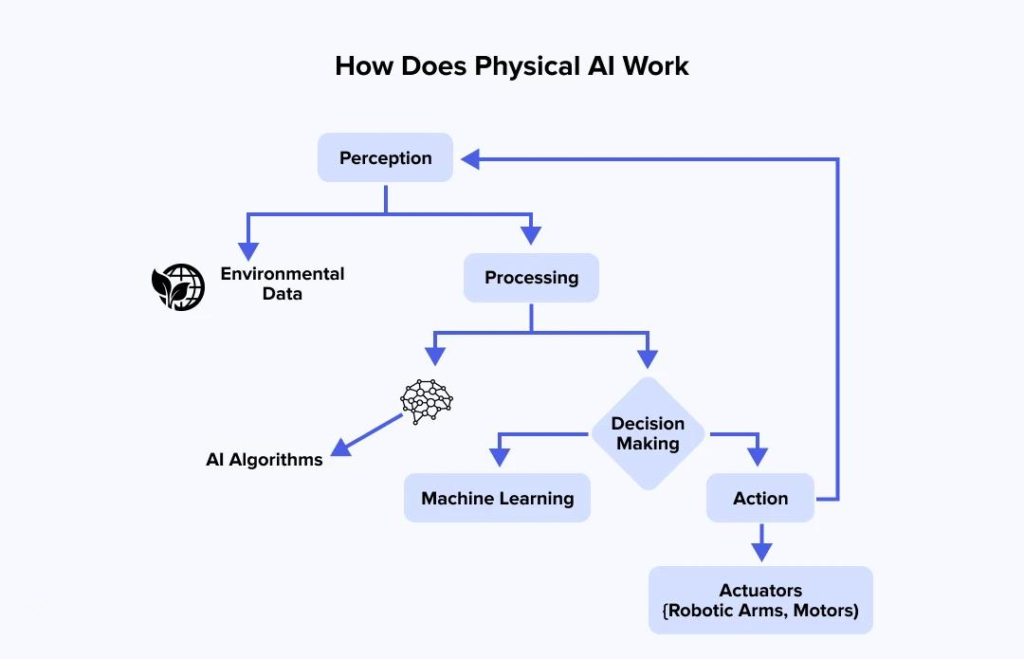


Step 1️⃣ Data Collection
Sensors continuously monitor the environment.
Examples include:
- Cameras
- Microphones
- Motion sensors
- GPS
Step 2️⃣ Signal Processing
Collected signals undergo filtering and preprocessing.
Objectives include:
- Removing errors
- Eliminating noise
- Enhancing quality
Step 3️⃣ Feature Extraction
Important characteristics are identified.
Examples:
- Face edges
- Object shapes
- Temperature trends
- Vehicle speed
Step 4️⃣ Intelligence Processing
The AI engine analyzes extracted features.
It performs:
- Classification
- Prediction
- Pattern recognition
- Optimization
Step 5️⃣ Decision Making
The system selects the optimal action based on:
- Probability
- Rules
- Historical experience
- Current conditions
Step 6️⃣ Action Execution
Commands are sent to:
- Robots
- Motors
- Industrial machines
- Autonomous vehicles
- Smart devices
Step 7️⃣ Continuous Learning
After every action, feedback improves future performance.
This learning loop makes intelligent systems increasingly accurate over time.
Comparison 📊
| Feature | Traditional Systems | Intelligent Systems |
|---|---|---|
| Learning | No | Yes |
| Adaptability | Low | High |
| Automation | Limited | Advanced |
| Decision Making | Rule-based | AI-driven |
| Accuracy | Fixed | Improves over time |
| Error Recovery | Manual | Automatic |
| Scalability | Moderate | Excellent |
| Prediction | None | Advanced |
Intelligent System Workflow Diagram & Engineering Tables 📈


Functional Block Diagram
Environment
      │
      ▼
 Sensors
      │
      ▼
Data Collection
      │
      ▼
Preprocessing
      │
      ▼
AI Model
      │
      ▼
Decision Engine
      │
      ▼
Controller
      │
      ▼
Actuator
      │
      ▼
Action
      │
      ▼
Feedback
      └──────────────► Learning Module
Major Technologies
| Technology | Purpose |
|---|---|
| Artificial Intelligence | Intelligent reasoning |
| Machine Learning | Learning from data |
| Deep Learning | Complex pattern recognition |
| IoT | Data collection |
| Robotics | Physical automation |
| Computer Vision | Image understanding |
| NLP | Language processing |
| Edge Computing | Local decision making |
Examples 💡
Smart Traffic Control 🚦
Traffic cameras monitor congestion.
AI adjusts traffic lights automatically.
Result:
- Reduced delays
- Less pollution
- Improved safety
Intelligent Manufacturing 🏭
Robotic arms inspect products using computer vision.
Benefits include:
- Higher accuracy
- Faster production
- Lower waste
Medical Diagnosis 🩺
AI analyzes medical images.
Doctors receive faster diagnostic recommendations.
Applications include:
- Cancer detection
- Brain imaging
- Heart disease prediction
Smart Agriculture 🌾
Sensors measure:
- Soil moisture
- Temperature
- Humidity
The intelligent system controls irrigation automatically.
Autonomous Vehicles 🚗
Vehicles combine:
- Cameras
- LiDAR
- GPS
- Radar
- AI
They identify roads, obstacles, pedestrians, and traffic signs.
Real-World Applications 🌎
Intelligent systems are used across nearly every engineering discipline.
Manufacturing
✔ Predictive maintenance
✔ Industrial robots
⭐ Quality control
✔ Process optimization
Healthcare
✔ Medical imaging
⭐ Drug discovery
✔ Patient monitoring
✔ Surgical robots
Energy
✔ Smart grids
⭐ Renewable energy optimization
✔ Power forecasting
✔ Fault detection
Civil Engineering
✔ Structural health monitoring
⭐ Smart cities
✔ Traffic management
✔ Bridge inspection
Aerospace
✔ Flight control
⭐ Satellite navigation
✔ Autonomous drones
✔ Aircraft diagnostics
Cybersecurity
✔ Threat detection
⭐ Malware identification
✔ Fraud detection
✔ Network monitoring
Common Mistakes ❌
Many engineering teams encounter similar problems during intelligent system development.
Using Poor Quality Data
Garbage data produces poor predictions.
Ignoring Data Bias
Biased datasets lead to unfair decisions.
Overfitting Models
Models perform well during training but fail in real environments.
Poor Sensor Calibration
Incorrect sensor readings reduce accuracy.
Lack of Testing
Systems must be evaluated under many operating conditions.
No Feedback Loop
Without continuous learning, performance stagnates.
Challenges & Solutions 🛠️
| Challenge | Solution |
|---|---|
| Large datasets | Cloud computing |
| High computational cost | GPU acceleration |
| Cybersecurity threats | Encryption and authentication |
| Data privacy | Secure data governance |
| Hardware limitations | Edge AI optimization |
| Real-time processing | Parallel computing |
| Model bias | Diverse training datasets |
| Explainability | Explainable AI techniques |
Case Study 🏭
AI-Based Predictive Maintenance in a Smart Factory
A manufacturing company experienced frequent failures of industrial motors.
Problem
Unexpected breakdowns caused:
- Production delays
- High maintenance costs
- Equipment damage
Solution
Engineers installed:
- Vibration sensors
- Temperature sensors
- AI predictive analytics
The intelligent system monitored machines continuously.
Results
- Equipment downtime reduced by 40%
- Maintenance costs reduced by 30%
- Productivity increased by 25%
- Equipment lifespan extended significantly
This case demonstrates how intelligent systems create measurable business value through predictive decision-making and continuous monitoring.
Essential Tips ⭐
✅ Start with high-quality data.
✅ Select appropriate AI algorithms.
⭐ Validate models using independent datasets.
✅ Monitor performance continuously.
✅ Keep software updated.
⭐ Protect systems from cyber threats.
✅ Design scalable architectures.
✅ Document every engineering decision.
⭐ Test under real operating conditions.
✅ Always include human oversight for critical applications.
Frequently Asked Questions ❓
1. What is an intelligent system?
It is a system capable of learning, reasoning, making decisions, and adapting using artificial intelligence and data-driven techniques.
2. Is Artificial Intelligence the same as an intelligent system?
No. Artificial Intelligence is a technology, while an intelligent system is a complete engineering solution that often incorporates AI alongside sensors, software, communication, and control components.
3. Which programming languages are commonly used?
Popular languages include:
- Python
- C++
- Java
- MATLAB
- R
4. What industries benefit most?
Manufacturing, healthcare, transportation, finance, aerospace, energy, agriculture, cybersecurity, logistics, and smart city infrastructure all benefit significantly.
5. What skills should engineering students learn?
Students should focus on:
- Programming
- Mathematics
- Machine Learning
- Data Analysis
- Embedded Systems
- Control Engineering
- Robotics
- Cloud Computing
6. Can intelligent systems replace engineers?
No. They automate repetitive and data-intensive tasks while engineers remain essential for system design, validation, ethical oversight, innovation, and strategic decision-making.
7. What is the biggest challenge in building intelligent systems?
Ensuring reliable, unbiased, and secure decision-making with high-quality data while meeting real-time performance and safety requirements.
Conclusion 🎯
Intelligent systems represent the convergence of artificial intelligence, engineering, automation, and data science into powerful solutions capable of transforming industries and society. By combining advanced sensing, robust data processing, adaptive learning algorithms, and intelligent decision-making, these systems enable machines to perform increasingly complex tasks with speed, precision, and autonomy.
As Industry 4.0, smart cities, autonomous transportation, and connected healthcare continue to expand across the USA, UK, Canada, Australia, and Europe, the demand for engineers skilled in intelligent systems will only increase. Mastering the underlying theory, system architecture, implementation process, and real-world applications equips both students and professionals to contribute to safer factories, smarter infrastructure, more efficient energy systems, and innovative products.
Investing in a strong foundation in intelligent systems today means preparing for a future where engineering excellence is defined not only by mechanical or electrical performance but also by the ability of systems to learn, adapt, and make intelligent decisions in an ever-changing world. 🤖🌍📈