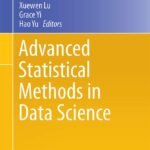
Handbook of Statistical Analysis 3rd Edition: AI and ML Applications – The Complete Beginner-to-Professional Engineering Guide for Data-Driven Decision Making 📊🤖
Introduction 🚀
Artificial Intelligence (AI) and Machine Learning (ML) have transformed nearly every engineering discipline, from manufacturing automation and autonomous vehicles to medical diagnosis and financial forecasting. Behind every intelligent model lies one essential foundation:
Statistical Analysis.
Without statistical thinking, machine learning models become nothing more than mathematical guesswork. Statistics enables engineers to understand data, measure uncertainty, validate predictions, identify patterns, and build trustworthy AI systems.
Whether you’re an engineering student learning data science or a professional developing AI-powered solutions, understanding statistical analysis is no longer optional—it’s an essential engineering skill.
Modern AI systems rely heavily on statistics to answer questions such as:
- 📈 Is this prediction reliable?
- 🎯 Which features matter the most?
- 📊 Does the model overfit the data?
- 🔍 Is the observed improvement statistically significant?
- ⚙️ How can uncertainty be measured?
This handbook explains statistical analysis from both beginner and advanced engineering perspectives while connecting every concept directly to AI and Machine Learning applications.


Background Theory 📚
Statistics is the science of collecting, organizing, analyzing, interpreting, and presenting data.
Machine learning can be viewed as applied statistical modeling enhanced with computational algorithms.
The relationship between AI and statistics includes:
- Probability Theory
- Linear Algebra
- Calculus
- Optimization
- Experimental Design
- Statistical Inference
- Bayesian Analysis
- Regression
- Hypothesis Testing
Historically:
- Classical statistics focused on explaining relationships.
- Machine learning focuses on prediction.
- Modern AI combines both approaches.
For example:
Traditional statistics asks:
“Why does this happen?”
Machine learning asks:
“Can we accurately predict what happens next?”
Engineering today requires both.
Definition 📖
Statistical Analysis is the systematic process of collecting, cleaning, summarizing, interpreting, and modeling data to support decision-making under uncertainty.
In AI and Machine Learning, statistical analysis helps engineers:
- Build predictive models
- Evaluate algorithms
- Reduce uncertainty
- Improve decision quality
- Detect hidden relationships
- Measure confidence
- Validate experimental results
Core Components of Statistical Analysis 🧩
Descriptive Statistics
Descriptive statistics summarize datasets.
Examples include:
- Mean
- Median
- Mode
- Range
- Variance
- Standard Deviation
- Percentiles
These metrics describe what has already happened.
Inferential Statistics
Inferential statistics use samples to make conclusions about populations.
Common techniques include:
- Confidence intervals
- Hypothesis testing
- ANOVA
- Bayesian inference
These methods estimate unknown information.
Probability Theory 🎲
Probability measures uncertainty.
Machine learning algorithms constantly estimate probabilities such as:
- Spam detection
- Disease diagnosis
- Fraud detection
- Customer behavior
Statistical Modeling
Models explain relationships among variables.
Examples include:
- Linear Regression
- Logistic Regression
- Poisson Regression
- Bayesian Models
Step-by-Step Statistical Analysis Workflow 🔄
Step 1 — Define the Engineering Problem
Clearly identify:
- Objectives
- Inputs
- Outputs
- Success criteria
Example:
Predict machine failure before breakdown.
Step 2 — Collect Data 📥
Possible sources:
- IoT Sensors
- Databases
- APIs
- Surveys
- Manufacturing equipment
- Medical devices
High-quality data produces high-quality AI.
Step 3 — Clean the Data 🧹
Remove:
- Missing values
- Duplicates
- Outliers
- Incorrect records
- Noise
Poor preprocessing often causes poor model performance.
Step 4 — Explore the Data 🔍
Perform:
- Histograms
- Scatter plots
- Box plots
- Correlation analysis
- Distribution analysis
Understand the data before modeling.
Step 5 — Select Statistical Techniques
Choose based on objectives.
Examples:
| Goal | Method |
|---|---|
| Prediction | Regression |
| Classification | Logistic Regression |
| Group Comparison | ANOVA |
| Feature Selection | Correlation Analysis |
| Pattern Discovery | Clustering |
Step 6 — Train Machine Learning Models 🤖
Examples include:
- Random Forest
- Decision Trees
- Neural Networks
- Support Vector Machines
- Gradient Boosting
Statistics guides parameter estimation.
Step 7 — Validate Results
Evaluate using:
- Accuracy
- Precision
- Recall
- F1 Score
- ROC Curve
- Cross Validation
Validation prevents overfitting.
Step 8 — Deploy the Model 🚀
Monitor:
- Model drift
- Prediction accuracy
- Data quality
- Statistical stability
Continuous monitoring keeps AI reliable.


Statistical Techniques Used in AI 📊
Regression Analysis
Predicts continuous values.
Applications:
- House prices
- Energy consumption
- Temperature forecasting
Classification
Predicts categories.
Examples:
- Email spam
- Disease diagnosis
- Image recognition
Clustering
Groups similar observations.
Applications:
- Customer segmentation
- Image compression
- Recommendation systems
Bayesian Statistics
Uses prior knowledge and updates probabilities with new evidence.
Widely used in:
- Robotics
- Medical AI
- Autonomous systems
Hypothesis Testing
Determines whether observed differences are statistically significant.
Useful in:
- A/B Testing
- Clinical trials
- Algorithm comparison
Comparison ⚖️
| Feature | Traditional Statistics | Machine Learning |
|---|---|---|
| Goal | Explain data | Predict outcomes |
| Dataset Size | Small to Medium | Medium to Massive |
| Assumptions | Many | Fewer |
| Focus | Interpretation | Prediction |
| Complexity | Lower | Higher |
| Automation | Limited | Extensive |
| Feature Engineering | Manual | Often Automated |
| Scalability | Moderate | High |
Important Statistical Metrics 📈
| Metric | Purpose |
|---|---|
| Mean | Average value |
| Variance | Data spread |
| Standard Deviation | Dispersion |
| Correlation | Relationship strength |
| Covariance | Joint variability |
| P-value | Statistical significance |
| Confidence Interval | Reliability estimate |
| RMSE | Prediction error |
| MAE | Average error |
| R² Score | Regression quality |
Engineering Diagrams and Concepts 🏗️
AI Statistical Pipeline
Raw Data
    ↓
Cleaning
    ↓
Feature Engineering
    ↓
Statistical Analysis
    ↓
Machine Learning
    ↓
Validation
    ↓
Deployment
Model Evaluation Flow
Training Data
      ↓
Model Training
      ↓
Testing
      ↓
Performance Metrics
      ↓
Model Improvement
Data Distribution Overview
| Distribution | AI Usage |
|---|---|
| Normal | Regression |
| Uniform | Simulation |
| Binomial | Classification |
| Poisson | Event Prediction |
| Exponential | Reliability Engineering |


Examples 💡
Example 1 — Predictive Maintenance
Factory sensors monitor:
- Temperature
- Pressure
- Vibration
Statistical analysis detects abnormal patterns before machine failure.
Example 2 — Medical Diagnosis
Patient data includes:
- Blood pressure
- Age
- Heart rate
AI predicts disease probability using statistical models.
Example 3 — Smart Traffic Systems
Traffic cameras collect:
- Vehicle count
- Speed
- Congestion
Machine learning predicts traffic conditions.
Example 4 — Energy Consumption
Smart meters collect electricity usage.
Regression predicts future energy demand.
Real-World Applications 🌍
Statistical analysis powers engineering systems in:
Manufacturing
- Predictive maintenance
- Quality control
- Process optimization
Healthcare
- Disease prediction
- Drug discovery
- Medical imaging
Civil Engineering
- Structural monitoring
- Earthquake prediction
- Infrastructure inspection
Mechanical Engineering
- Failure prediction
- Reliability analysis
- Vibration monitoring
Electrical Engineering
- Smart grids
- Load forecasting
- Fault detection
Aerospace Engineering
- Flight optimization
- Sensor fusion
- Autonomous navigation
Finance
- Fraud detection
- Credit scoring
- Risk analysis
Environmental Engineering
- Climate prediction
- Pollution monitoring
- Water quality assessment
Common Mistakes ❌
Many engineers encounter avoidable errors when applying statistical analysis:
- Ignoring missing data
- Using insufficient sample sizes
- Confusing correlation with causation
- Overfitting machine learning models
- Ignoring feature scaling
- Misinterpreting p-values
- Selecting inappropriate evaluation metrics
- Failing to validate assumptions
- Data leakage between training and testing sets
- Neglecting model monitoring after deployment
Challenges & Solutions 🛠️
| Challenge | Solution |
|---|---|
| Missing data | Imputation methods |
| Outliers | Robust statistical techniques |
| Imbalanced datasets | Resampling techniques |
| High dimensionality | PCA and feature selection |
| Overfitting | Cross-validation and regularization |
| Data drift | Continuous monitoring |
| Noisy data | Filtering and preprocessing |
| Computational cost | Distributed computing |
Case Study 🏭
Predictive Maintenance in Manufacturing
A manufacturing company experienced unexpected failures in industrial motors.
Problem
Unexpected downtime caused production losses.
Data Collected
- Temperature
- Motor vibration
- RPM
- Operating hours
- Current consumption
Statistical Analysis
Engineers:
- Removed outliers
- Calculated correlations
- Performed feature selection
- Built predictive models
Machine Learning Models Tested
- Logistic Regression
- Random Forest
- Gradient Boosting
Results
- Downtime reduced by 38%
- Maintenance costs reduced by 24%
- Prediction accuracy exceeded 94%
- Equipment lifespan increased significantly
Engineering Lessons
- High-quality data is essential.
- Statistical validation improves trust.
- Continuous monitoring sustains long-term performance.
Essential Tips ⭐
- 📚 Learn probability before advanced AI.
- 📊 Always visualize data first.
- 🔍 Check assumptions before applying statistical tests.
- 🧹 Clean data thoroughly before training models.
- 📈 Use cross-validation instead of a single train-test split.
- 🤖 Compare multiple algorithms rather than relying on one.
- 📉 Monitor prediction errors over time.
- ⚙️ Document preprocessing steps for reproducibility.
- 🧠 Balance model accuracy with interpretability.
- 🔄 Continuously retrain models as new data becomes available.
Frequently Asked Questions ❓
1. Why is statistical analysis important in AI?
Statistics helps AI systems learn from data, quantify uncertainty, validate predictions, and improve decision-making.
2. Is machine learning the same as statistics?
No. Statistics emphasizes inference and explanation, while machine learning emphasizes prediction. Modern AI integrates both disciplines.
3. Which programming languages are commonly used?
Python is the most popular, followed by R, Julia, MATLAB, and SQL for data handling.
4. Which statistical topics should beginners learn first?
Start with descriptive statistics, probability, distributions, hypothesis testing, regression, and correlation before moving to advanced ML concepts.
5. How does statistical analysis improve machine learning models?
It enhances feature selection, data preprocessing, model evaluation, uncertainty estimation, and overall reliability.
6. What is overfitting?
Overfitting occurs when a model learns training data—including noise—too closely, reducing its ability to generalize to unseen data.
7. Which industries rely heavily on statistical AI?
Healthcare, manufacturing, finance, transportation, telecommunications, environmental science, cybersecurity, aerospace, and smart cities all depend on statistical AI techniques.
Conclusion 🎯
Statistical analysis is the cornerstone of Artificial Intelligence and Machine Learning. Every successful AI application—from predictive maintenance and autonomous vehicles to medical diagnostics and financial forecasting—relies on sound statistical principles to transform raw data into reliable, actionable insights.
For engineering students, mastering statistics builds the foundation needed to understand algorithms rather than simply using them. For professionals, statistical thinking enables the design of robust, interpretable, and scalable AI systems that perform reliably in real-world environments. By combining rigorous data preparation, appropriate statistical methods, careful model validation, and continuous monitoring, engineers can develop intelligent solutions that are both accurate and trustworthy.
As AI continues to evolve across industries in the USA, UK, Canada, Australia, and Europe, proficiency in statistical analysis will remain one of the most valuable skills for solving complex engineering challenges and driving innovation with confidence.