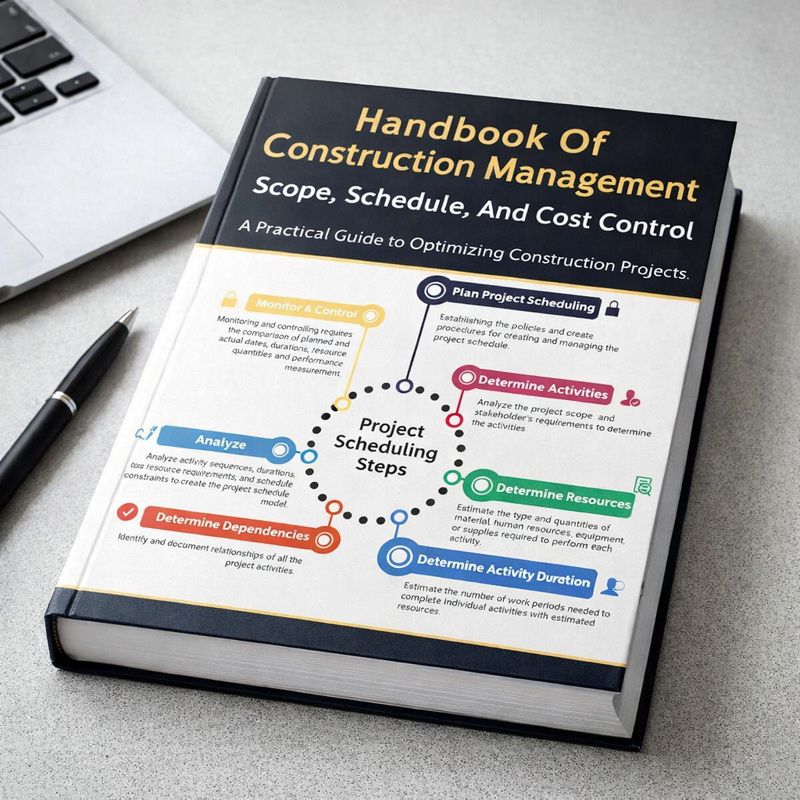
📘 Handbook of Construction Management: Scope, Schedule, and Cost Control in Modern Engineering Projects
🚧 Introduction
Construction projects are among the most complex engineering endeavors undertaken by modern society. Whether building a residential tower in London, a transportation hub in New York, or renewable energy infrastructure in Australia, successful project delivery depends heavily on effective construction management.
Construction management integrates technical engineering knowledge, financial planning, scheduling, and coordination of multidisciplinary teams to ensure projects are delivered safely, on time, and within budget. Among the many elements that define project success, three pillars stand out as the most critical:
- Scope Control
- Schedule Management
- Cost Control
These three components form what project managers commonly call the Project Management Triangle or Triple Constraint. If one factor changes, the others must adjust accordingly.
For example:
- Expanding project scope often increases costs and extends timelines.
- Tight schedules may increase labor costs.
- Budget constraints may require scope reduction.
Modern construction projects involve thousands of tasks, multiple contractors, regulatory requirements, and high financial stakes. A failure in management can lead to delays, budget overruns, safety issues, and legal disputes.
This handbook provides a comprehensive engineering overview of construction management, focusing on the practical application of scope, schedule, and cost control. It is designed for both students learning project management fundamentals and professional engineers seeking advanced strategies used in major projects across the United States, United Kingdom, Canada, Australia, and Europe.
🏗️ Background Theory
📊 Project Management Foundations
Construction management is built upon general project management theory, which focuses on organizing resources to achieve specific objectives within defined constraints.
The foundational framework most widely used in engineering is based on the Project Management Body of Knowledge (PMBOK) methodology, which divides project management into several knowledge areas including:
- Scope Management
- Schedule Management
- Cost Management
- Risk Management
- Procurement
- Quality Control
- Communication Management
Among these, scope, schedule, and cost represent the operational core of project delivery.
🔺 The Project Management Triangle
The Triple Constraint Model describes the relationship between three key project parameters.
| Constraint | Description | Impact |
|---|---|---|
| Scope | What work must be done | Defines project deliverables |
| Time | How long the project takes | Defines schedule deadlines |
| Cost | How much the project costs | Defines project budget |
The triangle demonstrates that:
- Increasing scope typically increases cost and time
- Reducing budget often requires reducing scope
- Shortening schedule usually increases cost
⚙️ Systems Engineering Perspective
From an engineering perspective, construction projects function as complex systems composed of interacting subsystems such as:
- Structural engineering
- Mechanical systems
- Electrical systems
- Environmental infrastructure
- Transportation networks
Effective construction management therefore requires systems thinking, ensuring all components operate together efficiently.
📘 Technical Definition
📐 Construction Management
Construction management is the professional discipline that applies engineering principles, management techniques, and technological tools to plan, coordinate, and control construction projects from inception to completion.
It includes:
- Project planning
- Resource allocation
- Budget management
- Risk mitigation
- Quality control
- Stakeholder coordination
📋 Scope Management
Scope management involves defining and controlling the work required to complete a project. It ensures that the project includes all necessary tasks—and only those tasks.
Key processes include:
- Scope planning
- Scope definition
- Work breakdown structure (WBS)
- Scope validation
- Scope change control
⏱️ Schedule Management
Schedule management involves planning, monitoring, and controlling project timelines to ensure timely completion.
It includes:
- Activity sequencing
- Time estimation
- Schedule development
- Progress monitoring
💰 Cost Control
Cost control involves estimating, budgeting, and managing project expenses throughout the project lifecycle.
This includes:
- Cost estimation
- Budget development
- Cost monitoring
- Financial reporting
- Variance analysis
⚙️ Step-by-Step Explanation of Construction Management
🔹 Step 1: Project Initiation
At the beginning of a construction project, stakeholders define:
- Project goals
- Initial budget
- Site requirements
- Regulatory constraints
Key documents include:
- Feasibility studies
- Project charter
- Preliminary design concepts
🔹 Step 2: Scope Definition
Engineers and project managers define the exact deliverables required.
This stage includes creating the Work Breakdown Structure (WBS).
Example WBS for a building project:
| Level | Task |
|---|---|
| 1 | Building Construction |
| 2 | Foundation |
| 3 | Structural Frame |
| 4 | Electrical Systems |
| 5 | Interior Finishing |
Breaking work into smaller tasks allows accurate scheduling and cost estimation.
🔹 Step 3: Schedule Development
Once the tasks are identified, engineers determine:
- Task dependencies
- Task durations
- Resource allocation
Two common scheduling techniques include:
Critical Path Method (CPM)
Identifies the longest sequence of dependent tasks that determines the minimum project duration.
Program Evaluation and Review Technique (PERT)
Uses probability estimates to manage uncertainty in task durations.
🔹 Step 4: Cost Estimation
Engineers estimate costs using methods such as:
- Analogous estimation
- Parametric estimation
- Bottom-up estimation
Cost categories typically include:
| Category | Examples |
|---|---|
| Labor | Skilled workers |
| Materials | Concrete, steel |
| Equipment | Cranes, excavators |
| Overhead | Administrative costs |
🔹 Step 5: Budget Development
The estimated costs are aggregated to create the project budget.
This includes contingency reserves to handle uncertainties.
🔹 Step 6: Construction Execution
During construction, project managers coordinate:
- Contractors
- Engineers
- Suppliers
- Inspectors
Monitoring tools track:
- Schedule progress
- Cost performance
- Quality standards
🔹 Step 7: Monitoring and Control
Project performance is continuously evaluated using Key Performance Indicators (KPIs).
Important metrics include:
- Schedule Variance (SV)
- Cost Variance (CV)
- Earned Value (EV)
🔹 Step 8: Project Closeout
After completion:
- Final inspections occur
- Documentation is finalized
- Contractors receive final payments
- Lessons learned are recorded
⚖️ Comparison of Project Management Approaches
| Approach | Characteristics | Suitable Projects |
|---|---|---|
| Traditional Waterfall | Sequential phases | Large infrastructure |
| Agile Construction | Flexible iterations | Modular projects |
| Lean Construction | Waste reduction | Manufacturing-style projects |
| Integrated Project Delivery | Collaborative approach | Complex urban projects |
Traditional approaches dominate large-scale engineering projects due to regulatory and safety requirements.
📊 Diagrams & Tables
🔺 Project Management Triangle
▲
|
|
Cost ◄—–► Time
This diagram illustrates the relationship between scope, cost, and time.
Example Construction Schedule
| Task | Duration | Dependency |
|---|---|---|
| Site Preparation | 2 weeks | None |
| Foundation | 4 weeks | Site Preparation |
| Structural Frame | 6 weeks | Foundation |
| Electrical | 3 weeks | Frame |
| Finishing | 5 weeks | Electrical |
🏢 Examples
Example 1: Residential Building
Scope:
- 20-story apartment building
Schedule:
- 24 months
Budget:
- $60 million
Challenges included:
- Material shortages
- Weather delays
Solution:
- Adjusted procurement strategy
Example 2: Highway Expansion
Scope:
- 50 km highway expansion
Schedule:
- 36 months
Budget:
- $450 million
Major activities included:
- Earthworks
- Bridge construction
- Traffic management
🌍 Real-World Applications
Construction management is used in many engineering sectors.
Infrastructure Projects
Examples include:
- Highways
- Railways
- Airports
- Bridges
Commercial Buildings
Includes:
- Office towers
- Shopping centers
- Hotels
Energy Projects
Includes:
- Wind farms
- Solar plants
- Power stations
Industrial Facilities
Includes:
- Factories
- Warehouses
- Data centers
In these sectors, effective management reduces financial risk and improves project efficiency.
❌ Common Mistakes in Construction Management
Poor Scope Definition
Incomplete scope leads to frequent change orders.
Unrealistic Scheduling
Overly optimistic timelines often result in project delays.
Inaccurate Cost Estimates
Underestimating costs can create severe budget overruns.
Lack of Communication
Miscommunication between stakeholders can cause coordination failures.
Weak Risk Management
Ignoring risks such as weather or supply chain issues can disrupt projects.
⚠️ Challenges & Solutions
Challenge 1: Cost Overruns
Solution
- Implement Earned Value Management
- Monitor spending regularly
Challenge 2: Schedule Delays
Solution
- Use critical path analysis
- Maintain buffer times
Challenge 3: Labor Shortages
Solution
- Workforce planning
- Automation technologies
Challenge 4: Supply Chain Disruptions
Solution
- Multiple suppliers
- Early procurement strategies
📚 Case Study: Airport Terminal Expansion
Project Overview
An international airport in Europe expanded its terminal to handle 15 million passengers annually.
Project details:
- Budget: $1.2 billion
- Duration: 5 years
- Workforce: 3,000 workers
Challenges
- Tight construction timeline
- Operational airport environment
- Complex mechanical systems
Solutions Implemented
Engineers applied:
- Building Information Modeling (BIM)
- Advanced scheduling software
- Integrated project delivery
Results
The project achieved:
- Completion within 4% of budget
- Only 2 months delay
- High safety performance
🧠 Tips for Engineers
Develop Strong Planning Skills
Good planning prevents costly mistakes.
Use Modern Technology
Tools include:
- BIM software
- Scheduling platforms
- Project management systems
Focus on Communication
Successful projects require coordination between many stakeholders.
Learn Financial Fundamentals
Understanding budgets improves project decisions.
Monitor Performance Metrics
Tracking KPIs ensures early detection of problems.
❓ FAQs
1. What is the main role of a construction manager?
A construction manager oversees planning, coordination, and execution of construction projects to ensure they meet scope, schedule, and cost objectives.
2. Why is scope management important?
Scope management prevents uncontrolled project expansion, known as scope creep, which can increase costs and delays.
3. What tools are used in construction scheduling?
Common tools include:
- Gantt charts
- Critical Path Method (CPM)
- Project scheduling software
4. How do engineers control construction costs?
Cost control involves budgeting, monitoring expenses, and analyzing cost variance to prevent overruns.
5. What is the critical path in project management?
The critical path is the longest sequence of dependent tasks that determines the minimum project duration.
6. What technologies improve construction management?
Technologies include:
- Building Information Modeling (BIM)
- AI-driven scheduling
- Drone site monitoring
7. What is Earned Value Management?
Earned Value Management is a project management technique used to measure project performance by comparing planned progress with actual performance.
🏁 Conclusion
Construction management is a vital discipline in modern engineering, ensuring that complex projects are delivered successfully. By effectively managing scope, schedule, and cost, engineers and project managers can balance competing constraints while maintaining quality and safety.
In large-scale projects across the United States, Europe, Canada, and Australia, advanced management techniques such as critical path analysis, cost monitoring systems, and digital modeling technologies have transformed how construction projects are executed.
However, success still depends heavily on careful planning, accurate cost estimation, effective communication, and continuous monitoring. Engineers who master these skills become valuable leaders capable of delivering projects that shape the infrastructure of modern society.
As construction projects continue to grow in complexity, the integration of digital technologies, data analytics, and sustainable engineering practices will further enhance the field of construction management.
For both students entering the profession and experienced engineers seeking to refine their skills, understanding the principles outlined in this handbook provides a strong foundation for managing the challenges of modern construction projects.