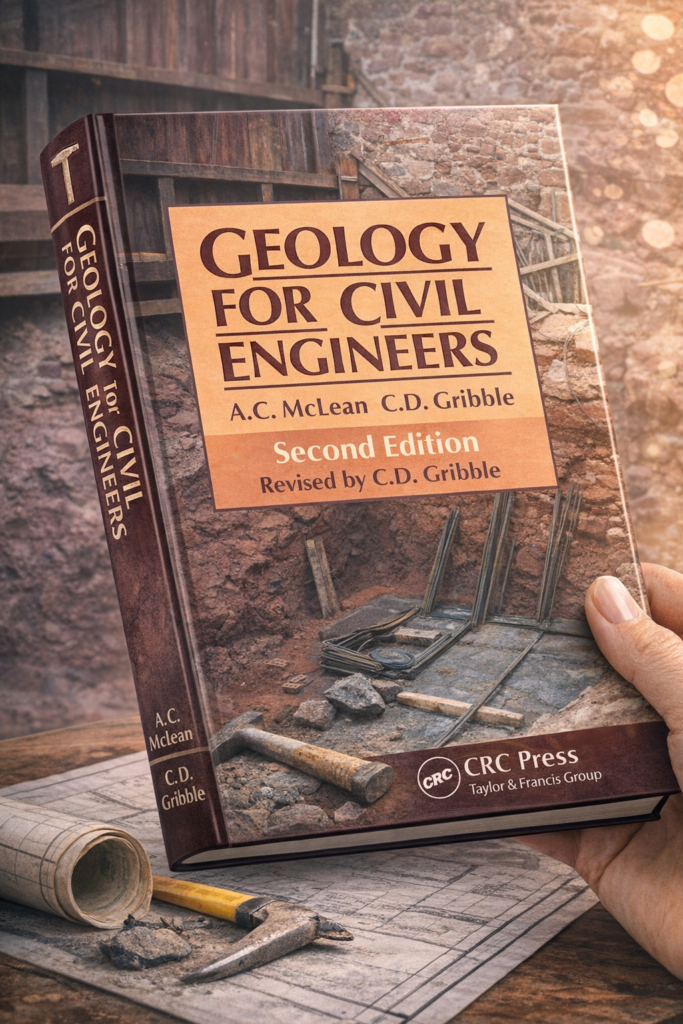
🌍 Geology for Civil Engineers 2nd Edition: An Educational & Technical Guide for Safe and Sustainable Infrastructure 📘
🔰 Introduction: Why Geology Is Essential for Civil Engineers
Civil engineering and geology are inseparable disciplines that work hand in hand to shape the modern built environment. Geology provides civil engineers with critical insights into the Earth’s materials, structures, and natural processes—elements that form the foundation of every construction and infrastructure project.
A strong understanding of geology enables civil engineers to accurately assess site conditions, anticipate geological hazards, and design structures capable of withstanding time, loads, and environmental changes. In this article, we explore how geology supports civil engineering in creating safe, durable, and efficient structures across various applications.
🧱🔍 1. Why Geology Matters in Civil Engineering
Geology plays a fundamental role in nearly every phase of civil engineering projects, from early planning to long-term maintenance.
🌋🪨 1.1 Understanding the Earth’s Composition
Civil engineers must understand the types of rocks and minerals present at construction sites. Each geological material behaves differently under load and environmental conditions.
Igneous rocks (e.g., granite) are extremely strong and ideal for foundations.
Sedimentary rocks (e.g., sandstone) may be porous and less stable.
Metamorphic rocks (e.g., marble) offer high strength but may contain fractures or planes of weakness.
Understanding these properties directly influences material selection and foundation design.
⚠️🌍 1.2 Assessing Geological Risks
Geological hazards can significantly affect structural safety and service life. Common risks include:
Landslides: Often caused by unstable slopes or intense rainfall.
Earthquakes: Resulting from tectonic movements that impact structural stability.
Soil Instability: Weak or expansive soils may cause settlement or foundation failure.
Proper geological assessment helps engineers mitigate these risks early.
🗺️📊 1.3 Importance of Geological Surveys in Site Selection
Before construction begins, geological surveys provide essential data such as:
Soil classification
Groundwater levels
Rock formations
Hidden geological hazards
These surveys ensure that construction is safe, economical, and technically sound.
🧠📐 2. Key Geological Concepts for Civil Engineers
To apply geology effectively, civil engineers must master several core geological principles.
🪨🔬 2.1 Rocks and Minerals
Rock classification helps engineers evaluate suitability for construction:
Igneous Rocks: High strength and durability.
Sedimentary Rocks: Variable strength, often weaker.
Metamorphic Rocks: Strong but sometimes brittle due to internal stresses.
🌱⚙️ 2.2 Soil Mechanics
Soil mechanics examines how soils behave under loads and environmental changes. Key parameters include:
Shear Strength: Resistance to sliding or deformation.
Permeability: Rate at which water flows through soil.
Compaction: Improves load-bearing capacity and reduces settlement.
🧭🏔️ 2.3 Geological Structures
Structural geology focuses on features that influence stability:
Faults: Cracks that may trigger seismic activity.
Folds: Bent rock layers indicating stress zones.
Strata: Layered rock arrangements affecting excavation and foundations.
🏗️🌐 3. Applications of Geology for Civil Engineers – Second Edition
Geology is applied across a wide range of civil engineering projects to ensure safety and sustainability.
🏢🔩 3.1 Foundation Design
Foundation stability depends on geological conditions:
Shallow Foundations: Used where soil is strong and stable.
Deep Foundations: Required for weak, compressible, or expansive soils.
🚇🪜 3.2 Tunnel Construction
Tunnel engineering demands precise geological knowledge:
Rock Hardness determines excavation techniques.
Groundwater Levels influence drainage and waterproofing.
Fault Zones increase collapse risks and require reinforcement.
⛰️🧱 3.3 Slope Stability
Slopes near roads, railways, and buildings must be stabilized through:
Reinforcement systems (retaining walls, anchors).
Drainage solutions to reduce pore water pressure.
Vegetation techniques to control erosion.
🧪🛠️ 4. Tools and Techniques Used in Geological Studies
Modern civil engineering relies on advanced geological investigation methods.
🧭📍 4.1 Field Surveys
On-site investigations include:
Rock mapping to identify faults and lithology.
Soil sampling for moisture and composition analysis.
🧫🔍 4.2 Laboratory Testing
Laboratory tests evaluate material properties:
Triaxial tests to measure soil strength.
X-ray diffraction to determine mineral composition.
📡🌐 4.3 Geophysical Methods
Non-invasive techniques reveal subsurface conditions:
Seismic surveys to detect layers and faults.
Magnetic surveys to identify anomalies and mineral zones.
🏗️📚 5. Case Studies in Geology for Civil Engineers 2nd Edition
Real-world examples highlight geology’s critical role.
🌉🧱 5.1 Bridge Construction on Unstable Soil
Weak clay soils required deep pile foundations, ensuring long-term stability and safety.
🚧🪨 5.2 Tunnel Engineering and Geological Faults
Unexpected fault zones delayed construction. Advanced surveys and monitoring allowed adaptive excavation and reinforced linings.
❌🏚️ 5.3 Lessons from Construction Failures
Failures caused by ignored geological conditions—such as expansive soils—underline the importance of thorough site investigations.
⚠️🌦️ 6. Challenges in Applying Geology to Civil Engineering
Despite its importance, challenges remain.
📉🗂️ 6.1 Incomplete Data
Subsurface conditions may not be fully revealed during surveys.
🏙️📈 6.2 Rapid Urbanization
Construction in geologically sensitive areas increases risk levels.
🌍🔥 6.3 Climate Change
Increased erosion, flooding, and landslides demand adaptive engineering designs.
🚀🔮 7. Future of Geology for Civil Engineers 2nd Edition
The integration of technology is shaping the future.
🤖🧠 7.1 Advanced Technology
AI & Machine Learning for smarter data interpretation.
GIS systems for accurate spatial analysis.
🌱🏗️ 7.2 Sustainable Construction
Environmentally responsible material sourcing.
Designs that adapt to long-term geological changes.
🤝🧑🔬 7.3 Collaborative Approaches
Closer cooperation between geologists and engineers leads to innovative solutions.
❓📌 FAQs
Q1: What is the role of geology for civil engineers?
Geology helps engineers understand soil and rock behavior, identify hazards, and design stable structures.
Q2: Why are geological surveys essential?
They provide accurate subsurface data for safe site selection and design.
Q3: What happens if geology is ignored?
Structural failure, safety risks, and increased project costs.
Q4: Which tools are commonly used?
Core drilling, seismic imaging, and laboratory soil testing.
Q5: Can geology support sustainable construction?
Yes, it minimizes environmental impact and enhances long-term stability.
🏁 Conclusion: Geology as the Backbone of Civil Engineering
Geology is the backbone of civil engineering, ensuring that structures remain safe, stable, and sustainable. By integrating geological principles into planning and design, engineers can reduce risks and improve durability. With advancing technology and collaboration, geology will continue to drive innovation in modern civil engineering.