Fundamentals of Machine Learning: A Practical Engineering Guide for Students and Professionals
Machine learning (ML) has evolved from a specialized research discipline into a practical engineering technology used in manufacturing, finance, healthcare, transportation, energy, software, robotics, and scientific research. At its core, machine learning enables computer systems to discover useful patterns in data and use those patterns to make predictions, classifications, or decisions.
For engineers, understanding ML is not simply about knowing how to call a Python library. A successful ML system requires a combination of mathematics, statistics, programming, data engineering, optimization, experimentation, and domain knowledge. ⚙️🧠
This guide explains the fundamentals of machine learning from both beginner and engineering perspectives, starting with the underlying theory and progressing toward model development, evaluation, real-world applications, and common engineering challenges.


Background Theory
Traditional computer programming generally follows a straightforward structure:
Input + Rules → Output
An engineer writes explicit rules that tell a computer what to do. For example, a conventional program might calculate whether a motor temperature exceeds a predefined safety limit:
T>Tlimit⇒Alarm=1
Machine learning approaches the problem differently:
Input + Examples → Learning Algorithm → Model
Instead of manually writing every rule, the engineer provides representative data and allows an algorithm to estimate relationships within that data.
For example, a predictive-maintenance model could receive:
- Motor temperature 🌡️
- Vibration level
- Rotational speed
- Current consumption
- Operating hours
- Historical failure information
The model can then learn a relationship between these variables and equipment failure.
Mathematically, a simple supervised learning problem can be expressed as:
y=f(X)+ϵ
where:
- (X) = input features
- (y) = target/output
- (f) = unknown relationship learned by the model
- (\epsilon) = noise or unexplained variation
The objective is not merely to memorize existing examples. The important engineering goal is generalization: performing well on new data that the model has never seen.
Definition
Machine learning is a branch of artificial intelligence in which computational algorithms learn patterns or relationships from data and use the learned representation to make predictions, classifications, generate outputs, or support decisions.
A useful engineering definition is:
Machine learning is an optimization-driven process for constructing a mathematical model that maps observed input data to useful outputs while minimizing an appropriate measure of error or loss.
For a supervised learning problem, the model may be represented as:
^=fθ(x)
where:
- is an input vector,
- is the predicted output,
- is the model,
- represents learned parameters.
The model is trained by minimizing a loss function:
θ∗=argθminL(y,fθ(x))
This simple equation captures a fundamental idea behind many ML systems: learn parameters that make predictions as accurate as possible according to a defined objective.
Key Machine Learning Terminology
Dataset: A collection of observations used for analysis and modeling.
Feature: An input variable used by a model.
Target: The value the model attempts to predict.
Model: A mathematical representation of learned relationships.
Parameter: A value learned during training.
Hyperparameter: A configuration selected before or during training, such as learning rate or tree depth.
Training: The process of fitting model parameters using data.
Inference: Using a trained model to produce predictions on new inputs.
Loss function: A mathematical measure of prediction error.
Generalization: The ability to perform effectively on previously unseen data.
Major Types of Machine Learning
Machine learning is commonly divided into several learning paradigms.
Supervised Learning
In supervised learning, the training dataset contains known target values.
Examples include:
- Predicting house prices
- Detecting defective components
- Classifying emails
- Estimating energy consumption
- Predicting equipment failure
Two major supervised learning tasks are classification and regression.
Classification predicts categories:
y∈{0,1}
Regression predicts continuous quantities:
y∈R
Unsupervised Learning
Unsupervised learning works primarily with data without predefined target labels.
Typical applications include:
- Customer segmentation
- Anomaly detection
- Dimensionality reduction
- Pattern discovery
- Clustering machine operating states
For example, a clustering algorithm may discover several groups of machines based on vibration and temperature measurements without being explicitly told what each group represents.
Reinforcement Learning
Reinforcement learning involves an agent, an environment, actions, and rewards.
The basic cycle is:
State→Action→Reward→New State
The agent attempts to learn a strategy, or policy, that maximizes cumulative reward.
Applications include robotics, industrial control, autonomous systems, and game-playing systems.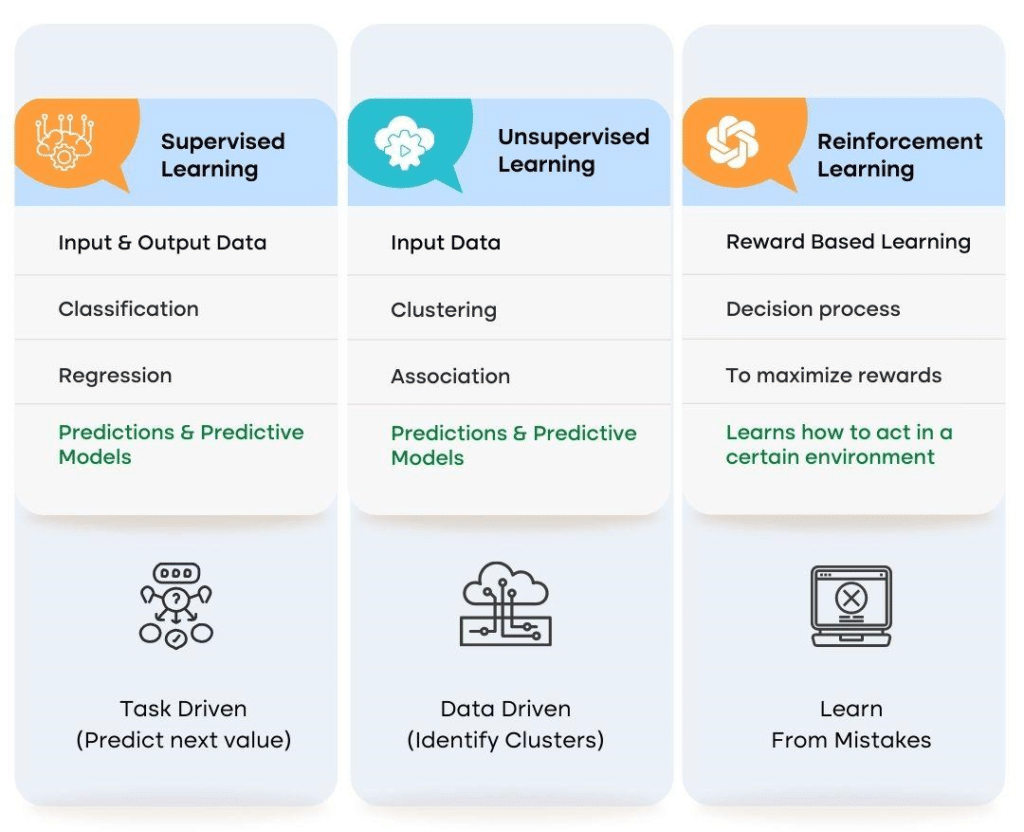


Step-by-Step Machine Learning Process
A machine learning project should be treated as an engineering workflow rather than simply a model-training exercise.
Step 1: Define the Problem
Start with the engineering or business problem.
Instead of saying:
“We need artificial intelligence.”
Define something measurable:
“Predict whether a pump will experience a fault within the next seven days.”
This produces a clear target and evaluation criterion.
Step 2: Collect Data
Data may come from:
- Sensors
- Databases
- APIs
- Manufacturing systems
- Transaction records
- Images
- Text
- Public datasets
- Experimental measurements
Data quality is often more important than algorithm complexity.
Step 3: Explore the Dataset
Before training anything, engineers should examine:
- Missing values
- Outliers
- Duplicate records
- Variable distributions
- Correlations
- Class imbalance
- Measurement errors
- Temporal patterns
Exploratory data analysis can reveal problems that would otherwise remain hidden.
Step 4: Prepare the Data
Typical preprocessing operations include:
- Handling missing values
- Encoding categorical variables
- Scaling numerical variables
- Removing duplicates
- Correcting inconsistent measurements
- Detecting extreme outliers
For example, standardization can be expressed as:
z=σx−μ
where (\mu) is the mean and (\sigma) is the standard deviation.
Step 5: Engineer Features
Feature engineering transforms raw information into variables that are more useful for the model.
For a rotating machine, raw sensor data might be transformed into:
These engineered variables can make physical relationships easier for algorithms to learn.
Step 6: Split the Data
A typical project separates data into:
- Training set
- Validation set
- Test set
For example:
| Dataset | Typical Role |
|---|---|
| Training | Learn model parameters |
| Validation | Select models and tune hyperparameters |
| Test | Estimate final generalization |
The exact proportions depend on the dataset and project requirements.


Step 7: Select a Baseline
Before implementing a sophisticated neural network, establish a simple baseline.
Examples include:
- Mean prediction
- Linear regression
- Logistic regression
- Decision tree
A complex model should provide measurable improvement over a reasonable baseline.
Step 8: Train the Model
During training, the algorithm adjusts its parameters to minimize the selected loss.
For gradient-based optimization:
θnew=θold−η∇θL
where:
- = learning rate
- = gradient of the loss with respect to model parameters
This optimization process is fundamental to many modern ML algorithms.
Step 9: Validate and Tune
Engineers adjust hyperparameters and compare candidate models.
Examples include:
- Tree depth
- Number of estimators
- Regularization strength
- Learning rate
- Number of neural-network layers
- Batch size
Validation data helps determine whether changes improve actual predictive performance.
Step 10: Test the Final Model
The test dataset should provide an independent assessment after model selection is complete.
This is important because repeatedly tuning a model against the test set can effectively turn the test set into another training/validation resource.
Step 11: Deploy and Monitor
Deployment is not the end.
A production ML system must be monitored for:
- Prediction quality
- Data drift
- Feature drift
- Latency
- Availability
- Unexpected inputs
- Model degradation
Modern ML workflows therefore extend beyond experimentation into continuous monitoring and maintenance.
Comparison of Common Machine Learning Algorithms
Different engineering problems require different algorithms.
| Algorithm | Main Use | Advantages | Limitations |
|---|---|---|---|
| Linear Regression | Regression | Simple, interpretable | Limited nonlinear capability |
| Logistic Regression | Classification | Fast and interpretable | Linear decision boundary |
| Decision Tree | Classification/Regression | Easy to explain | Can overfit |
| Random Forest | Classification/Regression | Robust and versatile | Larger computational cost |
| Gradient Boosting | Classification/Regression | High predictive performance | Requires tuning |
| K-Means | Clustering | Simple segmentation | Requires choosing cluster count |
| Neural Network | Complex prediction | Powerful nonlinear modeling | Data and compute intensive |
| Support Vector Machine | Classification/Regression | Effective in some high-dimensional problems | Scaling and tuning can matter |
The best algorithm is not necessarily the most sophisticated one. ⚙️
For structured engineering data, tree-based models may outperform a neural network while being easier to explain and maintain.
Diagrams and Engineering Data Flow
A simplified ML engineering architecture looks like this:
┌─────────────────┐
│   Raw Data      │
│ Sensors / Logs  │
└────────┬────────┘
         ↓
┌─────────────────┐
│ Data Cleaning   │
│ & Validation    │
└────────┬────────┘
         ↓
┌─────────────────┐
│ Feature         │
│ Engineering     │
└────────┬────────┘
         ↓
┌─────────────────┐
│ Train / Validate│
│ / Test          │
└────────┬────────┘
         ↓
┌─────────────────┐
│ ML Model        │
└────────┬────────┘
         ↓
┌─────────────────┐
│ Deployment      │
└────────┬────────┘
         ↓
┌─────────────────┐
│ Prediction      │
│ + Monitoring    │
└─────────────────┘
A practical workflow should also contain a feedback loop:
This is why production ML is an ongoing engineering lifecycle rather than a one-time programming task. Google also emphasizes that productionizing ML introduces additional pipeline, evaluation, and monitoring complexity beyond ordinary software development.
Examples
Example 1: Predicting Energy Consumption
Suppose an industrial building records:
- Outdoor temperature
- Humidity
- Occupancy
- Time of day
- HVAC settings
- Historical electricity consumption
The target could be:
Energynext hour=f(X)
A regression algorithm can learn the relationship and predict future energy demand.
The resulting prediction could support load scheduling and energy optimization.
Example 2: Manufacturing Defect Detection
A factory produces metal components.
Each component can be represented by measurements such as:
The model predicts:
The system could automatically identify potentially defective parts before they reach the next production stage.
Example 3: Predictive Maintenance
Consider a pump equipped with vibration and temperature sensors.
The model estimates:
If the predicted failure probability exceeds an engineering threshold, maintenance personnel can inspect the equipment.
The objective is not simply to maximize ML accuracy. The real objective may be reducing:
This distinction is extremely important in engineering.
Real-World Applications
Machine learning is now integrated into numerous engineering disciplines.
Mechanical Engineering
Applications include:
- Predictive maintenance
- Fault diagnosis
- Remaining useful life estimation
- Manufacturing optimization
- Quality inspection
Electrical Engineering
ML can support:
- Load forecasting
- Power-quality analysis
- Fault detection
- Renewable-energy forecasting
- Smart-grid optimization
Civil Engineering
Potential applications include:
- Structural-health monitoring
- Construction safety
- Traffic prediction
- Concrete-property prediction
- Infrastructure inspection
Chemical Engineering
ML can assist with:
- Process optimization
- Soft sensors
- Fault detection
- Yield prediction
- Process control
Software Engineering
Machine learning is widely used for:
- Recommendation systems
- Search ranking
- Fraud detection
- Spam filtering
- Natural-language processing
- Computer vision
The fundamental principle remains the same: convert useful data into reliable predictions or decisions.
Common Mistakes
Using Too Little Data
A sophisticated algorithm cannot compensate indefinitely for insufficient or unrepresentative data.
Solution: Improve data coverage and ensure that training examples represent real operating conditions.
Data Leakage
Data leakage occurs when information that would not be legitimately available at prediction time influences model training.
For example, using a future measurement to predict a past event can produce artificially impressive results.
Solution: Design the data pipeline according to the actual prediction timeline.
Ignoring Class Imbalance
Suppose only 1% of industrial components fail.
A model predicting “no failure” every time could achieve 99% accuracy while being practically useless.
Solution: Consider precision, recall, F1-score, ROC-AUC, PR-AUC, and cost-sensitive metrics where appropriate.
Overfitting
Overfitting occurs when a model learns training-specific patterns that do not generalize.
A simplified conceptual relationship is:
Training Error≪Test Error
Solutions include:
- Regularization
- Cross-validation
- Simpler models
- More training data
- Feature selection
- Early stopping
Choosing Algorithms Before Understanding the Problem
Starting with “Which neural network should I use?” is often the wrong first question.
The better question is:
What prediction or decision are we trying to improve, and what data is legitimately available?
Challenges and Solutions
| Challenge | Engineering Solution |
|---|---|
| Poor data quality | Build validation and cleaning pipelines |
| Missing values | Use justified imputation or robust models |
| Data leakage | Separate preprocessing and evaluation correctly |
| Overfitting | Regularization, validation, simpler models |
| Model drift | Continuous production monitoring |
| High inference latency | Optimize architecture and deployment |
| Poor interpretability | Use interpretable models or explainability techniques |
| Imbalanced classes | Use appropriate metrics and sampling strategies |
| Limited computing resources | Optimize model size and training strategy |
| Changing operating conditions | Retrain using representative recent data |
Case Study: Predictive Maintenance for an Industrial Pump
Imagine an industrial facility operating 500 pumps.
Historically, maintenance is performed on a fixed schedule. However, some pumps fail unexpectedly between maintenance intervals, causing expensive downtime.
Problem
The engineering team wants to estimate whether a pump is likely to experience a failure within the next seven days.
Data
Each pump generates:
- Vibration
- Temperature
- Pressure
- Flow rate
- Motor current
- Operating hours
- Maintenance history
Feature Engineering
The raw signals are converted into meaningful features:
Model
The team begins with logistic regression as a baseline and then evaluates tree-based algorithms.
The objective is:
P(Failure=1∣X)
Evaluation
Accuracy alone is insufficient because failures may be rare.
The engineering team evaluates:
- Precision
- Recall
- F1-score
- False-negative rate
- Maintenance cost
- Avoided downtime
Deployment
The model receives new sensor information periodically and produces a risk score.
For example:
| Pump | Failure Probability | Action |
|---|---|---|
| P-101 | 0.08 | Normal monitoring |
| P-102 | 0.21 | Review trend |
| P-103 | 0.67 | Schedule inspection |
| P-104 | 0.91 | Immediate investigation |
The final engineering decision should combine model output with operating procedures, safety requirements, and expert judgment.
This illustrates a crucial principle: ML should support engineering decisions rather than automatically replace engineering responsibility.
Essential Tips
🔹 Start with the engineering problem. Do not begin with an algorithm.
🔹 Understand your data. Data quality, measurement systems, sampling frequency, and sensor limitations matter enormously.
🔹 Build a baseline first. A simple model establishes a performance reference.
🔹 Separate training, validation, and testing. Protect the final evaluation from repeated tuning.
🔹 Use domain knowledge. Physical laws and engineering constraints can improve feature design and model reliability.
🔹 Measure what matters. A 99% accurate model may still be useless if its false-negative cost is unacceptable.
🔹 Monitor production behavior. A model that works today may degrade as equipment, users, environments, or processes change.
🔹 Prefer simplicity when possible. If a simpler model delivers equivalent performance, it may be easier to explain, deploy, and maintain.
🔹 Document assumptions. Every ML model has boundaries and conditions under which its predictions may become unreliable.
🔹 Think about the complete system. Data collection, preprocessing, model serving, monitoring, security, and maintenance are all part of ML engineering.
Frequently Asked Questions
What is machine learning in simple terms?
Machine learning is a method of building computer systems that learn useful patterns from data rather than relying entirely on manually programmed rules. The trained system can then use those patterns to make predictions or decisions on new data.
What mathematics is needed to learn machine learning?
The most useful foundations are algebra, statistics, probability, calculus, and linear algebra. Beginners do not need to master advanced mathematics before starting, but understanding vectors, matrices, derivatives, probability distributions, and optimization becomes increasingly important for advanced ML engineering.
What is the difference between AI and machine learning?
Artificial intelligence is the broader field concerned with creating systems capable of tasks associated with intelligent behavior. Machine learning is one major approach within AI that uses data-driven learning algorithms.
What is the difference between training and inference?
Training is the process of learning model parameters from data. Inference occurs when the trained model receives new input and generates a prediction or output.
Why are training, validation, and test datasets separated?
Training data is used to learn parameters. Validation data helps select models and tune hyperparameters. Test data provides a final estimate of how the selected system performs on unseen examples.
Is deep learning the same as machine learning?
No. Deep learning is a subset of machine learning based primarily on multi-layer neural networks. Machine learning also includes many non-neural approaches such as linear models, decision trees, random forests, support vector machines, and clustering algorithms.
Does a more complicated model always produce better results?
No. Model performance depends on the problem, data quality, feature representation, optimization, and generalization. A simpler algorithm can sometimes outperform a much larger model, especially on structured engineering datasets.
Is machine learning useful for engineers?
Absolutely. ML can complement traditional engineering methods in areas such as predictive maintenance, fault detection, optimization, forecasting, quality control, structural monitoring, robotics, and process analysis. The strongest results generally come from combining ML knowledge with domain-specific engineering expertise.
Conclusion
The fundamentals of machine learning begin with a simple idea: use data to learn relationships that can help solve practical problems. 🧠⚙️
However, successful machine learning engineering involves far more than selecting an algorithm. Engineers must define the problem correctly, collect reliable data, understand its statistical and physical properties, engineer useful features, train appropriate models, validate them carefully, and evaluate performance using metrics connected to the real-world objective.
The fundamental workflow can be summarized as:
Problem→Data→Features→Model→Training→Validation→Testing→Deployment→Monitoring
For students, these fundamentals provide the foundation for advanced subjects such as deep learning, computer vision, natural-language processing, reinforcement learning, and MLOps.
For professional engineers, they provide something equally important: a framework for determining when machine learning is appropriate, how to build it responsibly, and how to measure whether it actually improves an engineering system.
The most important lesson is therefore not “use the most advanced AI model.” It is:
Define the right problem, use trustworthy data, build a measurable solution, and continuously verify that the model works in the real world. 🚀